
经济衰退

Search documents
“黑天鹅”来袭!欧美股市全线下跌!国际原油期货价格承压
Zheng Quan Shi Bao· 2025-08-02 04:40
Market Overview - The U.S. stock market experienced a significant decline, with the Dow Jones Industrial Average falling by 1.23%, the S&P 500 down by 1.60%, and the Nasdaq dropping by 2.24% on Friday [1] - European markets also faced losses, with Germany's DAX index down by 2.66%, France's CAC40 down by 2.91%, and the UK's FTSE 100 down by 0.70% [2][3] Economic Data - Recent U.S. labor market data indicates a slowdown, with non-farm payrolls adding only 73,000 jobs in July, below expectations, and the unemployment rate rising slightly to 4.2% [6] - Revisions to previous months' data showed a significant downward adjustment, with May's job additions revised from 144,000 to just 19,000, and June's from 147,000 to 14,000 [6] - The labor market's rapid deceleration raises concerns about a potential recession, as indicated by the weak employment figures [6] Federal Reserve Response - The disappointing labor market data has increased pressure on the Federal Reserve to consider interest rate cuts, especially among dissenting members of the FOMC [7] - Fed Chair Jerome Powell maintains that the labor market remains robust but acknowledges the need to monitor inflation risks, particularly in light of new tariffs imposed by President Trump [6][7] Tariff Developments - President Trump signed an executive order to raise tariffs on Canada from 25% to 35%, effective August 1, and introduced a new "reciprocal tariff" framework for several countries, with rates ranging from 10% to 41% [7][8] - This move has heightened market anxiety and contributed to the overall decline in stock prices [7] Commodity Market Impact - International oil prices fell sharply, with U.S. crude oil down by 2.89% to $67.26 per barrel and Brent crude down by 3.00% to $69.55 per barrel, driven by concerns over a potential recession and increased production from OPEC+ [9][10] - Precious metals saw gains, with COMEX gold futures rising by 2.01% to $3,416.00 per ounce and silver up by 1.07% to $37.11 per ounce [11]


突然!全线暴跌
Sou Hu Cai Jing· 2025-08-02 04:31
来源:中国基金报、北京时间 编辑:毕群 编审:杨艳 欧美股市全线暴跌 8月1日晚间,全球暴跌,欧洲股市普遍跌超2%。 美股道指跌超600点,纳指跌超 2%,标普500指数跌超1.6%。 美元指数大跳水。 黄金价格暴涨。 恐慌指数飙升。 油价暴跌。 疲弱的 就业数据和新关税引发抛售 8月1日晚间,全球市场剧变的背后,是 投资者权衡经济疲软的明显迹象以 及美国总统特朗普调整后的关税政策。 根据美国劳工统计局周五发布的报告,7月非农就业人数仅增加 7.3万人,远低于经济学家一致预期的10万人。而前几个月的数据被大幅下修——6月的新增就业人数从 14.7万人下调至1.4万人,5月从12.5万人下调至1.9万人,这表明劳动力市场早已开始走弱。 在过去三个 月中,美国非农就业增长平均仅为3.5万人,创下疫情以来最差表现。 数据发出了更强烈的信号:劳动 力市场正在明显走弱。不仅就业增长显著放缓、失业率上升,失业人员找工作的难度也在加大,工资涨 幅基本停滞。这进一步加大了已经在进行中的消费与企业支出放缓风险。 该报告为本周的一系列重要 经济数据画上句号,这些数据显示美国经济内生动能正在减弱、通胀改善停滞不前,这也是美联储本周 ...
“黑天鹅”来袭,全线下跌
Zheng Quan Shi Bao· 2025-08-02 00:23
Core Viewpoint - The announcement of "reciprocal tariffs" by the U.S. has triggered global market turmoil, leading to declines in both U.S. and European stock markets [1][6]. Market Performance - U.S. stock indices closed lower, with the Dow Jones Industrial Average down 1.23% at 43,588.58, the S&P 500 down 1.60% at 6,238.01, and the Nasdaq down 2.24% at 20,650.13 [2]. - For the week, the Dow Jones fell 2.92%, the S&P 500 dropped 2.36%, and the Nasdaq decreased by 2.17% [2]. - European markets also experienced declines, with Germany's DAX down 2.66%, France's CAC40 down 2.91%, and the UK's FTSE 100 down 0.70% [2][3]. Economic Indicators - Recent U.S. labor market data shows a significant slowdown, with non-farm payrolls adding only 73,000 jobs in July, below expectations, and the unemployment rate rising to 4.2% [6]. - Revisions to previous months' data revealed a sharp downward adjustment, with May's job additions revised from 144,000 to just 19,000 and June's from 147,000 to 14,000 [6]. - This data suggests a rapid deceleration in the labor market, raising concerns about a potential recession [6]. Federal Reserve Response - The weak labor market data has increased pressure on the Federal Reserve to consider interest rate cuts, especially in light of the new tariffs [7]. - Fed Chair Jerome Powell emphasized the need to remain vigilant about inflation risks, particularly with the backdrop of new tariffs imposed by President Trump [6][7]. Tariff Details - President Trump signed an executive order to raise tariffs on Canada from 25% to 35%, effective August 1, with new reciprocal tariff rates ranging from 10% to 41% for various countries [7][8]. Oil Market Impact - International oil prices fell sharply, with U.S. crude down 2.89% to $67.26 per barrel and Brent crude down 3.00% to $69.55 per barrel, driven by concerns over the labor market and OPEC+ production increases [9][10]. - OPEC+ has increased production significantly, with a total increase of 1.8 million barrels per day since May, contributing to downward pressure on oil prices [10]. Precious Metals and Bonds - On August 1, international precious metals futures saw gains, with COMEX gold up 2.01% to $3,416.00 per ounce and silver up 1.07% to $37.11 per ounce [11]. - U.S. Treasury yields fell across the board, with the 2-year yield down 25.49 basis points to 3.698% and the 10-year yield down 14.62 basis points to 4.220% [11].

“黑天鹅”来袭!全线下跌!
证券时报· 2025-08-02 00:08
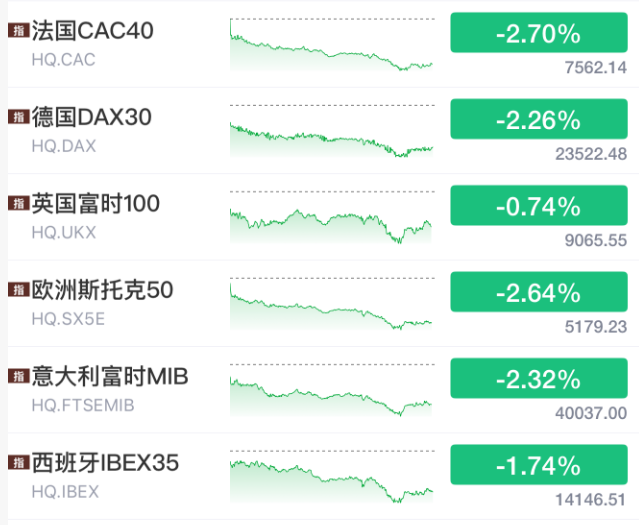
美国抛出"对等关税"新表格,引发全球市场再动荡,欧美股市周五全线收跌。 截至收盘,美国三大股指全线下跌。道琼斯工业指数跌1.23%,标普500指数跌1.60%,纳斯达克指数跌2.24%。 最新数据显示美国劳动力市场明显放缓,叠加美国抛出"对等关税"新表格,导致市场避险情绪高涨。 | 名称 | 现价 | 涨跌 | 涨跌幅 | 年初至今 | | --- | --- | --- | --- | --- | | 道琼斯工业指数 | 43588.58 | -542.40 | -1.23% | 2.45% | | 纳斯达克指数 | 20650.13 | -472.32 | -2.24% | 6.94% | | 标普500 | 6238.01 | -101.38 | -1.60% | 6.06% | 本周,道琼斯工业指数累计下跌2.92%,标普500指数累计下跌2.36%,纳斯达克指数累计下跌2.17%。 欧洲股市也全线下挫。德国DAX指数跌2.66%,本周累计跌3.27%;法国CAC40指数跌2.91%,本周累计跌3.68%;英国富时100指数跌0.7%,本周累计跌 0.57%。 | 名称 | 现价 | 涨跌 | 涨跌幅 ...

今夜,黑天鹅!全崩了!
Zhong Guo Ji Jin Bao· 2025-08-01 16:21
Market Overview - Global markets experienced a significant downturn on August 1, with European stocks dropping over 2% and the U.S. stock market also facing substantial losses, including the Dow Jones falling over 600 points, the Nasdaq declining over 2%, and the S&P 500 dropping more than 1.6% [1][3]. Economic Indicators - The U.S. labor market showed signs of weakness, with non-farm payrolls increasing by only 73,000 in July, significantly below the expected 100,000. Additionally, previous months' data were revised downwards, indicating a troubling trend in employment growth [7]. - The average non-farm employment growth over the past three months was only 35,000, marking the worst performance since the pandemic began [7]. Federal Reserve Response - The weak employment data and new tariff policies have increased pressure on the Federal Reserve to consider interest rate cuts. The probability of a rate cut in September rose from approximately 40% to nearly 90% following the release of the employment data [10]. - The Federal Reserve's decision to maintain interest rates unchanged for the fifth consecutive time was met with dissent from two members advocating for a 25 basis point cut, a situation not seen since 1993 [10]. Tariff Impact - The updated tariff policies announced by President Trump, which include rates ranging from 10% to 41% and an additional 40% on goods circumventing tariffs, have negatively impacted market sentiment [11]. - The most shocking development was the increase in tariffs on imports from Canada, the U.S.'s largest trading partner, from 25% to 35% [12]. Market Sentiment - The combination of weak employment data and new tariffs has led to a sell-off in the markets, with analysts expressing concerns about the potential for negative employment growth in the coming months, raising fears of an economic recession [9][12].
美股,“大狼”将至!
Jin Rong Jie· 2025-08-01 10:54
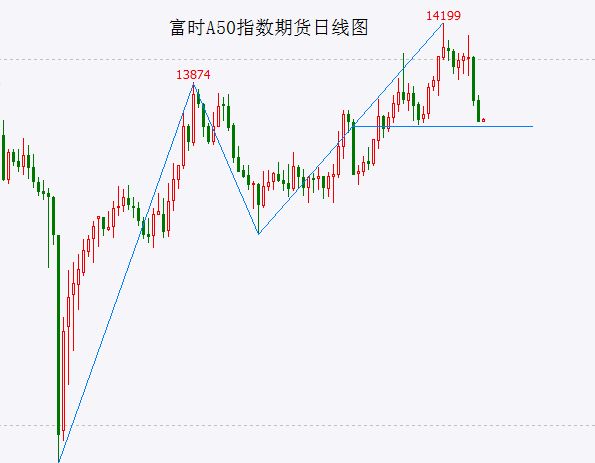
Group 1 - The performance of heavyweight stocks is weak, with the FTSE A50 index futures experiencing a continuous decline reaching support levels, indicating a potential confirmation of the peak if a significant downward movement occurs [1] - The CSI 1000 index and the ChiNext index showed a strong upward movement with gaps left, suggesting the possibility of forming a double top and reaching new highs in the future, although the current phase is near the top of the recent uptrend [1][3] Group 2 - The US stock market has not been discussed recently due to a lack of clear signals, but recent trading has shown a downward trend, indicating potential top signals emerging again [5] - The Nasdaq futures have formed a standard trumpet shape, suggesting that the market may be nearing a significant peak, with the possibility of a major market correction on the horizon [5] - There is a growing concern about the sustainability of the US stock market, with indications that the prolonged bull market may be coming to an end, as the economy shows signs of recession and the stock market appears to be in a bubble [5]
国投期货综合晨报-20250801
Guo Tou Qi Huo· 2025-08-01 05:09
1. Report Industry Investment Ratings No relevant content provided. 2. Core Views of the Report - The short - term trend of crude oil is expected to be oscillating and strengthening, and investors can focus on the hedging value of out - of - the - money call options [2]. - Precious metals may continue to experience oscillating adjustments, and attention should be paid to the US non - farm payrolls guidance [3]. - Copper short positions should be held as the import tariff on refined copper is excluded, reversing the physical import arbitrage expectation [4]. - Aluminum may continue to be under pressure and oscillate in the short term due to inventory accumulation and weak consumption [5]. - For various commodities, different trading strategies are recommended according to their specific supply - demand and market conditions, such as short - selling aluminum oxide, waiting for inventory verification for aluminum, etc. 3. Summary by Commodity Categories Energy Commodities - **Crude Oil**: Overnight international oil prices declined. Although trade wars suppress market sentiment, there are still supporting factors from sanctions on oil. The short - term trend is expected to be oscillating and strengthening [2]. - **Fuel Oil & Low - Sulfur Fuel Oil**: The cracking spreads of FU and LU are further declining due to weak fundamentals and the support of the crude oil market [22]. - **Asphalt**: In August, domestic production is expected to decline compared to July. Demand recovery is delayed, and inventory reduction is weak. The price trend follows crude oil [23]. - **Liquefied Petroleum Gas**: The overseas market is under pressure due to supply loosening. The domestic market is also under pressure, and the price is generally low [23]. - **Urea**: The futures price has fallen sharply. The agricultural demand is in the off - season, and the short - term market is expected to be weakly oscillating [24]. - **Methanol**: A coastal olefin plant is under maintenance, and the port is accumulating inventory seasonally. The domestic supply is sufficient, and attention should be paid to macro - policies [25]. Metal Commodities - **Copper**: The price has fallen below the MA60 moving average. Trump's tariff policy affects the import arbitrage expectation, and short positions should be held [4]. - **Aluminum**: The price is declining. The social inventory of aluminum ingots is accumulating, and the short - term trend is under pressure [5]. - **Cast Aluminum Alloy**: It has followed the decline of Shanghai aluminum. The short - term price is under pressure, but it has certain resilience in the medium term [6]. - **Alumina**: The industry profit has recovered, but the market is in an oversupply state. Short - selling is recommended near the recent high of 3500 yuan [7]. - **Zinc**: The macro - optimistic sentiment has faded. The supply - demand pattern is supply - increasing and demand - weakening. Short - selling on rebounds is the main strategy [8]. - **Nickel and Stainless Steel**: The price of nickel is oscillating. The upstream price support has weakened, and short - selling is recommended [10]. - **Tin**: The price has fallen below the MA60 moving average. High - position short positions should be held [11]. Chemical Commodities - **Polypropylene, Plastic & Propylene**: The demand for propylene has increased slightly, but the market is lackluster. Polyolefin futures are in an interval - consolidation pattern [28]. - **PVC & Caustic Soda**: PVC is weakening, and the short - term price is expected to be oscillating and weakening. Caustic soda is running weakly, and the long - term price is under pressure [29]. - **PX & PTA**: The prices of PX and PTA have fallen. The mid - term processing margin has a repair drive, but it needs the recovery of downstream demand [30]. - **Ethylene Glycol**: The price is declining. The domestic supply is increasing, and the overseas supply is stabilizing [31]. - **Short - Fiber & Bottle Chip**: The prices have followed the decline of raw materials. Short - fiber can be considered for long - position allocation in the medium term, while bottle chips have long - term over - capacity pressure [32]. Agricultural Commodities - **Soybean & Soybean Meal**: The US soybean is under pressure due to good weather and high excellent - rate. The domestic soybean meal inventory is accumulating. The market is waiting for the result of trade negotiations [36]. - **Soybean Oil & Palm Oil**: The prices of both are adjusting. A long - position allocation strategy at low prices is recommended, and attention should be paid to weather and policies [37]. - **Rapeseed Meal & Rapeseed Oil**: The Canadian rapeseed price is expected to be in a consolidation state. The short - term strategy is to wait and see [38]. - **Corn**: The futures price is oscillating and weakening. The US corn is growing well, and the domestic market focuses on the supply in the circulation link [40]. - **Cotton**: The price is declining. The downstream demand is weak, and the new - season production in Xinjiang is expected to increase. The operation strategy is to wait and see or conduct intraday trading [43]. - **Sugar**: The US sugar trend is downward, and the Zhengzhou sugar lacks positive factors. The short - term price is expected to be oscillating [44]. - **Apple**: The price is oscillating. The market focuses on the new - season production estimate, and the operation strategy is to wait and see [45]. - **Wood**: The supply - demand situation has improved, and the futures price is expected to rise. A long - position strategy is recommended [46]. - **Paper Pulp**: The price is falling. The supply is relatively loose, and the demand is weak. The price may return to low - level oscillation [47]. Others - **Stock Index**: The stock market declined, and the mid - term market is expected to be relatively positive. Allocation to technology - growth sectors and low - level consumer sectors can be considered [48]. - **Treasury Bond**: The futures price of treasury bonds has strengthened. The yield curve is expected to steepen in the short term [49].
分析师:美联储后续降息在沟通层面极具挑战
news flash· 2025-07-30 18:41
分析师:美联储后续降息在沟通层面极具挑战 金十数据7月31日讯,Facet公司首席投资官Tom Graff表示,美联储显然处于一个棘手的位置。逻辑上, 他们预期新关税将带来一定程度的通胀,理想情况下美联储希望等到通胀见顶后再考虑降息。但压力正 在加大,即使白宫没有施加外部压力,近期劳动力市场的疲软也足以让美联储感到担忧。实际上这很可 能正是沃勒和鲍曼在此次会议中投票反对维持利率不变、主张降息的原因。我认为,此次决议为美联储 在9月会议上启动降息奠定了基础,并可能在年内再降息1到2次。问题在于,尽管物价可能会上升,美 联储却仍需启动降息,这在沟通层面将极具挑战性。而特朗普对利率的持续施压进一步加剧了这一沟通 难度。届时,鲍威尔可能会被外界视为在屈从于特朗普的要求。但如果就业增长继续走弱,经济陷入衰 退的可能性将不断上升,而鲍威尔届时也将无法再对此视而不见。 ...
生死72小时!华尔街进入“战备状态”
Jin Shi Shu Ju· 2025-07-30 04:58
Core Points - Investors are preparing for a critical three days in the U.S. market, with a series of economic events, corporate earnings, and the impending tariff deadline from Trump testing Wall Street's resolve [1] - The U.S. stock market has rebounded from April lows, reaching historical highs, driven by economic resilience despite the trade war and optimism surrounding AI's potential to boost growth [1] - The upcoming week is highlighted as potentially the most crucial of the year, with significant data releases starting with Q2 GDP and the Federal Reserve's interest rate decision [1] Economic Data and Corporate Earnings - The Atlanta Fed predicts a Q2 GDP annualized growth rate of approximately 2.9%, primarily reflecting a decline in imports [3] - The Labor Department is expected to report 115,000 new jobs for July, down from 147,000 in the previous month, with any deviation from expectations likely to cause market volatility [3] - Major companies such as Microsoft, Meta, Apple, and Amazon, with a combined market capitalization exceeding $11 trillion, are set to release earnings, significantly impacting Wall Street [1] Market Sentiment and Risks - Analysts express concern over the scale of the stock market's gains, with the S&P 500 up 8.3% this year and a 12-month price-to-earnings ratio projected at 22 times [1] - There is uncertainty regarding whether Trump will impose tariffs on countries without trade agreements by the August 1 deadline, which could lead to market volatility [4][5] - Despite a general expectation that Trump will avoid imposing tariffs that could cause significant market disruptions, the risk remains due to his unpredictable nature [5]
华尔街情绪转向:特朗普关税雷声大雨点小?贸易战恐慌骤降
Jin Shi Shu Ju· 2025-07-29 04:29
Group 1 - The current effective tariff rate on imported goods in the U.S. is expected to stabilize between 15% and 20%, significantly lower than the potential 25% or higher rates proposed in April [1] - Economists have noted a decrease in recession fears, with JPMorgan reducing its recession risk estimate from 60% to 40%, indicating a shift in sentiment regarding the economic outlook [1] - The recent U.S.-EU trade agreement is seen as a factor that may alleviate concerns about inflation and economic slowdown, despite the tariffs still having a potential dampening effect on growth [1] Group 2 - Morgan Stanley's strategist suggests that the most likely outcome for the U.S. economy is low growth accompanied by persistent inflation, with trade restrictions and immigration policies negatively impacting growth more than regulatory easing and fiscal stimulus [2] - The final outcome of trade negotiations remains uncertain, with several issues still pending before the August 1 deadline, which could lead to high tariffs affecting major trading partners [2] - The recent U.S.-EU agreement will provide new insights for the Federal Reserve to assess the impact of tariffs on inflation, with expectations that the Fed will maintain its current interest rate policy in the short term [2] Group 3 - Citigroup economists have indicated that while the effective tariff rate has increased significantly from the beginning of the year, the stabilization around 15% is likely to keep the growth drag and inflation risks moderate [3]