
国内大循环

Search documents
国家统计局:8月规模以上工业增加值增长5.2% 国民经济运行总体平稳、稳中有进
Guo Jia Tong Ji Ju· 2025-09-15 02:17
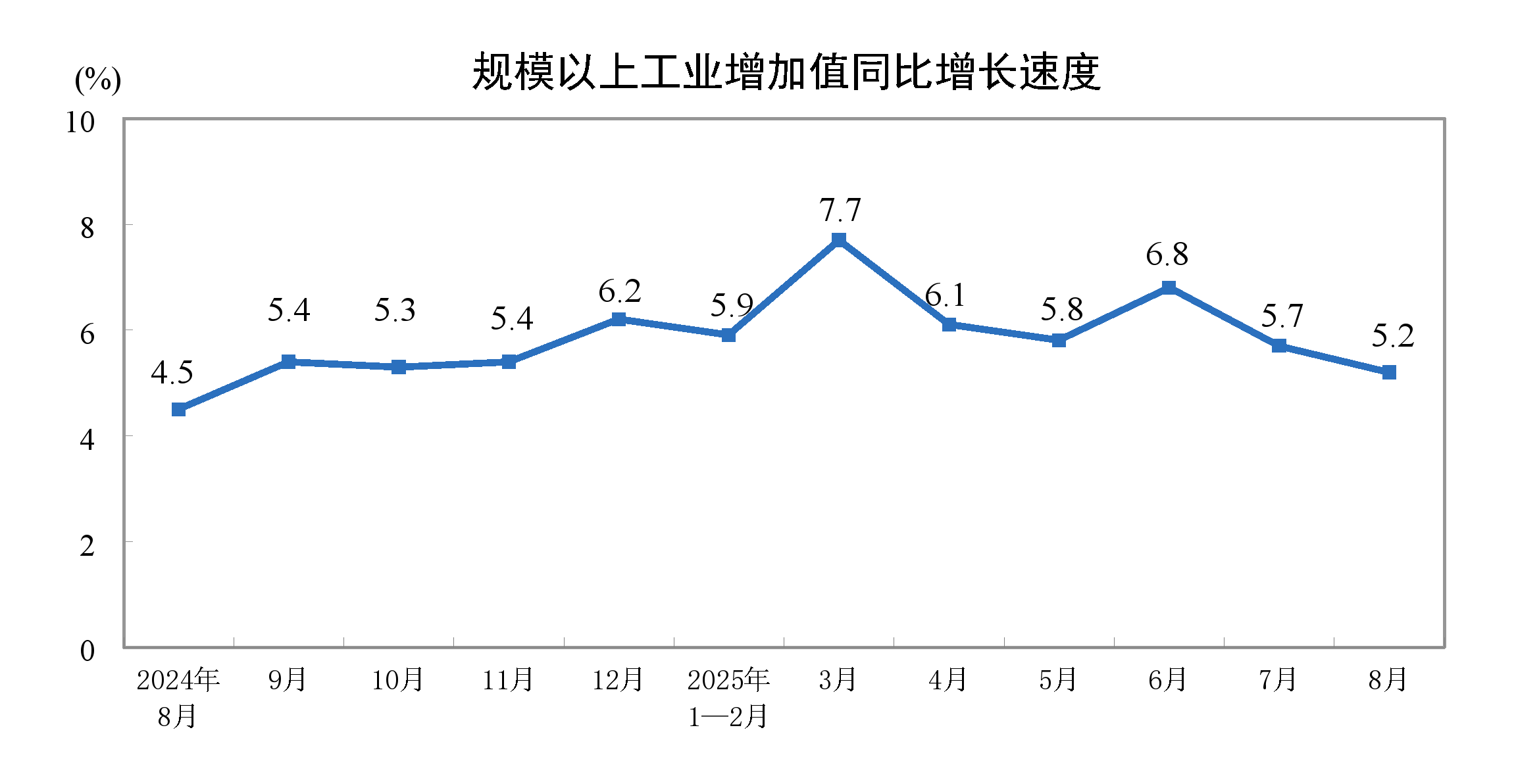
Economic Overview - In August, the national economy maintained overall stability and progressed steadily, with a focus on implementing the decisions of the central government and enhancing macro policy adjustments [30][38] - The industrial added value above designated size increased by 5.2% year-on-year in August, with a month-on-month increase of 0.37% [31][38] - From January to August, the industrial added value grew by 6.2% year-on-year [31][38] Industrial Performance - The mining industry saw a year-on-year increase of 5.1%, while the manufacturing sector grew by 5.7%, and the electricity, heat, gas, and water production and supply industry increased by 2.4% in August [31][38] - High-tech manufacturing and equipment manufacturing industries performed well, with growth rates of 9.3% and 8.1% respectively, surpassing the overall industrial growth [31][38] Product Output - Among 623 industrial products, 319 saw year-on-year output growth in August, including steel (12.3 million tons, +9.7%), ethylene (314,000 tons, +10.4%), and automobiles (2.752 million units, +10.5%) [7][31] - New energy vehicles experienced significant growth, with production increasing by 22.7% [31][38] Service Sector Growth - The service sector production index rose by 5.6% year-on-year in August, with notable growth in information transmission, software, and financial services [32][38] - The business activity index for the service sector was at 50.5, indicating expansion [32][38] Investment Trends - Fixed asset investment (excluding rural households) reached 326.111 billion yuan from January to August, with a year-on-year increase of 0.5% [34][38] - Manufacturing investment grew by 5.1%, while real estate development investment declined by 12.9% [34][38] Trade Performance - In August, the total value of goods imports and exports was 38,744 billion yuan, a year-on-year increase of 3.5%, with exports growing by 4.8% [35][38] - From January to August, the total value of goods imports and exports reached 295,696 billion yuan, with exports increasing by 6.9% [35][38] Employment and Price Trends - The urban survey unemployment rate was 5.3% in August, showing a slight increase from the previous month [36][38] - The Consumer Price Index (CPI) decreased by 0.4% year-on-year in August, while the industrial producer prices fell by 2.9% [37][38]

短期哪些政策在酝酿?——政策周观察第47期
一瑜中的· 2025-09-15 01:45
Core Viewpoint - The article outlines the recent policy directions from various Chinese government departments, emphasizing the focus on domestic economic growth, consumer spending, and investment in key sectors to stabilize and enhance the economy. Policy Framework - **Policy Orientation**: The National Development and Reform Commission (NDRC) emphasizes strengthening domestic circulation and improving policy tools for economic development [2][12]. - **Fiscal Policy**: The Ministry of Finance indicates ample room for fiscal policy adjustments, with a focus on debt resolution and proactive measures for local government debt management [2][20]. - **Consumer Spending**: Measures to boost service consumption and automotive sales are highlighted, including the removal of restrictive measures and support for vehicle trade-in programs [2][3][22]. Social Welfare - **Living Standards**: The NDRC plans to invest more in human capital and improve social welfare mechanisms, including minimum wage adjustments and healthcare reforms [3][13]. Investment Strategies - **Financial Tools**: The establishment of new policy-oriented financial instruments is prioritized, alongside efforts to clear corporate debts and support major infrastructure projects [3][20]. - **Private Investment**: The government encourages private capital to invest in new productivity sectors and infrastructure, with measures to enhance bidding processes and central budget support [3][15]. Industry-Specific Initiatives - **Automotive Sector**: The automotive industry is set to see a targeted increase in sales, with a goal of approximately 32.3 million vehicles sold in 2025, including a significant rise in electric vehicle sales [22]. - **Energy Sector**: The power equipment industry aims for a stable growth rate of around 6% annually, with a focus on enhancing supply and demand dynamics [21]. International Trade and Relations - **US-China Trade Talks**: Upcoming discussions between Chinese officials and US representatives will address trade tariffs and export controls, indicating ongoing tensions in international trade relations [5][15].

财政部报告:1至7月,全国一般公共预算收入同比增长0.1%
Xin Jing Bao· 2025-09-13 07:56
Core Viewpoint - The report presented by the Minister of Finance indicates that China's fiscal policy has become more proactive this year, with overall budget execution and fiscal operations remaining stable. Fiscal Revenue and Expenditure - From January to July, the national general public budget revenue reached 135,839 billion yuan, showing a year-on-year growth of 0.1% [2][3] - During the same period, the national general public budget expenditure was 160,737 billion yuan, reflecting a year-on-year increase of 3.4% [2][3] Policy Implementation and Focus Areas - The government has implemented a series of fiscal policies to support consumption, including personal consumption loans and subsidies for elderly care services [2][3] - The issuance of ultra-long-term special government bonds has been accelerated, with 761 billion yuan issued by the end of July, supporting key projects [2][3] - Key focus areas for fiscal policy include promoting technological and industrial innovation, deepening fiscal and tax system reforms, and enhancing social welfare investments [3][4] Future Fiscal Policy Directions - The report emphasizes the need for a more proactive fiscal policy, with a focus on accelerating budget execution and improving fund utilization efficiency [4] - Future efforts will include supporting employment and foreign trade, fostering new growth drivers, and enhancing fiscal governance effectiveness [4] - The government aims to strengthen domestic circulation and maintain policy continuity and stability while addressing uncertainties in the economy [4]
谋划“十五五”要看清哪些“变”?
Yang Shi Xin Wen Ke Hu Duan· 2025-09-12 03:45
Group 1 - The core viewpoint emphasizes the need for strategic determination and confidence in the face of complex changes in both international and domestic environments, as highlighted in the Central Political Bureau meeting on July 30 [1][5] - The "three faces" proposed by the 20th Central Committee provide a crucial perspective for understanding the changes in the "15th Five-Year Plan," indicating that the development environment is undergoing profound and complex transformations [1][3] - The need to adapt to new expectations from the public, including demands for quality, sustainability, and fairness, is essential for planning the "15th Five-Year Plan" [3][5] Group 2 - The article discusses the importance of recognizing both changes and constants in the context of reform, emphasizing that while certain aspects may change, the strategic direction and goals remain steadfast [5][6] - The necessity of maintaining a balance between change and stability is highlighted, indicating that while the environment is changing, the foundational strengths of the economy, such as resilience and potential, have not altered [5][7] - The call for proactive identification and response to changes, including the need to navigate risks and seize opportunities, is a recurring theme in the planning for the "15th Five-Year Plan" [1][3][7]

经济随笔丨谋划“十五五”要看清哪些“变”?
Yang Shi Xin Wen Ke Hu Duan· 2025-09-12 01:47
Group 1 - The core viewpoint emphasizes the need for strategic determination and confidence in the face of complex changes in both international and domestic environments, as highlighted in the planning for the "15th Five-Year Plan" [2][4] - The "three faces" proposed by the 20th National Congress provide a critical perspective for understanding the changes in the "15th Five-Year Plan," indicating that the development environment is undergoing profound and complex transformations [2][4] - The need to adapt to new expectations from the public, including demands for quality, sustainability, and fairness, is crucial in the planning process for the "15th Five-Year Plan" [4][5] Group 2 - The article discusses the importance of recognizing both "change" and "stability" in the context of reform, emphasizing that while the environment is changing, the fundamental economic strengths and long-term positive trends remain unchanged [9][10] - It highlights the necessity of understanding the interplay between favorable and unfavorable changes, advocating for proactive measures to leverage opportunities and mitigate risks [5][7] - The concept of "guarding against black swans and gray rhinos" is introduced, stressing the importance of risk prevention and management in the face of global uncertainties [5][7]

渤海证券研究所晨会纪要(2025.09.12)-20250912
BOHAI SECURITIES· 2025-09-12 01:47
Market Overview - Major indices experienced gains over the past five trading days, with the Shanghai Composite Index rising by 2.91% and the ChiNext Index increasing by 10.00% [2] - The trading volume significantly decreased, with a total of 11.26 trillion yuan traded, averaging 2.25 trillion yuan per day, a reduction of 414.68 billion yuan compared to the previous five trading days [2] - Among the sectors, only the banking industry saw a decline, while the communication, electronics, and power equipment sectors led the gains [2] Economic Data - In August, exports grew by 4.4% year-on-year, a decrease of 2.8 percentage points from July, attributed to a high base last year and prior "export rush" effects [2] - The Consumer Price Index (CPI) remained flat month-on-month in August, with a year-on-year decline of 0.4%, influenced by sufficient pork supply and energy price pressures [2] - The Producer Price Index (PPI) showed a month-on-month stabilization and a narrowing year-on-year decline for the first time since March, driven by a lower base and "anti-involution" measures [2] Policy Insights - The Ministry of Finance emphasized strengthening domestic circulation as a key task for fiscal policy, focusing on consumer stimulation and public service investments [3] - The National Development and Reform Commission highlighted the need for capacity governance in key industries and addressing irrational competition in its report on economic development plans [3] Investment Strategy - The policy direction from the Political Bureau meeting aims to consolidate the recovery of the capital market, alleviating investor concerns about market downturn risks [4] - Short-term market themes remain active, but their sustainability needs to be observed, with structural performance expected to outperform the overall market as valuations recover [4] Industry Opportunities - Investment opportunities in the TMT sector are anticipated due to advancements in domestic computing power and the "AI+" initiative [4] - The power equipment and non-ferrous metals industries may benefit from unexpected demand for energy storage and breakthroughs in solid-state battery production [4] - The financial sector is expected to see investment opportunities as the capital market stabilizes [4]
瑞达期货沪锡产业日报-20250911
Rui Da Qi Huo· 2025-09-11 08:44
1. Report's Industry Investment Rating - Not mentioned in the provided content 2. Core View of the Report - Macroscopically, the finance minister emphasizes strengthening the domestic cycle, and China's August CPI, core CPI, and PPI show certain trends; the US inflation unexpectedly drops. Fundamentally, Myanmar's Wa State restarts mining permit approval but actual output is expected in Q4, Congo's Bisie mine plans to resume production in stages, and tin ore processing fees remain low. In the smelting sector, July's output increase is due to multiple factors, but raw material shortages are still serious in Yunnan and the waste recycling system in Jiangxi is under pressure. On the demand side, downstream processing enterprises are in the peak - season recovery period with slow order recovery. Recently, tin prices fluctuate downward, domestic and LME inventories increase, and the spot premium is maintained. Technically, with a decline in positions and stable prices, the bullish sentiment is cautious, and there is support at M60. It is recommended to wait and see or go long lightly on dips [3] 3. Summary According to Relevant Catalogs 3.1 Futures Market - The closing price of the main contract of Shanghai tin is 271,260 yuan/ton, up 830 yuan; the closing price of the October - November contract of Shanghai tin is - 220 yuan, up 110 yuan; the LME 3 - month tin price is 34,635 US dollars/ton, up 600 US dollars. The main contract's open interest of Shanghai tin is 26,606 lots, down 744 lots; the net position of the top 20 in futures of Shanghai tin is - 937 lots, down 260 lots. The LME tin total inventory is 2410 tons, up 55 tons; the Shanghai Futures Exchange inventory of tin is 7773 tons, up 207 tons; the Shanghai Futures Exchange warehouse receipts of tin are 7504 tons, up 22 tons; the LME tin cancelled warrants are 225 tons, up 100 tons [3] 3.2现货市场 - The SMM 1 tin spot price is 271,100 yuan/ton, up 1000 yuan; the Yangtze River Non - ferrous Market 1 tin spot price is 271,390 yuan/ton, up 1350 yuan. The basis of the Shanghai tin main contract is - 330 yuan/ton, down 1110 yuan; the LME tin cash - 3 months spread is 27 US dollars/ton, down 34 US dollars [3] 3.3 Upstream Situation - The import volume of tin ore and concentrates is 1.21 million tons, down 0.29 million tons. The average price of 40% tin concentrate is 259,100 yuan/ton, up 1000 yuan; the processing fee of 40% tin concentrate by Antaike is 10,500 yuan/ton, unchanged. The average price of 60% tin concentrate is 263,100 yuan/ton, up 1000 yuan; the processing fee of 60% tin concentrate by Antaike is 6500 yuan/ton, unchanged [3] 3.4 Industry Situation - The monthly output of refined tin is 14,000 tons, down 1600 tons; the import volume of refined tin is 3762.32 tons, up 143.24 tons [3] 3.5 Downstream Situation - The price of 60A solder bar in Gejiu is 175,850 yuan/ton, up 560 yuan. The cumulative output of tin - plated sheets (strips) is 1.6014 million tons, up 0.1445 million tons; the export volume of tin - plated sheets is 0.1407 million tons, down 0.0339 million tons [3] 3.6 Industry News - The director of the National Development and Reform Commission points out measures such as accelerating employment, enterprise, market, and expectation stabilization, implementing fiscal and monetary policies, releasing domestic demand potential, promoting innovation, and ensuring people's livelihood. China's August economic data shows CPI, core CPI, and PPI trends, and the US inflation unexpectedly drops [3] 3.7 Key Points to Watch - No news today [3]
今年以来预算执行和财政运行总体平稳
Zhong Guo Zheng Quan Bao· 2025-09-10 20:18
Fiscal Policy Overview - The fiscal policy has become more proactive this year, with overall budget execution and fiscal operations remaining stable [1][2] - From January to July, the national general public budget revenue reached 135,839 billion yuan, a year-on-year increase of 0.1% [1] - During the same period, general public budget expenditure was 160,737 billion yuan, reflecting a year-on-year growth of 3.4% [1] Key Initiatives - The government has implemented various fiscal measures to boost consumption, including personal consumption loans and subsidies for elderly care services [1][2] - The scope of subsidies has been expanded to include vehicle scrappage and replacement, as well as digital products [1] - Special long-term bonds were issued earlier than last year, totaling 761 billion yuan by the end of July, supporting key projects [1] Focus Areas for Fiscal Policy - The fiscal policy will continue to focus on technology and industrial innovation, reforming the fiscal and tax system, and enhancing risk management in key areas [2][3] - There will be an emphasis on increasing public welfare investments and promoting rural revitalization and regional coordinated development [2] - The government aims to strengthen fiscal management and discipline while ensuring the effective execution of budgets [2] Future Directions - The fiscal policy will prioritize domestic circulation and implement proactive macroeconomic policies to address uncertainties [3] - There will be a focus on stabilizing employment, foreign trade, and market expectations while enhancing the effectiveness of fiscal governance [3] - The government plans to encourage private investment and expand the scope of public services supported by investments [2][3]
人大常委会|透过预算执行报告 看财政政策如何更加积极
Xin Hua She· 2025-09-10 15:47
Group 1 - The core viewpoint of the report emphasizes the implementation of a more proactive fiscal policy to ensure stable budget execution and financial operations [1][2] - The report outlines the intention to accelerate budget execution, improve fund utilization efficiency, and ensure fund security [1] - Key areas of focus include supporting employment and foreign trade, fostering new growth drivers, enhancing public welfare, and mitigating risks in critical sectors [1] Group 2 - The strategy will prioritize strengthening domestic circulation and implementing flexible macro policies to address uncertainties while ensuring high-quality development [2] - The government aims to maintain policy continuity and stability while enhancing flexibility and predictability in economic management [2]
财政部部长蓝佛安:下一步将把做强国内大循环摆到更加突出的位置 持续发力、适时加力实施更加积极有为的宏观政策
Xin Hua She· 2025-09-10 15:38
Core Viewpoint - The report presented by the Minister of Finance indicates that China's fiscal policy has become more proactive this year, with overall budget execution and fiscal operations remaining stable [1][2]. Fiscal Revenue and Expenditure - From January to July, the national general public budget revenue reached 135,839 billion yuan, showing a year-on-year growth of 0.1% [1]. - During the same period, the national general public budget expenditure was 160,737 billion yuan, reflecting a year-on-year increase of 3.4% [1]. Implementation of Fiscal Policies - The government has implemented a series of fiscal policies to support consumption, including personal consumption loans and subsidies for elderly care services [1][2]. - The scope of subsidies has been expanded to include the scrapping and updating of automobiles and the replacement of household appliances, as well as digital products like mobile phones [1]. Focus Areas of Fiscal Policy - The fiscal policy has concentrated on promoting technological and industrial innovation, deepening tax and fiscal reforms, and enhancing social welfare [2]. - There is a strong emphasis on rural revitalization, regional coordinated development, and ecological civilization construction [2]. Future Fiscal Policy Directions - The report outlines plans to accelerate budget execution, improve fund utilization efficiency, and ensure fund security [3]. - Future efforts will focus on stabilizing employment and foreign trade, fostering new growth drivers, and enhancing fiscal governance [3]. - The government aims to strengthen domestic circulation and maintain policy continuity and stability while being flexible and anticipatory in response to uncertainties [3].