避险情绪

Search documents
历史性时刻!白银首次突破100美元
Sou Hu Cai Jing· 2026-01-24 00:35
1月23日周五,全球金属市场掀起新一轮上涨高潮,以期货即月合约收盘价计,金银齐创2020年来最大单周涨幅,进入2026年以来保持每周累涨。 纽约期银和伦敦现货白银均史上首次突破100美元关口。 黄金连续第五个交易日盘中创历史新高,进一步逼近5000美元大关,伦铜重上1.3万美元,接近本月稍早创下的盘中最高纪录。其他贵金属和工业金属涨 势凌厉。美股盘中,纽约钯金期货曾涨约7%,铂金期货曾涨超7%,伦镍和伦锡周五收盘分别涨超4%和9.5%。 这轮涨势受到多重因素推动。美元走弱、投资者资金大规模流出货币和主权债券,加之特朗普抨击美联储威胁央行独立性、美欧关系恶化以及地缘政治局 势动荡,均加剧了避险情绪,共同推动金属持续上涨。 评论提及,特朗普关于美国"舰队"正前往伊朗的言论促使投资者涌入白银、黄金和铜等基本金属。这里所说的舰队是指,据新华社报道,美国总统特朗普 22日周四在总统专机"空军一号"上对媒体表示,美国正调集重兵前往伊朗,许多舰艇正在向伊朗行进。 机构普遍看涨贵金属后市。华尔街见闻上周提到,摩根大通预计,金价到2026年第四季度将达到5000美元,长期甚至看向6000美元;花旗在牛市情景下将 未来0-3个月 ...


今日期货市场重要快讯汇总|2026年1月24日
Xin Lang Cai Jing· 2026-01-24 00:31
Group 1: Precious Metals Futures - The precious metals market has recently experienced explosive growth, with silver prices breaking historical barriers. Spot silver prices first exceeded $100 per ounce, driven by increased safe-haven demand and frantic retail purchases from Shanghai to New York [1][8] - Spot silver continued to rise, surpassing $101 per ounce with a daily increase of 5.04%, then climbing to $102 per ounce with a 6.14% daily increase, and finally breaking $103 per ounce with a 7.16% daily increase [1][9] - Gold prices also showed strong performance, with New York futures breaking multiple key levels, rising from $4970 per ounce (1.16% daily increase) to $5020 per ounce (1.44% daily increase) [1][9] Group 2: Positioning Data - According to the Commodity Futures Trading Commission (CFTC), as of the week ending January 20, the net long positions of gold speculators on the New York Mercantile Exchange (COMEX) increased by 2,614 contracts to 139,162 contracts, while silver speculators reduced their net long positions by 3,719 contracts to 11,326 contracts [2][10] Group 3: Base Metals Futures - Among base metals, tin and silver futures in the domestic market performed notably well. Tin futures saw significant daily increases of 6% (currently at 444,960.00 yuan), 7% (currently at 449,000.00 yuan), and 8% (currently at 453,230.00 yuan) [3][11] - Silver futures also experienced substantial gains, with daily increases of 5% (25,336.00 yuan), 6% (25,575.00 yuan), and 7% (25,818.00 yuan) [3][11] Group 4: Energy and Shipping Futures - In the energy futures market, U.S. natural gas futures prices rose significantly, with an increase of over 6.00%, currently at $5.348 per million British thermal units, and further expanding to 7.00%, currently at $5.417 per million British thermal units [4][12] - Domestic fuel oil futures saw a daily increase of 6%, currently at 2,770.00 yuan [5][13] Group 5: Macro and Market Impact - On a macro level, there is a renewed trend in global asset diversification, with emerging market stocks, currencies, and precious metals continuing a strong start in 2026, closely related to the pressure on the U.S. dollar due to tensions between the U.S. and Europe [6][14] - Additionally, geopolitical uncertainties are further elevating safe-haven sentiment, as discussions among Russian, American, and Ukrainian delegations continue in Abu Dhabi. New U.S. sanctions on Iran targeting its oil and energy export networks may impact energy market supply expectations [7][15]
历史性时刻!白银首次突破100美元
华尔街见闻· 2026-01-24 00:00
Core Viewpoint - The global metal market is experiencing a significant surge, with gold and silver reaching their highest weekly gains since 2020, driven by various geopolitical and economic factors [2][7]. Group 1: Precious Metals Performance - Gold has reached a historical high, nearing $5000 per ounce, while silver has surpassed $100 for the first time in history [3][7]. - Silver futures have seen a cumulative increase of over 14% this week, marking the largest weekly gain since July 2020, and have risen over 40% year-to-date [9]. - Analysts predict that gold prices could reach $5000 by Q4 2026, with some forecasts even suggesting a long-term target of $6000 [18]. Group 2: Market Drivers - The surge in metal prices is attributed to a weaker dollar, significant capital outflows from currencies and sovereign bonds, and heightened geopolitical tensions, particularly related to U.S.-Iran relations [7][21]. - Trump's comments about U.S. military movements towards Iran have intensified safe-haven demand for metals like gold and silver [7][11]. Group 3: Emerging Market Trends - There is a notable acceleration in the de-dollarization trend globally, with emerging market assets attracting record inflows, particularly into funds like the iShares Core MSCI Emerging Markets ETF [8]. - The demand for silver is bolstered by strong industrial needs, especially from the solar energy sector, and increased retail buying in China [11][13]. Group 4: Future Outlook - Analysts from major financial institutions like Citigroup and UBS have raised their short-term price targets for silver to $100 and $70 respectively, reflecting a bullish sentiment despite potential volatility [12][13]. - UBS anticipates that silver prices could still have about 25% upside potential from current levels, although a correction may occur later in the year [13]. Group 5: Base Metals Performance - Copper prices have rebounded, driven by a weaker dollar and supply disruptions, with LME copper trading above $13,000 per ton [19][21]. - Nickel and tin have also seen significant price increases, with nickel reaching a new high since June 2024 [19]. Group 6: Supply and Demand Dynamics - The supply chain for copper is under pressure due to labor strikes in Chile, which have halted operations at key mines [21]. - The influx of copper into Asian warehouses is partly driven by Chinese smelters capitalizing on favorable arbitrage opportunities, although domestic demand may be affected by a slowing real estate sector [22].

铂、钯期价双双大涨,靠什么因素驱动?
Qi Huo Ri Bao· 2026-01-23 23:36
1月23日,海外铂期货价格突破2600美元/盎司,并创出新高,海外钯期货价格则逼近2000美元/盎司关 口。与此同时,广期所铂、钯期价同样强势上涨。截至昨日收盘,铂期货主力合约2606上涨10.39%, 报685.9元/克;钯期货主力合约2606上涨3.98%,报497.95元/克。 国信期货首席分析师顾冯达认为,铂、钯期价上涨是海外市场避险情绪升温、金属板块整体强势、基本 面偏强等因素共同作用的结果。 记者注意到,海外铂现货租赁市场的年化利率已飙升至35%的历史高位。对此,顾冯达认为,这一情况 说明市场确实存在"一铂难求"的现象。 曾可认为,在铂价上涨背景下,投资需求显著提升,同时氢能产业与商业航天等新兴领域打开长期成长 空间,预计2026年铂仍将延续供不应求的态势,缺口可能会进一步扩大。 虽然铂、钯同属铂族金属,但供需前景存在差异。顾冯达介绍,钯的供需面远弱于铂。虽然钯价短期受 金属板块带动上涨,但其需求严重依赖内燃机汽车,当下电动化转型将对其构成长期压制。相关机构预 测,2026年钯市场可能会小幅过剩。 曾可介绍,钯需求高度依赖汽车尾气催化剂(占比超80%)。"受新能源汽车加速发展与铂替代趋势明显的 双 ...

Gold Rips Higher as Risk-Off Sentiment Batters the Dollar
Yahoo Finance· 2026-01-23 21:45
Happy Friday, traders. Welcome to our weekly market wrap, where we take a look back at these last five trading days with a focus on the market news, economic data, and headlines that had the most impact on gold prices and other key correlated assets— and may continue into the future. Here’s what you need to know: Gold surged more than $350/oz (+7.9%) on the week, trading within reach of the $5,000/oz psychological barrier. Silver joined the rally, topping $100/oz for the first time and gaining roughly ...
金属狂欢掀高潮!白银首次破百、黄金逼近5000美元,伦铜重上1.3万大关
Hua Er Jie Jian Wen· 2026-01-23 17:21
23日周五,全球金属市场掀起新一轮上涨高潮。 纽约期银和伦敦现货白银均史上首次突破100美元关口,黄金连续第五个交易日刷新历史新高,进一步逼近5000美元大关,伦铜重上1.3万美元,接近 本月稍早创下的盘中最高纪录。其他贵金属和工业金属涨势凌厉。周五美股早盘刷新日高时,纽约铂金和钯金期货分别涨超6%和约7%,工业金属伦 镍和伦锡周五盘中均涨超4%。 这轮涨势受到多重因素推动。美元走弱、投资者资金大规模流出货币和主权债券,特朗普抨击美联储威胁央行独立性以及地缘政治局势动荡,均加剧 了避险情绪,共同推动金属持续上涨。 评论提及,特朗普关于美国"舰队"正前往伊朗的言论促使投资者涌入白银、黄金和铜等基本金属。这里所说的舰队是指,据新华社报道,美国总统特 朗普22日周四在总统专机"空军一号"上对媒体表示,美国正调集重兵前往伊朗,许多舰艇正在向伊朗行进。 华尔街机构普遍看涨贵金属后市。华尔街见闻上周提到,摩根大通预计,金价到2026年第四季度将达到5000美元,长期甚至看向6000美元;花旗在牛 市情景下将未来0-3个月金价目标上调至5000美元,白银目标上调至100美元;瑞银预计白银从当前水平仍有约25%的上涨空间,但 ...

伦铜升破13000美元 避险情绪升温提振金属市场
Xin Lang Cai Jing· 2026-01-23 17:14
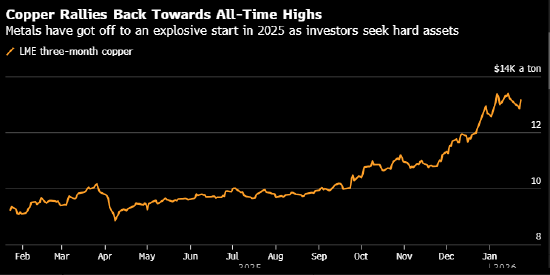
铜价升破每吨13000美元,金属市场全线上涨,越来越多投资者撤出货币和主权债券助推了这一涨势。 新浪合作大平台期货开户 安全快捷有保障 铜价升破每吨13000美元,金属市场全线上涨,越来越多投资者撤出货币和主权债券助推了这一涨势。 在伦敦金属交易所,铜一度上涨了3.3%,达到每吨13182美元,接近本月早些时候创下的历史新高。镍 和锡均跃升。 特朗普对地缘政治秩序的搅动以及对美联储的再度抨击,正引发市场避险情绪升温。通常情况下,这主 要利好黄金和白银,但近来这种影响已外溢至基本金属市场。 这进一步推升了铜价。自去年年中以来,大型矿产生产扰动、电气化带动的需求激增,以及在潜在关税 出台前对美国的发货大幅上升推升了铜价。投资者兴趣的激增也助推了金属市场的涨势。 新浪合作大平台期货开户 安全快捷有保障 特朗普对地缘政治秩序的搅动以及对美联储的再度抨击,正引发市场避险情绪升温。通常情况下,这主 要利好黄金和白银,但近来这种影响已外溢至基本金属市场。 这进一步推升了铜价。自去年年中以来,大型矿产生产扰动、电气化带动的需求激增,以及在潜在关税 出台前对美国的发货大幅上升推升了铜价。投资者兴趣的激增也助推了金属市场的涨势。 ...
股指、黄金周度报告-20260123
中盛期货· 2026-01-23 12:35
1. Report Industry Investment Rating - No relevant content provided 2. Core Viewpoints of the Report - In the short - term, policy releases positive signals, but corporate earnings haven't improved significantly. Be cautious about the short - term rebound of stock indices. The US - EU trade tension eases, and the independence of the Federal Reserve is maintained. However, due to uncertainties in the Russia - Ukraine and Iran situations, beware of profit - taking pressure after the rapid rise of gold [38]. - In the medium - to long - term, the valuation of stock indices will still be dragged down by the decline in corporate earnings growth at the molecular end. The support at the denominator end mainly comes from the recovery of risk appetite, including the intensification of domestic counter - cyclical adjustment policies and the easing of international trade situations. Stock indices are expected to maintain a wide - range oscillation. The US tax - cut policy will gradually stimulate the economy, narrowing the space for the Federal Reserve to further cut interest rates. In this case, gold may face a deep adjustment [38]. 3. Summary According to Relevant Catalogs 3.1 Domestic Macroeconomic Data - In 2025, China's GDP increased by 5% year - on - year, achieving the annual development target. From January to December, fixed - asset investment decreased by 3.8% year - on - year, industrial added value increased by 5.9% year - on - year, and total retail sales of consumer goods increased by 3.7% year - on - year, indicating weak endogenous economic growth and insufficient demand as the main contradiction [6]. 3.2 Stock Index Fundamental Data - In late December 2025, the year - on - year growth rate of broad money supply M2 was 8.5% (previous value 8%), and M1 was 3.8% (previous value 4.9%). The growth rate slowed down for three consecutive months, and the gap between M1 and M2 further widened [19]. - The margin trading balance in the Shanghai and Shenzhen stock markets rose to 26985.57 billion yuan, reaching a new high. The central bank conducted 1181 billion yuan of 7 - day reverse repurchase operations this week, achieving a net injection of 229.5 billion yuan [21]. 3.3 Gold Fundamental Data - In the third quarter of the US, real GDP increased by 4.4% quarter - on - quarter, and the core PCE price index in November increased by 2.8% year - on - year, in line with market expectations. It shows that the US economy is slowly recovering, but inflation remains high [24]. - The growth of Shanghai gold futures warehouse receipts and inventory slowed down, and COMEX gold inventory in New York decreased slightly, indicating a relief of delivery pressure [37]. 3.4 Strategy Recommendation - In 2025, China's economic recovery foundation is not solid. The government has strengthened counter - cyclical adjustment policies. Although there are positive policy signals, corporate earnings haven't improved significantly, and stock indices may fluctuate in the short term. The easing of US - EU trade tensions and the maintenance of the Federal Reserve's independence may lead to a rebound in the US dollar index. Due to uncertainties in the Russia - Ukraine and Iran situations, gold has risen rapidly and reached a new high [38].
建信期货有色金属周报-20260123
Jian Xin Qi Huo· 2026-01-23 12:20
Report Information - Report Title: Non-ferrous Metals Weekly Report [1] - Date: January 23, 2026 [2] - Researchers: Zhang Ping, Yu Feifei, Peng Jinglin [3] Industry Investment Rating - Not provided in the report Core Viewpoints - Aluminum prices are mainly driven by macro and capital factors. Short-term adjustments may be needed due to macro mood fluctuations and previous rapid price increases, but prices are likely to rise easily and fall hard. Nickel market is expected to have significant upward elasticity due to policy disturbances. Zinc prices may continue to show high-level oscillations, with limited continuous upward momentum [13][49][73] Summary by Metals Aluminum Market Review - This week, aluminum prices were strongly supported around 24,000 yuan. The overall market showed an external-strong and internal-weak pattern, with the import window closed. Alumina futures prices rebounded after a mid-week decline due to a mine accident in Guinea. Aluminum alloy followed the trend of Shanghai aluminum. High prices continued to suppress terminal demand, and inventory increased slightly compared to last week [8] Operation Suggestions - Although both domestic and overseas ore sectors were disturbed to some extent this week, ore prices remained weak. Alumina is expected to fluctuate widely at low levels under the pressure of an oversupply. The supply of electrolytic aluminum remained stable, and aluminum processing showed a slight recovery. Considering the current situation, short-term price adjustments may be needed, but prices are likely to rise easily and fall hard [13] Fundamental Changes - **Bauxite Market**: Domestic and overseas bauxite prices were weak. Some northern domestic mines reduced production due to weather and are gradually resuming work, while southern mines remained stable. Overseas, the bauxite market was quiet, and alumina plants had low purchasing willingness [14] - **Alumina**: Futures prices rebounded from a low level, but the oversupply situation remained unchanged. The weighted index of Shanghai Nonferrous Metals decreased slightly compared to last week, and the operating rate of domestic alumina plants decreased [18][19] - **Electrolytic Aluminum**: The profit level of the smelting industry remained high. The total industry cost decreased slightly, while the average profit increased [25] - **Aluminum Ingot Import and Export**: The import window remained closed. In December 2025, the net import of aluminum ingots increased [31] - **Aluminum Processing**: The operating rate of aluminum processing enterprises increased slightly, but different sectors showed different trends. Some sectors were affected by environmental protection, weather, and other factors, while others were supported by orders from specific fields [34] - **Inventory**: Aluminum ingot inventory increased slightly compared to last week, while aluminum rod inventory increased significantly [38][41] Nickel Market Review - Nickel prices strengthened again this week, maintaining a high-level wide-range oscillation pattern. Spot trading remained cold, and the import window was closed [45] Operation Suggestions - The expected shortage of nickel ore supply supported miners to continuously raise prices. Nickel iron prices continued to rise, while nickel salt prices weakened. Policy disturbances are expected to support the nickel market to maintain significant upward elasticity [48][49] Fundamental Changes - **Nickel Ore Market**: Prices in the Philippines and Indonesia increased significantly. The import volume of nickel ore in November 2025 decreased compared to the previous month but increased compared to the same period last year [50] - **Nickel Iron Market**: The production of nickel iron in China and Indonesia decreased in December 2025. The supply side continued to hold firm prices, and the demand side showed some activity but with differences between upstream and downstream [54] - **Electrolytic Nickel Market**: The production capacity of electrowon nickel was rapidly released. In December 2025, the monthly production of electrolytic nickel in China increased, and the import and export volumes also changed [61] - **Nickel Sulfate Market**: Nickel salt prices decreased slightly this week. The production of nickel sulfate in December 2025 decreased, and the industry's operating load remained at a certain level [65] - **Stainless Steel Market**: The inventory of the stainless steel market increased slightly, mainly due to the contradiction between rising futures prices and weak terminal demand [69] Zinc Market Review - The non-ferrous metals sector showed differentiation and high-level adjustments. Zinc prices at high levels showed a callback, and then strengthened in the second half of the week. The import window was not fully opened, and the spot premium decreased slightly [70][71] Operation Suggestions - The zinc concentrate market remained tight. The supply of zinc ore was affected by seasonal and overseas factors, and the processing fee was expected to remain low. The demand side was weak, and zinc prices were likely to oscillate at high levels with limited upward momentum [72][73] Fundamental Changes - **Supply Side**: The supply of domestic zinc ore was tight, and the import processing fee decreased. The production of zinc ingots in January is expected to increase slightly compared to December [76][77] - **Demand Side**: The operating rates of galvanizing, die-casting zinc alloy, and zinc oxide enterprises increased slightly, but overall demand was weak due to high zinc prices and environmental protection measures [78][79] - **Spot Market**: Domestic zinc inventory decreased slightly, while LME zinc inventory increased. The cash-3M spread of LME zinc remained in contango [80]
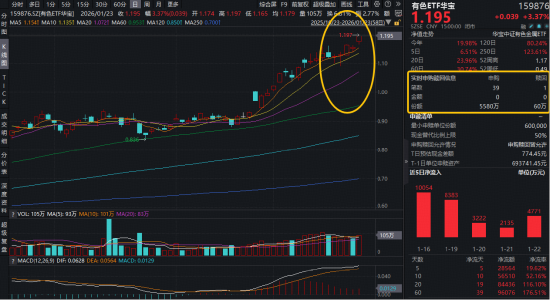
猛拉3.3%!有色ETF华宝(159876)放量突破上市高点!全天获资金净申购5520万份!白银有色等4股涨停!
Xin Lang Ji Jin· 2026-01-23 12:03
Group 1 - The non-ferrous metal sector continues its strong performance, with stocks like Huafeng Aluminum, Baiyin Nonferrous Metals, and Tongling Nonferrous Metals hitting the daily limit, indicating robust market interest [1] - The non-ferrous ETF, Huabao (159876), saw a maximum intraday increase of 3.55%, closing up 3.37%, with a significant net subscription of 55.2 million units, breaking its previous listing high [1] - Geopolitical risks are rising, contributing to increased safe-haven demand and pushing gold prices to a historical high of $4,950 per ounce, with domestic gold jewelry prices reaching 1,500 yuan per gram [3] Group 2 - The long-term outlook for gold prices remains strong due to several factors, including ongoing U.S. fiscal risks, strong global central bank demand for gold, and the expectation of continued interest rate cuts in the U.S. through 2026 [3] - The strong performance of non-ferrous metals is attributed to macro-financial policies and structural changes in supply and demand, particularly driven by emerging demands in AI and new energy sectors [3] - The Huabao non-ferrous ETF and its linked funds cover a wide range of metals, including copper, aluminum, gold, rare earths, and lithium, allowing investors to capture the overall sector's beta performance [3]