
美联储降息

Search documents
美国1月CPI出炉 关税与通胀走势引关注
Sou Hu Cai Jing· 2026-02-14 05:32
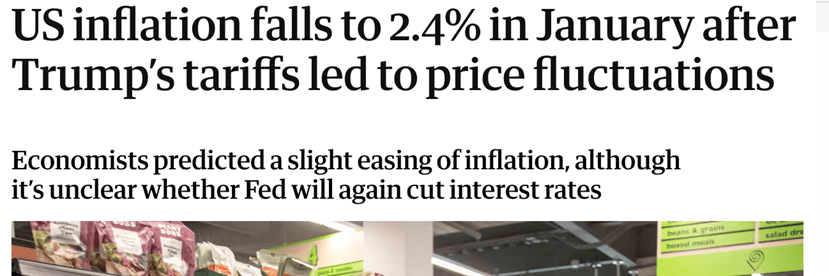
据英国卫报等外媒报道,美国劳工统计局当地时间周五公布数据显示,1月美国消费者价格指数(CPI)录得2.4%,环 比上涨0.2%;剔除食品与能源的核心CPI环比上涨0.3%。这一同比数据低于经济学家此前预期的2.5%。 数据显示,2025年美国物价波动明显,4月通胀降至2.3%,为四年多来最低,随后逐步攀升,9月达到3%,11月、12 月回落至2.7%。 数据公布后,美国股指期货波动有限,国债收益率下行。市场机构认为,通胀数据超预期回落,为美国居民消费成本 带来缓解。 受低于预期的通胀数据影响,期货市场对美联储降息预期升温。据芝加哥商品交易所集团FedWatch工具显示,交易员 上调6月份美联储降息概率至约83%。市场普遍预计,美联储在2025年下半年三次降息后,或将维持利率不变直至6 月。 CNBC报道称,美国经济当前呈现喜忧参半格局。亚特兰大联储数据显示,美国第四季度经济增长率预计为3.7%,但 通胀水平仍高于美联储2%的年度目标,劳动力市场增长偏弱。 对于关税与通胀关系,有分析人士称,关税主要对家具、家电等部分商品价格产生影响,并未推升广泛通胀。美国财 政部长Scott Bessent表示,投资热潮有望推 ...

华尔街谨慎看待金价,二季度上涨势头会削弱吗?
Sou Hu Cai Jing· 2026-02-14 05:32
Group 1 - The core viewpoint of the articles indicates a decline in the U.S. Consumer Price Index (CPI) for January, with the annual rate dropping from 2.7% to 2.4%, marking the lowest level since May 2025 [1] - The core CPI also decreased from 2.6% to 2.5%, reaching the lowest point since March 2021, which has influenced market expectations regarding interest rate adjustments by the Federal Reserve [1] - The probability of a rate cut by the Federal Reserve in June has increased to 69%, up from 63% prior to the data release, reflecting market sentiment towards monetary policy [1] Group 2 - In the gold market, 33% of analysts predict that international gold prices will remain above $5000 per ounce in the coming week, while 25% expect a decline, and 42% foresee a period of consolidation [1] - Among retail traders, 63% anticipate an increase in international gold prices next week, while 20% expect a decrease, and 17% predict stability [1] - Bart Melek, TD Securities' Managing Director and Global Commodity Strategist, suggests that volatility in the precious metals market will become the norm, with a forecasted average gold price of $5000 per ounce for the first quarter [1] Group 3 - Kevin Walsh's appointment as the new Federal Reserve Chairman and the resolution of U.S. trade tariffs are identified as two uncertain factors that could impact international gold prices [2] - There is a divergence in market opinions regarding Walsh's stance, indicating potential volatility in market reactions [2] - A stable resolution to U.S. trade tariffs could negatively affect international gold, silver, and even copper prices [2]
广发宏观:美国1月通胀相对温和
GF SECURITIES· 2026-02-14 05:24
[Table_Page] 宏观经济研究报告 2026 年 2 月 14 日 证券研究报告 [Table_Title] 广发宏观 1 月美国 CPI 数据显示,通胀整体仍具韧性+放缓。CPI 同比增 2.4% ,低于预期的 2.5%,前值+2.7%;环比 +0.2%,低于预期和前值的+0.3%。核心 CPI 同比增 2.5%,符合预期,前值 2.6%;核心 CPI 环比+0.3%,符 合预期,高于前值的 0.2%。 能源价格增速显著回落,环比-1.5%,其中,汽油(-3.2%)和燃油(-5.7%)价格回落为主要背景。 食品价格环比为+0.2%,前值为 0.7%。其中,家庭食品(food at home)和餐馆用餐价格增速均显著回落,环 比分别为+0.2%和 0.1%,前值分别为 0.6%和 0.7%。 1 月核心商品环比为 0%,持平于前值,核心服务价格有所回弹,环比从 0.3%回升至 0.4%。 [Tabl e_Author] 分析师: 郭磊 分析师: 陈嘉荔 SAC 执证号:S0260516070002 SFC CE.no: BNY419 SAC 执证号:S0260523120005 021-3800357 ...
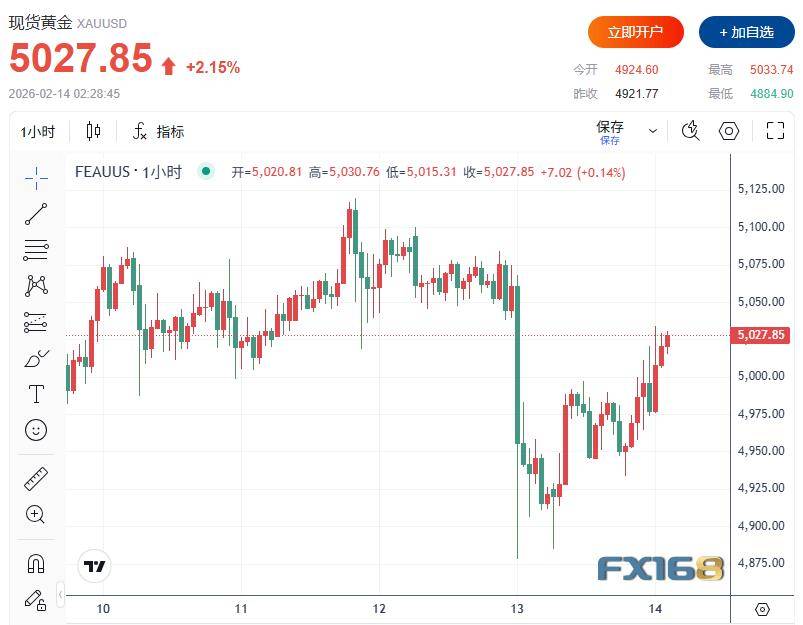
年内“三次降息”押注升至50%!美国1月CPI意外降至2.4% 黄金飙涨逾110美元上破5030
Sou Hu Cai Jing· 2026-02-14 05:21
追踪利率预期的两年期美债收益率在数据发布后小幅下跌,周五下行0.05个百分点至3.42%。期货市场交易员提高 了对今年第三次降息的押注,将这一情景的隐含概率从40%上调至50%。 周五(2月13日),在美国通胀数据弱于预期后,黄金价格上涨超过2%。此前,本周早些时候公布的强劲就业数 据一度打压降息预期,而最新CPI数据则重新点燃市场对美联储今年降息的希望。 美国1月通胀降幅超出预期,CPI同比增幅降至2.4%,在全球最大经济体价格压力缓和的背景下,投资者因此小幅 增加了对美联储降息的押注。 美国劳工统计局(BLS)周五公布的数据显示,该同比增速较12月的2.7%进一步回落,也低于彭博对经济学家调 查所得的2.5%预期。 汽油价格下跌以及住房相关成本增速放缓,共同抑制了总体通胀水平。剔除食品和能源后的核心通胀降至接近五 年来最低水平。 数据还显示,核心通胀同比降至2.5%,为2021年3月以来最低水平;该读数符合华尔街预期,且较12月的2.6%进 一步回落。 根据LSEG汇编的数据,市场目前预计美联储今年将累计降息63个基点,首次降息时间预计在7月。 康奈尔大学经济学家埃斯瓦尔·普拉萨德(Eswar Prasa ...
startrader:CPI报告落地 华尔街上调美联储年内降息预期至2.5次
Sou Hu Cai Jing· 2026-02-14 05:14
Core Viewpoint - The January CPI report released by the U.S. Bureau of Labor Statistics has triggered volatility in global financial markets, leading Wall Street institutions to adjust their expectations for the Federal Reserve's monetary policy, with a consensus now anticipating a total rate cut of approximately 63 basis points this year, equivalent to about "2.5 rate cuts" [1] Group 1: CPI Data and Market Reactions - The January CPI data shows a cooling trend, with a year-on-year increase of 2.4%, below the market expectation of 2.5%, and down 0.3 percentage points from December 2025's 2.7%, marking the lowest level since May 2025 [3] - The core CPI, excluding food and energy, rose by 2.5% year-on-year, meeting expectations and representing the lowest level since 2021, while the month-on-month increase was 0.3%, indicating a slight rebound but not altering the overall trend of declining inflation [3] - Energy prices significantly contributed to the cooling of inflation, with the energy price index decreasing by 1.5% month-on-month, including a 3.2% drop in gasoline prices, alleviating overall price pressures [3] Group 2: Wall Street's Rate Cut Expectations - Prior to the CPI data release, Wall Street's expectations for rate cuts were conservative, with traders anticipating a total cut of only 58 basis points for the year, and significant disagreement on the timing of cuts [4] - Following the CPI data, expectations surged, with the probability of a June rate cut rising to over 80%, and April's cut probability increasing to 30%, leading to an adjusted total rate cut expectation of 63 basis points [4] - Different Wall Street institutions have varying interpretations of the rate cut path, with Goldman Sachs Asset Management predicting two cuts this year, the first potentially in June, while Pacific Investment Management Company believes two cuts are reasonable based on the encouraging inflation report [4] Group 3: Constraints on Federal Reserve's Decision-Making - Despite rising rate cut expectations, the Federal Reserve's policy decisions face multiple constraints, as both CPI and core CPI remain above the Fed's long-term inflation target of 2%, and strong non-farm payroll data indicates a resilient labor market [5] - The robust performance of the labor market diminishes the necessity for rapid rate cuts, as noted by Nomura Securities, highlighting that the positive response from inflation data is still limited by employment resilience [5] - Following the CPI data release, market reactions included rising U.S. Treasury prices, a declining dollar index, and increased attractiveness of precious metals, indicating a re-pricing of global financial markets around new interest rate expectations [5]
IC外汇平台:美国1月通胀放缓但仍高于2% 市场下调短期降息预期
Sou Hu Cai Jing· 2026-02-14 05:14
Core Viewpoint - The Chicago Fed President Goolsbee expressed a cautious stance on interest rate cuts, emphasizing the need for substantial progress in bringing inflation down to the Fed's 2% target before considering any rate reductions [1][3]. Inflation Data - The U.S. Consumer Price Index (CPI) for January recorded a year-on-year increase of 2.4%, the lowest since May 2025, and below the market expectation of 2.5% [3]. - The core CPI, excluding food and energy, rose by 2.5% year-on-year, matching market expectations and marking the lowest level since March 2021 [3]. Economic Environment - Goolsbee indicated that while the January inflation report showed positive signs, there are still significant concerns, particularly regarding service sector inflation, which remains persistent and is not driven by tariffs [3]. - The impact of tariffs on U.S. inflation has been previously noted, with various industries experiencing price increases, but it remains uncertain if the peak effect has passed [3]. Interest Rate Outlook - Goolsbee suggested that there is still room for further rate cuts before reaching the neutral interest rate level, which neither stimulates nor suppresses economic growth [4]. - The market's expectations diverge from Goolsbee's cautious outlook, with traders increasing bets that the Fed may complete more than two rate cuts by 2026 [4]. - According to CME's "FedWatch" data, the probability of a 25 basis point rate cut in March is only 9.8%, while the probability of maintaining the current rate is 90.2% [4].
【广发宏观陈嘉荔】美国1月通胀相对温和
郭磊宏观茶座· 2026-02-14 03:38
Core Insights - The article discusses the January 2026 U.S. Consumer Price Index (CPI) data, indicating a year-on-year increase of 2.4%, which is lower than the expected 2.5% and previous value of 2.7% [1][5] - Core CPI increased by 2.5% year-on-year, meeting expectations, while month-on-month it rose by 0.3%, also in line with forecasts [1][5] - The overall inflation remains resilient yet shows signs of moderation, alleviating initial market concerns regarding tariff impacts and seasonal effects [1][5] Inflation Data Analysis - January's CPI data reflects a year-on-year increase of 2.4% and a month-on-month increase of 0.2%, both lower than expectations [1][5] - Core CPI year-on-year growth is at 2.5%, consistent with expectations, while the month-on-month growth is 0.3%, surpassing the previous month's 0.2% [1][5] - The market had anticipated higher inflation due to tariffs and seasonal effects, but the CPI results were relatively mild [1][5] Core Goods and Services - Core goods prices remained flat, with a year-on-year increase of 1.1% and no month-on-month change [10][11] - The price of used cars fell significantly by 1.8% month-on-month, contributing negatively to the core CPI [10][11] - Excluding used cars, core goods prices rebounded to a month-on-month increase of 0.4%, indicating a shift in inflation pressure towards other categories like appliances and clothing [12][11] Service Sector Inflation - Core service prices increased by 0.4% month-on-month, slightly higher than the previous month's 0.3% [12][13] - Year-on-year, core service prices rose by 2.9%, down from 3% previously, with notable increases in transportation and education services [12][13] - Rent prices showed a month-on-month increase of 0.2%, down from 0.4%, suggesting a potential correction from previous high rates [12][13] Seasonal Adjustments and Weight Changes - The Bureau of Labor Statistics (BLS) announced seasonal factor revisions and weight adjustments, which may lead to a slight statistical decline in CPI readings by the end of 2026 [14][15] - The adjustments increased the weight of categories with weaker price growth, such as used cars, while decreasing the weight of faster-growing categories like transportation services [14][15] Market Reactions - Following the CPI data release, the market slightly increased the probability of a Federal Reserve rate cut in June to 51.8% from 48.9% [16] - U.S. Treasury yields fell, with the 2-year yield decreasing by 7 basis points to 3.4% and the 10-year yield down by 5 basis points to 4.04% [16] - The stock market showed mixed results, with small-cap stocks performing well, indicating a rotation of funds towards sectors with higher growth potential [17]

新一轮俄美乌会谈即将举行!国内金属市场节前普遍收跌
Qi Huo Ri Bao· 2026-02-14 03:07
Market Performance - COMEX gold futures rose by 2.17% to $5050.50 per ounce, while COMEX silver futures increased by 1.98% to $77.180 per ounce [1] - The three major US stock indices closed mixed, with the Dow Jones up 0.10%, the Nasdaq down 0.22%, and the S&P 500 up 0.05% [1] - Major tech stocks like Apple and Nvidia fell over 2%, while Google and Meta dropped more than 1% [1] Domestic Metal Market - The domestic metal market saw a general decline before the Spring Festival, with significant drops in prices for tin and silver [3] - Shanghai gold futures fell by 1.61% to 1110.10 yuan per gram, while Shanghai silver futures dropped by 5.52% to 19782 yuan per kilogram [3] - The decline in gold and silver prices is attributed to weakened market sentiment and risk appetite, exacerbated by a significant drop in US stocks [3][4] Employment Data Impact - The US non-farm payroll data for January showed an increase of 130,000 jobs, significantly exceeding the market expectation of 70,000 [4] - This strong employment data has reduced the perceived necessity for the Federal Reserve to lower interest rates in the short term [4] - However, the total projected job growth for 2025 was revised down by 898,000, indicating that one month's data may not reflect a complete turnaround in the job market [4] Market Sentiment and Future Outlook - Analysts suggest that the gold and silver markets are currently in a "rebalancing" phase, with prices expected to remain volatile in the short term [5] - Long-term factors such as high global debt, geopolitical tensions, and structural shortages in silver are expected to support higher prices after adjustments [5] - The upcoming release of key macroeconomic data during the holiday period is anticipated to significantly influence precious metal prices post-holiday [6][7]
黄金深夜反弹破5040美元 美国CPI降至2.4%创2025年5月新低 高盛料6月降息澳新上调金价至5800美元
Sou Hu Cai Jing· 2026-02-14 02:32
2月13日深夜,黄金出现反弹。在前一日刚经历下跌后,黄金价格在深夜时段持续拉升,突破5040美元 关口,几乎完全收复此前跳水形成的失地。 市场关注的美国1月未季调CPI年率数据显示,该数值从2.7%回落至2.4%,创下2025年5月以来新低,低 于市场预期中值2.5%。该数据显示通胀未出现加速迹象,为美联储维持当前货币政策提供支撑。 澳新银行上调黄金价格预测,将2026年第二季度目标价从此前的5400美元/盎司提升至5800美元/盎司, 主要基于美联储货币政策放松、地缘政治紧张局势加剧以及美元进一步走软等判断。 黄金短期走势仍存在剧烈波动的可能性,但市场核心支撑逻辑未发生根本性转变,全球央行持续购金等 长期支撑因素依然存在。 市场有风险,投资需谨慎。本文为AI基于第三方数据生成,仅供参考,不构成个人投资建议。 来源:市场资讯 高盛资产管理公司多行业固定收益投资主管Lindsay Rosner表示:"仍然预期美联储今年将降息两次,下 一次降息将在6月份进行。" ...
美联储降息概率预期上升,黄金、白银大涨
Xin Lang Cai Jing· 2026-02-14 01:56
Core Viewpoint - The release of US CPI data has led to an increased market expectation for a Federal Reserve interest rate cut, resulting in a decline in the US dollar index and enhancing the attractiveness of precious metal assets [1][1]. Group 1: Market Reactions - COMEX gold futures rose by 2.33%, reaching $5063.80 per ounce [1]. - COMEX silver futures increased by 2.10%, reaching $77.27 per ounce [1].