货币政策宽松

Search documents
财信证券:下半年货币政策将维持适度宽松的总基调
Sou Hu Cai Jing· 2025-07-15 05:14
Group 1 - The central bank's monetary policy is expected to maintain a moderately accommodative tone in the second half of the year despite a shift in language regarding rate cuts and reserve requirement ratio adjustments [1][2] - The foundation for economic recovery in China is still fragile, with uncertainties in external demand for the third quarter and expectations of a potential rate cut by the Federal Reserve in September [1][2] - The central bank aims to enhance domestic demand, stabilize social expectations, and invigorate market activity to support the overall economic and social development goals for the year [1] Group 2 - China is not seeking to gain international competitive advantage through currency depreciation, reflecting the country's confidence and responsibility [2] - The removal of certain phrases regarding market behavior and the weakening of statements on preventing excessive currency fluctuations indicate a reduced risk of RMB depreciation [2] - The RMB/USD exchange rate is expected to trend towards stability and gradual appreciation in the future [2]
2025年6月金融数据及新闻发布会解读:从央行新闻发布会再看股债汇三角
Yin He Zheng Quan· 2025-07-14 13:38
Monetary Supply and Credit Growth - M1 increased by 4.6% year-on-year in June 2025, up from 2.3% in the previous period[1] - M2 growth reached 8.3%, marking a return above 8% for the first time in 14 months, compared to 7.9% previously[1] - New social financing (社融) totaled 4.2 trillion yuan, with a year-on-year increase of 900.8 billion yuan, resulting in a growth rate of 8.9%[1] Loan and Deposit Trends - Financial institutions issued 2.24 trillion yuan in new loans, a year-on-year increase of 110 billion yuan, maintaining a loan growth rate of 7.1%[1] - Total deposits increased by 3.21 trillion yuan in June, with household deposits rising by 2.47 trillion yuan and corporate deposits by 1.78 trillion yuan[3] - The growth of effective social financing (excluding government financing) rose to 6.06%, up from 5.98%[6] Market Outlook and Policy Implications - The central bank emphasized the importance of stabilizing social expectations and stimulating market vitality through monetary policy[8] - The central bank aims to maintain the RMB exchange rate at a reasonable and balanced level, avoiding depreciation for competitive advantage[8] - The 10-year government bond yield is expected to fluctuate between 1.5% and 1.7% in the second half of the year[41]
宝城期货国债期货早报-20250714
Bao Cheng Qi Huo· 2025-07-14 03:28
1. Report Investment Rating - No investment rating information is provided in the report. 2. Core Viewpoints - The short - term, medium - term, and reference views of TL2509 are all "oscillation", with an intraday view of "oscillation on the weak side". The core logic is that the monetary policy environment is relatively loose, but the possibility of a short - term interest rate cut is low [1]. - For varieties such as TL, T, TF, and TS, the intraday view is "oscillation on the weak side", the medium - term view is "oscillation", and the reference view is "oscillation". Due to the recent rapid recovery of risk appetite in the domestic stock market, the safe - haven demand for bonds has decreased. The possibility of the central bank cutting interest rates in the short term is low, so treasury bond futures are in a consolidation phase. However, under the general tone of moderately loose policies, the adjustment space for treasury bond futures is limited. In the long - term, the logic of an upward trend in treasury bond futures is relatively solid, and they will continue to oscillate and consolidate in the short term [5]. 3. Summary by Related Catalogs 3.1 Variety Viewpoint Reference - Financial Futures Stock Index Sector - The time - cycle definitions are: short - term is within one week, and medium - term is from two weeks to one month. For TL2509, the short - term, medium - term, and reference views are "oscillation", and the intraday view is "oscillation on the weak side". The core logic is the loose monetary policy environment and low short - term interest - rate cut possibility [1]. 3.2 Main Variety Price Market Driving Logic - Financial Futures Stock Index Sector - For varieties TL, T, TF, and TS, the intraday view is "oscillation on the weak side", the medium - term view is "oscillation", and the reference view is "oscillation". Last Friday, treasury bond futures oscillated in a narrow range. The recovery of stock - market risk appetite reduced bond safe - haven demand. The short - term interest - rate cut possibility is low, leading to a consolidation of treasury bond futures. With a loose policy tone, the adjustment space is limited. Given weak inflation, insufficient domestic demand, and external demand affected by tariffs, a loose monetary environment is needed in the second half of the year, making the long - term upward logic of treasury bond futures solid. In the short term, they will continue to oscillate and consolidate [5].
2025年下半年宏观经济、政策与市场展望
2025-07-14 00:36
Summary of Key Points from Conference Call Industry Overview - The conference call discusses the macroeconomic outlook for China in the second half of 2025, focusing on the challenges of rebalancing the economy due to oversupply and the need for policy adjustments in various sectors, including real estate and antitrust measures [1][3][4]. Core Insights and Arguments - **Economic Growth Projections**: China's GDP growth is expected to be around 5.1% for 2025, with a higher growth rate in the first half of the year but facing downward pressure on prices [1][5]. - **Macroeconomic Policies**: Anticipated further interest rate cuts and strong fiscal policies, with no additional budget deficit expected [1][5][12]. The budget deficit for the second half of the year is projected to increase by approximately 2 trillion yuan compared to the previous year [5]. - **Supply-Side Reform 2.0**: This reform is broader than the previous iteration in 2016, addressing not only traditional industries but also emerging sectors like solar energy and electric vehicles [3][8]. The current capacity utilization rate is around 74%, slightly better than the previous low [8]. - **Consumer Demand and Inflation**: The need to stimulate consumer demand is emphasized, with a focus on improving the distribution of income and enhancing social security systems to boost consumption rates, which currently stand at only 39% [10][11]. Inflation is expected to remain weak, with CPI potentially turning negative again [1][14]. - **Market Dynamics**: The A-share market is expected to see structural characteristics in the second half of the year, driven by valuation increases rather than profit growth [2][6]. The focus will be on corporate earnings, particularly in response to changes in real estate and export demand [18]. Additional Important Content - **Antitrust and Real Estate Policies**: The implementation of antitrust policies and adjustments in real estate regulations are crucial for addressing the oversupply issue [3][7]. - **K-Shaped Recovery**: The current economic situation reflects a K-shaped recovery, where some sectors recover while others lag behind, necessitating coordinated efforts to stimulate demand and investment [9][10]. - **Long-term Economic Strategy**: The call highlights the importance of transitioning from supply-side reforms to demand-side initiatives to achieve a balanced economic framework [4][10]. - **Currency and Commodity Outlook**: The Chinese yuan is expected to appreciate slightly, while commodity prices, particularly in the A-share market, may diverge from overall economic performance [17][18]. This summary encapsulates the key points discussed in the conference call, providing insights into the current economic landscape and future expectations for China.
韩国央行按兵不动!维持利率在2.5%不变,房价上涨和关税成为焦点
智通财经网· 2025-07-10 03:20
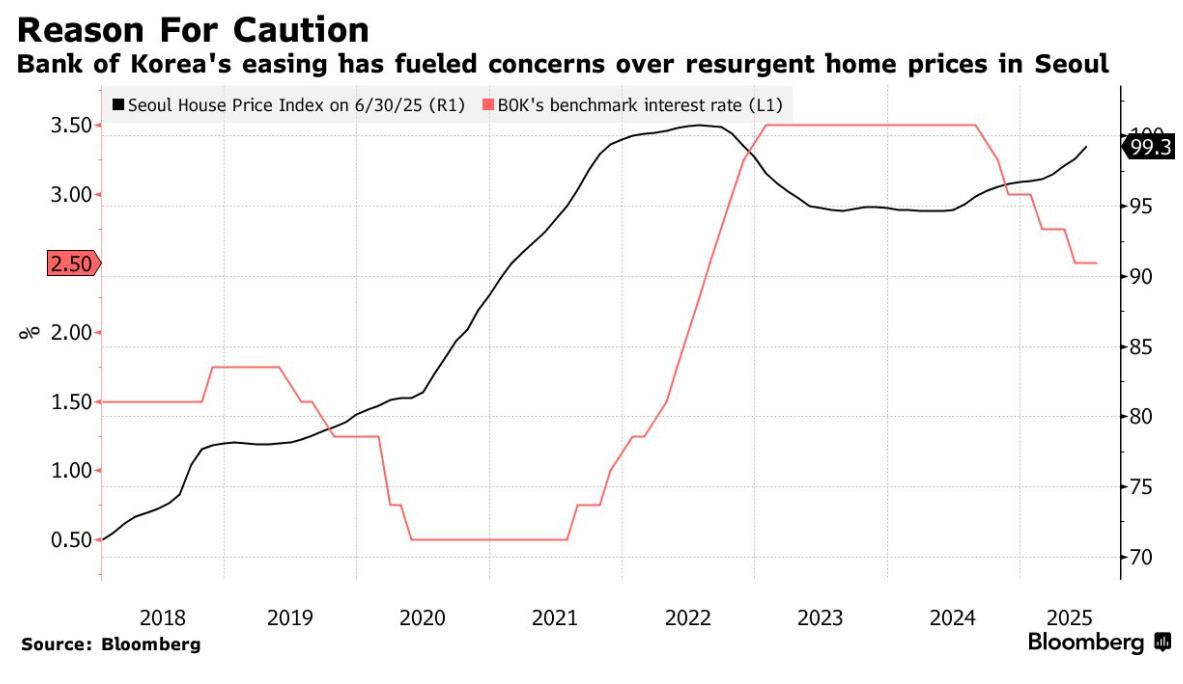
Core Viewpoint - The Bank of Korea has decided to maintain the benchmark interest rate at 2.5% amid rising housing prices and economic threats from U.S. tariffs, indicating a cautious approach to monetary policy while monitoring the effects of previous easing measures [1][4]. Group 1: Monetary Policy Decisions - The Bank of Korea has kept the 7-day repurchase rate unchanged at 2.5%, aligning with the expectations of 19 surveyed economists [1]. - The central bank has lowered interest rates twice this year and four times in the last quarter of the previous year, reflecting concerns over rapid easing potentially leading to a real estate boom similar to the post-pandemic period [1][4]. - Economists anticipate a possible rate cut in August, suggesting that fiscal expansion may necessitate policy coordination [4]. Group 2: Economic Challenges - One of the most pressing challenges for the South Korean economy is managing the impact of U.S. tariffs, with a comprehensive tariff on Korean goods set to increase to 25% on August 1 [4]. - Specific tariffs on the automotive and steel industries continue to pose significant obstacles to economic growth [4]. - The central bank is expected to remain vigilant regarding trade developments while monitoring the real estate market [4]. Group 3: Housing Market Dynamics - Recent months have seen a surge in mortgage growth, with June recording the largest increase in housing loans in nine months [5]. - The housing price expectation index rose to its highest level since October 2021, indicating a potential resurgence in the real estate market [5]. - The government has introduced new regulations to limit the maximum mortgage amounts in the Seoul metropolitan area, though the effectiveness of these measures in curbing household borrowing risks remains uncertain [5].

十年国债ETF(511260)规模破150亿元!债市往后怎么看?
Sou Hu Cai Jing· 2025-07-10 02:06
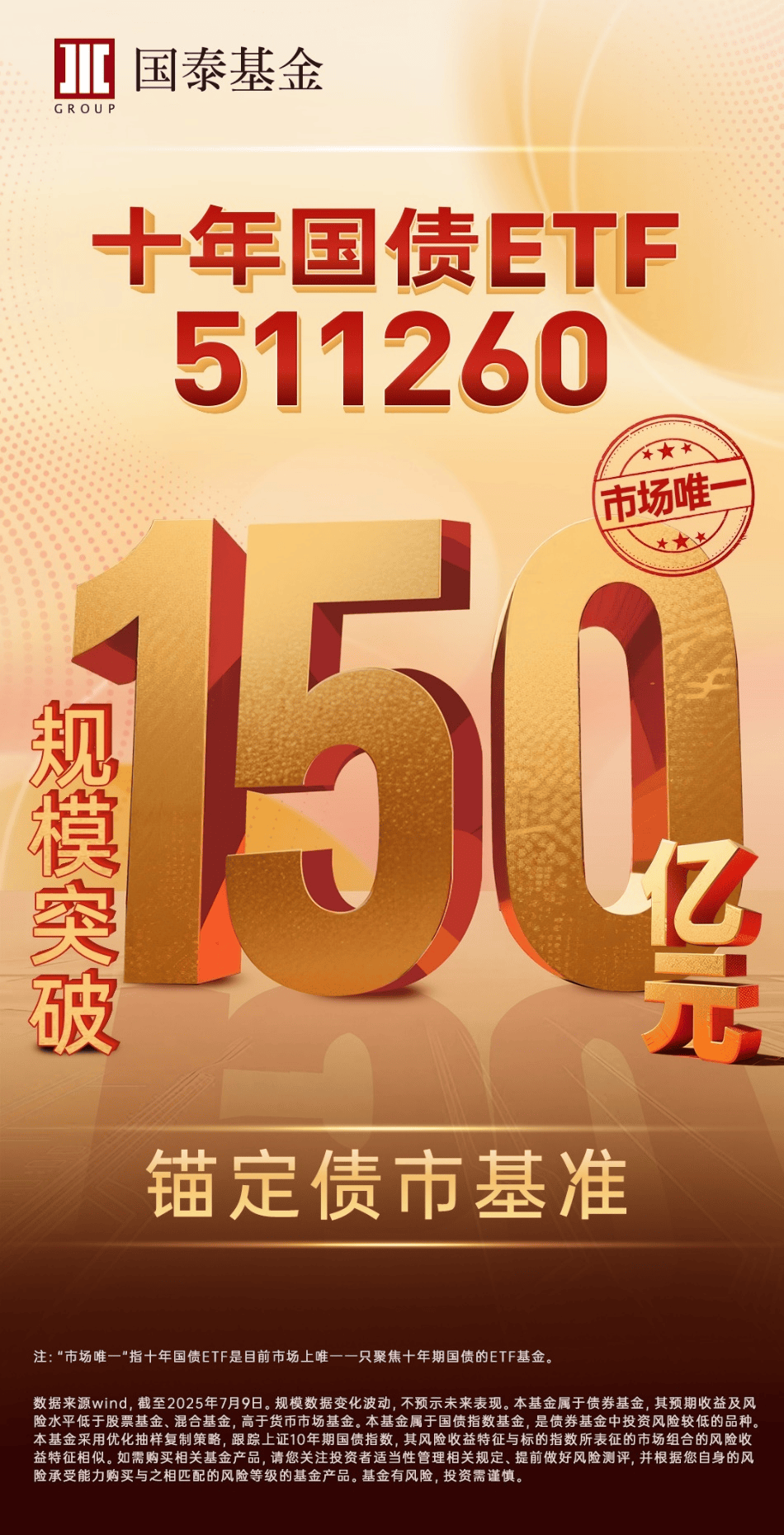
Core Viewpoint - The bond market is currently experiencing significant inflows, particularly in the ten-year government bond ETF (511260), which has seen over 1.1 billion yuan in net inflows for five consecutive days and over 10 billion yuan in the past month, indicating strong liquidity and investment interest [1]. Short-term Investment Opportunities - Short-term bonds are expected to benefit from ongoing monetary policy adjustments, as the central bank is likely to maintain a loose monetary stance to stimulate financing demand amid a structurally transforming economy [4]. - The potential for further interest rate cuts or reserve requirement ratio reductions could enhance the attractiveness of short-term bonds, making them a viable investment option [4]. Long-term Investment Opportunities - Long-term bonds are influenced by fundamental economic conditions and current inflation levels, with the third quarter being a period of increased fiscal activity and a seasonal decline in bond supply [5]. - The trend of "asset allocation scarcity" is expected to strengthen, leading to increased demand for long-term bonds from both institutional and trading entities, providing opportunities for yield and capital gains [5]. Overall Market Outlook - The outlook for the bond market in the second half of the year is optimistic, with the ten-year government bond ETF (511260) being highlighted as a favorable investment vehicle due to its liquidity and ease of trading [6]. - The ten-year government bond yield serves as a key indicator for the bond market, and the ETF's performance is expected to reflect broader market trends [6].
白银价格预测:由于关税紧张局势,白银在近13年高位盘整
Sou Hu Cai Jing· 2025-07-09 06:22
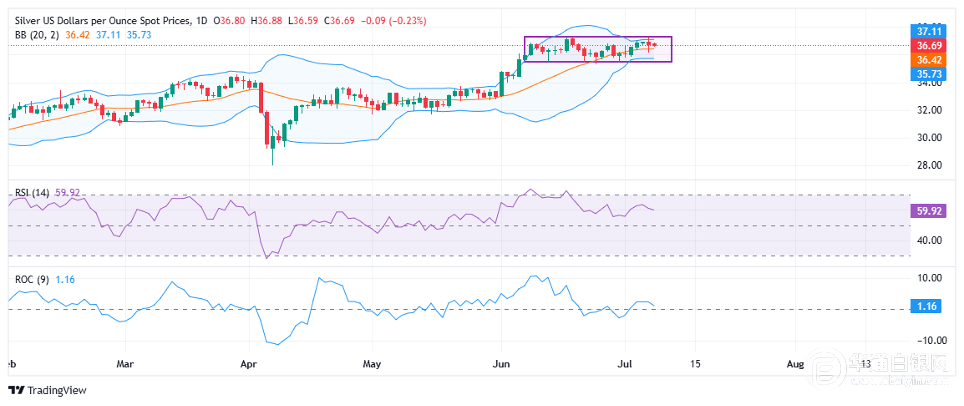
Core Viewpoint - Silver prices are stabilizing around $36.70, remaining near a 13-year high amid ongoing trade tensions and geopolitical risks [1][3]. Group 1: Market Conditions - Silver is trading within a range of $35.50 to $37.30, with the 20-day moving average at $36.42 acting as immediate support [3][5]. - The recent announcement by Trump imposing a 25% tariff on 14 countries, including major trading partners like Japan and South Korea, has heightened trade tensions [2][3]. - The extension of the deadline for reciprocal tariffs from July 9 to August 1 provides more negotiation time but keeps trade tensions elevated [3]. Group 2: Technical Analysis - Silver prices have been consolidating for the past four weeks, reflecting a cautious stance among traders following a strong rebound in early June [5]. - The Bollinger Bands are narrowing, indicating reduced volatility and the potential for a breakout, although a clear directional trigger is needed [5]. - Momentum indicators suggest a cautious bullish outlook, with the Relative Strength Index (RSI) around 60, indicating moderate buying interest without signs of being overbought [5]. Group 3: Price Levels - A daily close above $37.30 would confirm a bullish breakout, potentially paving the way for prices to reach $38.00 and $39.00 in the short term [6]. - The first support level is at approximately $36.42, which aligns with the middle line of the Bollinger Bands; a break below this level could expose the lower end at around $35.72 [6]. - If the support at $36.42 fails, the next downside target would be $34.50, indicating a deeper corrective move [6].
新西兰联储:部分委员强调,若在7月进一步实施货币政策宽松,将起到保障作用,以确保经济活动的复苏。但基于不确定性增加和近期通胀风险,最终决定维持利率。
news flash· 2025-07-09 02:04
Core Viewpoint - The Reserve Bank of New Zealand (RBNZ) has decided to maintain interest rates despite discussions among some members about the potential benefits of further monetary policy easing in July to support economic recovery, citing increased uncertainty and recent inflation risks [1] Summary by Relevant Categories Monetary Policy - Some members of the RBNZ emphasized that implementing further monetary policy easing in July could provide a safeguard to ensure the recovery of economic activity [1] Economic Conditions - The decision to maintain interest rates is influenced by rising uncertainty and recent inflation risks, indicating a cautious approach to monetary policy amidst fluctuating economic conditions [1]
路透调查:家庭债务劲升警讯亮起 韩国央行7月会议料暂停降息
Xin Hua Cai Jing· 2025-07-08 05:42
Group 1 - The core viewpoint of the articles indicates that the Bank of Korea is expected to pause its interest rate cuts in the upcoming meeting, but a resumption of rate cuts is anticipated next month to support economic growth [1][2] - Economic data shows that mortgage loans in South Korea increased by 5.6 trillion won (approximately 4.1 billion USD) in May, which is an acceleration from the previous month's increase of 4.8 trillion won [1] - The Bank of Korea's monetary policy committee members express concerns about the risks associated with the real estate market and household debt, emphasizing the need for caution [1] Group 2 - Despite a cumulative rate cut of 100 basis points since the end of last year, the Bank of Korea's committee members believe further monetary easing is necessary to stimulate economic growth, especially after a 0.2% contraction in the first quarter [2] - Most economists predict that the policy rate will be lowered by 25 basis points to 2.25% by the end of the third quarter, with differing opinions on the year-end rate among economists [2] - Economic growth expectations for 2025 have been revised down from 1.3% to 0.9%, aligning closely with the Bank of Korea's forecast of 0.8%, while the average inflation rate for this year is expected to be around 2.0% [2]
政策深化“反内卷”有利于A股中长期盈利预期改善,500质量成长ETF(560500)红盘上扬
Xin Lang Cai Jing· 2025-07-08 02:59
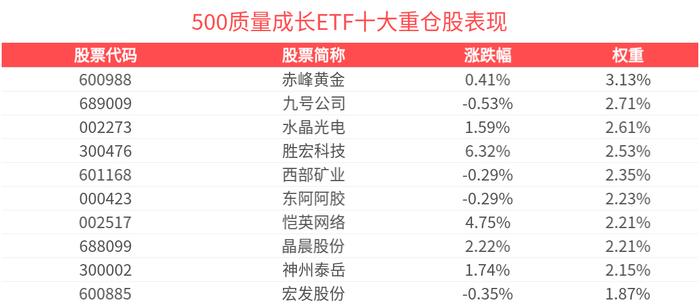
Group 1 - The core viewpoint indicates that the 中证500质量成长指数 has shown a positive trend, with a 0.66% increase as of July 8, 2025, and notable gains in constituent stocks such as 景旺电子 (up 9.38%) and 华测检测 (up 5.94%) [1] - The 500质量成长ETF has experienced significant growth in scale, with an increase of 27.11 million yuan over the past three months, ranking it in the top third among comparable funds [1] - The outlook for the A-share market remains optimistic, with expectations of potential interest rate cuts by the central bank and a focus on "stabilizing growth" in domestic policies [1][2] Group 2 - The 中证500质量成长指数 is currently at a historical low valuation, with a price-to-book ratio (PB) of 1.87, which is lower than 90.5% of the time over the past three years, indicating strong valuation appeal [2] - The index comprises 100 high-profitability, sustainable, and cash-rich companies selected from the 中证500 index, providing diverse investment options for investors [2] - As of June 30, 2025, the top ten weighted stocks in the 中证500质量成长指数 account for 20.42% of the index, with companies like 东吴证券 and 恺英网络 being the most significant contributors [2]