
宽松货币政策

Search documents
欧洲央行降息拓展政策空间
Jing Ji Ri Bao· 2025-06-09 21:44
Core Viewpoint - The European Central Bank (ECB) has lowered key interest rates in the Eurozone to stabilize market expectations and address economic weaknesses, while facing structural challenges that will influence future economic performance [1][2]. Group 1: Interest Rate Changes - On June 5, the ECB reduced the deposit facility rate, main refinancing rate, and marginal lending rate by 25 basis points to 2.00%, 2.15%, and 2.40% respectively [1]. - The ECB's decision comes amid a weakening economic growth momentum, with GDP growth expectations for 2025 revised down to 0.9% [1][3]. Group 2: Economic Context - The Eurozone economy is experiencing internal demand deficiencies and external trade environment deterioration, exacerbated by increased tariffs on steel and aluminum products by the U.S. [1][3]. - The Eurozone inflation rate fell to 1.9% in May, the first time below the 2% target in eight months, providing room for the ECB to implement rate cuts [1][2]. Group 3: Impact of Rate Cuts - Short-term, the rate cuts are expected to lower financing costs, boosting consumption and investment, particularly in conjunction with fiscal stimulus plans like Germany's €46 billion corporate tax reduction [2]. - Long-term, the rate cuts indicate a shift in ECB policy focus from controlling inflation to stabilizing growth, although future rate paths remain data-dependent [2][4]. Group 4: Market Reactions - European stock markets have shown positive performance, with the German DAX index up 22% year-to-date and the Stoxx50 index rising 10.6% [3]. - However, challenges persist, including weak growth in manufacturing and services, and potential conflicts between ECB monetary policy and national fiscal policies [3][4]. Group 5: Future Considerations - Key uncertainties include the progress of trade disputes, inflation trends, and the advancement of structural reforms, which are crucial for enhancing economic resilience [4]. - The ECB's recent rate cut is viewed as a defensive measure to respond to current pressures while allowing flexibility for future policy adjustments [4].
南财快评丨欧央行再降息,或意在刺激投资对冲美国关税
2 1 Shi Ji Jing Ji Bao Dao· 2025-06-06 12:11
Core Viewpoint - The European Central Bank (ECB) has lowered its key interest rates by 25 basis points, marking the eighth rate cut since March of the previous year, in response to increasing pressures on economic growth due to global uncertainties [1][3]. Group 1: Interest Rate Changes - The ECB's deposit facility rate, main refinancing rate, and marginal lending rate have been reduced from 3.75%, 4.25%, and 4.5% to 2.00%, 2.15%, and 2.40% respectively [1]. - This decision reflects the ECB's ongoing efforts to maintain price stability and support economic growth amid geopolitical developments and global financial imbalances [1][4]. Group 2: Economic Indicators - The inflation rate in the Eurozone decreased from 2.2% in April to 1.9% in May, with a projected average inflation rate of 2.0% for 2025, down by 0.3 percentage points from March [3]. - The ECB forecasts a GDP growth rate of 0.9% for this year, with projections of 1.1% and 1.3% for the following two years [3]. - The unemployment rate in the Eurozone is estimated to be 6.2% in April 2025, the lowest since the euro's introduction, with a 0.3% increase in employment numbers in the first quarter of this year [3]. Group 3: Policy Implications - The ECB's rate cut is interpreted as a measure to counterbalance the impact of U.S. tariffs, especially given the lack of substantial consensus on tariff issues between the U.S. and Europe [3][5]. - ECB President Lagarde emphasized the need for investment stimulation through low interest rates, indicating that supportive policies are likely to be implemented soon [5]. - The ECB aims to simplify and encourage capital inflow into Europe, whether through returning European investments or attracting non-European investments [4].
央行大规模逆回购稳市场流动性 A500指数ETF(159351)持续表现活跃 成交额居全市场同类第一
Mei Ri Jing Ji Xin Wen· 2025-06-06 08:05
Group 1 - The A-share market experienced a four-day winning streak in June, with the Shanghai Composite Index closing at 3385.36 points, up 0.04% [1] - The A500 Index ETF (159351) showed strong performance, with a total trading volume of 2.769 billion yuan and a turnover rate of 18.82%, both ranking first among similar products in the market [1] - The People's Bank of China (PBOC) conducted a buyout reverse repurchase operation for the first time at the beginning of the month, injecting 1 trillion yuan into the banking system for a period of three months (91 days) [1] Group 2 - The A500 Index ETF tracks the CSI A500 Index, consisting of 500 stocks with large market capitalization and good liquidity, providing a balanced industry distribution and favoring large and mid-cap styles [2] - Investors can access quality core asset opportunities through the A500 Index ETF linked funds (Class A 022453; Class C 022454) [2]
欧洲央行降息25个基点,年内八次降息后宽松货币政策周期将结束
Xin Jing Bao· 2025-06-06 03:48
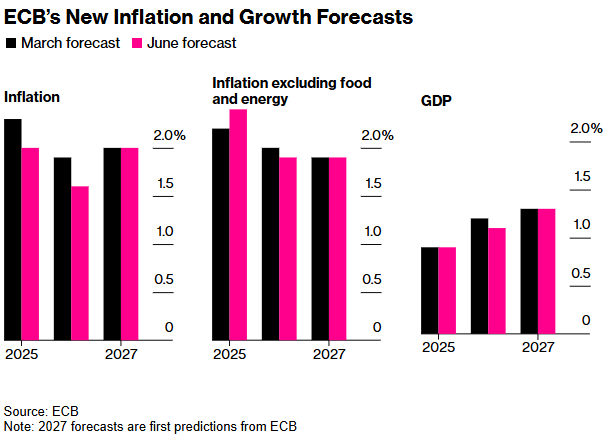
Group 1 - The European Central Bank (ECB) announced a 25 basis point cut in three key interest rates, effective June 11, marking the eighth rate cut in a year, signaling further monetary easing [1] - After the rate cut, the deposit facility rate, main refinancing rate, and marginal lending rate are set at 2.00%, 2.15%, and 2.40% respectively [1] - ECB President Lagarde indicated that the monetary policy cycle is nearing its end, and the ECB is equipped to handle upcoming uncertainties at the current interest rate levels [1] Group 2 - The ECB unexpectedly lowered its inflation forecast for the Eurozone, projecting an overall inflation rate of 2.0% in 2025, 1.6% in 2026, and 2.0% in 2027, with the 2026 forecast being particularly surprising to the market [2] - The Eurozone's economic growth is showing signs of slowing, with projected GDP growth rates of 0.9% in 2025, 1.1% in 2026, and 1.3% in 2027 [2] - The ECB noted that global trade policy uncertainties may continue to suppress business investment and exports in the short term, but improvements in financing conditions will enhance the Eurozone's ability to withstand external shocks [2] Group 3 - The ECB will adopt a data-dependent and meeting-by-meeting approach to determine appropriate monetary policy, without committing to a specific interest rate path [3] - This approach aligns with market expectations and allows for future policy flexibility [3] Group 4 - The divergence in monetary policy between the ECB and the Federal Reserve (Fed) may intensify, as the ECB continues its easing while the Fed has not cut rates this year, resulting in a rate gap of over 2 percentage points [4] - The Fed's Beige Book indicates a slight decline in U.S. economic activity, with tariffs and uncertainty impacting the economy broadly [4] - Fed officials view inflation as a primary risk, with many preferring to delay rate cuts due to the uncertain impact of tariffs on the economy [4] Group 5 - Fed officials express concerns about inflation risks, particularly due to the potential impact of Trump's trade policies, which may continue to push prices higher through various channels [5] - Current monetary policy is deemed effective in responding to macroeconomic changes [5] Group 6 - The impact of tariffs on U.S. economic growth and employment remains unclear, but there are concerns about their short-term effects on inflation [6] - President Trump has expressed dissatisfaction with the Fed's pace of rate cuts, raising concerns about the independence of the Fed's monetary policy [6]
24小时环球政经要闻全览 | 6月6日
Sou Hu Cai Jing· 2025-06-06 00:47
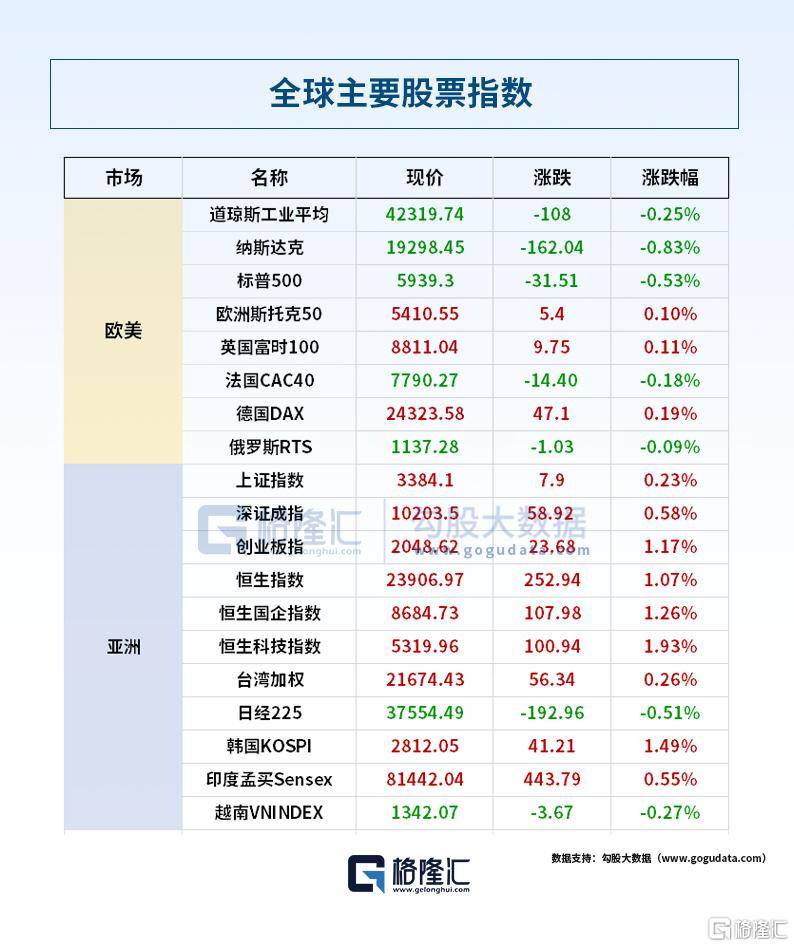
| 市场 | 名称 | 现价 | 涨跌 | 涨跌幅 | | --- | --- | --- | --- | --- | | 欧美 | 道琼斯工业平均 | 42319.74 | -108 | -0.25% | | | 纳斯达克 | 19298.45 | -162.04 | -0.83% | | | 标普500 | 5939.3 | -31.51 | -0.53% | | | 欧洲斯托克50 | 5410.55 | 5.4 | 0.10% | | | 英国富时100 | 8811.04 | 9.75 | 0.11% | | | 法国CAC40 | 7790.27 | -14.40 | -0.18% | | | 德国DAX | 24323.58 | 47.1 | 0.19% | | | 俄罗斯RTS | 1137.28 | -1.03 | -0.09% | | | 上证信数 | 3384.1 | 7.9 | 0.23% | | | 深证成指 | | 10203.5/L _ 58.92 | 0.58% | | | 创业板指anghul.co | | 2048.62 goguda23,68m | 1.17% | | | ...



一年内第八次降息,欧央行下调关键利率
Sou Hu Cai Jing· 2025-06-05 13:40
Group 1 - The European Central Bank (ECB) announced a 25 basis point cut in key interest rates, bringing the deposit facility rate to 2.00%, the main refinancing rate to 2.15%, and the marginal lending rate to 2.40%, aligning with market expectations [1] - This marks the fourth rate cut in 2023 and the eighth since the current easing cycle began in June 2024, reflecting ongoing economic challenges in the Eurozone [1] - The ECB's decision is influenced by weak economic growth and a recent drop in inflation to below the target rate of 2%, providing room for continued accommodative policies [1] Group 2 - The ECB projects Eurozone GDP growth rates of 0.9% for 2025, 1.1% for 2026, and 1.3% for 2027, with CPI growth expected to be 2% in 2025, followed by 1.6% and 2% in 2026 and 2027 respectively [1] - There is increasing market sentiment advocating for a pause in rate cuts, with concerns that trade barriers, a tight labor market, and rising infrastructure and defense spending may elevate inflation expectations in the medium term [1] - Following the rate decision, the euro experienced volatility against the dollar, initially rising before retreating, indicating market uncertainty [2]
欧洲央行年内第八次降息 通胀回落与贸易压力成主因
智通财经网· 2025-06-05 13:34
智通财经APP获悉,在通胀率八个月来首次跌破2%关口,且美国关税政策持续冲击经济之际,欧洲央 行于当地时间6月5日宣布下调存款利率25个基点至2%,符合市场普遍预期。这是该行自2024年7月以来 第八次启动降息,进一步释放宽松货币政策信号。 欧洲央行在声明中指出:"当前通胀率已接近管理委员会设定的2%中期目标水平。"尽管5月通胀率降至 1.9%的低位,但政策制定者仍保持谨慎态度。声明特别提及,特朗普政府实施的贸易保护主义政策正 对欧洲企业投资和出口造成短期压力,尽管各国政府增加的国防及基建投资或将在中长期为经济增长提 供支撑。 市场反应印证了政策调整的影响:德国十年期国债收益率应声下跌约5个基点至2.48%,显示避险情绪 升温;欧元兑美元汇率在短暂冲高后回落至1.1418,基本持平于降息前水平。货币市场小幅增加对今年 进一步降息幅度的押注,预计总计降息 33 个基点,相当于再次下调 25 个基点且有三分之一概率再下 调。 经济数据显示,欧元区经济放缓趋势愈发明显。本周数据显示 5 月份通胀率降至 1.9%,为 8 个月来首 次跌破 2%,也是 2021 年以来第二次,经济放缓主因服务业价格涨幅放缓,而此前这一 ...
李在明上台,韩国转机将至?
Guo Ji Jin Rong Bao· 2025-06-04 14:18
Economic Overview - South Korea's new president, Lee Jae-myung, has pledged to initiate an emergency economic task force to achieve a virtuous economic cycle through national finances [1] - The Consumer Price Index (CPI) for May was reported at 116.27, reflecting a year-on-year increase of 1.9%, which is below the Bank of Korea's 2% inflation target [1][3] - The economic outlook is grim, with many financial institutions lowering their growth forecasts for South Korea due to ongoing trade tensions with the U.S. [1][5] Inflation and Price Trends - Core CPI, excluding food and energy, rose by 2.0% year-on-year and 0.2% month-on-month, indicating persistent inflation in personal services [3] - Prices for petroleum products fell by 2.3% year-on-year, with gasoline and diesel prices decreasing by 3.5% and 5.5%, respectively [3] - Agricultural and livestock prices saw a slight increase of 0.1%, while the fresh food index dropped by 5.0% year-on-year [3] Government Response and Fiscal Policy - The South Korean government approved a supplementary budget of 13.8 trillion KRW (approximately 725.7 million RMB) to mitigate the impact of U.S. tariffs and stabilize prices [4] - The Bank of Korea has revised its economic growth forecast for the year down to 0.8%, significantly lower than previous estimates [4][5] - The new administration is expected to implement fiscal stimulus measures to support strategic industries and enhance the stock market [9] Trade Relations and External Pressures - The U.S. has increased tariffs on steel and aluminum, which poses a significant challenge for South Korea's export-driven economy [8] - South Korea is the fourth-largest steel exporter to the U.S., accounting for 13.1% of U.S. steel imports, and is facing increased export pressure due to the tariff hikes [8] - The ongoing trade negotiations with the U.S. are seen as critical for the new government's success [7][9] Market Reactions - Following the announcement of the new government, the yield on South Korea's 10-year government bonds rose by over 10 basis points to 2.90% [9][10] - Analysts predict that bond issuance may exceed initial plans, with estimates suggesting issuance could reach 230 trillion KRW in 2025 [9] - The Bank of Korea has lowered the benchmark interest rate from 2.75% to 2.5%, with expectations of further reductions by year-end [10]
每日机构分析:6月4日
Xin Hua Cai Jing· 2025-06-04 11:55
Group 1 - Danske Bank reports an improvement in the US dollar's performance following better-than-expected hiring data, with the 30-year US Treasury yield approaching 5% [1] - The US job market data, including ADP employment figures and initial jobless claims, will be closely monitored for further insights [1] - The 10-year Japanese government bond yield is expected to fluctuate between 1.4% and 1.5%, influenced by market concerns over long-term bond demand and upcoming significant events [2] Group 2 - Goldman Sachs indicates that Trump's "retaliatory tax" clause may weaken foreign investors' interest in US assets, potentially redirecting attention to European markets [2] - European investors' confidence is rising, with the proportion of investments in the US expected to reverse from 45% back to lower levels, as the European Stoxx 600 index has increased by 8% since early 2025 [2] - South Korea's inflation rate has slowed to 1.9% in May, below the central bank's target, providing a basis for potential monetary easing to support economic growth [3] Group 3 - HSBC economists predict that the Reserve Bank of India will lower interest rates by 25 basis points in an upcoming meeting, with another cut expected in August, bringing rates down to 5.5% [4] - The Indian central bank has room for further policy easing, focusing on interest rate tools rather than liquidity injections, with inflation projected to remain below target levels [4] - The final interest rate cut of the year may occur in December, contingent on the economic growth situation at that time [4]
每日机构分析:5月30日
Xin Hua Cai Jing· 2025-05-30 11:47
Group 1 - UBS forecasts global AI spending to reach $360 billion by 2025, a 60% increase from previous estimates, and further grow to $480 billion by 2026 [1] - Major global cloud platforms reported a strong 24% year-over-year revenue growth, indicating robust cloud business growth and increased adoption of AI across various industries [1] - UBS suggests balancing exposure between semiconductor and software stocks to manage volatility despite a positive long-term outlook on AI [1] Group 2 - The strong performance of the yen is unlikely due to low real interest rates, leading Japanese life insurance companies to reduce measures against potential losses from yen appreciation [2] - Japanese life insurers have shifted from buying to selling overseas stocks, reflecting a decrease in interest in foreign bonds despite higher yields compared to US, UK, Germany, and Australia [2] - PIMCO analysts expect Germany to have more fiscal space compared to other European countries, with overall European fiscal policy unlikely to expand significantly in the coming years [2] Group 3 - Tokyo's inflation rate rose to 3.6% in May, the highest since early 2023, exceeding market expectations, which may lead to a reassessment of the likelihood of a Bank of Japan rate hike [3] - If the Bank of Japan raises rates in July, it could support the yen and reduce hedging costs for Japanese investors in US assets [3] - The Federal Reserve may need to implement more accommodative monetary policy later this year to support the US economy, potentially leading to a weaker dollar [3] Group 4 - The iTraxx Europe Main index tracking euro investment-grade credit default swaps remained stable at 57 basis points, indicating no significant change in the market's view on the default risk of high-grade corporate debt in the eurozone [3]