就业市场

Search documents
【广发宏观陈嘉荔】2025年杰克逊霍尔会议鲍威尔演讲简评
郭磊宏观茶座· 2025-08-23 03:01
Core Viewpoint - The Jackson Hole Economic Policy Symposium serves as a significant platform for discussing global economic issues, influencing market expectations regarding U.S. monetary policy, particularly in terms of interest rate adjustments and inflation outlooks [1][6][19]. Group 1: Jackson Hole Economic Policy Symposium Insights - The symposium is hosted annually by the Kansas City Fed in Jackson Hole, Wyoming, and includes central bank governors, finance ministers, and academic and financial professionals [1][6]. - In the 2022 meeting, Fed Chair Powell adopted a hawkish stance, emphasizing the need for aggressive rate hikes to combat high inflation, which subsequently led to a faster pace of U.S. interest rate increases [1][6]. - The 2023 meeting saw Powell indicating a more cautious approach, stating that the Fed would proceed carefully, which resulted in a halt to further rate increases [1][6][7]. Group 2: Powell's 2025 Speech Highlights - In his 2025 speech, Powell expressed a dovish outlook, suggesting that changes in economic prospects and risk balances may necessitate adjustments in the Fed's policy stance [2][8]. - He noted that the impact of tariffs on inflation might be relatively short-lived, indicating a potential for inflationary pressures to stabilize [2][10]. - Powell highlighted that while the labor market appears balanced, it is characterized by a significant slowdown in both labor supply and demand, increasing the risk of layoffs and rising unemployment [2][11]. Group 3: FOMC Long-Term Goals and Monetary Policy Strategy - The FOMC released a new statement modifying its long-term goals, removing references to the "zero lower bound" and emphasizing the use of all policy tools to achieve dual objectives of maximum employment and price stability [3][12]. - The statement shifted from a flexible average inflation targeting strategy back to a simpler inflation targeting approach, indicating a return to traditional inflation management [3][12][13]. - The FOMC's focus has now shifted to promoting "maximum employment," allowing for more flexibility in policy adjustments without being constrained by perceived employment gaps [3][12][13]. Group 4: Market Reactions and Economic Indicators - The dovish tone from Powell increased the probability of a September rate cut, with market expectations reflecting an 84% chance of a rate reduction following the Jackson Hole meeting [5][19]. - Following the meeting, U.S. stock markets surged, with the Dow Jones rising by 1.89%, the S&P 500 by 1.52%, and the Nasdaq by 1.88%, indicating positive market sentiment towards potential rate cuts [5][19]. - Key economic indicators, such as employment data and inflation expectations, remain critical in shaping future monetary policy decisions, with the Fed closely monitoring these metrics [4][14][20].


What to Expect from Fed Chair Powell's Jackson Hole Speech
ZACKS· 2025-08-22 15:20
Group 1 - The Federal Reserve has maintained interest rates at 4.25-4.50% year-to-date, with a focus on achieving full employment and controlling inflation, targeting a 2% inflation rate [2][3] - Recent economic trends show a cooling labor market alongside rising inflation due to tariff initiatives, raising questions about a potential 25-basis-point rate cut at the upcoming September meeting [3][8] - The Fed's decision-making process is heavily reliant on economic data, with the next Personal Consumption Expenditures (PCE) report due shortly after Powell's speech, which is expected to be data-dependent [6][8] Group 2 - The June PCE report indicated a headline inflation rate of +2.6%, which is moving away from the Fed's +2% target, while core PCE remained at +2.8% for two consecutive months [7][8] - The market showed positive movement in pre-market futures, with the S&P 500 attempting to break a five-session losing streak, reflecting adjustments in tech stock valuations and retail earnings amid tariff considerations [9]

KVB安全吗:鲍威尔讲话能否打破黄金3330-3350震荡格局?
Sou Hu Cai Jing· 2025-08-22 09:41
Group 1 - The recent trends in the gold market are influenced by both news and technical factors, with the Federal Reserve's policy direction being the largest uncertainty [1] - The latest meeting minutes indicate that most officials prefer to keep interest rates unchanged, while a minority suggests early rate cuts, leading to an 85% market bet on a rate cut in September [1] - The internal discussion within the Federal Reserve about adjusting the inflation target framework could lead to a hawkish interpretation by the market [1] Group 2 - The U.S. economic performance shows contradictions, with July's CPI at 2.7% and core CPI at 3.0%, still above the Fed's 2% target, while the job market is weakening, with August non-farm payrolls at 73,000 and an unemployment rate of 4.2% [3] - The market sentiment reflects a scenario where inflation is not fully stabilized, but employment is declining, contributing to frequent fluctuations in gold prices [3] - Institutional trading patterns are evident, with gold prices experiencing sharp rises and falls, attributed to high-frequency trading [3] Group 3 - Technically, gold remains in a consolidation range, with daily fluctuations between $3,325 and $3,352 per ounce, and resistance levels at $3,348, $3,355, and $3,360 [4] - Support levels are identified at $3,330, $3,325, and $3,310, with the daily pattern showing solid support below but insufficient bullish momentum [4] - Short-term indicators suggest a balanced state between bulls and bears, with MACD showing a bullish crossover but diminishing volume [4] Group 4 - The potential volatility from Powell's speech is significant, with a hawkish tone possibly driving prices below $3,325 towards $3,310 or even $3,300 [6] - A dovish tone could push prices up to the $3,360 to $3,370 range, while a neutral stance may keep prices within the $3,330 to $3,350 range [6] - Position sizing and risk management are crucial, with recommendations to limit single positions to 1%-2% of the account and to adjust positions before major announcements [6]

聚焦杰克逊霍尔!鲍威尔演讲或成美联储政策关键转折点
Zhi Tong Cai Jing· 2025-08-21 22:20
Group 1 - Federal Reserve Chairman Jerome Powell is set to speak at the global central bank conference in Jackson Hole, Wyoming, which is viewed as a critical moment for the future direction of monetary policy [1] - Market expectations are high for Powell to confirm the likelihood of a rate cut in September, with a 73.5% probability of a 25 basis point cut during the September 16-17 meeting according to CME FedWatch [1] - Recent volatility in U.S. stock markets is noted, with the Nasdaq index down 2.4% for the week, the S&P 500 down 1.2%, and the Dow Jones Industrial Average down 0.4% [1] Group 2 - Analysts warn that if Powell does not commit to or suggest that market expectations are excessive, it could lead to significant repricing of bond yields and risk assets [1] - Support for a rate cut is based on moderate consumer price increases due to tariffs and signs of cooling in the job market, but there are concerns about rising inflation as wholesale prices recorded their largest increase in three years [1] - Political pressure on Powell is increasing, with President Trump criticizing the Fed's slow rate cuts and calling for the resignation of Fed Governor Cook over alleged mortgage application fraud [2]
又有银行下调利率,存钱越来越没利息了!
Sou Hu Cai Jing· 2025-08-21 14:01
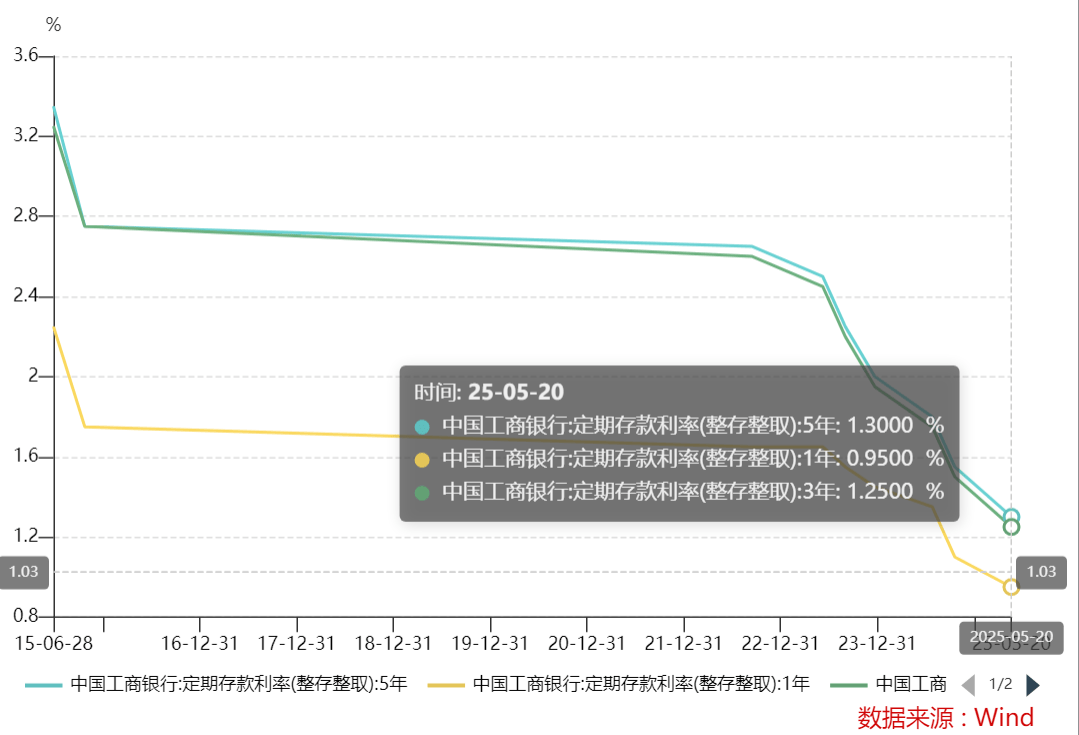
Group 1 - Several village banks in Zhejiang, Guizhou, and Jilin have announced reductions in deposit interest rates, with decreases ranging from 10 to 20 basis points [1] - Jiangsu Bank has lowered its three-year fixed deposit rate from 1.85% to 1.75%, a reduction of 10 basis points, while Zhejiang Shengzhou Ruifeng Village Bank has reduced its five-year fixed deposit rate to 1.3% [1] - The four major banks' two-year, three-year, and five-year deposit rates are currently at 1.05%, 1.25%, and 1.30%, respectively, which were adjusted in May [1] Group 2 - The trend of interest rate cuts typically starts with large banks lowering their deposit rates, followed by smaller banks [3] - Smaller banks have been quicker to follow the rate cuts initiated by larger banks, with some even offering lower rates than the major banks, such as Beijing Huairou Rongxing Village Bank's three-year and five-year rates at 1.20% [4] Group 3 - A new round of interest rate cuts may be on the horizon as smaller banks have nearly completed their adjustments [5] - The latest Loan Prime Rate (LPR) has remained unchanged for three consecutive months, leading to speculation about potential rate cuts in September [6] Group 4 - The likelihood of a rate cut in September hinges on two main factors: the actions of the Federal Reserve and domestic economic data [8] - The Federal Reserve has maintained its interest rate at 4.25%-4.5% as of July, with employment and inflation data being critical indicators for future rate decisions [10] Group 5 - Market analysis suggests a 92% probability of a rate cut in September, with expectations of a 25 basis point reduction, potentially increasing to 50 basis points if employment data worsens [10] - Warren Buffett's recent investments in housing-related stocks indicate a belief that lower interest rates are forthcoming, which could signal a turning point for the housing industry [13] Group 6 - Domestic economic data shows underperformance, with July's consumption growth at 3.7%, industrial value-added growth at 5.7%, and fixed asset investment growth at only 1.6%, all below market expectations [14][15] - The reliance on exports is insufficient to support economic growth, and uncertainties in exports further complicate the outlook for September's LPR adjustments [15]
铜冠金源期货商品日报-20250821
Tong Guan Jin Yuan Qi Huo· 2025-08-21 05:51
1. Report Industry Investment Rating No relevant content provided. 2. Core Views of the Report - Overseas risk appetite continues to contract, with A-shares surging and the Science and Technology Innovation 50 leading the gains. The market is waiting for the further development of the relationships among the US, Europe, Russia, and Ukraine, as well as the guidance from Fed Chair Powell's speech at the Jackson Hole Global Central Bank Annual Meeting on Friday [2][5]. - The prices of precious metals rebounded due to increased market uncertainty. Copper prices are waiting for a driving force. Aluminum prices are expected to adjust within a limited range. Alumina prices face increasing pressure. Zinc prices are stabilizing and recovering. Lead prices are weakly oscillating. Tin prices are in a tangled state. Industrial silicon prices are weakly oscillating. Lithium carbonate prices are fluctuating widely. Nickel prices are oscillating within a range. Crude oil prices are oscillating. Soybean and rapeseed meal prices may oscillate. Palm oil prices may oscillate and adjust [4][6][8][10][11][13][15][16][19][20][21][22][25]. 3. Summary by Relevant Catalogs 3.1 Macro - Overseas: The Fed's July meeting minutes released hawkish signals. Most people believe that inflation risks are higher than employment risks, with differences focusing on the impact of tariffs and interest rate levels. Some are worried about the instability of long - term inflation expectations and the fragility of the US Treasury market, and also concerned about the potential risks of stablecoins. Trump pressured to remove "dissidents" from the Fed, and the independence of the Fed is under threat. The market risk appetite continues to decline, with the US dollar index oscillating weakly, the 10Y US Treasury yield slightly declining, and US stocks continuing to fall. Gold, copper, and oil all rebounded. Attention is paid to the US August PMI tonight [2]. - Domestic: Leaders conducted intensive research and made speeches. A - shares rebounded after Wednesday's oscillation, with the trading volume shrinking to 2.45 trillion yuan. The market risk appetite recovered, the Science and Technology Innovation 50 rose by more than 3%, and sectors such as GPU and liquor led the gains. The bond market fell again as the stock market strengthened. The short - term risk appetite may be approaching the peak, and the bond market is expected to start a recovery [3]. 3.2 Precious Metals - On Wednesday, international precious metal futures prices both closed higher. Trump's call for Fed Governor Cook to resign increased market uncertainty, the US dollar index turned down, and precious metal prices rebounded. The Fed's July meeting minutes were hawkish. The meeting between the leaders of the US, Ukraine, and Russia cooled down. Investor risk aversion increased. Short - term precious metal prices are expected to maintain an oscillating trend [4][5]. 3.3 Copper - On Wednesday, the main contract of Shanghai copper oscillated narrowly, and LME copper sought support at the 9700 level. The macro situation shows that the Fed is facing a dilemma between rising inflation and a deteriorating employment market. The market is highly concerned about Powell's speech at the Jackson Hole Central Bank Annual Meeting on Friday. The CME observation tool shows that the probability of a Fed rate cut in September is 85%. In terms of industry, First Quantum has launched a $1.25 billion expansion project for its Kansanshi copper mine in Zambia. Short - term copper prices are expected to maintain an oscillating state waiting for a driving force [6][7]. 3.4 Aluminum - On Wednesday, the main contract of Shanghai aluminum closed at 20,535 yuan/ton, down 0.19%. The LME aluminum closed at $2,577/ton, up 0.37%. The Fed's July meeting minutes were hawkish. The short - term attitude of the Fed needs to be further observed. Fundamentally, aluminum prices have slightly declined in the past two days. At the transition between the off - season and peak season, downstream restocking at low prices has slightly improved, and the spot discount has converged. Technically, the downward adjustment range of aluminum prices is expected to be limited [8][9]. 3.5 Alumina - On Wednesday, the main contract of alumina futures closed at 3,147 yuan/ton, up 0.03%. The supply of alumina is expected to increase in the future, and the warehouse receipt inventory continues to accumulate, so the price pressure is increasing. Attention should be paid to the changes in production capacity [10]. 3.6 Zinc - On Wednesday, the main contract of Shanghai zinc oscillated narrowly during the day and slightly shifted upwards at night, and LME zinc closed higher. In July, the import of zinc concentrates exceeded expectations, while the import of refined zinc met expectations. Currently, raw materials are abundant. As zinc prices fall to near the previous low, downstream price fixing at low points increases. Short - term zinc prices are stabilizing and recovering, waiting for the guidance from Powell's speech on Friday [11][12]. 3.7 Lead - On Wednesday, the main contract of Shanghai lead oscillated narrowly both during the day and at night, and LME lead closed higher. Globally, the high visible inventory exerts pressure on lead prices. Domestically, the improvement in consumption falls short of expectations, and the production side is relatively stable. Lead prices lack the driving force to rise but also have no continuous downward momentum due to cost support. The fundamentals maintain a state of weak supply and demand [13][14]. 3.8 Tin - On Wednesday, the main contract of Shanghai tin first declined and then rebounded during the day and moved horizontally at night, and LME tin oscillated. In July, Myanmar's tin mines resumed production, but China's imports from Myanmar decreased instead. Indonesia's exports of refined tin decreased month - on - month, and overseas supplies remained tight. In the short term, the low LME inventory is difficult to reverse. Near Powell's speech, the expectation of a rate cut in September is volatile, and tin prices are in a tangled state [15]. 3.9 Industrial Silicon - On Wednesday, the main contract of industrial silicon oscillated weakly. Fundamentally, the supply side is showing a marginal loosening trend, while the demand side has limited consumption growth. The social inventory decreased slightly last week. The domestic anti - involution sentiment has cooled down. Short - term futures prices are expected to enter a weakly oscillating state [16][17]. 3.10 Carbonate Lithium - On Wednesday, carbonate lithium was weakly running, and the spot price was stable. An upstream salt factory in Jiangxi announced the resumption of production, but the actual output in August is expected to be limited. The core factor driving the wide - range price fluctuations may be the market's lack of confidence in the supply contraction promoted by policies. Short - term lithium prices may fluctuate widely due to emotional disturbances [19]. 3.11 Nickel - On Wednesday, nickel prices oscillated. The Fed's July meeting minutes showed that the economic outlook remains pessimistic. Under the expectation of abundant nickel ore supply, the price is still strong, but nickel iron plants are under cost pressure. The refined nickel market is warming up. Nickel prices are at the lower end of the range, and attention should be paid to the rebound at low levels [20]. 3.12 Crude Oil - On Wednesday, crude oil oscillated and strengthened. The market is waiting for the progress of the tripartite peace talks, and the market disturbances are relatively limited. The significant inventory reduction by the EIA has temporarily boosted market sentiment. However, the bearish fundamentals and the expectation of cooling geopolitical risks remain unchanged, and oil prices maintain an oscillating and wait - and - see state [21]. 3.13 Soybean and Rapeseed Meal - On Wednesday, the soybean meal 01 contract fell, and the rapeseed meal 01 contract rose. The second - day inspection results showed that the number of soybean pods in Nebraska was good, while that in Indiana was slightly lower than the same period last year. The dry weather in the US soybean - producing areas is expected to continue, and the yield per unit may be lowered. US soybean growers hope to reach a trade agreement with China. Short - term soybean and rapeseed meal prices may oscillate [22][23][24]. 3.14 Palm Oil - On Wednesday, the palm oil 01 contract fell. The latest data shows that the export demand for Malaysian palm oil is good, which supports the price and limits the decline. The US's exemption obligation for small refineries may be introduced earlier than expected, and US soybean oil oscillated and fell. Short - term palm oil prices may oscillate and adjust [25][26].
盾博dbg:7月只有两位官员支持降息,但部分官员将在9月支持降息
Sou Hu Cai Jing· 2025-08-21 02:50
Group 1 - The meeting minutes indicate that almost all officials support maintaining interest rates unchanged, with the pro-maintenance faction arguing that the impact of tariff policies on inflation remains unclear, while the opposing faction advocates for preemptive measures against potential economic downturn risks [2] - The July non-farm employment data was significantly revised down to 114,000 from the previous 206,000, with the unemployment rate rising to 4.3% [2] - Fed officials Waller and Bowman noted that price fluctuations caused by tariffs are one-time events and should not primarily influence monetary policy [2] Group 2 - Recent economic data shows structural inflation divergence, with goods price growth slowing to 1.7% while service sector inflation remains high at 4.2% [3] - The job market is deteriorating faster than expected, with the July unemployment rate exceeding 4% and job vacancy rates dropping to 5.3% [3] - The meeting minutes suggest that the Fed may be adjusting its policy framework, with Powell attempting to calculate "inflation excluding tariffs," reflecting confusion in addressing the impacts of new trade policies [3] - The Fed is increasingly focusing on financial stability risks, as indicated by a 2.1% decline in commercial real estate prices and a 15% rise in small business bankruptcy rates, showing the high-interest rate environment's impact on the real economy [3]

科技股大 “失血”!英伟达盘中跌近 4%,标普市值一度蒸发超万亿美元
Feng Huang Wang Cai Jing· 2025-08-20 23:04
Group 1 - The U.S. stock market experienced mixed results, with the Nasdaq down 0.67%, S&P 500 down 0.24%, and Dow Jones up 0.04% [1] - Major tech stocks saw declines, with Intel leading the drop at approximately 7%, while Google, Tesla, Apple, and Amazon fell over 1% [1] - The Nasdaq Golden Dragon China Index rose by 0.33%, with mixed performances among popular Chinese stocks, including a rise of 8% for GDS Holdings and over 3% for Tiger Brokers [1] Group 2 - The Federal Reserve's July meeting minutes revealed that only two officials supported a rate cut, with the majority favoring the current rate of 4.25%-4.50% [2] - The release of July's non-farm payroll data showed job additions far below expectations, with an increase in unemployment and a drop in labor participation rate to its lowest since late 2022 [2] - The minutes indicated a significant internal division within the Fed regarding interest rate decisions, marking the first time since 1993 that multiple officials publicly disagreed [2] Group 3 - The S&P 500 index saw a significant sell-off, losing approximately $1 trillion in market capitalization over four days due to concerns over the Fed's hawkish stance and high valuations in tech stocks [3] - Nvidia experienced a nearly 4% drop before the release of the Fed minutes, while Palantir saw a maximum intraday decline of over 9%, marking a cumulative drop of 23.87% since August 12 [3] Group 4 - Investor sentiment is divided, with some viewing the market downturn as a buying opportunity, while others believe that high valuations necessitate profit-taking [4][5] - Analysts suggest that the current market has fully priced in future positives, leaving little room for error, which could lead to a fragile balance [5]





会议纪要显示美联储内部分歧加剧 9月降息预期升温
智通财经网· 2025-08-20 22:28
Group 1 - The Federal Reserve's July 29-30 meeting minutes reveal increasing internal divisions regarding monetary policy, particularly concerning tariff impacts, inflation risks, and employment market conditions [1][2] - The decision to maintain interest rates in the 4.25% to 4.5% range was made with a vote of 9 to 2, marking the first time since 1993 that two Fed governors disagreed with the majority [1] - Officials expressed differing views on the impact of tariffs on inflation, with some advocating for more time to assess trade policy effects, while others argued that waiting for clearer signals is impractical [1] Group 2 - In the employment market, some officials noted low unemployment rates and near "maximum employment," while others pointed to slowing wage growth and reduced job creation, indicating a potential cooling in labor demand [2] - The minutes highlighted concerns about economic activity growth remaining subdued in the second half of the year, with actual income growth slowing potentially suppressing household consumption [2] - The upcoming employment report, which revised down non-farm payrolls by 258,000 for May and June, may exacerbate the Fed's internal concerns about economic slowdown [2] Group 3 - External political pressures complicate the Fed's internal divisions, with President Trump repeatedly calling for significant rate cuts and criticizing Fed Chair Powell's leadership [3] - Both Waller and Bowman, appointed by Trump, are viewed as potential successors, with Waller advocating for gradual rate cuts of up to 150 basis points [3] - Powell acknowledged the strong and logical viewpoints of Bowman and Waller, emphasizing that the meeting discussions were thorough [3]
FXGT:美联储利率走向成焦点
Sou Hu Cai Jing· 2025-08-20 15:56
Core Viewpoint - The focus of the market is on the Federal Reserve's interest rate policy, which impacts the monetary environment, real estate, consumer finance, and the overall economic outlook [1][10] Inflation Data - The Consumer Price Index (CPI) rose by 0.2% month-on-month in July, with an annual rate of 2.7%. The core CPI increased by 3.1% year-on-year, remaining above the Fed's 2% target. The core Personal Consumption Expenditures (PCE) price index is expected to rise by 0.3% in July, with an annual rate potentially reaching 3% [3][7] Employment Market - The employment market remains resilient, but monthly job growth has slowed, with the unemployment rate holding steady at a low of 4.2%. This combination of high inflation and slightly cooling employment makes the monetary policy path more delicate [7][10] Federal Reserve Meeting - Investors should pay close attention to the upcoming annual central bank meeting, as speeches may provide important signals regarding future policy direction. The market widely anticipates a 0.25 percentage point rate cut in September, with the possibility of a similar adjustment later in the year [7][10] Investment Strategy - The company advises that market volatility may increase until interest rate expectations become clearer. Real estate, bonds, and interest rate-sensitive assets will be directly affected. The dollar's performance will largely depend on changes in interest rate expectations, with potential downward pressure if stronger rate cut signals are released [10]