资产荒

Search documents
13-15年牛市的原因、过程和结构
Xinda Securities· 2025-08-14 11:12
Group 1 - The macroeconomic background during 2013-2015 showed a significant decline in economic growth and price indicators, leading to a liquidity-driven bull market despite unresolved issues [3][8][19] - The decline in PPI had a greater impact on policy and liquidity than on profitability, indicating a decoupling of stock market performance from earnings during the latter part of the bull market [3][19][23] - The influx of resident funds into the stock market was primarily through bank-securities transfers and margin financing, with a notable increase in public fund issuance in the first half of 2015 [3][41][51] Group 2 - The market performance from 2013 to 2015 was characterized by weak earnings but abundant funds, resulting in a significant bull market [3][36][41] - The stock market experienced a structural bull market in 2013, followed by a comprehensive bull market in 2014 despite worsening economic conditions [3][36][37] - The improvement in the supply-demand structure of the stock market was a fundamental driver of the bull market, aided by a decrease in IPOs and an increase in margin financing [3][55] Group 3 - The market style shifted from TMT to financial cycles and back to TMT, with small-cap stocks performing strongly in the early and late stages of the bull market [3][27][36] - The strongest performing sectors during the bull market included TMT, new consumption, and value stocks driven by themes like the Free Trade Zone and Belt and Road Initiative [3][27][36] Group 4 - The financial sector saw significant gains in the second half of 2014, attributed to a turning point in real estate policy and an influx of resident funds into undervalued cyclical stocks [3][36][39] - The opening of the Shanghai-Hong Kong Stock Connect and subsequent interest rate cuts contributed to the rapid rise of financial stocks in late 2014 [3][39][41] Group 5 - The growth of growth stocks during 2013-2015 was driven by the booming mobile internet sector, with public funds increasing their positions in sectors like electronics and media [3][5][21] - The rapid increase in new A-share accounts in 2014-2015 was facilitated by the development of internet finance and the relaxation of account opening restrictions [3][51][53]
债市日报:8月14日
Xin Hua Cai Jing· 2025-08-14 07:50
Core Viewpoint - The bond market is experiencing a short-term correction, with government bond futures declining and interbank bond yields rising slightly, indicating suppressed market sentiment [1][2]. Market Performance - Government bond futures closed lower across the board, with the 30-year main contract down 0.36% to 117.88, and the 10-year main contract down 0.12% to 108.325 [2]. - Interbank bond yields generally increased, with the 30-year government bond yield rising by 0.5 basis points to 1.97%, and the 10-year government bond yield increasing by 0.75 basis points to 1.7275% [2]. International Market Trends - In North America, U.S. Treasury yields fell across the board, with the 2-year yield down 5.84 basis points to 3.668% and the 10-year yield down 6 basis points to 4.231% [3]. - In Asia, Japanese bond yields rose, with the 10-year yield up 2.3 basis points to 1.543% [4]. Primary Market Insights - The Ministry of Finance reported weighted average winning yields for 3-year and 20-year government bonds at 1.42% and 2.0596%, respectively, with bid-to-cover ratios of 2.86 and 5.2 [5]. Liquidity Conditions - The central bank conducted a reverse repurchase operation of 128.7 billion yuan at a rate of 1.40%, resulting in a net withdrawal of 32 billion yuan for the day [6]. - The social financing scale increased by 2.399 trillion yuan in the first seven months of the year, reflecting a year-on-year increase of 5.12 trillion yuan [6]. Institutional Perspectives - Institutions suggest that the bond market's configuration strength remains intact despite concerns about deposits moving to the stock market, as overall bank deposits have not decreased [8]. - The economic fundamentals are expected to remain stable, with potential for monetary policy easing, leading to a forecasted decline in bond yields by year-end [8][9].
固定收益点评:“搬家”的存款还是存款
GOLDEN SUN SECURITIES· 2025-08-14 06:36
1. Report Industry Investment Rating - Not provided in the content 2. Core Viewpoints of the Report - The "relocated" deposits remain as deposits and do not reduce the allocation power in the bond market. Even if residents' deposits move to the stock market, they still exist in the form of margin deposits, so the overall bank deposits do not decrease, and the asset - side allocation power will not decline [1]. - Credit showed negative growth and relied on bills, indicating weak financing demand. Both corporate and household credit demand was weak in July, with high - frequency data showing a weakening in real - estate sales [2][9]. - Government bonds are still the main support for social financing. However, if there is no new fiscal budget, government bond supply may decrease year - on - year in the future, and social financing may face pressure again [3][4][14]. - The base effect pushed up the M1 growth rate, and non - bank deposits drove the M2 growth rate to rebound. As the government bond issuance pace slows down, fiscal deposits may decrease year - on - year, increasing market liquidity [5][20]. - The bond market may experience short - term or periodic fluctuations and is waiting for a breakthrough. As the commodity and stock markets cool down, the bond market is expected to oscillate in the short term, and interest rates may break through downward as the fundamentals change and the asset shortage evolves, more likely around or in the fourth quarter [6][23]. 3. Summary by Relevant Contents Credit Situation - In July, new credit was - 500 billion yuan, a year - on - year decrease of 310 billion yuan. Corporate long - term loans decreased year - on - year, short - term loans were flat compared with the previous year, and bill financing increased year - on - year. Household new long - term and short - term loans both decreased year - on - year, and high - frequency data showed weak real - estate sales and household credit demand [2][9]. Social Financing Situation - In July, new social financing was 1.16 trillion yuan, a year - on - year increase of 389.3 billion yuan, with a year - on - year growth rate of 9.0%. Government bonds were the main support, with an increase of 555.9 billion yuan year - on - year to 1.244 trillion yuan. Non - government bond social financing growth was weak, and if there is no new budget, government bond supply may decrease year - on - year in the future, putting pressure on social financing growth [3][4][14]. Monetary Supply Situation - In July, the M1 growth rate rebounded from 4.6% to 5.6% mainly due to the base effect, and there was no trend - like increase in the two - year compound growth rate. The M2 growth rate was 8.8%, a 0.5 - percentage - point increase from the previous month, mainly driven by the year - on - year increase in non - bank deposits. As the government bond issuance pace slows down, fiscal deposits may decrease year - on - year, increasing market liquidity [5][17][20]. Bond Market Outlook - The bond market may experience short - term or periodic fluctuations. As the commodity and stock markets cool down, the 10 - year and 30 - year treasury bonds are expected to oscillate in the short term. As the fundamentals change and the asset shortage evolves, interest rates may break through downward, more likely around or in the fourth quarter [6][23].
AH溢价逼近“隐形底”!创新药、科技、非银板块持续吸金
Mei Ri Jing Ji Xin Wen· 2025-08-13 08:53
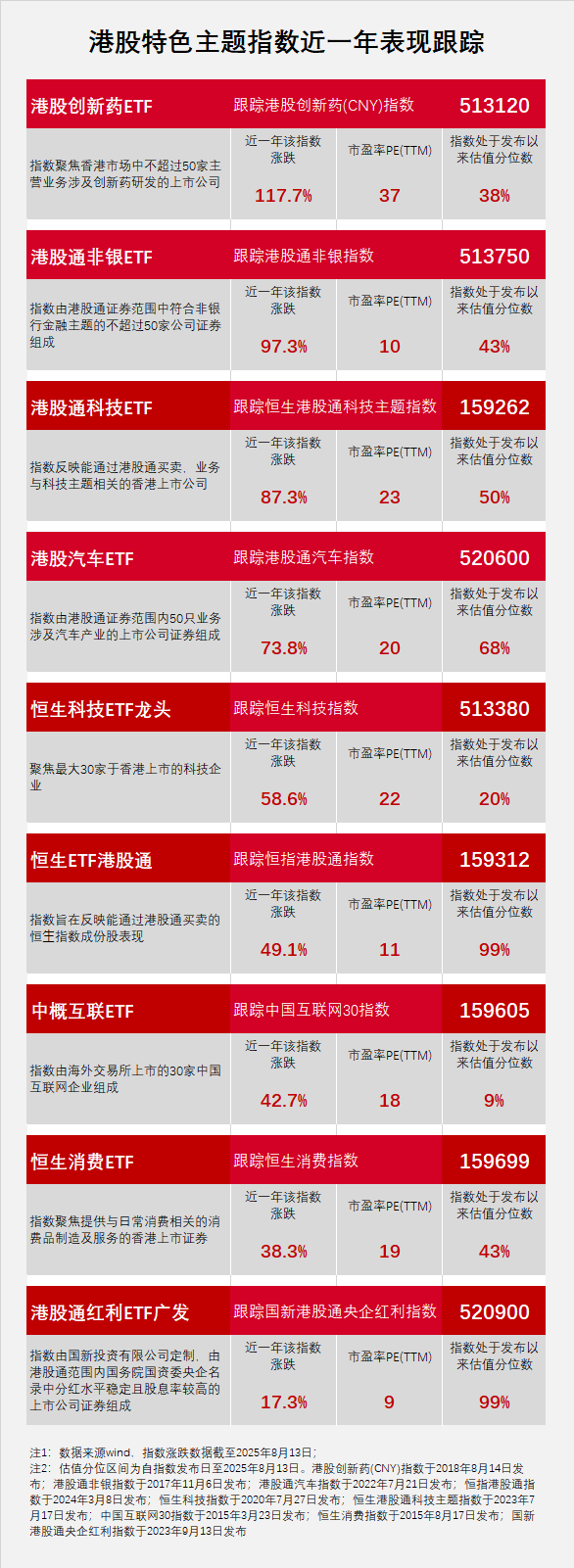
Core Viewpoint - The Hong Kong stock market continues its strong performance, with the Hang Seng Index rising by 2.58%, driven by positive market sentiment and significant inflows into various ETFs managed by GF Fund [1]. Group 1: Market Performance - The Hong Kong stock market's strong performance is reflected in the gains of nine ETFs under GF Fund, with the Hong Kong Innovative Drug ETF (513120) rising over 4.26%, and several other ETFs, including the China Concept Internet ETF (159605) and the Hang Seng Technology ETF Leader (513380), also showing gains exceeding 3% [1]. - The AH premium index has dropped to around 125%, nearing historical lows, which is attributed to continuous inflows from southbound funds and the attractiveness of high-dividend assets in the Hong Kong market [1]. Group 2: Investment Strategies - Huatai Securities' Hong Kong stock strategy team recommends focusing on sectors with improving sentiment and low valuations, particularly emphasizing technology stocks [2]. - The team suggests increasing allocations to internet e-commerce leaders ahead of the mid-August reporting period for overseas Chinese stocks, particularly those with good valuation and improving sentiment [2]. Group 3: ETF Product Overview - GF Fund's range of nine Hong Kong ETFs covers key sectors such as technology, innovative drugs, non-bank financials, and new consumption, catering to investors' needs for capturing market trends [3]. - The Hong Kong Innovative Drug ETF (513120) is the largest in the market, with a scale exceeding 18 billion, and has delivered over 100% returns this year [2]. - The Hong Kong Non-Bank ETF (513750) has also seen significant inflows, with a scale surpassing 13.7 billion, allowing for efficient investment in quality non-bank assets [2].

浙商银行,突遭举牌!
券商中国· 2025-08-12 23:31
Core Viewpoint - Insurance capital is increasingly investing in bank stocks, particularly those with high dividend yields, as evidenced by multiple insurance companies acquiring significant stakes in various banks, including Zheshang Bank [1][10]. Group 1: Insurance Capital Involvement - Minsheng Insurance increased its stake in Zheshang Bank by acquiring 1 million H-shares on August 11, reaching a 5% ownership threshold that triggered a mandatory disclosure [1][3][4]. - A total of 7 banks have been targeted by insurance capital this year, with China Merchants Bank being the only one to have been targeted three times [1][10]. - Other insurance companies, such as Baidian Life and Taiping Life, have also increased their holdings in Zheshang Bank, indicating a trend of insurance capital favoring stable, high-dividend bank stocks [7][14]. Group 2: Zheshang Bank Overview - Zheshang Bank, established in 2004, has total assets of approximately 3.44 trillion yuan as of March 2023 [5]. - The bank has distributed a total cash dividend of 13.254 billion yuan over the last three fiscal years, with annual cash dividend ratios exceeding 30% [8]. Group 3: Market Trends and Analysis - The trend of insurance capital acquiring bank stocks is driven by factors such as the search for stable returns in a low-interest-rate environment and the appeal of high dividend yields [14][15]. - The banking sector has seen significant stock price increases, with A-shares and H-shares of Zheshang Bank rising approximately 21.8% and 33% respectively this year [8].

3600点之上,一家基金公司自购2.3亿!
Sou Hu Cai Jing· 2025-08-12 17:21
Group 1 - A fund company announced on August 11 that it purchased no less than 230 million in its index funds, indicating strong confidence in the market despite the index being at 3600 points [1] - The market showed significant strength with a notable rise in the stock of Cambrian, which hit the daily limit due to increased procurement volume for the second half of the year, boosting market sentiment [3] - The announcement of a 90-day delay on tariffs by Trump has positively impacted market expectations, reinforcing the notion of a bullish trend supported by fundamental factors [3] Group 2 - The current market environment is characterized by ample liquidity due to the Federal Reserve's interest rate cuts and domestic policies aimed at expanding credit and stimulating domestic demand, which is expected to attract external capital into the A-share market [5] - The positive shift in domestic technology narratives suggests that A-shares still offer investment value, enhancing the potential for profit in the current market cycle [5]

业绩比较基准集中下调 低利率时代理财产品如何突围
Xin Hua Wang· 2025-08-12 06:11
中国证券报记者梳理发现,民生理财、招银理财、华夏理财、中银理财等理财公司近期密集发布下 调理财产品业绩比较基准的公告,部分产品下调幅度超100个基点。 理财产品业绩比较基准下调与其底层资产收益率走低密切相关。在当前低利率环境下,理财公司适时调 降业绩比较基准,可避免理财产品实际收益率与业绩比较基准偏离过大的问题,及时调整投资者收益预 期。 展望2025年,业内人士认为,资产荒料持续,在适度宽松的货币政策下,低利率环境难言完结。为应对 债市波动,不少理财公司调整产品底层资产投资策略,加强投资者预期管理;同时,加强投研能力建 设,积极布局权益市场,为投资者提供更加多元的投资选择。 加强投资者预期管理 近日,多家理财公司密集发布下调理财产品业绩比较基准的公告。例如,1月13日,民生理财发布公告 称,根据理财合同约定及当前市场情况,决定自下一投资周期(2025年1月15日开放日后)起,将"民生 理财贵竹慧赢添利固收增强半年定开1号理财产品"的业绩比较基准调整为2.7%-3.1%,较此前下调10个 基点。 又如,招银理财1月6日宣布,根据理财产品合同约定,该公司发行的"招睿卓远系列一年定开9号增强型 固定收益类理财计划 ...
为何险资偏爱银行股?机构解读未来增持空间
Huan Qiu Wang· 2025-08-12 04:35
Core Viewpoint - The insurance capital's adjustment in stock market investments, particularly the increased allocation to bank stocks, has garnered significant market attention, with a notable year-on-year growth in investments [1][3]. Group 1: Investment Trends - As of the end of Q1 2025, life and property insurance companies have collectively invested 2.82 trillion in the stock market, representing a 44.5% year-on-year increase and a 19.5 percentage point rise compared to the end of 2024 [1]. - Insurance companies show a strong preference for high-dividend stocks, particularly in the banking sector, which is evident in their investment strategies [3]. Group 2: Investment Structure - The OCI (Other Comprehensive Income) account has become increasingly important as a vehicle for equity allocation by insurance capital [3]. - The focus of insurance capital's stock investments is primarily on high-dividend sectors, with bank stocks being a significant target for recent capital increases [3]. Group 3: Market Analysis - The banking sector is favored due to its high dividend yield of 3.73% as of August 5, combined with stable dividends and sound operational characteristics, making it an attractive investment option [3]. - Bank stocks are currently undervalued at a price-to-earnings ratio of 0.77x, which is significantly lower than other high-dividend sectors like coal and oil [3]. Group 4: Future Projections - Forecasts suggest that insurance capital will bring an additional 1,404 billion and 737 billion to bank stocks in 2025, with a projected 29% increase in incremental funds compared to 2024 [4]. - Long-term investments in bank stocks are viewed as a necessary strategy, with expectations of continued support from favorable funding conditions, stable fundamentals, and ongoing policy catalysts [4].

债市周观察:股市上涨对债市仍有压制,十年期国债重回1.7以上
Great Wall Securities· 2025-08-12 02:45
Report Industry Investment Rating - No information provided on the industry investment rating [1][2] Core Viewpoints - The short - term fluctuations caused by current policies are constrained within the interest rate central framework, and the bond market will return to the fundamentals in the medium term after short - term negative shocks [2][19] - In the context of continued loose funding, the bond market is expected to maintain an oscillation range of 1.65% - 1.75%. A decline below 1.65% or a new low requires a substantial domestic interest rate cut, so whether the Fed cuts interest rates in September is an important variable [2][19] Summary by Directory 1. Interest Rate Bond Last Week's Data Review - **Funding Rates**: DR001 remained at around 1.31% with a 1BP weekly fluctuation; R001 was around 1.35% and closed at 1.34% on August 8th with a 1BP weekly fluctuation. DR007 fell 2BP from 1.45% on August 4th to 1.43% on August 8th; FR007 dropped from 1.48% to 1.46% with a 2BP weekly decline [7] - **Open Market Operations**: The central bank's reverse - repurchase injection volume shrank to 1126.7 billion yuan, with a total maturity of 1660 billion yuan, resulting in a net capital injection of - 536.5 billion yuan [7] - **Sino - US Market Interest Rates**: The inversion of the 10 - year bond yield spread between China and the US slightly increased. The 6 - month SOFR rate in the US dropped from 4.10% on August 4th to 4.06% on August 8th, while the 6 - month SHIBOR rate in China remained stable at 1.61%. As of August 8th, the 6 - month interest rate spread was - 245BP with a slightly reduced inversion. The 2 - year and 10 - year bond yield spreads were - 236BP and - 258BP respectively, with a slightly increased inversion in the short - and long - term spreads [13] - **Term Spreads**: The term spreads of Chinese bonds and US bonds both slightly expanded. The 10 - 2 year spread of Chinese bonds increased from 28BP to 29BP; the 10 - 2 year spread of US bonds expanded by 1BP to 51BP [15] - **Interest Rate Term Structure**: The yield curve of Chinese bonds shifted downward by about 2BP - 3BP; the yield curve of US bonds flattened, with most maturities rising except for the 3 - month maturity, and the mid - term callback was relatively large [15] 2. Narrowing of CPI and PPI Month - on - Month Declines - **CPI**: In July, the year - on - year CPI was flat, down 0.1 percentage points from the previous month. The food item of CPI was - 1.6% year - on - year, down 1.3 percentage points from the previous month, while the non - food item was 0.3% year - on - year, up 0.3 percentage points from the previous month. The core CPI increased by 0.8% year - on - year, with the growth rate expanding for three consecutive months. The month - on - month CPI rose from - 0.1% to 0.4%, the highest since February this year. Service consumption, driven by the summer tourism season, had a significant month - on - month increase [20][21] - **PPI**: In July, the year - on - year decline of PPI remained at 3.6%, and the month - on - month decline narrowed by 0.2 percentage points to - 0.2%, the first narrowing since March this year. The narrowing of PPI month - on - month mainly relied on the recovery of producer goods ex - factory prices. The month - on - month decline in prices of multiple industries narrowed, which was consistent with the increase in commodity prices [28] 3. Key Bond Market Events Last Week - **US Employment Data and Fed Rate - Cut Probability**: The US non - farm payrolls in July increased by 73,000, lower than the expected 110,000, and the unemployment rate was 4.2%. The poor employment data increased the probability of a Fed rate cut in September [30] - **Bond Market Underwriting Regulations**: On August 7th, a notice on strengthening self - discipline management of bond underwriting quotes in the inter - bank bond market was issued, stating that lead underwriters should not bid for bond projects with underwriting fees below cost [32]
什么信号?又要征税了!
Sou Hu Cai Jing· 2025-08-11 01:45
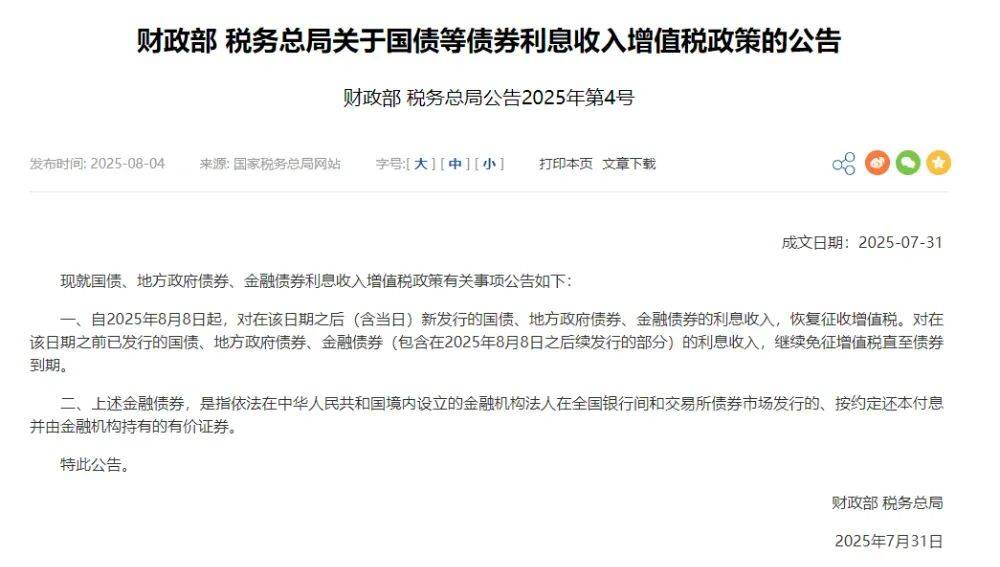
Core Viewpoint - The Chinese government will reinstate value-added tax (VAT) on interest income from newly issued government bonds, local government bonds, and financial bonds starting from August 8, 2025, while existing bonds issued before this date will remain exempt from VAT until maturity [1][3]. Group 1: Tax Policy Changes - The VAT rates are set at 6% for financial institutions (e.g., banks, insurance companies) and 3% for asset management products (e.g., public funds, brokerage asset management) [3][4]. - For example, a newly issued 1 million yuan 10-year government bond with a coupon rate of 1.7% will yield an annual interest of 17,000 yuan, leading to a tax liability of 1,020 yuan for banks and 510 yuan for public funds [4][6]. Group 2: Impact on Different Investors - The policy primarily affects institutional investors, particularly banks, which hold 70% of government debt, as they will face increased tax burdens [6][7]. - Individual investors, whose monthly interest income from government bonds is below the 100,000 yuan tax exemption threshold, will not be affected by the VAT [6][8]. Group 3: Rationale Behind the Policy - The reinstatement of VAT is aimed at addressing the overheating of the bond market, which has grown from 63 trillion yuan to 183 trillion yuan over the past decade, and to restore fairness between interest-bearing bonds and credit bonds [7][8]. - The government is also facing rising fiscal pressures, particularly due to declining land sale revenues, necessitating new tax revenues, which could amount to 34 billion yuan in the short term and potentially reach 100 billion yuan annually in the long term [7][8]. Group 4: Economic Implications - The tax on bond interest is seen as a mechanism to encourage funds to flow out of low-risk assets like government bonds and into equities, real estate, and consumption, thereby stimulating the economy [8][9]. - The policy signals potential future tax reforms, including the introduction of inheritance tax, capital gains tax, and property tax, as part of broader fiscal strategies [8][12].