
息差

Search documents
江苏银行(600919):非信贷资产高增 资产质量稳健
Xin Lang Cai Jing· 2025-08-24 06:31
Core Viewpoint - Jiangsu Bank's H1 2025 performance shows steady growth in operating income, pre-provision operating profit (PPOP), and net profit attributable to shareholders, with year-on-year growth rates of 7.78%, 7.89%, and 8.05% respectively, indicating stable performance despite slight fluctuations compared to Q1 2025 [1] Group 1: Performance Highlights - The bank's interest-earning assets grew by 30.51% year-on-year by the end of H1 2025, further increasing by 2.69 percentage points from Q1 2025 [1] - Non-loan assets are the main driver of balance sheet expansion, with investment assets and interbank assets growing by 35.79% and 67.40% respectively, showing significant quarter-on-quarter increases [2] - The loan portfolio increased by 18.33% year-on-year, maintaining a high growth rate despite a slight quarter-on-quarter decline of 0.49% [2] - Interest-bearing liabilities grew by 27.87% year-on-year, with deposits increasing by 21.63%, reflecting strong growth on the liability side [2] Group 2: Income and Asset Quality - Non-interest income showed signs of recovery, with a year-on-year decline of 20.1% in other non-interest income, although the rate of decline narrowed in Q2 2025 due to a recovery in the bond market [2] - The bank's asset quality remains robust, with a non-performing loan ratio of 0.84% at the end of H1 2025, a decrease of 2 basis points from the previous quarter [2] - The provision coverage ratio stood at 331.02%, indicating sufficient provisions despite a quarter-on-quarter decline of 12.49 percentage points [2] Group 3: Risks and Opportunities - The net interest margin decreased by 19 basis points to 1.61% in Q2 2025, primarily due to a decline in the yield on interest-earning assets [3] - The growth rate of risk-weighted assets was 18.73%, which may impact the sustainability of internal capital growth, as the annualized ROE growth rate was only 10.71% [3] - The bank's strong fundamentals, high dividend yield, and resilience in performance position it as an attractive investment opportunity, especially in a favorable policy environment [3]

江苏银行(600919):营收和不良改善
Xin Lang Cai Jing· 2025-08-23 06:29
Core Viewpoint - Jiangsu Bank maintains high growth in performance, with a sequential decline in interest margin and improvement in asset quality [1] Financial Performance Overview - In H1 2025, Jiangsu Bank's revenue and net profit attributable to shareholders increased by 7.8% and 8.0% year-on-year, respectively, with sequential growth rates improving by 1.6 percentage points and declining by 0.1 percentage points [2] - As of the end of Q2 2025, the non-performing loan (NPL) ratio decreased by 2 basis points to 0.84%, while the provision coverage ratio fell by 12 percentage points to 331% [2] Revenue and Profit Growth - Jiangsu Bank's revenue and profit growth rates in H1 2025 remained in the single digits, aligning with market expectations. The revenue growth improved compared to Q1 2025, primarily due to a reduction in the drag from other non-interest income, while net interest income continued to grow significantly [3] - Other non-interest income decreased by 20% year-on-year, with the decline narrowing by 13 percentage points compared to Q1 2025. Net interest income grew by 19% year-on-year, with a slowdown of 3 percentage points compared to Q1 2025 [3] - The bank's tax expenses significantly decreased year-on-year, offsetting the increased impairment losses, mainly due to enhanced recovery and disposal of non-performing assets [3] - For the full year, revenue and profit growth are expected to maintain single-digit increases, supported by strong loan growth in the first half and potential gains from bond investments [3] Interest Margin Analysis - In Q2 2025, Jiangsu Bank's interest margin declined by 18 basis points to 1.62%, with asset yield decreasing more than the cost of liabilities [4] - The asset yield fell by 26 basis points to 3.49%, influenced by lower loan and bond market rates, with respective declines of 17 basis points and 31 basis points compared to H2 2024 [4] - The cost of liabilities decreased by 9 basis points to 1.83%, continuing the downward trend due to the maturity of high-interest deposits and the renewal of interbank liabilities [4] - The costs of deposits, bond issuance, and interbank liabilities decreased by 24 basis points, 20 basis points, and 20 basis points, respectively, compared to H2 2024 [4] - Future interest margin declines are expected to narrow as loan and deposit declines are roughly matched [4] Asset Quality Improvement - Key risk indicators improved in Q2 2025, with the NPL ratio, attention rate, and overdue rate decreasing by 2 basis points, 9 basis points, and 1 basis point to 0.84%, 1.24%, and 1.10%, respectively [5] - The NPL generation rate in H1 2025 decreased by 37 basis points to 1.34% compared to 2024 [5] - By product type, the NPL ratios for corporate and retail loans decreased by 9 basis points and 1 basis point to 0.88% and 0.87%, respectively [5] - The provision coverage ratio fell by 12 percentage points to 331%, with impairment amounts slightly lower than the NPL generation [5] Profit Forecast and Valuation - Jiangsu Bank's net profit attributable to shareholders is projected to grow by 8.40%, 7.79%, and 6.83% for 2025-2027, with corresponding book values per share of 14.36, 15.74, and 17.21 yuan [6] - The current price corresponds to a price-to-book (PB) ratio of 0.78, 0.71, and 0.65 for 2025-2027. The target price is set at 14.16 yuan per share, corresponding to a PB of 0.99 for 2025, indicating a potential upside of 27% [6]
常熟银行(601128):中期分红超预期,结构提“质”更见效
Shenwan Hongyuan Securities· 2025-08-08 06:19
Investment Rating - The report maintains a "Buy" rating for Changshu Bank, with a projected price-to-book (PB) ratio of 0.74 times for 2025 [11]. Core Insights - Changshu Bank reported a revenue of 6.06 billion yuan for the first half of 2025, reflecting a year-on-year growth of 10.1%, while the net profit attributable to shareholders reached 1.97 billion yuan, up 13.5% year-on-year [4][7]. - The bank's non-performing loan (NPL) ratio remained stable at 0.76%, with a provision coverage ratio of approximately 490% [4][11]. - The bank has adopted a strategy focusing on smaller loans and credit, with 70% of new loans in the first half of 2025 being below 10 million yuan [5][7]. Financial Performance - For the first half of 2025, the bank's net interest income was 4.64 billion yuan, showing a slight increase of 0.8% year-on-year, while non-interest income surged by 57% [7][13]. - The bank's total loans reached 251.47 billion yuan, with a growth rate of 5.2% compared to the previous year [13]. - The bank's cost-to-income ratio improved to 34.56%, down from 36.87% in 2023, indicating better operational efficiency [13]. Dividend Policy - Changshu Bank announced an interim dividend of 0.15 yuan per share, representing a payout ratio of approximately 25.3%, which is an increase from 19.8% in 2024 [7][11]. Loan and Deposit Structure - The bank's loan growth slowed to 5.2% in the second quarter of 2025, with a significant portion of new loans being smaller in size [5][10]. - Deposit growth remained robust at nearly 10%, with an increase in the proportion of demand deposits [5][7]. Asset Quality - The bank's proactive measures in asset management have led to a stable NPL generation rate of 1.05% for the first half of 2025, with significant recoveries from previously written-off loans [11][12]. - The bank's asset quality remains strong, with a focus on managing risks associated with personal business loans [11].

对银行股的三点看法
Zheng Quan Shi Bao· 2025-07-12 07:20
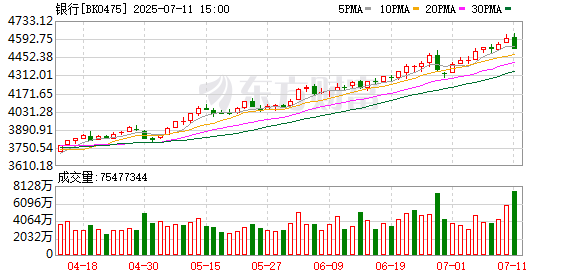
Core Viewpoint - The recent significant rise in the banking sector does not provide a straightforward investment conclusion, as the market is complex and influenced by various factors [2]. Short-term Gains Not a Decision Basis - Short-term price increases can affect public opinion but should not be the basis for investment decisions. Historical examples show that prices can continue to rise or fall dramatically after a short-term surge [4]. Need for Improvement in Interest Margins - Despite low bad debt rates and high capital adequacy ratios, the banking sector faces risks from low interest margins, which are at historically low levels. Improvement in these margins is tied to the overall economic recovery [6][7]. Valuation Considerations - The lowest valuations for the banking sector have passed, with current valuations still not high. The relative attractiveness of bank stocks is decreasing as prices rise, especially considering high leverage and potential bad debt risks [9]. Differences Among Banks - There are significant differences in operational performance and valuation among banks. Investors should consider various factors such as bad debt generation, net interest margin changes, asset composition, capital adequacy, and management quality when evaluating banks [11].

东海证券晨会纪要-20250616
Donghai Securities· 2025-06-16 07:49
Group 1 - Government financing continues to support social financing, with M1 growth improving. As of the end of May, the social financing scale increased by 8.7% year-on-year, while M2 and M1 grew by 7.9% and 2.3% respectively [5][6][7] - The new corporate medium and long-term loans decreased by 1,700 million yuan year-on-year, reflecting the substitution effect of government debt and corporate bonds [6][7] - The government issued 14,633 million yuan in new government bonds in May, which is an increase of 2,367 million yuan compared to the same period last year, supporting a rapid growth in social financing [7][8] Group 2 - Global asset review indicates that the stock market mostly declined, while crude oil prices rebounded significantly due to geopolitical tensions in the Middle East [12][13] - Brent crude oil prices surged over 7% on June 13, with concerns about supply disruptions from Iran potentially affecting global oil production [14] - The domestic equity market saw a decline, with the Shanghai Composite Index falling by 0.75% to 3,377 points, and the Shenzhen Component Index and ChiNext also experiencing losses [19][20] Group 3 - The report highlights the importance of focusing on stable dividends and recovery potential in investment strategies, particularly in state-owned banks and leading small and medium-sized banks [11] - The report suggests that the overall asset quality remains stable, despite the need for further confirmation regarding retail asset risks [11][22] - The report emphasizes the need for a balanced approach in credit issuance, focusing on both total volume and structural optimization to support consumption and innovation [7][11]
2025年一季度商业银行主要监管指标点评:盈利维持稳定,基本面韧性强
EBSCN· 2025-05-18 11:13
Investment Rating - The report maintains a "Buy" rating for the banking industry, indicating a projected investment return exceeding the market benchmark index by more than 15% over the next 6-12 months [1]. Core Insights - The banking sector demonstrates strong resilience in fundamentals, with stable profitability and asset quality. In Q1 2025, commercial banks achieved a net profit of 656.8 billion, with a year-on-year profit growth decline of 2.3% [4][5]. - The report highlights that the decline in profit growth is consistent with the previous year, with non-interest income contributing 25% to total revenue, an increase of 2.5 percentage points compared to 2024 [5][6]. - The report emphasizes the stability of asset quality, with a non-performing loan (NPL) ratio of 1.51%, slightly up by 1 basis point from the end of the previous year [23][24]. Summary by Sections Profitability and Revenue - In Q1 2025, the profitability of commercial banks decreased by 2.3%, with state-owned banks showing a profit growth of 0.1%, while joint-stock banks, city commercial banks, and rural commercial banks experienced declines of 4.5%, 6.7%, and 2% respectively [5][7]. - The report notes that the net interest margin (NIM) narrowed to 1.43%, down 9 basis points year-on-year, with state-owned banks having a NIM of 1.33% [15][18]. Credit and Asset Quality - The report indicates that credit issuance remains strong, with total assets of commercial banks growing at a rate of 7.2% year-on-year. New loans and non-credit assets increased by 9.1 trillion and 4.6 trillion respectively [8][9]. - The NPL ratio remains stable at 1.51%, with a provision coverage ratio above 200%, indicating a robust capacity to absorb potential losses [23][24]. Capital Adequacy - As of Q1 2025, the risk-weighted assets (RWA) of commercial banks grew by 6.4%, leading to a slight decline in capital adequacy ratios across various bank types [29][30]. - The core Tier 1 capital adequacy ratio for commercial banks stands at 10.7%, reflecting a decrease from the previous year [29]. Investment Recommendations - The report suggests focusing on banks with strong fundamentals and high dividend yields, particularly large state-owned banks, which exhibit solid investment value due to their high dividend rates [31][44]. - It also highlights the potential of mid-sized banks with convertible bonds, which have shown strong performance recently [44][46].
银行2024年年报与2025年一季报综述:重定价冲击叠加债市震荡,25Q1业绩承压
China Post Securities· 2025-05-16 02:16
Industry Investment Rating - The industry investment rating is maintained at "Outperform the Market" [1] Core Viewpoints - The report highlights that the overall operating income, pre-provision profit, and net profit attributable to shareholders of listed banks for 2024 are expected to grow at rates of 0.08%, -0.72%, and 2.35% respectively. In Q1 2025, these growth rates are projected to decline to -1.72%, -2.15%, and -1.20%, indicating a downward trend in performance due to the impact of interest rate adjustments and market fluctuations [3][10][13] - The report emphasizes that the non-interest income growth of banks has slowed down due to market volatility, which has affected trading positions and overall performance [4][10] - The asset quality of listed banks is showing slight improvement, with the non-performing loan ratio decreasing from 1.24% in 2024 to 1.23% in Q1 2025, and the overall provision coverage ratio remaining stable around 239.91% in 2024 and 237.92% in Q1 2025 [4][10][13] Summary by Sections 1. Impact of Repricing and Market Fluctuations - The report notes that the combination of repricing impacts and market volatility has led to a decline in performance for Q1 2025, with significant drops in revenue and profit growth rates compared to 2024 [3][10] - The performance of city commercial banks has been notably better than other types of banks, with positive revenue growth in both 2024 and Q1 2025 [10][13] 2. Growth of Interest-Generating Assets - The growth rate of interest-generating assets for listed banks was 0.44% in 2024, with a slight increase to 0.79% in Q1 2025. However, the growth in deposits remained stable at 5.59% in 2024 and 6.22% in Q1 2025 [4][10] 3. Interest Margin Performance - The report indicates that both the yield on interest-generating assets and the cost of interest-bearing liabilities have decreased significantly in Q1 2025, affecting the interest margin performance across banks [4][10] 4. Non-Interest Income Growth - Non-interest income growth for listed banks was 6.71% in 2024, but it fell to -1.87% in Q1 2025, primarily due to the impact of market conditions on fee income and other non-interest revenues [4][10] 5. Asset Quality Improvement - The report highlights a slight improvement in asset quality, with a marginal decrease in the non-performing loan ratio and stable provision coverage ratios, indicating a cautious but positive trend in credit quality [4][10][13] 6. Investment Recommendations - The report suggests focusing on major state-owned banks such as Industrial and Commercial Bank of China, China Construction Bank, and Bank of Communications, as well as regional banks like Chongqing Bank and Chengdu Bank, which may benefit from supportive fiscal policies [5][10]




工商银行(601398):公司简评报告:息差和中间业务收入压力或趋于平缓
Donghai Securities· 2025-05-13 10:22
Investment Rating - The report maintains an "Overweight" rating for the company [1] Core Views - The company reported a Q1 2025 revenue of 212.77 billion yuan, a decrease of 3.22% year-on-year, and a net profit attributable to shareholders of 84.16 billion yuan, down 3.99% year-on-year [2] - Total assets at the end of Q1 stood at 51.55 trillion yuan, reflecting an increase of 8.29% year-on-year, with a non-performing loan ratio of 1.33%, down 1 basis point quarter-on-quarter [2] - The net interest margin for Q1 was 1.33%, a decline of 15 basis points year-on-year [2] Summary by Sections Financial Performance - Q1 2025 revenue decreased by 3.22% year-on-year to 2127.74 billion yuan, with net profit down 3.99% to 841.56 billion yuan [2] - Total assets increased by 8.29% year-on-year to 51.55 trillion yuan, with a non-performing loan ratio of 1.33% [2] Loan and Deposit Growth - Government financing has driven growth in investment assets, while loan growth has slightly slowed due to demand factors [6] - Deposit growth has shown a slight recovery, influenced by macroeconomic policies [6] Interest Margin and Income - The net interest margin for Q1 was 1.33%, reflecting a decline due to repricing effects [6] - Fee and commission income has seen a narrowing decline, with potential for recovery in the upcoming quarters [6] Asset Quality - The overall asset quality remains stable, with a non-performing loan ratio of 1.33% at the end of 2024 [7] - Individual loan risks are expected to be manageable, supported by a solid customer base and prudent risk management [7] Earnings Forecast and Investment Recommendation - The company is expected to maintain stable operations despite rising pressures, with projected revenues of 817.5 billion yuan, 833 billion yuan, and 880.2 billion yuan for 2025, 2026, and 2027 respectively [8] - The report maintains an "Overweight" rating based on the company's strong customer base, diversified business, and stable dividend policy [8]
杭州银行(600926):利息加速,息差企稳,利润持续高增长
Changjiang Securities· 2025-05-05 03:12
Investment Rating - The investment rating for Hangzhou Bank is "Buy" and is maintained [9]. Core Views - Hangzhou Bank's Q1 2025 revenue growth is 2.2%, with a net profit growth of 17.3% and net interest income growth of 6.8%. The bank's loan and deposit growth is strong, with loans increasing by 6.2% and deposits by 6.0% compared to the beginning of the year. It is expected that the credit growth will continue to maintain double-digit growth throughout the year. The non-performing loan ratio remains stable at 0.76%, and the coverage ratio is at 530%, indicating strong asset quality [2][6]. Summary by Sections Financial Performance - In Q1 2025, Hangzhou Bank's net interest income increased by 6.8%, driven by stable net interest margins and strong balance sheet expansion. Non-interest income decreased by 5.4% year-on-year, primarily due to a high base from the previous year and fluctuations in the bond market, which led to an 18.0% decline in investment income. However, fee income grew by 22.2% [12][20]. Scale and Growth - Total assets grew by 5.2% compared to the beginning of the year, with loans increasing by 6.2%. Corporate loans grew by 9.7%, supported by strong infrastructure demand in developed regions. Retail loans saw a slight decline of 1.3%, but mortgage lending is expected to continue its recovery throughout the year. Deposits increased by 6.0%, with corporate deposits growing by 6.6% and retail deposits by 6.5% [12][20]. Interest Margin - The cost of liabilities continues to improve, alleviating downward pressure on interest margins. The net interest margin for the full year 2024 is expected to be 1.41%, with a stable trend observed since Q4. The cost of deposits is projected to decline by 15 basis points year-on-year, contributing to the expected growth in net interest income [12][20]. Asset Quality - The bank maintains excellent asset quality, with a non-performing loan ratio stable at 0.76% and a coverage ratio of 530%. The net generation rate of non-performing loans for 2024 is expected to be 0.80%, reflecting retail risk fluctuations, but remains at a good level compared to peers. The bank's low exposure to internet loans and partnerships with leading institutions suggest manageable risk levels [12][20]. Investment Recommendation - The bank's performance is expected to maintain high-quality growth, with current valuations significantly undervalued. The projected dividend per share (DPS) is expected to grow by 25% year-on-year, and the compound dividend yield over the next three years is anticipated to lead the industry. The stock price is close to the convertible bond redemption price, indicating potential upward valuation after the bond is absorbed [12][20].

邮储银行(601658):信贷增速领跑,关注优化结构、夯实拨备成效
Shenwan Hongyuan Securities· 2025-04-30 14:41
Investment Rating - The report maintains a "Buy" rating for Postal Savings Bank of China (601658) [1] Core Views - The bank's revenue for Q1 2025 decreased by 0.1% year-on-year, with net profit declining by 2.6% [6] - The non-performing loan (NPL) ratio increased slightly to 0.91%, while the provision coverage ratio fell to 266% [6] - The bank's loan growth outpaced major state-owned banks, with a year-on-year increase of 9.8% in Q1 2025 [6] - The net interest margin (NIM) decreased to 1.71%, reflecting ongoing pressure on interest rates [6] - The report anticipates a modest recovery in profitability, projecting net profit growth rates of 1.45%, 4.15%, and 6.72% for 2025, 2026, and 2027 respectively [6] Financial Data and Earnings Forecast - Q1 2025 revenue was 893.6 billion yuan, with a net profit of 252.5 billion yuan [4] - The bank's total loans reached 9,356.2 billion yuan, with total deposits at 15,976.5 billion yuan [10] - The forecast for total operating income is 351,263.09 million yuan for 2025, with a projected year-on-year growth rate of 0.71% [5] - The bank's return on equity (ROE) is projected to decline to 9.49% in 2025 [5] - The price-to-book (PB) ratio is currently at 0.57, with a projected dividend yield of 5.1% for 2025 [6]
