成长股

Search documents
A股上涨空间仍在,瑞银最新展望!海外投资者态度越发积极
券商中国· 2025-09-04 23:33
Core Viewpoint - Investor confidence in Chinese assets is increasing, with a notable rise in overseas investors' willingness to allocate to non-USD assets, particularly Chinese assets, indicating a potentially strong year for Chinese assets [1][4]. Group 1: Foreign Investment Trends - As of June, the scale of foreign investors' holdings in A-shares exceeded 3 trillion RMB, accounting for 7.4% of the total free float market capitalization of A-shares [1]. - The number of overseas investors from the US and the Middle East attending the A-share seminar has significantly increased compared to previous years, reflecting a growing interest in Chinese assets [1]. - The growth of ETFs and new programmatic trading rules has led to increased attention from trading-type foreign capital towards the Chinese market, while allocation-type and investment-type foreign capital remain cautious, focusing on the sustainability of fundamental policies [3]. Group 2: Economic and Market Conditions - Since September of last year, overseas investors have become more positive about China, supported by domestic policies providing bottom protection for A-shares and the emergence of new economic sectors [4]. - The current global interest rate cut expectations and low domestic interest rates create a favorable liquidity environment for capital inflow into the Chinese stock market [3]. - A-shares are expected to maintain an upward trend due to continuous economic policy support and a clearer external environment, with high-quality companies likely to stand out in the new economic development cycle [4]. Group 3: Market Dynamics and Performance - The narrative of building an investor-centric financial market in A-shares has been realized, with a slow bull market expected to continue [6]. - The current market rally is largely driven by liquidity rather than corporate earnings changes, indicating that the shift of household financial assets is just beginning [6]. - Growth stocks are favored for investment in the second half of the year, with expectations of better performance for small-cap stocks, although the marginal difference compared to large-cap stocks may not be as pronounced as in the first half [6][7]. Group 4: Profitability and Valuation - A-share profitability is expected to improve significantly this year, with an estimated growth rate of around 6% for the full year, driven by a base effect and recovery in earnings [9]. - Despite the rebound in market valuations, the decline in government bond yields is likely to push A-share valuations higher, as A-shares remain relatively attractive compared to global markets [9]. - The technology sector's performance is supported by policy backing and changing industry trends, with further room for growth in valuations as more fundamental improvements and earnings recoveries occur [9][10].


创业板指站上2900点,如何判断入场时机?
Zheng Quan Zhi Xing· 2025-09-01 07:29
Core Viewpoint - The A-share market, particularly the ChiNext index, has shown strong performance, with the ChiNext index rising over 2% and maintaining above 2900 points, reflecting a significant recovery and growth trend in the market [2][3]. Group 1: Market Performance - The ChiNext index has outperformed the broader market by 50% over the past year, with a nearly 90% increase, supported by favorable macroeconomic and industrial policies, as well as a significant recovery in certain sectors [3][5]. - The recent performance of the ChiNext index is attributed to three main factors: a dovish shift from the Federal Reserve, supportive policies for high-growth sectors, and positive market sentiment driven by themes like domestic substitution and AI [5][6]. Group 2: Valuation Metrics - The current Buffett indicator, which compares the total market capitalization of A-shares to GDP, stands at approximately 84%, indicating that the market is not significantly overvalued and may still have room for growth [6][7]. - The ChiNext index's price-to-earnings (PE) ratio is at 41.61x, which is below its historical average, suggesting that it is in a relatively low valuation zone compared to other major indices [7][9]. Group 3: Investment Strategy - Investors are advised to consider gradual entry into the market rather than making large investments at once, as the market has experienced a prolonged upward trend since April [9][10]. - Setting appropriate profit-taking levels is recommended, especially for those entering the market at a later stage, to manage potential volatility [10].


半年股票持仓增加四千亿,A股上市险企这样布局资本市场
Di Yi Cai Jing· 2025-08-31 12:38
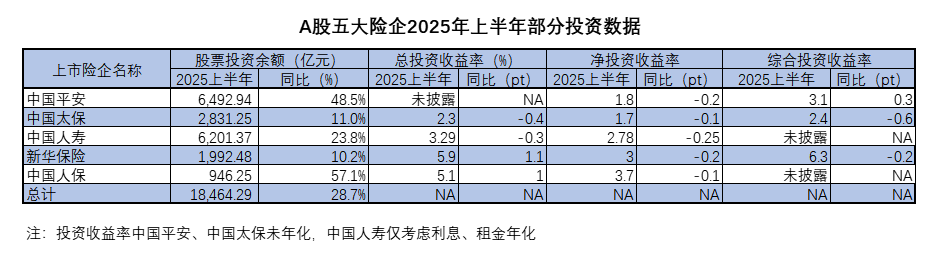
Core Viewpoint - The five major listed insurance companies in A-shares have significantly increased their stock investments, with a total increase of 411.86 billion yuan, representing a growth of 28.7% compared to the end of last year [1][6]. Group 1: Investment Performance - As of the end of the first half of the year, the total investment assets of the five A-share listed insurance companies reached 19.7 trillion yuan, an increase of 7.5% from the end of last year, accounting for 54.4% of the total insurance funds [2]. - The total investment return rates of various insurance companies showed a mixed performance, with China Pacific Insurance and China Life experiencing a year-on-year decline, while New China Life and China Reinsurance saw an increase of about 1 percentage point [4]. - The net investment return rates generally decreased by 0.1 to 0.25 percentage points, attributed to the decline in bond interest income in a low-interest-rate environment [6]. Group 2: Stock Investment Trends - The stock investment balance of the five major listed insurance companies reached 1.8 trillion yuan at the end of the first half, with an increase of 411.86 billion yuan, marking a growth of 28.7% [6]. - China Re and China Ping An saw stock investment increases of around 50%, while China Pacific Insurance and New China Life had smaller increases of 11% and 10.2%, respectively [6]. - New China Life had the highest proportion of stock investments in total investment assets at 11.6%, while China Ping An and China Pacific Insurance had lower proportions around 15% [6]. Group 3: Future Investment Strategies - Insurance companies plan to continue increasing their investments in the capital market, focusing on high-dividend stocks and growth stocks as part of their investment strategy [8][9]. - The companies expressed confidence in the capital market, citing regulatory support and favorable policies as key factors for optimism [8][9]. - The insurance companies are also participating in long-term investment pilot programs, with several funds already established to invest in stocks, focusing on companies with stable dividends and growth potential [11][12][13].



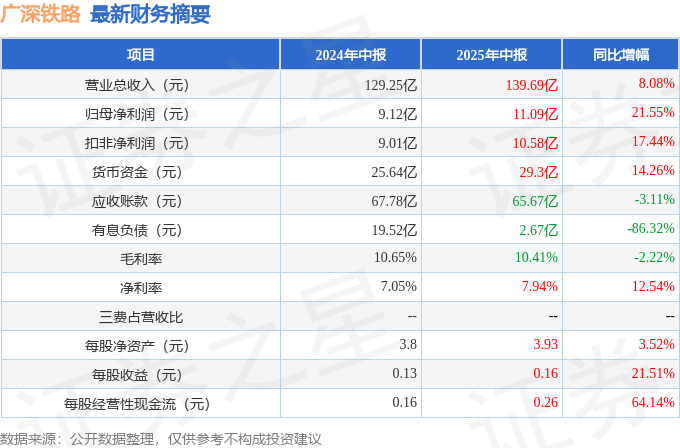
广深铁路2025年中报简析:营收净利润同比双双增长,公司应收账款体量较大
Zheng Quan Zhi Xing· 2025-08-29 22:59
Core Viewpoint - Guangshen Railway (601333) reported a strong performance in its 2025 interim report, with significant increases in revenue and net profit compared to the previous year [1][2]. Financial Performance - Total revenue for the 2025 interim period reached 13.969 billion yuan, an increase of 8.08% year-on-year [1]. - Net profit attributable to shareholders was 1.109 billion yuan, reflecting a year-on-year increase of 21.55% [1]. - In Q2 2025, total revenue was 7.073 billion yuan, up 11.84% year-on-year, while net profit for the quarter surged by 75.38% to 641 million yuan [1]. - Gross margin stood at 10.41%, down 2.22% year-on-year, while net margin improved to 7.94%, up 12.54% year-on-year [1]. - Earnings per share increased by 21.51% to 0.16 yuan, and operating cash flow per share rose by 64.14% to 0.26 yuan [1]. Financial Ratios and Metrics - The company's return on invested capital (ROIC) was 3.78%, indicating weak capital returns [2]. - The net profit margin for the previous year was 3.91%, suggesting low added value in products or services [2]. - The ratio of accounts receivable to net profit reached 619.43%, indicating a significant amount of receivables relative to profit [2]. Debt and Cash Flow - The company reported a substantial decrease in interest-bearing debt, down 86.32% to 267 million yuan [1]. - Cash assets are considered healthy, but the cash flow situation requires monitoring, with cash assets to current liabilities ratio at 62.76% [2]. Shareholder Activity - The company is held by a prominent fund manager, Xu Yan from Dachen Fund, who has recently increased his holdings [3]. - The largest fund holding Guangshen Railway is Dachen Rui Xiang Mixed A, with a total scale of 5.194 billion yuan and a recent net value increase of 0.01% [4].

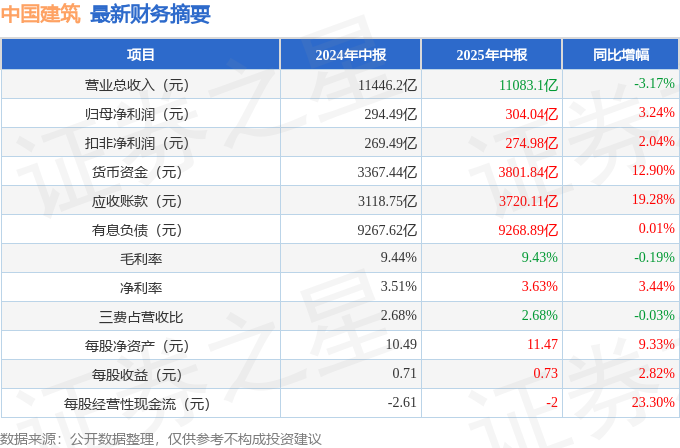
中国建筑2025年中报简析:净利润同比增长3.24%
Zheng Quan Zhi Xing· 2025-08-29 22:41
Core Viewpoint - China State Construction Engineering Corporation (CSCEC) reported a mixed performance in its 2025 interim financial results, with a slight increase in net profit but a decline in total revenue compared to the previous year [1]. Financial Performance - Total revenue for the first half of 2025 was 1,108.31 billion yuan, a decrease of 3.17% year-on-year [1]. - Net profit attributable to shareholders reached 30.404 billion yuan, reflecting a year-on-year increase of 3.24% [1]. - In Q2 2025, total revenue was 552.965 billion yuan, down 7.11% year-on-year, while net profit attributable to shareholders was 15.391 billion yuan, up 5.94% [1]. - Gross margin stood at 9.43%, a decrease of 0.19% year-on-year, while net margin improved to 3.63%, an increase of 3.44% [1]. - The company reported earnings per share of 0.73 yuan, up 2.82% year-on-year [1]. Financial Ratios and Metrics - The company's return on invested capital (ROIC) for the previous year was 5.04%, indicating a generally weak capital return [3]. - The average cash flow from operations over the past three years was 1.02 times the current liabilities, suggesting a need for attention to cash flow management [3]. - The debt ratio for interest-bearing liabilities reached 26.81%, indicating a significant level of leverage [3]. Shareholder Insights - The most notable fund manager holding shares in CSCEC is Jiang Cheng from Zhongtai Securities, who has recently increased his stake [4]. - The largest fund holding CSCEC shares is Zhongtai Xingyuan Flexible Allocation Mixed A, with a total scale of 4.645 billion yuan and a recent net value increase of 0.85% [5]. Market Expectations - Analysts project that CSCEC's performance for 2025 will reach approximately 47.622 billion yuan, with an average earnings per share forecast of 1.15 yuan [3].

创指为何近期明显跑赢大盘?这三个驱动是关键
Zheng Quan Zhi Xing· 2025-08-29 07:55
Group 1 - The A-share market is performing well, with the Shanghai Composite Index up by 0.5% and the ChiNext Index rising over 2.5%, approaching 2900 points [2] - The ChiNext Index has outperformed the broader market by nearly 50% over the past year, driven by favorable macroeconomic and industrial policies, continued liquidity, and significant recovery in certain industries [3] Group 2 - The outperformance of the ChiNext Index is attributed to three main factors: 1. The recent dovish shift by the Federal Reserve, increasing the likelihood of interest rate cuts in September, alongside a domestic downtrend in interest rates, benefiting growth stocks [5] 2. High industry sentiment in key sectors such as new energy, biomedicine, AI, and semiconductors, which are in an upward cycle with high earnings certainty [5] 3. The resonance of market sentiment and narratives around domestic substitution, AI autonomy, and anti-involution themes, leading to a rally in technology leaders and making the ChiNext Index a key emotional outlet for investors [5] Group 3 - As of the end of August 2025, the ChiNext Index's price-to-book (PB) ratio is 4.9794, with a historical percentile of 47.5% over the past 1440 trading days, meeting the buying criteria for investment [6] - Due to the recent rise in the ChiNext Index, the valuation percentile has increased rapidly, potentially affecting future buying conditions [9] - The company has set up a bi-weekly investment strategy in the low-volatility dividend index, investing 1000 yuan each period, as historical performance has been favorable [9]

国联民生(601456):并表民生证券 叠加自营实现高收益 经营业绩大幅提升
Xin Lang Cai Jing· 2025-08-29 04:28
Core Viewpoint - The company has shown significant growth in revenue and net profit, driven by the consolidation of Minsheng Securities and strong investment returns, outperforming the market index [1][2]. Financial Performance - In the first half of 2025, the company achieved a total revenue of 42.5 billion yuan, a year-on-year increase of 269.4%, with a net profit attributable to shareholders of 11.3 billion yuan, up 1185.2% [1]. - The second quarter alone saw revenue of 24.5 billion yuan, a year-on-year increase of 168.4% and a quarter-on-quarter increase of 56.7%, with net profit reaching 7.5 billion yuan, up 145.1% year-on-year and 99.7% quarter-on-quarter [1]. Brokerage and Investment Banking - The brokerage business revenue surged over 200%, with 9.0 billion yuan in revenue for the first half of 2025, a year-on-year increase of 223.8%, accounting for 22.6% of total revenue [1]. - Investment banking revenue also saw a significant increase, reaching 5.3 billion yuan, up 214.1% year-on-year, with equity underwriting totaling 13.1 billion yuan, a 160.2% increase [2]. Asset Management and Investment Returns - Asset management revenue grew steadily, reaching 3.6 billion yuan, a year-on-year increase of 14.4%, with total assets under management at 296.5 billion yuan, up 137.5% [2]. - Investment income, including fair value, reached 21.0 billion yuan, a year-on-year increase of 458.8%, with a strategy focusing on dividend value stocks and growth stocks [2]. Profit Forecast and Valuation - The company has revised its profit forecast upwards, expecting net profits of 21.6 billion yuan, 21.0 billion yuan, and 22.1 billion yuan for 2025-2027, with corresponding year-on-year growth rates of +444%, -3%, and +5% [3]. - The current market capitalization corresponds to a price-to-book (PB) ratio of 1.33x, 1.29x, and 1.25x for the respective years [3].

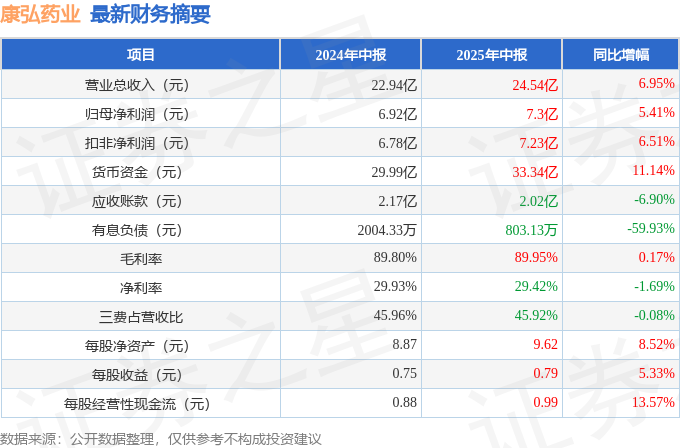
康弘药业2025年中报简析:营收净利润同比双双增长
Zheng Quan Zhi Xing· 2025-08-28 22:59
Financial Performance - The company reported a total revenue of 2.454 billion yuan for the first half of 2025, representing a year-on-year increase of 6.95% [1] - The net profit attributable to shareholders reached 730 million yuan, up 5.41% year-on-year [1] - In Q2 2025, total revenue was 1.255 billion yuan, an increase of 4.46% compared to the same quarter last year [1] - The net profit for Q2 was 330 million yuan, reflecting a year-on-year growth of 3.45% [1] Profitability Metrics - The gross profit margin stood at 89.95%, a slight increase of 0.17% year-on-year [1] - The net profit margin was 29.42%, down 1.69% year-on-year [1] - Total selling, administrative, and financial expenses amounted to 1.127 billion yuan, accounting for 45.92% of revenue, a decrease of 0.08% year-on-year [1] Asset and Liability Management - Cash and cash equivalents increased to 3.334 billion yuan, up 11.14% year-on-year [1] - Accounts receivable decreased to 202 million yuan, down 6.90% year-on-year [1] - Interest-bearing liabilities significantly reduced to 8.0313 million yuan, a decrease of 59.93% [1] Shareholder Value - Earnings per share (EPS) increased to 0.79 yuan, a rise of 5.33% year-on-year [1] - The net asset value per share reached 9.62 yuan, up 8.52% year-on-year [1] - Operating cash flow per share was 0.99 yuan, reflecting a year-on-year increase of 13.57% [1] Investment Insights - The company's return on invested capital (ROIC) was 13.53%, indicating strong capital returns [3] - The historical median ROIC since the company went public is 17.58%, with only one year of loss since its listing [3] - Analysts expect the company's performance in 2025 to reach 1.37 billion yuan, with an average EPS forecast of 1.48 yuan [3] Fund Holdings - The largest fund holding the company is Dazhong Rui Xiang Mixed A, which increased its position to 12.2538 million shares [4] - Other funds have shown varied changes in their holdings, with some increasing and others decreasing their positions [4] - The fund manager of Dazhong Rui Xiang Mixed A, Xu Yan, is recognized for expertise in value and growth stocks [4]

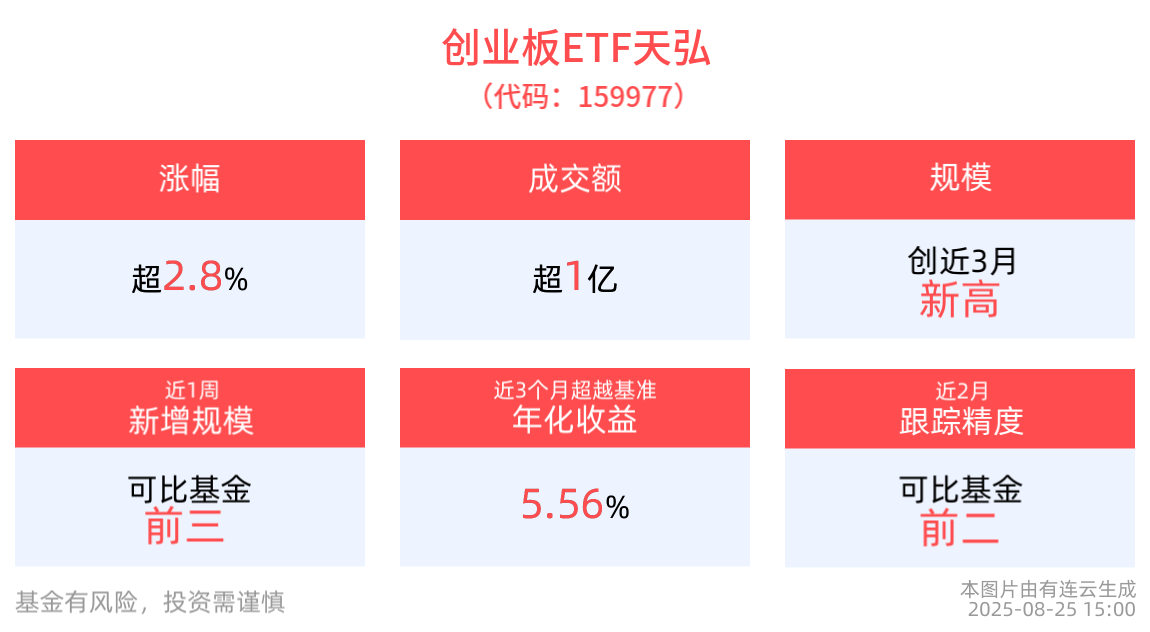
涨势如虹,王者归来!创业板ETF天弘(159977)昨日涨近3%,规模创近3月新高
Sou Hu Cai Jing· 2025-08-26 01:59
Group 1 - The core viewpoint of the articles indicates a bullish trend in the ChiNext market, driven by favorable macroeconomic conditions and strong performance in technology and healthcare sectors [3][4][5] - As of August 25, 2025, the ChiNext ETF Tianhong (159977) saw a 2.84% increase, with a trading volume of 1.03 billion yuan, while the ChiNext Index (399006) rose by 3.00% [3] - The latest scale of the ChiNext ETF Tianhong reached 9.302 billion yuan, marking a three-month high [3] - Leveraged funds are increasingly entering the market, with the latest margin buying amounting to 2.755 million yuan and a margin balance of 22.3729 million yuan [3] Group 2 - Analysts attribute the recent surge in the ChiNext to several factors, including a relatively calm global macro market and optimistic expectations for interest rate cuts by the Federal Reserve [4] - The market is witnessing a rally led by major technology stocks, particularly in the domestic chip sector, resonating with patriotic narratives [4] - Non-bank financials are also gaining strength, contributing to the index's upward momentum [4] Group 3 - The A-share market is gradually emerging from a slow bull phase, with recent trading activity confirming a bullish trend [4] - The ChiNext's price-to-earnings (PE) ratio stands at 39.39x, which is relatively low compared to historical averages, indicating potential for valuation expansion [4][5] - The expected compound annual growth rate (CAGR) for ChiNext's revenue is approximately 20% and for net profit is about 29% for 2025-2026, significantly outpacing other major indices [5] Group 4 - The ChiNext has historically performed well during bull markets, with a rebound of approximately 74.58% from September 24, 2024, to August 15, 2025, suggesting further upside potential [5] - Investors are advised to consider entry points during market pullbacks to lower costs, while maintaining a long-term view on industry trends [5] - The ChiNext ETF Tianhong closely tracks the ChiNext Index, which consists of 100 stocks with high market capitalization and liquidity, reflecting the market's performance [5]
牛市旗手——券商,到底值不值得投资?
雪球· 2025-08-24 01:51
Core Viewpoint - The article discusses the dual nature of brokerage firms in the A-share market, highlighting their role as both a "flag bearer" in bull markets and a "flag" in bear markets, emphasizing the need for investors to understand their cyclical nature and the associated risks [3][10]. Group 1: Brokerage Firms as Bull Market Leaders - Brokerage firms are often seen as the leaders in bull markets, with significant short-term profit potential during these periods [3]. - Historical data shows that during the 2006-2007 bull market, CITIC Securities' stock price surged from 4 yuan to 117 yuan, a maximum increase of over 30 times [4]. - In the bull market from June 2014 to April 2015, the CSI All Share Securities Index (399975) rose from below 500 points to 1800 points, a gain of over 260% in just five months, significantly outperforming the Shanghai Composite Index [4][5]. Group 2: Long-term Value Erosion - Despite their explosive growth in bull markets, brokerage firms have shown long-term value erosion, with the CSI Securities Index declining from 1000 points to 915 points over 18 years, resulting in a cumulative return of -8.50%, underperforming the Shanghai Composite Index's -5.66% [3][5]. - The dividend yield of the brokerage index is only 1.50%, compared to 2.36% for the Shanghai Composite Index, indicating that long-term holding of brokerage stocks may not yield satisfactory returns [5][6]. Group 3: Structural and Ecological Constraints - The long-term value weakness of brokerage firms is attributed to a dual constraint of a single business structure and a homogenized industry ecology [6]. - Most brokerage firms derive over 70% of their revenue from traditional channel businesses, which are highly dependent on market conditions and lack stable cash flow [6][7]. - The intense competition among brokerage firms leads to a lack of differentiation, resulting in a "price war" that diminishes long-term profitability [7]. Group 4: Misconceptions about Brokerage Stocks - Many investors mistakenly treat brokerage firms as growth stocks, while they are actually cyclical stocks that depend on market cycles for profitability [8][9]. - The volatility of brokerage stocks can lead to significant losses if investors hold them through bear markets, as evidenced by the CSI Securities Index dropping from 1810 points to 466 points after the 2015 bull market, a decline of over 70% [8][9]. Group 5: Investment Strategy Recommendations - The classification of brokerage firms as either "flag bearers" or "flags" depends on the investor's strategy: short-term trend investors may benefit from timely entry and exit, while long-term value investors may find them less reliable [10]. - For long-term investors, brokerage firms should be viewed as cyclical assets rather than core holdings, with a focus on selecting firms that successfully transition their business models [10][11].