
滞胀风险

Search documents
贵金属中长期看多逻辑未变
Qi Huo Ri Bao· 2025-11-13 23:26
Core Viewpoint - The Federal Reserve's recent interest rate cut of 25 basis points has led to increased market expectations for further rate cuts due to evident signs of economic slowdown in the U.S. [1] Economic Indicators - A series of data indicates a clear slowdown in the U.S. economy, prompting market speculation about additional rate cuts by the Federal Reserve [1] - The potential resolution of the U.S. government "shutdown" crisis is expected to improve overseas liquidity [1] Gold Market Dynamics - Strong physical demand for gold persists, with central banks continuing to purchase gold, providing long-term support for gold prices [1] - Short-term gold and silver prices may continue to rebound, influenced by upcoming economic data releases [1] Monetary Policy Outlook - The U.S. monetary policy remains in a loose cycle, which may exacerbate stagflation risks [1] - The expansion of U.S. government debt could negatively impact the global dollar credit system, maintaining the long-term investment value in precious metals [1]
机构看金市:11月4日
Zhong Guo Jin Rong Xin Xi Wang· 2025-11-04 05:07
Group 1 - The long-term bullish logic for precious metals remains unchanged despite short-term pressures on gold prices due to hawkish signals from Powell and a decline in safe-haven demand [1] - The ongoing U.S. government shutdown reflects fiscal pressures and bipartisan conflicts, which may negatively impact the global dollar credit system [1] - Concerns over global debt and monetary policy are driving central banks and investors to continue purchasing gold, supporting future price increases [1] Group 2 - The recent dovish statements from Fed officials, including Cook and Daly, suggest a potential rate cut in December, influenced by weak economic data [2] - The latest U.S. manufacturing PMI of 48.7 indicates a contraction, reinforcing market expectations for interest rate cuts and providing short-term support for gold and silver prices [2] - UBS maintains that gold is a resilient investment strategy amid ongoing economic and geopolitical uncertainties, with a price target of $4,700 per ounce [2] Group 3 - Citi reports that new tax regulations may increase gold procurement costs for jewelers by up to 7%, potentially impacting the profitability of major players in the industry [2] - The industry is currently analyzing the implications of the new tax policy, which could lead to price increases to offset cost pressures [2] - The competitive landscape may favor leading companies if they can effectively manage the increased costs associated with the new regulations [2]
国际黄金期货价格30日上涨2.4%
Xin Hua She· 2025-10-31 01:02
Group 1 - The core viewpoint of the articles highlights the significant increase in gold and silver futures prices, driven by ongoing market uncertainties and strong investment demand for gold [1][2] - The December 2025 gold futures price rose by $96.6, closing at $4038.3 per ounce, marking a 2.45% increase [1] - Central banks globally purchased 220 tons of gold in Q3, a 28% increase from the previous quarter, with total gold reserves rising by 634 tons over the past year [1] - The World Gold Council forecasts that total gold purchases for 2025 will range between 750 to 900 tons due to geopolitical tensions, high inflation, and trade policy uncertainties [1] - The European Central Bank decided to maintain interest rates, aligning with market expectations [1] - Louise Street, a senior market analyst at the World Gold Council, remains optimistic about the gold market outlook, citing a weakening dollar, general expectations of rate cuts, and stagflation risks as supportive factors for gold investment demand [1] - Despite a historic rise in gold prices this year, institutions are cautious about the pace of future increases [1] Group 2 - The December silver futures price increased by 145.5 cents, closing at $48.7320 per ounce, reflecting a 3.08% rise [2]
全球黄金需求 创下单季最高纪录
Shang Hai Zheng Quan Bao· 2025-10-30 14:50
Core Insights - The global gold market is experiencing significant demand growth, driven primarily by investment needs, with a record total demand of 1313 tons in Q3 2025, amounting to $146 billion [1][2] Group 1: Gold Price Trends - As of October 30, 2025, the London spot gold price reached $3974.16 per ounce, marking a daily increase of over 1% [1] - The average gold price in Q3 2025 hit a record high of $3456.54 per ounce, reflecting a year-on-year increase of 40% and a quarter-on-quarter increase of 5% [1] Group 2: Investment Demand - Investment demand for gold surged to 537 tons in Q3 2025, a 47% year-on-year increase, constituting 55% of the total net demand for the quarter [1] - Investors have significantly increased their holdings in physical gold ETFs, with an additional 222 tons added in Q3 2025, leading to a total inflow of $26 billion [2] Group 3: Gold Supply Dynamics - The total global gold supply reached 1313 tons in Q3 2025, a record high, with gold mine production increasing by 2% to 977 tons and recycled gold supply rising by 6% to 344 tons [3] - The ongoing geopolitical tensions, high inflation, and uncertainties in global trade policies are driving the demand for gold as a safe-haven asset [3] Group 4: Central Bank Purchases - Central banks accelerated their gold purchases in Q3 2025, with a net purchase of 220 tons, a 28% increase from Q2 and a 10% year-on-year rise [2]
黄金,投资激增47%
第一财经· 2025-10-30 10:02
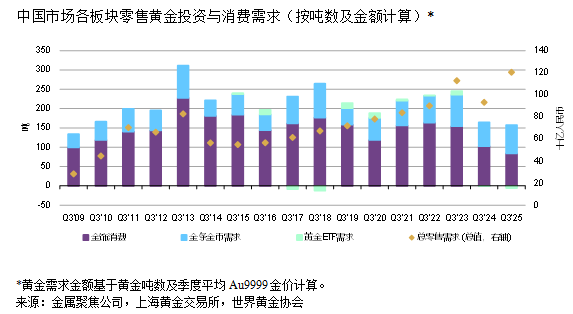
Core Insights - The article highlights a significant increase in global gold demand, particularly driven by investment, following the recent interest rate cut by the Federal Reserve [3][6]. Group 1: Global Gold Demand Trends - In Q3 2025, global gold demand reached a record high of 1313 tons, with a total value of $146 billion, marking the highest quarterly demand ever [3]. - Investment demand for gold surged to 537 tons in Q3, a 47% year-on-year increase, accounting for 55% of total gold demand [3]. - Gold ETFs saw substantial inflows, with holdings increasing by 222 tons in Q3, translating to $26 billion in investment [3]. Group 2: China Market Performance - In contrast, China's gold demand showed a decline, with retail investment and consumption dropping to 152 tons in Q3, a 7% year-on-year decrease and a 38% quarter-on-quarter decline, marking the weakest Q3 since 2009 [6]. - Gold ETF demand in China turned negative, with outflows of 3.8 billion RMB (approximately $540 million) in Q3, ending a three-quarter inflow trend [6]. - Despite the challenges, the total assets under management (AUM) for gold ETFs in China grew by 11% to 168.8 billion RMB (about $23.7 billion) due to rising gold prices [6]. Group 3: Central Bank Purchases - Global central banks continued to purchase gold, with net purchases reaching 220 tons in Q3, a 28% increase from the previous quarter and a 10% increase year-on-year [7]. - Cumulatively, central banks bought 634 tons of gold in the first three quarters of 2025 [7].


全球黄金需求三季度创历史新高,避险需求激增成主要推手
Huan Qiu Wang· 2025-10-30 09:55
Core Insights - The World Gold Council's latest report indicates that global gold demand reached a record high of 1,313 tons and a total value of $146 billion in Q3 2025, driven by heightened interest in gold as a safe-haven asset amid global market volatility [1] Investment Demand Surge - Investment demand for gold surged to 537 tons in Q3, marking a significant 47% year-on-year increase and accounting for 55% of total gold net demand [3] - Factors contributing to this increase include geopolitical uncertainties, a weakening dollar, and rising gold prices, which have triggered a "fear of missing out" (FOMO) among investors [3] - Gold ETFs saw substantial inflows, with global holdings increasing by 222 tons and inflow amounts reaching $26 billion in Q3 [3] - For the first three quarters of 2025, global gold ETF holdings increased by 619 tons (approximately $64 billion), with North American funds leading the way [3] Jewelry Consumption Pressure - In contrast to the booming investment demand, global jewelry consumption faced significant pressure, declining by 19% year-on-year to 371 tons in Q3, the lowest level for that quarter since 2020 [4] - Despite a seasonal rebound in India and China, year-on-year performance remained weak [4] - Central banks continued to purchase gold, with net purchases totaling 220 tons in Q3, a 28% increase from Q2 and a 10% year-on-year rise [4] Chinese Market Dynamics - The Chinese market exhibited structural characteristics, with total retail gold investment and consumption (including jewelry, bars, coins, and ETFs) declining by 7% year-on-year to 152 tons in Q3, the weakest performance since 2009 [5] - However, the monetary value of this demand reached a historical high of 120.4 billion yuan (approximately $16.9 billion), reflecting a 29% year-on-year increase [5] - Gold bar and coin sales in China rose by 19% year-on-year to 74 tons, while gold ETF experienced a net outflow of 3.8 billion yuan in Q3 [6] Market Outlook - The outlook for the gold market remains optimistic, driven by persistent factors such as geopolitical tensions, high inflation, and uncertainties in global trade policies [6] - The report anticipates a seasonal improvement in jewelry consumption in China in Q4, while investment demand is expected to remain relatively strong [6]
全球黄金需求,创新高
Di Yi Cai Jing· 2025-10-30 07:03
Core Insights - The World Gold Council reported that global gold demand reached a record high of 1,313 tons in Q3 2025, with a total value of $146 billion [1] - Central banks accelerated gold purchases, totaling 220 tons in Q3, a 28% increase from Q2 and a 10% year-over-year rise [1] - China's retail gold investment and consumption demand was 152 tons in Q3 2025, a 7% year-over-year decline, but the monetary value surged by 29% to approximately $16.9 billion [1] - The outlook for the gold market remains optimistic due to a weakening dollar, expectations of interest rate cuts, and the risk of stagflation [1] Global Gold Demand - In Q3 2025, global gold demand reached 1,313 tons, marking the highest quarterly demand on record [1] - The total monetary value of this demand was $146 billion [1] Central Bank Purchases - Central banks net purchased 220 tons of gold in Q3 2025, which is a 28% increase from the previous quarter and a 10% increase year-over-year [1] - The total net gold purchases by central banks for the first three quarters of 2025 amounted to 634 tons, which, while lower than the exceptionally high levels of the past three years, remains significantly above the average levels prior to 2022 [1] China's Gold Market - China's retail gold investment and consumption demand reached 152 tons in Q3 2025, reflecting a 7% decline compared to the previous year [1] - However, the monetary value of this demand was approximately 1,204 billion RMB (around $16.9 billion), representing a 29% year-over-year increase and setting a record for Q3 [1] Market Outlook - The gold market outlook is optimistic, driven by a weakening dollar, general expectations of interest rate cuts, and the presence of stagflation risks, which may further support gold investment demand [1] - Gold prices have been consistently reaching new records this year, indicating potential for further upward movement in the current market environment [1] - Research indicates that the market is not yet saturated, and the strategic value of allocating to gold remains solid [1]
全球黄金需求,创新高
第一财经· 2025-10-30 06:54
Core Insights - The World Gold Council reported that global gold demand reached a record high of 1,313 tons in Q3 2025, with a total value of $146 billion [1] - Central banks accelerated gold purchases, totaling 220 tons in Q3, a 28% increase from Q2 and a 10% year-over-year rise [1] - China's retail gold investment and consumption demand reached 152 tons in Q3 2025, a 7% year-over-year decline, but the monetary value surged by 29% to approximately $16.9 billion [1] - The outlook for the gold market remains optimistic due to a weakening dollar, expectations of interest rate cuts, and the risk of stagflation, which may further support gold investment demand [1] Group 1 - Global gold demand in Q3 2025 reached 1,313 tons, marking the highest quarterly demand on record [1] - Central banks' net gold purchases totaled 220 tons in Q3, reflecting a significant increase compared to previous quarters [1] - China's retail gold investment and consumption demand, while down in volume, saw a substantial increase in monetary value, indicating strong market interest [1] Group 2 - The continuous rise in gold prices suggests that there is still potential for further increases in the market [1] - The strategic value of gold allocation remains solid, indicating that the market has not yet reached saturation [1] - The combination of macroeconomic factors is likely to sustain the demand for gold in the near future [1]

高频数据扫描:美国CPI低于预期,滞胀风险仍未解除
Bank of China Securities· 2025-10-26 23:51
Report Industry Investment Rating - The report does not provide an industry investment rating [1][2] Core Viewpoints - US CPI in September was lower than market expectations, but the stagflation risk remains unresolved. The cooling of the US real - estate market has curbed inflation, but price increases in non - rent services and core commodities are still high. Retailer inventory is tight, and an aggressive trade policy may exacerbate inflation risks [2] - The 10 - year US Treasury yield is oscillating around the 4% mark. The outcome of the US Supreme Court's tariff case and the resolution of the US government "shutdown" affect the US Treasury market. Caution should be exercised when the 10 - year yield is below 4% [2] - The price index of edible agricultural products has rebounded. There are changes in prices of various commodities such as oil, metals, and building materials. The average daily trading area of commercial housing in 30 large - and medium - sized cities from October 1 - 21, 2025, decreased compared to the same period in 2024 [2] Summary by Related Catalogs High - frequency Data and Important Macroeconomic Indicators Trend Comparison - The report shows various charts comparing high - frequency data with important macro - indicators such as industrial added value, PPI, CPI, and export volume, including copper prices, steel production, and commodity price indices [8][23][29] US and European Important High - frequency Indicators - Charts display US weekly economic indicators, initial jobless claims, unemployment rates, same - store sales growth, PCE, and financial conditions indexes, as well as the implied prospects of interest rate hikes/cuts by the US Federal Reserve and the European Central Bank [96][98][105] High - frequency Data Seasonal Trends - Seasonal trends of high - frequency data are presented, including data on steel production, production material price indices, and commodity price indices [107][113][116] High - frequency Traffic Data in Beijing, Shanghai, Guangzhou, and Shenzhen - The report shows the year - on - year changes in subway passenger volume in Beijing, Shanghai, Guangzhou, and Shenzhen [160][164][167]

美国- 地区性银行坏账风波、政府关门与数据“真空”
2025-10-19 15:58
Summary of Key Points from the Conference Call Industry Overview - The discussion primarily revolves around the **U.S. banking sector**, particularly focusing on **regional banks** and the implications of the ongoing **government shutdown** on the economy and financial markets [1][2][7]. Core Insights and Arguments - **Regional Bank Bad Debt Crisis**: The bad debt issues stem from credit fraud involving ZionsBankCorp and West Alliance, which provided loans to an investment fund that mismanaged collateral, leading to market sell-offs. This situation has raised concerns about credit risk despite the amounts involved being relatively small [2][3]. - **Impact of Government Shutdown**: The U.S. government has been shut down for three weeks, creating a data vacuum that increases uncertainty in key economic indicators such as employment and inflation, further exacerbating market volatility [7][11]. - **Large Banks' Financial Health**: Recent financial reports from large banks indicate a healthy status with no signs of systemic risk, contrasting with the issues faced by smaller regional banks [5]. - **Non-Bank Credit Risks**: There is a growing concern regarding non-bank institutions, particularly private credit and Business Development Companies (BDCs), which have seen rapid growth in loan balances from $900 billion in 2023 to $1.7 trillion in 2025. However, the stock prices of firms like Blackstone have dropped nearly 20%, indicating market caution [6]. - **Economic Losses from Shutdown**: The government shutdown is projected to result in a weekly loss of $15 billion, totaling $60 billion if it lasts a month, which could equate to a 0.2% decline in GDP [12]. Additional Important Points - **Market Sentiment and Bond Yields**: The market is increasingly worried about the lack of key economic data, leading to a drop in two-year and ten-year Treasury yields below critical levels. There is speculation that the Federal Reserve may need to implement significant rate cuts due to anticipated poor economic data [3][15]. - **Political Dynamics**: The ongoing political standoff over healthcare funding is a significant factor in the government shutdown, with both parties using the situation to gain political leverage ahead of upcoming elections [8][9]. - **Long-term Economic Implications**: While government shutdowns typically result in short-term impacts, potential layoffs could lead to longer-lasting negative effects on the economy if they occur [13][14]. This summary encapsulates the critical aspects of the conference call, highlighting the current challenges faced by the U.S. banking sector and the broader economic implications of the government shutdown.