
通胀黏性

Search documents
黄金市场2025年11月观察:政策、地缘与资金博弈下的震荡格局
Sou Hu Cai Jing· 2025-11-07 04:43
Core Insights - The gold market in November 2025 is characterized by "high-level consolidation and tug-of-war between bulls and bears," with international gold prices testing the $4000 per ounce mark repeatedly [1] - The recent tax policy changes and brand premium differentiation have led to a three-tier pricing system in the domestic market, impacting the wholesale market significantly [4] Group 1: Market Dynamics - The new tax policy exempts standard gold traded through the Shanghai Gold Exchange and futures exchanges from VAT, while off-market transactions incur a 13% VAT, affecting the Shenzhen Shui Bei wholesale market [4] - The price gap between Shui Bei market gold and brand retail prices has narrowed to approximately 90 yuan per gram due to increased costs for some merchants [4] - Major banks like ICBC and CCB have paused gold accumulation services, raising concerns about liquidity tightening, although ICBC quickly resumed operations, indicating a focus on "regulating transactions" rather than "suppressing the market" [4] Group 2: Investment Sentiment - Despite ongoing uncertainties in the Middle East, market pricing of "extreme risks" has become more rational, with gold ETF holdings decreasing for four consecutive weeks, equivalent to a reduction of 69 tons of physical gold [4] - Speculative long positions have dropped to a three-month low, and the RSI indicator has decreased from 82 to 54, indicating a release of short-term overbought pressure [4] Group 3: Central Bank Support - Central bank gold purchases have become a long-term support factor, with global central banks acquiring 220 tons in Q3 2025, bringing the total for the year to 634 tons, nearing record levels from 2024 [4] - This "structural demand" effectively smooths out short-term volatility in the gold market [4] Group 4: Price Levels and Future Outlook - In the short term, gold prices need to test the support level of $3800 per ounce; a drop below this level could trigger programmatic selling [4] - The market is currently in a phase of "macro support versus technical pressure," with key variables to watch: 1. Federal Reserve policy: December rate cut probabilities have decreased by 25 basis points, but forward rate futures are pricing in a cumulative 50 basis point cut in 2025 [4] 2. Geopolitical risks: An escalation in the Middle East could reignite safe-haven demand [4] 3. Inflation persistence: The U.S. debt-to-GDP ratio has reached 123%, and if secondary inflation expectations rise, gold's inflation-hedging properties will become more pronounced [4]


金价大跌超3%!过去一周,市场发生了什么?
Sou Hu Cai Jing· 2025-11-03 05:37
Group 1: Market Performance - Major tech companies like Meta and Microsoft reported earnings below market expectations, leading to a decline in large tech stocks. However, strong Q3 earnings from Apple and Amazon alleviated concerns about an AI bubble, resulting in a rebound in the US stock market. The Dow Jones increased by 0.75%, the S&P 500 rose by 0.71%, and the Nasdaq surged by 2.24% [1] - International oil prices fell due to expectations that OPEC+ will continue its production increase plan in December amid insufficient demand growth. West Texas Intermediate (WTI) crude oil futures dropped by 0.85%, while Brent crude oil futures decreased by 1.32% [3] Group 2: Precious Metals Market - The international gold price fell by over 3% last week, influenced by profit-taking by investors, easing concerns over international trade tensions, and a rebound in investor risk appetite. The gold price declined by 3.41% [5] Group 3: Economic Indicators - The Bank of England is set to announce its latest interest rate decision, with expectations that the base rate will remain at 4% until clearer signs of economic slowdown emerge. However, Goldman Sachs suggests a potential 25 basis point cut due to lower-than-expected CPI growth in September [7] - Important employment data from the US, including the ADP employment report, is scheduled for release, while manufacturing PMI data will be published across the UK, US, and Eurozone. The US ISM manufacturing PMI is expected to show a slight increase, raising concerns about persistent inflation [9] Group 4: Upcoming Earnings Reports - This week, 129 companies in the S&P 500, including AMD and Qualcomm, will release their earnings reports. AMD is particularly favored due to strong performance in its data center business, with expectations of double-digit revenue growth in Q3. The performance of chip and consumer sector companies will be crucial in assessing the resilience of AI investments and domestic demand [11]


金银大热,基金限购!后市怎么走?
Guo Ji Jin Rong Bao· 2025-10-22 15:05
Core Viewpoint - The continuous rise in precious metal prices has led several related fund products to adjust their subscription limits, indicating increased market volatility and speculative sentiment [1][2][5]. Fund Subscription Limit Adjustments - On October 22, the Huatai-PineBridge Gold and Precious Metals Securities Investment Fund (LOF) announced a significant reduction in the subscription limit to 100 yuan per day per account, effective from October 23, 2025 [2][4]. - Similarly, the Guotai Junan UBS Silver Futures Securities Investment Fund (LOF) reduced its subscription limits for A and C class shares to 100 yuan and 1,000 yuan, respectively, starting October 20 [4][5]. - The Huatai-PineBridge fund had previously set a limit of 10,000 yuan just a day before the announcement, showcasing a drastic change in policy [4]. Market Conditions and Speculative Sentiment - The adjustments in subscription limits are attributed to the significant increase in gold and silver prices, which have seen volatility and heightened speculative activity in the market [4][5]. - As of October 22, gold prices have risen over 50% and silver prices nearly 70% year-to-date, indicating a strong bullish trend [6]. Risk Management and Investor Guidance - Fund managers are implementing stricter subscription measures to ensure the stability of investment portfolios and protect the interests of fund holders, signaling the high short-term risks associated with gold and silver investments [5][7]. - Financial institutions, including major banks, have also issued warnings regarding the increased volatility in precious metal prices, advising investors to manage their risk exposure carefully [7]. Future Outlook - Analysts suggest that while short-term fluctuations may occur, the long-term outlook for gold remains positive due to ongoing central bank purchases and macroeconomic factors [8]. - For silver, the transition from a traditional cyclical asset to a strategic growth asset is anticipated, driven by inflation, energy transition, and technological advancements [10].

摩通CEO警示劳动力市场转弱与通胀黏性 风险不确定性上升
Xin Lang Cai Jing· 2025-10-14 11:20
Core Viewpoint - JPMorgan Chase's CEO Jamie Dimon warns of risks related to a weakening labor market and persistent inflation while announcing slightly higher-than-expected credit loss provisions [1] Group 1: Economic Indicators - Dimon noted signs of a slowdown in job growth, indicating potential challenges in the labor market [1] - He emphasized that the overall U.S. economy remains resilient despite rising uncertainties [1] Group 2: External Factors - The CEO highlighted complex geopolitical situations, tariff and trade uncertainties, high asset prices, and sticky inflation risks as factors contributing to elevated uncertainty levels [1]

美国长债收益率“异常”上涨 “债券义警”拉响警报
2 1 Shi Ji Jing Ji Bao Dao· 2025-09-22 23:18
Group 1 - The 10-year U.S. Treasury yield rose to above 4.14% after the Federal Reserve's interest rate cut, despite expectations of a decline [1][2] - The stock market reached record highs with the S&P 500, Nasdaq 100, Dow Jones Industrial Average, and Russell 2000 indices all setting new records [1] - The rise in long-term bond yields is attributed to market behavior of "buying the expectation and selling the fact" following the Fed's rate cut [1][2] Group 2 - Concerns about persistent inflation are significant, as recent data indicates that inflation remains sticky, complicating the Fed's ability to lower rates further [2][5] - High long-term yields increase government interest payments, potentially exacerbating the fiscal deficit and creating a vicious cycle [3][6] - The current economic environment poses a challenge for sustaining long-term financing costs above 4% [3] Group 3 - Future downward potential for long-term yields may be limited, with the Fed's dot plot indicating a median forecast for the federal funds rate at 3.6% by the end of 2025 [4][5] - The Fed's cautious approach to rate cuts suggests that long-term Treasury yields may not quickly fall below 3% [5][6] - The market is adapting to a "higher for longer" interest rate environment, necessitating a reassessment of asset allocations [7]
美国9月FOMC会议点评:两难中的“中庸之道”
Guoxin Securities· 2025-09-21 05:59
Monetary Policy - The Federal Reserve lowered the federal funds target rate by 25 basis points to a range of 4.00%-4.25%[2] - The decision aligns with market expectations and reflects a "prudent easing" policy stance[3] Economic Outlook - The U.S. GDP growth rate for the first half of the year was approximately 1.5%, down from 2.5% in the same period last year[5] - Consumer spending has shown signs of weakness, while investment in equipment and intangibles has improved[5] - The median GDP growth forecast for 2025 is 1.6%, significantly lower than the 2024 level[7] Employment Trends - Non-farm payrolls have averaged only 29,000 new jobs over the past three months, well below the break-even level needed to maintain stable unemployment[8] - The unemployment rate is projected to be 4.5% this year, with a gradual decline expected thereafter[12] Inflation Concerns - The PCE index rose by 2.7% year-on-year in August, with core PCE at 2.9%, indicating persistent inflationary pressures[13] - The Fed's cautious language regarding inflation reflects heightened sensitivity to rising price levels[13] Political Influences - Political pressure from former President Trump has become a significant variable affecting Fed policy, with calls for more aggressive rate cuts[15] - The appointment of Miran to the Fed Board is seen as a move to strengthen Trump's influence within the Fed[16] Asset Management - The Fed will continue its balance sheet reduction at a pace of $40 billion per month, with no changes to the current schedule[19] - The overall asset balance of the Fed has been gradually declining, with total assets at approximately $6.61 trillion as of September 10, 2025[24]
9.16黄金最新行情走势分析及操作建议
Sou Hu Cai Jing· 2025-09-15 16:00
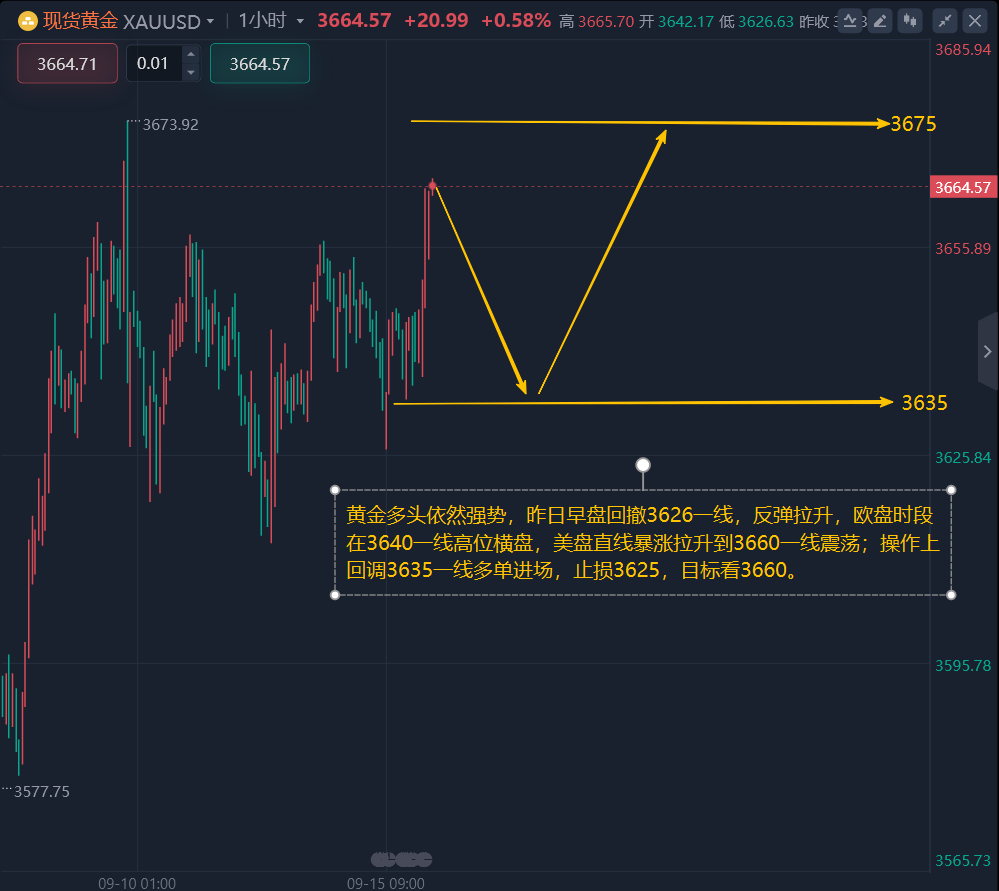
Core Viewpoint - Gold is positioned favorably between "stagflation" and "recession," with high CPI confirming persistent inflation and rising initial jobless claims reinforcing expectations for interest rate cuts [1] Group 1: Market Conditions - The combination of weak growth, loose policy, and sticky inflation is historically beneficial for gold [1] - Global central banks are continuing to de-dollarize, and frequent geopolitical conflicts are contributing to a favorable outlook for gold prices [1] Group 2: Price Movements - Gold has maintained a strong position above the 5-day moving average, with expectations for a potential breakout to new historical highs if it remains above this level [1] - Recent trading saw gold rebound from 3626, with a target range of 3620-3660, indicating a bullish sentiment [3] Group 3: Technical Analysis - Technical indicators show a bullish trend, with a golden cross on the 2-hour moving average and gold prices breaking through the upper Bollinger band [4] - Key support levels are identified at 3625-33, with a strong bullish stance maintained as long as prices stay above 3600 [4]
美联储降息“大局已定” 政策路径悬念重重
Shang Hai Zheng Quan Bao· 2025-09-14 19:38
Group 1 - The Federal Reserve is expected to restart interest rate cuts, with a high probability of a 25 basis point reduction, while a 50 basis point cut is also possible [1][4][5] - Recent economic data, including the August CPI and core CPI, align with market expectations, providing a basis for the Fed's decision to cut rates [1][2] - The labor market shows signs of weakness, with initial jobless claims rising to 263,000, the highest in nearly two years, indicating a potential shift in the Fed's monetary policy [1][3] Group 2 - Market focus has shifted to the pace and magnitude of future rate cuts, with analysts predicting three rate cuts within the year [4][5] - The Chicago Mercantile Exchange's FedWatch Tool indicates a 92.5% probability of a 25 basis point cut and a 7.5% chance of a 50 basis point cut in September [4] - Political factors are increasingly influencing the Fed's monetary policy decisions, adding complexity and uncertainty to the rate-cutting process [5][6] Group 3 - Global asset reactions to the Fed's rate cuts remain uncertain, with expectations of a weaker dollar and stronger stock market if a 25 basis point cut occurs [6] - A larger cut of 50 basis points could lead to increased liquidity but may also create market volatility [6][7] - Long-term implications suggest that if rate cuts are driven by political pressure rather than economic fundamentals, it could lead to uncontrolled inflation and necessitate a shift in monetary policy [7]
“买方真空”风险显现 日债收益率迭创新高
Shang Hai Zheng Quan Bao· 2025-08-22 22:14
Core Viewpoint - Japanese government bond yields have been rising significantly, driven by fiscal deficit concerns and policy uncertainties, leading to investor hesitance [1][3]. Group 1: Rising Bond Yields - Recent data shows that Japanese government bond yields have reached new highs, with the 20-year bond yield exceeding 2.67%, the highest since 1999, and the 10-year yield reaching 1.615%, the highest since October 2008 [2]. - Year-to-date, the 20-year bond yield has increased by nearly 45% [2]. - The Japanese Ministry of Finance plans to raise the provisional interest rate for government bonds to 2.6%, the highest level in 17 years, reflecting recent market yield averages plus a historical volatility adjustment [2]. Group 2: Fiscal Concerns Impacting Investors - The recent loss of a majority in the House of Councillors by the ruling coalition has heightened concerns over Japan's fiscal policy, leading to expectations of increased fiscal expansion [3]. - Investors are worried that if the ruling coalition shifts towards fiscal expansion to stabilize electoral support, the risk premium on Japanese government bonds will continue to rise [3]. - The demand side of the bond market is also changing, with traditional buyers like life insurance companies reducing their purchasing activity, contributing to a supply-demand imbalance [3]. Group 3: Cautious Monetary Policy - The Bank of Japan is maintaining a cautious approach to monetary policy normalization, avoiding rapid changes that could lead to market volatility [4]. - In July, the Bank of Japan kept the policy interest rate at around 0.5%, following a series of unchanged rates since the increase in January [5]. - Despite pressure from U.S. officials for the Bank of Japan to act on inflation, the actual implementation of interest rate hikes may be delayed due to persistent inflation, economic recovery uncertainties, and fiscal vulnerabilities [5].
美经济数据“冷热不均”及政策博弈,金价3350美元/盎司附近面临阻力
Sou Hu Cai Jing· 2025-08-13 05:19
Group 1 - The core viewpoint of the articles highlights the conflicting signals from recent economic data, particularly the July CPI, which has led to a decrease in market expectations for aggressive interest rate cuts by the Federal Reserve, subsequently impacting the attractiveness of gold as a non-yielding asset [1][2][4] - The July CPI showed a year-on-year increase of 2.7%, slightly below the expected 2.8%, while the core CPI rose by 3.1%, marginally exceeding the market expectation of 3.0%, indicating persistent inflationary pressures [1][2] - The market's reaction to the potential interest rate cut has been mixed, with the dollar index dropping by 0.5% to 97.85, typically favorable for gold, yet gold prices have shown weakness, with the Shanghai gold futures contract down 0.08% to 776.46 CNY per gram and spot gold down 0.07% to 3345.210 USD per ounce [2][4] Group 2 - The independence of the Federal Reserve is under scrutiny, particularly with the nomination of Milan as a potential board member, which could raise concerns about the politicization of monetary policy if he advocates for more accommodative measures [3] - The relationship between the White House and the Federal Reserve appears strained, as evidenced by the pressure exerted on Powell regarding the renovation of the Fed's headquarters, which may undermine market confidence in the Fed's credibility [3] - Analysts suggest that the recent decline in gold prices is influenced by three main factors: a reduction in the probability of a 50 basis point rate cut from 70% to 55%, a rebound in tech stocks attracting investment away from gold, and technical resistance around the 3350 USD per ounce level prompting profit-taking by some investors [4] Group 3 - The outlook for gold remains uncertain in the short term, with expectations of continued volatility, particularly in light of upcoming non-farm payroll data and statements from Federal Reserve officials [5] - If economic slowdown risks are confirmed by future data, renewed expectations for rate cuts could support a rebound in gold prices; conversely, if inflation remains sticky, gold may face further adjustments [5] - Long-term factors such as global geopolitical risks, trends towards de-dollarization, and central bank gold purchases are expected to provide a supportive floor for gold prices, suggesting structural investment opportunities [5]