
避险交易

Search documents
美国关税风波下资金“撤离”美元资产,避险交易升温
2 1 Shi Ji Jing Ji Bao Dao· 2025-10-13 15:41
Group 1 - The recent trade tensions in the U.S. have caused significant volatility in global capital markets, leading to a withdrawal of overseas institutional funds from dollar assets and a rise in demand for safe-haven assets [1][2] - As of October 13, the U.S. dollar index has seen a cumulative decline of 8.57% since the beginning of the year, while gold has surged over 52% year-to-date, breaking the $4,000 per ounce mark on October 8 and reaching a new high of over $4,060 [2][4] - The S&P 500 index has increased nearly 20% since the beginning of the year, but is now facing profit-taking pressures, particularly in the technology sector, with significant losses in major stocks like Nvidia, Tesla, and Amazon [3][4] Group 2 - European markets have mirrored the declines seen in U.S. markets, with the STOXX 600 index dropping 1.10% over the week, and there is limited capital inflow into Europe as a replacement destination [4][6] - Investment strategies suggest a focus on defensive growth stocks in the U.S. and China, with recommendations to gradually increase holdings in these markets as they approach key support levels [5][6] - Analysts expect that the current trade tensions will have a milder impact on various asset classes compared to previous events, with a likelihood of continued support for the Chinese stock market due to policy expectations and the potential for increased capital inflow [7]
芦哲:如何看待本轮特朗普的关税威胁?
Sou Hu Cai Jing· 2025-10-13 04:06
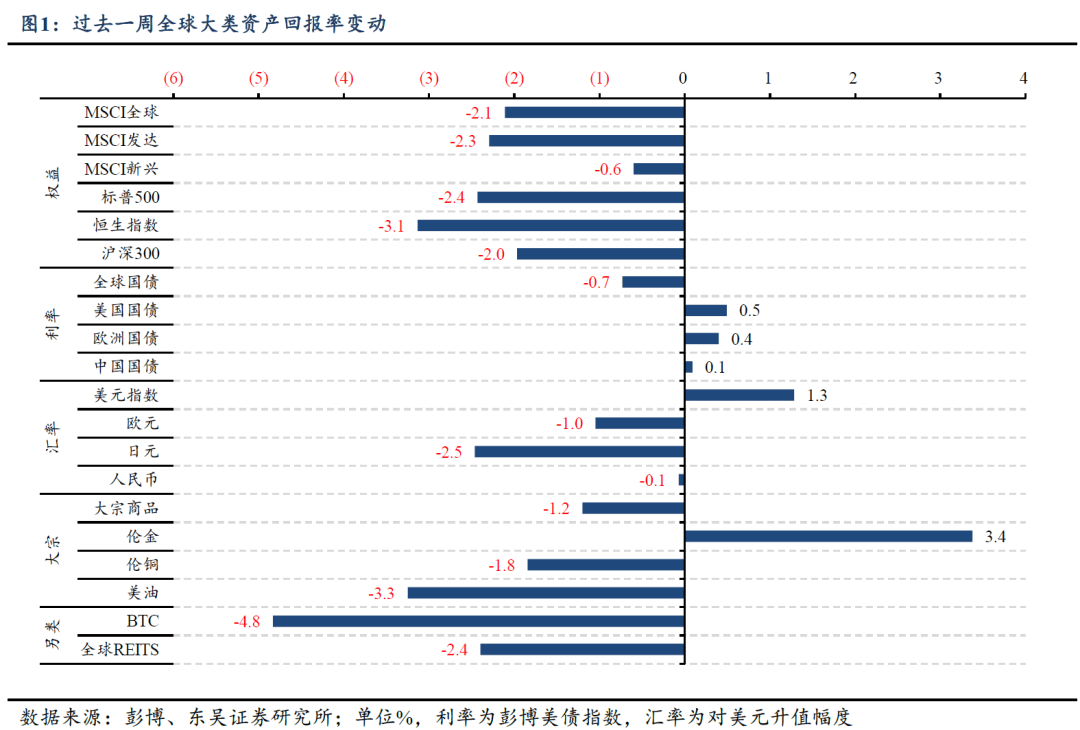
Core Viewpoint - Trump's renewed threat to impose tariffs on China has triggered risk-off trading in the market, leading to declines in U.S. stocks, copper, oil, bond yields, and the dollar index, while gold prices have fluctuated upwards. The impact of this tariff threat on the U.S. economy and markets is expected to be limited compared to the tariff shocks experienced in April, but it may increase inflationary pressures, complicating future interest rate cuts by the Federal Reserve. Attention should be paid to potential retaliatory measures and the escalation of trade conflicts into other critical areas such as rare earths and chips, as well as the progress of high-level meetings at APEC. In terms of trading strategy, risk assets like U.S. stocks may face accelerated adjustment risks due to the renewed tariff conflict, and if this leads to liquidity risks similar to those in April, gold and other safe-haven assets could be prioritized for investment. Once the new tariff conflict stabilizes, a gradual allocation to risk assets may be considered, with a focus on trading volumes in the CSI 300 ETF and U.S. stock index options [1][4]. Major Asset Classes - The renewed tariff threat from Trump has reignited risk-off trading, resulting in declines in U.S. stocks and bond yields, while gold prices have risen. At the beginning of the week, AMD and OpenAI's collaboration on AI chips boosted market sentiment, leading to new historical highs for U.S. stocks. However, following Trump's announcement of additional tariffs on China, U.S. stocks fell sharply. For the week of October 6 to October 10, the 10-year U.S. Treasury yield decreased by 8.70 basis points to 4.032%, and the 2-year yield fell by 7.43 basis points to 3.501%. The dollar index rose by 1.28% to 98.98, while the S&P 500 and Nasdaq indices dropped by 2.43% and 2.53%, respectively. Spot gold prices increased by 3.38% to $4017 per ounce [2][4]. Overseas Economy - The September FOMC minutes indicate internal divisions within the Federal Reserve regarding future interest rate paths. The preliminary consumer confidence index for October from the University of Michigan is 55, with expectations at 54 and a previous value of 55.1. Inflation expectations for the next year recorded by the New York Fed in September are 3.38%, up from 3.2%, while the Michigan index for October is 4.6%, with expectations at 4.7% and a previous value of 4.7%. The FOMC minutes reveal that concerns over recent employment growth slowing outweighed worries about persistent inflation, leading to the decision to initiate rate cuts in September. Most officials believe further monetary easing is appropriate for the remainder of the year, but there are still concerns about the risks of rising inflation, with some members suggesting that progress towards the 2% target has stalled, indicating ongoing divisions regarding future rate paths. As of October 7, the Atlanta Fed's GDPNow model predicts a 3.8% growth for Q3 2025, while the New York Fed's Nowcast model estimates a 2.34% growth for the same period [3][4]. Overseas Politics - Trump's renewed threat to impose tariffs on China has led to a resurgence of risk-off trading. On October 10, Trump announced that due to dissatisfaction with rare earth regulations, the U.S. will impose an additional 100% tariff on China starting November 1 and will implement export controls on key software. This escalation is influenced by external pressures easing, such as the recent ceasefire agreement between Israel and Palestine, allowing Trump to focus on U.S.-China trade relations. Additionally, the ongoing government shutdown in the U.S. necessitates a diversion of internal conflicts to external issues. The economic impact of the new tariffs is expected to be limited due to prior tariff threats and the seasonal nature of U.S.-China trade. However, the renewed tariff threat may reignite inflation risks in the U.S., particularly concerning imports from China. The market has become accustomed to Trump's unpredictable tariff policies, and the upcoming APEC meeting may provide an opportunity for high-level discussions between the two nations. Long-term, the experience from the 2018-19 trade conflicts suggests that tariff threats will persist and remain volatile, especially with the upcoming change in Federal Reserve leadership in May 2026, which may lead to a more dovish monetary policy [4].

美国7月非农就业数据大幅遇冷,“避险交易”回归黄金新一轮涨势开启
Soochow Securities· 2025-08-04 07:43
Investment Rating - The report maintains an "Overweight" rating for the non-ferrous metals industry [1] Core Views - The non-ferrous metals sector experienced a decline of 4.62% from July 28 to August 1, ranking 30th among all primary industries. The industrial metals sector fell by 3.81%, while precious metals dropped by 4.11% [15][1] - The return of "safe-haven trading" is expected to drive a new round of increases in gold prices due to disappointing U.S. non-farm payroll data [4][1] Summary by Sections Market Review - The Shanghai Composite Index fell by 0.94%, with the non-ferrous metals sector underperforming [15] - All sub-sectors within non-ferrous metals saw declines, with energy metals down 5.41% and small metals down 7.11% [15] Industrial Metals - **Copper**: Prices are expected to weaken due to the implementation of tariffs and seasonal demand suppression. As of August 1, LME copper was priced at $9,633/ton, down 1.66% week-on-week [34][2] - **Aluminum**: Prices are also expected to remain weak, with LME aluminum at $2,572/ton, down 2.26% week-on-week. The industry is seeing increased social inventory [39][3] - **Zinc**: Prices fell by 3.52% week-on-week, with LME zinc at $2,730/ton. Inventory levels fluctuated [41][3] - **Tin**: Prices decreased by 2.71% week-on-week, with LME tin at $33,215/ton. Supply remains tight due to seasonal impacts [47][3] Precious Metals - Gold prices are on the rise, with COMEX gold closing at $3,416.00/oz, up 2.32% week-on-week. This is attributed to weak U.S. employment data and a decline in U.S. Treasury yields [4][51] - The U.S. unemployment rate rose to 4.248%, the highest since November 2021, further supporting gold's appeal as a safe-haven asset [4][51]
金属周报 | 地缘风险与降息预期共振,黄金再启升势、铜价有所承压
对冲研投· 2025-06-16 12:28
Group 1 - The core viewpoint indicates that gold prices strengthened while copper prices declined, with COMEX gold rising by 3.65% and COMEX copper falling by 1.68% [2][3] - Risk appetite has decreased, leading to pressure on copper prices due to geopolitical tensions and market reactions to U.S. warnings regarding Israel and Iran [3][6] - Increased risk aversion has led to a resurgence in gold prices, driven by lower-than-expected CPI data and escalating conflicts in the Middle East [4][20] Group 2 - In the copper market, COMEX copper prices experienced significant fluctuations, with a notable decline attributed to geopolitical tensions and a cautious market sentiment [5][6] - The domestic refined copper consumption showed signs of weakening, which has made bullish sentiment cautious, although overall demand remains resilient [6][50] - The copper concentrate processing fee has shown stability, with recent market indicators suggesting that prices may have reached a bottom [9][12] Group 3 - In the precious metals market, gold significantly outperformed silver, with COMEX gold prices ranging between $3,313 and $3,468 per ounce [20][21] - The inventory levels for COMEX gold decreased by approximately 330,000 ounces, while COMEX silver inventory increased by about 3.74 million ounces [36][41] - SPDR gold ETF holdings increased by 6 tons to 940 tons, indicating a shift in market sentiment towards gold [41]

黄金股早盘强势!华富永鑫灵活配置混合(A/C:001466/001467) 聚焦黄金股投资
Xin Lang Cai Jing· 2025-06-03 03:51
Group 1 - The gold stock sector is experiencing significant gains, with notable increases in stocks such as Western Gold, Mankalon, and others, indicating strong market interest in gold-related investments [1] - The Huafu Yongxin Flexible Allocation Mixed Fund has heavily invested in gold-related companies, achieving a year-to-date increase of 25.23% as of May 30, 2025, reflecting the positive impact of rising gold prices on these stocks [1] - International gold prices have surged, with spot gold breaking through $3,380 per ounce and COMEX gold futures rising by 2.74% to $3,406.4 per ounce, indicating a bullish trend in the gold market [1] Group 2 - Short-term market sentiment is supported by potential risks from U.S. "reciprocal tariffs," leading to a rise in gold prices, while long-term uncertainties in global tariff policies and regional politics continue to bolster gold's appeal as a safe-haven asset [2] - The Huafu Yongxin Flexible Allocation Mixed Fund focuses on diversifying investments in A-share gold-related companies, allowing for exposure to the benefits of rising gold prices while mitigating risks associated with holding individual gold stocks [2]



29万亿美元市场动荡背后,热门“特朗普交易”突然告吹!
Jin Shi Shu Ju· 2025-05-12 06:37
Group 1 - A senior Federal Reserve official indicated that large-scale bond bets in April backfired, potentially causing the largest surge in U.S. Treasury yields since 1987 [1] - The turmoil began after President Trump announced significant new tariff measures on April 2, leading investors to initially flock to U.S. government bonds for safety, but yields reversed sharply shortly thereafter [1][2] - The 30-year Treasury yield rose nearly 50 basis points within a week, marking the largest increase since 1987 [1] Group 2 - The Federal Reserve's Roberto Perli noted that the unwinding of popular swap spread trades likely exacerbated liquidity tightening in the Treasury market [1][2] - Reports indicated that leveraged investors were caught off guard by the sudden volatility in the Treasury market [1] - Perli emphasized that the deterioration of liquidity in the U.S. Treasury market is real and significant [3]
【广发资产研究】关税冲击之下,避险交易延续——全球大类资产追踪双周报(4月第一期)
戴康的策略世界· 2025-04-17 08:58
戴康 CFA 广发证券发展研究中心 董事总经理(MD)、首席资产研究官 邮箱:daikang@gf.com.cn 报告摘要 ● 全球大类资产表现与宏观交易主线 : (4.7-4.16),全球大类资产表现分化,黄金>发达>债券>新兴。(4.2- 4.4),对等关税落地当周,避险&风险资产普跌。(4.7-4.16),对等关税对于全球资产冲击的程度有所缓和, 但全球大类资产主线仍然围绕"避险交易":避险资产的代表黄金已经率先企稳并大幅领涨;风险资产中,发达国 家和工业金属有所回补,而新兴市场表现仍偏弱。 ● 大类资产配置——新投资范式下,"全球杠铃策略"是反脆弱时代嬗变下全球资产配置的最佳应对。 我们在 25.4.9 《谋定而后动,做多的三个时机》 中提示:事件冲击的大波动中,全力做多的时机通常有三个:(1)胜 率提升—本轮要看到贸易摩擦缓和(跟踪观察);(2)估值极便宜(中国资产不贵);(3)流动性问题导致筹 码出清(可以是阶段性)带来机会。短期维持全球资产宜保持避险策略(中债瑞郎黄金)的判断,仍然建议以全 天候策略框架构建资产组合。中长期而言,关税强化了新范式的三大底层逻辑(逆全球化加剧、债务周期错位、 AI产 ...

美媒:担忧滞胀,美出现“典型避险交易日”
Huan Qiu Shi Bao· 2025-03-30 22:43
Group 1 - The US stock market experienced a significant decline, with the Dow Jones Industrial Average dropping over 700 points, marking a 1.7% decrease, the largest single-day drop since March 10 [1] - The Nasdaq index fell by 2.7%, resulting in a loss of approximately $505 billion in market value for the "Big Seven" tech companies [1] - The S&P 500 index decreased by nearly 2%, with 10 out of its 11 sectors closing lower, indicating a typical risk-off trading day characterized by rising bond prices and widening spreads [1] Group 2 - Recent economic data has raised concerns about stagflation in the US, with inflation levels falling short of expectations and consumer confidence deteriorating [2] - The core PCE price index for February showed a month-over-month increase of 0.4% and a year-over-year increase of 2.8%, both exceeding expectations [2] - The consumer confidence index for March dropped to 57, the lowest level since 2022, with consumers anticipating a 4.1% inflation rate over the next 5-10 years, the highest since February 1993 [2]