存款搬家

Search documents
理财登2025Q3季报解读:规模站上新台阶,存款仓位创历史新高
KAIYUAN SECURITIES· 2025-10-24 07:43
Investment Rating - The industry investment rating is optimistic (maintained) [1] Core Insights - The report highlights a significant increase in wealth management scale, reaching a historical high of 32.13 trillion yuan by the end of Q3 2025, with a year-on-year growth of 9.42% [14][18] - Despite a slight decrease in payout returns, the enthusiasm for new product fundraising remains strong, with an average single fundraising amount of 22.64 billion yuan, reflecting a robust willingness among investors to shift deposits into wealth management [20][21] - The report emphasizes the need for wealth management to adapt to industry changes by enhancing absolute return defenses and diversifying product offerings to cater to different customer segments [56][57] Summary by Sections 1. Liability Side: "Deposit Migration" Catalyzes High Growth in Wealth Management - Wealth management scale has reached a historical peak, with a growth of 2.18 trillion yuan in 2025, and Q3 typically being a peak season for wealth management [14][18] - Wealth management generated 179.2 billion yuan in returns for investors in Q3 2025, despite a slight decline compared to Q2 [17][21] 2. Asset Side: Increasing Allocation to Deposits & Repos, Building a Low-Volatility Safety Net - By the end of Q3 2025, cash and bank deposits accounted for 27.5% of the asset allocation, the highest recorded [25][27] - The proportion of wealth management supporting the real economy has decreased to 65%, marking a new low [35] 3. Competitive Landscape: Non-Licensed Banks' Wealth Management Market Share Falls Below 10% - By the end of Q3 2025, the scale of wealth management from non-licensed banks was 2.85 trillion yuan, representing 8.87% of the total market, the first time falling below 10% [37][38] - The report notes a trend of smaller banks transitioning to pure distribution models to enhance their income from wealth management products [51][52] 4. Conclusion: Upholding Absolute Returns and Enhancing Customer Segmentation, A Multi-Asset Future is Promising - The report suggests that low-volatility wealth management products may serve as the first stop for outflowing deposits, with a focus on maintaining fundraising momentum through diversified product offerings [56][57]
最高下调80BP!中小银行再迎降息潮
Guo Ji Jin Rong Bao· 2025-10-23 16:10
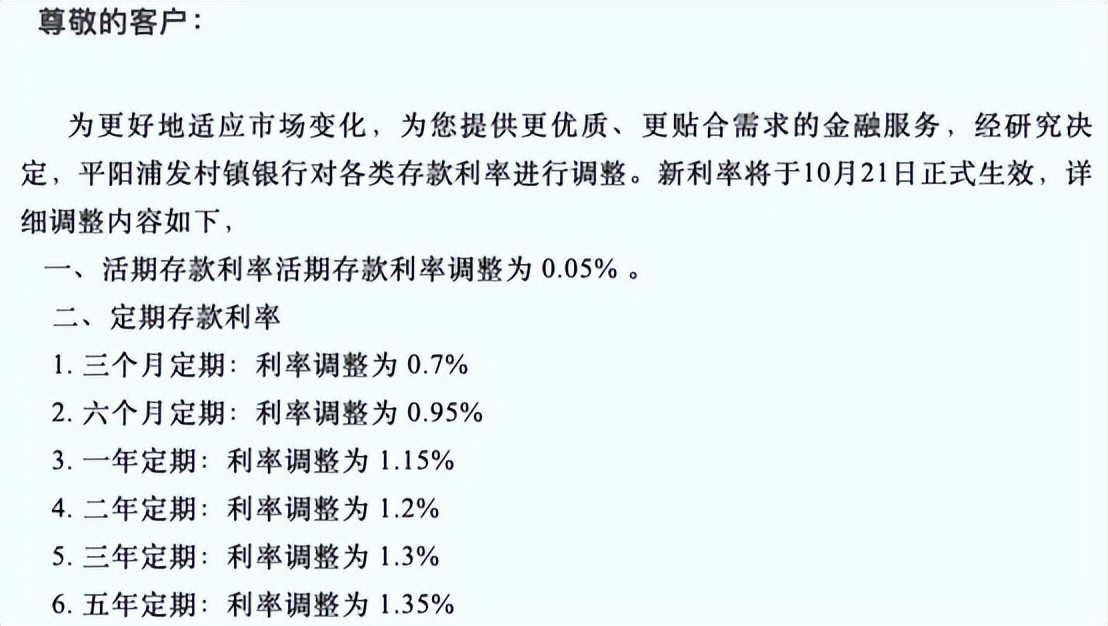
Core Viewpoint - Recent announcements from various local small and private banks indicate a new round of deposit rate cuts, primarily affecting fixed-term deposit rates, as banks adapt to changing market conditions and customer expectations [1][2]. Group 1: Deposit Rate Cuts - Numerous small and private banks across regions such as Henan, Yunnan, Guangdong, and Hainan have recently lowered their deposit rates, with some banks reducing rates by as much as 80 basis points [2]. - For instance, Pingyang Pudong Village Bank has reduced its three-year and five-year fixed deposit rates from 2.1% and 2.15% to 1.3% and 1.35%, respectively [2]. - Shanghai Huari Bank has initiated its seventh round of rate cuts this year, reducing its three-year fixed deposit rate by 15 basis points to 2.15% [2]. Group 2: Changes in Deposit Products - Some banks, such as Guizhou Wuchuan Rural Commercial Bank, have stopped the automatic renewal feature for high-interest deposit products like notice deposits and zero-balance savings [3]. - This shift indicates a broader trend of banks adjusting their product offerings in response to declining deposit rates [3]. Group 3: Future Outlook - Experts predict that there is still room for further interest rate cuts, as the downward trend in deposit rates continues [4]. - The People's Bank of China (PBOC) has maintained the Loan Prime Rate (LPR) steady for five consecutive months, with the one-year LPR at 3% and the five-year LPR at 3.5% [4]. - Analysts expect potential new rounds of interest rate cuts and reserve requirement ratio reductions from the central bank, which could lead to lower loan rates for businesses and consumers [4]. Group 4: Challenges for Commercial Banks - The decline in deposit rates and the rise of investment awareness among residents have led to a phenomenon termed "deposit migration," posing challenges for commercial banks [5]. - Experts suggest that banks should shift their focus from merely attracting deposits to enhancing customer service and product offerings to retain client funds and generate management fees [5].
中小银行降息潮再起,“存款搬家”结束了吗?
Huan Qiu Wang· 2025-10-23 08:13
Group 1 - The core viewpoint of the article highlights a new wave of deposit rate adjustments among small and medium-sized banks, with significant reductions in three-year and five-year deposit rates, prompting discussions on the future of household asset allocation in a low-interest-rate environment [1][3] - Several small and medium-sized banks have lowered their deposit rates, with some banks reducing rates by as much as 80 basis points, bringing three-year and five-year rates down to around 1.3% and 1.35% respectively [1][3] - The average deposit rates for various terms have continued to decline, with the three-year rate dropping by 0.4 basis points and the six-month rate by 0.2 basis points, indicating a persistent downward trend in deposit rates [4][3] Group 2 - The phenomenon of "deposit migration" has become a focal point, with household deposits increasing by 12.73 trillion yuan in the first three quarters of the year, although there are signs that this trend may be slowing down [5][1] - Analysts caution against concluding that the trend of deposit migration has ended, attributing the September deposit growth to seasonal factors related to bank assessments at the end of the quarter [5][1] - The banking wealth management scale has seen a decline, with a drop of 850 billion yuan in September, but is expected to recover in October due to maturing fixed-term deposits and continued decreases in deposit rates [8][6] Group 3 - The demand for "fixed income plus" wealth management products is gaining attention as a balanced choice for risk and return in the current low-interest-rate environment, with industry leaders advocating for multi-asset and multi-strategy approaches [8][9] - The potential for growth in "fixed income plus" products is significant, with expectations that their scale could exceed 1.4 trillion yuan for the year, driven by the need for higher returns in a low-yield environment [9][8]


存款搬家停下来了!这是什么信号?
大胡子说房· 2025-10-22 11:01
Group 1 - The core viewpoint of the article emphasizes the current economic situation, particularly focusing on CPI and PPI data, indicating a lack of inflation and a need for continued monetary and fiscal policy support [5][6][10] - In September, the CPI decreased by 0.3% year-on-year and increased by 0.1% month-on-month, while the PPI fell by 2.3% year-on-year, suggesting weak consumer demand and manufacturing prices [1][3] - The article highlights the importance of M1 and M2 monetary supply data, with M2 at 335.38 trillion yuan, growing by 8.4% year-on-year, and M1 at 113.15 trillion yuan, growing by 7.2%, indicating a narrowing M2-M1 gap [6][8][9] Group 2 - The narrowing of the M2-M1 gap suggests that M1 is growing faster, attributed to a decline in government bond prices, prompting individuals to withdraw funds from fixed-term investments back into demand deposits [9][10] - In September, household deposits increased by 2.96 trillion yuan, while non-bank financial institution deposits decreased by 1.06 trillion yuan, indicating a trend of funds returning to banks rather than remaining in investment accounts [10][11] - The article notes that the capital market's performance in September was lackluster, leading to a decrease in the "deposit migration" phenomenon, as investors were not seeing significant returns [12][13] Group 3 - The article anticipates continued government efforts to stimulate the capital market and address the economic situation, suggesting that the underlying logic for a bull market remains intact [15][19] - Upcoming key events, including trade negotiations and Federal Reserve meetings, are expected to influence market performance, with a cautious approach recommended until these events unfold [20][21] - The article encourages proactive asset allocation in anticipation of market movements following these critical events [22][23]

透过利率传导看“存款搬家”本质
Jing Ji Ri Bao· 2025-10-21 22:00
Core Insights - The recent increase in household deposits and non-bank financial institution deposits indicates a shift in asset allocation behavior among residents, reflecting a response to changes in asset return rates [1][2] Group 1: Deposit Trends - In the first three quarters of this year, RMB deposits increased by 22.71 trillion yuan, with household deposits rising by 12.73 trillion yuan and non-bank financial institution deposits increasing by 4.81 trillion yuan [1] - The growth rate of household deposits has slowed compared to previous highs, while non-bank deposits continue to grow rapidly [1][2] Group 2: Historical Context - The phenomenon of "deposit migration" is not new and has been a regular occurrence in the development of financial markets over the past 20 years, with various asset types attracting funds at different times [2] - The rapid growth of non-bank financial institution deposits is linked to the increased regularization of non-bank deposits and the holding of interbank certificates of deposit [2] Group 3: Impact of Interest Rates - Changes in interest rates act as a guiding mechanism for fund flows, with "deposit migration" resulting from relative changes in yields across different financial markets [2] - As expectations for bond and stock yields rise, individuals tend to increase their holdings in these assets, leading to a corresponding reduction in other asset allocations [2] Group 4: Economic Implications - Active asset reallocation based on yield comparisons can optimize resource allocation and support high-quality economic development [3] - The movement of funds into capital markets through various channels can provide direct financing support to the real economy, reflecting an increase in wealth management awareness among investors [3] Group 5: Challenges and Recommendations - Despite the benefits of diversified asset allocation, challenges such as information asymmetry, uneven investor education levels, and the need for improved market systems still exist [3] - Continuous investor education, diversification of financial product offerings, and enhanced market regulation are essential to maintain fair and transparent markets and protect investor rights [3]
多家中小银行,取消通知存款自动转存业务
财联社· 2025-10-21 10:55
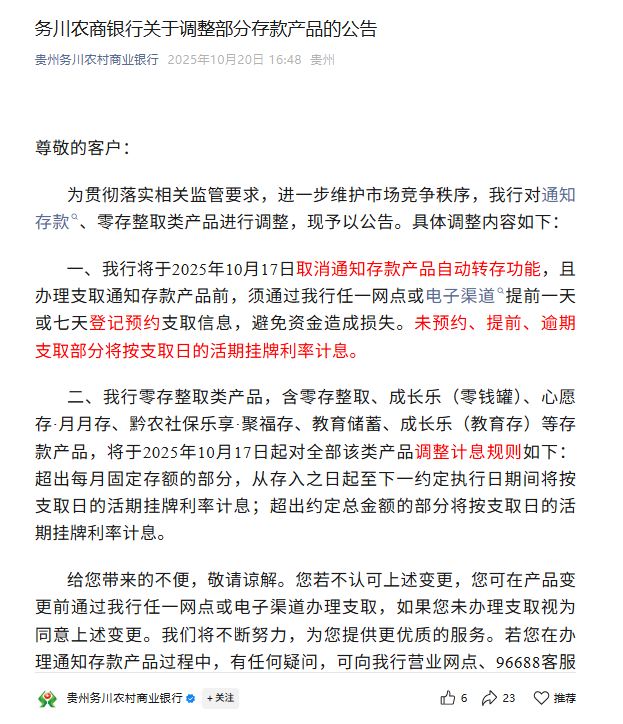
Core Viewpoint - Recent adjustments by several banks in Guizhou province, including the cancellation of automatic renewal for notice deposits, reflect a response to regulatory requirements aimed at maintaining market order and reducing high-interest deposit products [1][2][4]. Group 1: Bank Adjustments - Guizhou Wuchuan Rural Commercial Bank announced the cancellation of the automatic renewal feature for notice deposit products effective October 17, 2023, requiring customers to register for withdrawals in advance [2][4]. - Over ten banks in Guizhou, including Chishui Rural Credit Union and Wanshan Changzheng Village Bank, have made similar announcements regarding notice deposits [4]. - Beijing Bank has also adjusted its notice deposit rates, linking new unit notice deposits to its published rates starting October 1, 2025, with automatic interest calculation based on rate changes during the deposit period [4]. Group 2: Market Trends - The adjustments by smaller banks are seen as a continuation of trends initiated by larger state-owned and joint-stock banks, which began phasing out high-interest notice deposit products in the second half of last year [6]. - The overall pressure on banks' interest margins has led to a reduction in high-interest deposit products, with some banks exploring alternative methods for attracting deposits, such as issuing large-denomination certificates of deposit [6][7]. - The decline of high-interest deposits and the continuous reduction of fixed deposit rates may encourage customers to shift their savings towards bank wealth management products and gold investments [7].


降字当先,多家中小银行取消自动转存,能否助推“存款搬家”?
Feng Huang Wang· 2025-10-21 08:34
Core Viewpoint - Recent adjustments by several small and medium-sized banks in Guizhou Province, including the cancellation of automatic renewal for notice deposits, reflect a response to regulatory requirements aimed at maintaining market order and reducing high-interest deposit products [1][2][5]. Group 1: Regulatory Changes - Guizhou Wuchuan Rural Commercial Bank announced the cancellation of the automatic renewal feature for notice deposits effective October 17, in line with regulatory directives [1][2]. - Over ten banks in Guizhou, including rural credit cooperatives and village banks, have issued similar announcements regarding the adjustment of notice deposit products [5]. - Beijing Bank has also adjusted its notice deposit rates, linking new unit notice deposits to its listed interest rates starting October 1, 2025 [5]. Group 2: Market Impact - The adjustments by local banks are seen as a move to lower notice deposit interest rates and align them more closely with demand deposit rates [5][6]. - Major state-owned banks and most joint-stock banks had already halted automatic renewal of notice deposits in the second half of last year, indicating a broader industry trend [6]. - The disappearance of high-interest deposits and the continuous decline in fixed deposit rates may encourage customers to shift their funds towards bank wealth management products and gold investments [7]. Group 3: Industry Dynamics - The pressure on banks' interest margins has increased, prompting them to reduce high-interest deposit products while seeking alternative methods to attract deposits [6]. - The competitive landscape among banks remains intense, with the potential for some high-interest products to re-emerge in the future [6].
存款搬家结束了吗?
Western Securities· 2025-10-19 05:31
1. Report Industry Investment Rating There is no information provided in the report regarding the industry investment rating. 2. Core Viewpoints of the Report - The slowdown of deposit relocation does not mean it has ended. Further data observation is needed as the YoY growth rate of non - bank deposits remains at a relatively high level, and there are seasonal disturbances. Asset relocation may continue due to factors such as the high economic base and trade frictions in Q4 [2][14] - The bond market is likely to remain weakly volatile. A defensive approach is recommended, with control over the duration level, and seizing allocation and trading opportunities after adjustments [3][15] 3. Summary by Relevant Catalogs 3.1 Review Summary and Bond Market Outlook - This week, the bond market showed a "first decline then rise" trend. The 10Y and 30Y Treasury bond rates changed by +0.4bp and -3bp respectively. Market sentiment was affected by factors such as US - China negotiation signals, stock market trends, and economic data [10] - Deposit relocation accelerated in July and August but slowed down in September. It is still too early to conclude that it has ended [11][14] - The bond market is expected to be weakly volatile. It is recommended to focus on defense, control the duration, and choose to allocate certificates of deposit and short - term interest - rate bonds [15] 3.2 Bond Market Review 3.2.1 Fundamentals - The central bank had a net withdrawal this week, and the capital interest rate increased. Next week, the maturity volume of reverse repurchases is less than that of the previous week [16] - The R001 and DR001 increased by 5bp and 1bp respectively compared to October 11th. The 3M certificate of deposit issuance rate first rose, then fell, and then rose again [18] 3.2.2 Secondary Market Trends - Bond yields first rose and then fell. Except for the 7Y, 20Y, and 30Y Treasury bonds, the yields of other key - term Treasury bonds increased. Most of the term spreads of Treasury bonds narrowed [26] - The spread between new and old 10Y Treasury bonds first widened and then narrowed, the spread of 10Y China Development Bank bonds widened negatively, and the spread of 30Y Treasury bonds narrowed [29][30] 3.2.3 Bond Market Sentiment - The median duration of the full - sample bond funds slightly increased. The turnover rate of ultra - long bonds increased, and the 30Y - 10Y Treasury bond spread narrowed rapidly. The inter - bank leverage ratio rose to 107.6%, and the exchange leverage ratio decreased to 122.4%. The implied tax rate of 10 - year China Development Bank bonds slightly narrowed [33] 3.2.4 Bond Supply - This week, the net financing of interest - rate bonds decreased. Next week, the issuance scale of Treasury bonds will increase, and the 10Y Treasury bond 250016.IB will be re - issued. The issuance scale of local government bonds will also increase [48][51] - The net financing of certificates of deposit increased this week, and the average issuance rate rose to 1.63% [53] 3.3 Economic Data - In September, the import and export growth rates significantly rebounded, and prices generally recovered. The YoY decline of the freight rate index slowed down in October, and industrial production improved marginally [59][60] - The YoY growth rate of non - bank deposits declined in September, and the M1 growth rate increased [60] 3.4 Overseas Bond Market - The release of key US inflation data was postponed due to the government "shutdown." The expectation of a Fed rate cut in October has increased again, mainly due to the weak employment market [69] - US bonds rose, and most emerging markets had more gains than losses [70] 3.5 Major Asset Performance - The Shanghai Gold Index performed the best, followed by Chinese - funded US dollar bonds, Chinese bonds, the US dollar, convertible bonds, Shanghai Copper, rebar, the CSI 300 Index, live pigs, the CSI 1000 Index, and crude oil [74] 3.6 Policy Review - On October 17th, multiple policies were introduced, including promoting logistics cost reduction, expanding green trade, adjusting the Hainan duty - free shopping policy, and more. These policies aim to support economic development and stabilize market expectations [77][82]
存款搬家延续,理财公司增资潮起
Sou Hu Cai Jing· 2025-10-18 10:36
Core Insights - The rapid increase in bank wealth management products is driven by a shift in deposits, with a notable rise in non-bank deposits and a decrease in resident deposits, indicating a trend of residents moving their savings into wealth management products [2][3] Group 1: Market Growth - As of June 2023, the total scale of the bank wealth management market reached 30.67 trillion yuan, reflecting a year-on-year growth of 7.53% [2] - In July 2023, non-bank deposits increased by 2.14 trillion yuan, while resident deposits decreased by 1.11 trillion yuan, highlighting the ongoing trend of "deposit migration" towards wealth management products [2] Group 2: Capital Increase Trends - Wealth management companies have begun a significant capital increase trend, with four companies increasing their registered capital this year alone, surpassing the total number of capital increases in 2022 [3][4] - The registered capital of Xinyin Wealth Management was raised from 5 billion yuan to 10 billion yuan, marking a 100% increase [3] Group 3: Regulatory and Strategic Drivers - The capital increases are driven by regulatory compliance, business expansion, and strategic positioning, as companies must meet specific net capital requirements [4] - The management scale of Xinyin Wealth Management reached 2.32 trillion yuan, growing by 6.34% compared to the end of 2022, necessitating capital supplementation due to increased risk capital consumption [4][5] Group 4: Investment Strategy and Product Diversification - The increase in capital allows wealth management companies to enhance their investment in high-risk assets, such as equity and non-standard assets, thereby expanding their product offerings [6] - Analysts suggest that the capital increase serves as a buffer against potential investment losses, enabling companies to develop a more diverse product matrix [6] Group 5: Future Outlook - Industry experts predict that capital increases will become a normalized action in the coming years as companies enter a new phase of development [7][8] - The trend of "deposit migration" is expected to continue in the medium to long term, driven by a low-interest-rate environment and a shift in residents' asset allocation strategies [7]

非银存款连续两个月同比少增,存款搬家正在潮落
Hua Xia Shi Bao· 2025-10-18 05:56
Core Insights - The transfer of bank deposits to non-bank financial institutions can be described as a "tide rising and falling" phenomenon, where deposits move to wealth management and bond funds when deposit yields are lower than bond market returns [2] - In the first half of this year, there was a significant increase in non-bank deposits due to a wealth effect from rising capital markets, but the growth rate began to decline in August and September [2][3] - The latest data from the central bank indicates a decrease of 1.06 trillion yuan in non-bank deposits in September, with a year-on-year reduction of 1.97 trillion yuan [2] - In contrast, non-bank deposits increased by 1.18 trillion yuan in August, showing a year-on-year increase of 0.55 trillion yuan, but a month-on-month decrease of nearly 1 trillion yuan [2] - The trend of deposit migration peaked in July, with a notable increase in non-bank deposits, but this trend has started to slow down in August and September [3] Deposit Trends - In the first three quarters of this year, non-bank financial institution deposits increased by 4.81 trillion yuan, compared to an increase of 4.5 trillion yuan in the same period last year, indicating a slowdown in growth in the third quarter despite a strong first half [3] - Household deposits increased by 12.73 trillion yuan in the first three quarters, while non-financial enterprise deposits rose by 1.53 trillion yuan, a significant improvement from a decrease of 2.11 trillion yuan last year [3][4] - The increase in enterprise deposits is attributed to government bond issuance and local governments' efforts to clear overdue payments to businesses, which has improved corporate financial conditions [3][4] M1 and Investment Behavior - M1 has shown continuous improvement for five months, indicating an increase in demand deposits, which are primarily held for further investment rather than for earning interest [4] - The phenomenon of "deposit migration" reflects a reallocation of assets by residents in response to changes in asset return rates, indicating a broader risk appetite [4] - The growth of non-bank financial institution deposits is also linked to the increased regularization of non-bank deposits and a rise in interbank certificates of deposit [4][5] Regulatory Impact - In December 2024, new regulations aimed at curbing fund circulation will affect non-bank interbank deposit rates, but the current data suggests that the impact on non-bank deposits has been limited [5] - The sudden decrease in non-bank deposits in September indicates a potential shift in investor risk preferences, as rational investors may begin to move back towards deposit markets or fixed-income markets as capital markets reach certain heights [5]