
电动化转型

Search documents
记者实探2025成都车展 自主品牌成绝对主力
Di Yi Cai Jing· 2025-08-28 11:43
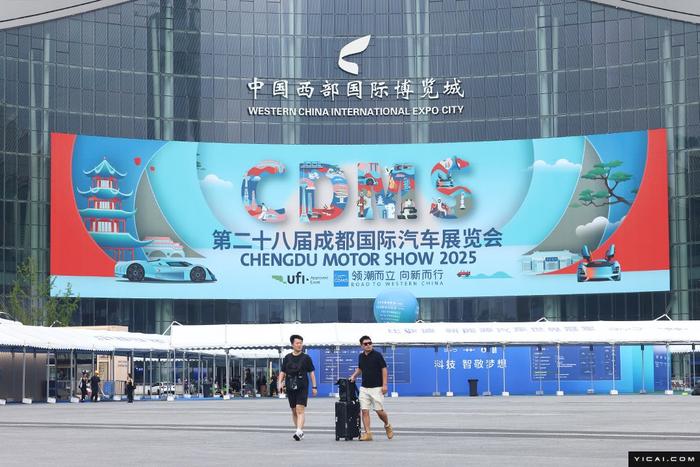
Core Insights - The 2025 Chengdu International Auto Show will be held from August 29 to September 7, featuring nearly 120 automotive brands and over 1,600 vehicles on display across an exhibition area of 220,000 square meters, covering key industry topics such as complete vehicles, modified cars, and the three electric systems [2] Group 1 - The area dedicated to new energy brands at the Chengdu Auto Show has expanded by 40% compared to last year, reaching a historical high [4] - Volvo's new XC70, which is the first model based on the new SMA super hybrid architecture, was globally launched at the event, marking Volvo's entry into the super hybrid market and a key step in its electrification strategy [6] - The Hongmeng Intelligent Driving system has achieved a milestone by collaborating with SAIC to launch the Shangjie H5 model, which features a 192-line laser radar and Hongmeng cockpit [8] Group 2 - The Mercedes-Benz booth showcased the new AMG CLE 53 4MATIC+ convertible and the all-new pure electric CLA, while the BMW M3 E46 GTR official replica version made its debut at the domestic auto show [10] - Great Wall Motors presented a high-tech smart cockpit concept car resembling a time machine [12] - NIO displayed its Firefly car, while staff were seen setting up outdoor promotional advertisements for Li Auto [13]

比亚迪7月欧洲销量暴增超200%,市占率超越特斯拉
Hua Er Jie Jian Wen· 2025-08-28 08:25
Core Insights - The European automotive market experienced its largest growth in 15 months in July, driven by a surge in demand for electric and hybrid vehicles, with new car registrations increasing by 5.9% year-on-year to 1.09 million units [1][2] Group 1: Market Performance - Plug-in hybrid vehicles saw the most significant increase, with sales soaring by 52% year-on-year, while pure electric vehicle sales grew by over 39.1%, marking the best performance since January [1][2] - Traditional hybrid vehicles remain the largest single category in the European market, accounting for over one-third of new registrations [2] - Total sales of pure electric, hybrid, and plug-in hybrid vehicles combined increased by 39.1%, representing 59.8% of new registrations, up from 51.1% in the previous year [2] Group 2: Brand Performance - BYD's sales surged by 225.3%, capturing a market share of 1.2%, while Tesla's sales plummeted by 40.2%, reducing its market share from 1.4% to 0.8% [3] - Traditional European automakers like Volkswagen and Ford achieved double-digit growth, with registrations increasing by 11.6% and 8.8%, respectively [3] Group 3: Challenges and Regulatory Environment - Despite the sales rebound, the European automotive industry faces challenges from U.S. tariffs disrupting supply chains and increasing market competition [1][4] - Industry executives have warned the EU that stringent environmental targets are unrealistic, with calls for a reevaluation of the 2035 goal for 100% zero-emission new cars [4] - The EU has responded by granting a three-year buffer period for stricter carbon dioxide emission targets [5]


中美市场双引擎驱动,丰田(TM.US)7月全球产销量再创历史新高
Zhi Tong Cai Jing· 2025-08-28 07:05
Group 1 - Toyota's global sales reached a record high in July, marking the seventh consecutive month of growth, driven by strong demand in the US and China despite global trade uncertainties [1] - In July, global sales (including subsidiaries Daihatsu and Hino) increased by 4% year-on-year to 963,796 units, with overseas market sales growing by 6% [1] - North America showed exceptional performance with a 20% increase in sales, supported by strong demand for trucks, SUVs, and hybrid models [1] Group 2 - In the first half of 2025, Toyota's global sales also hit a record high, with a 7.4% year-on-year increase, surpassing 5.5 million units, and production rising by 8.8% to 5.5 million units [2] - The US remains Toyota's largest export market, with sales reaching $40.8 billion last year, although tariff impacts have significantly affected the company [2] - Toyota has lowered its operating profit forecast for the fiscal year 2025 from 3.8 trillion yen to 3.2 trillion yen, anticipating a tariff impact of 1.4 trillion yen (approximately $9.5 billion) [2] Group 3 - Traditional Japanese automakers like Toyota face dual challenges from fluctuating trade policies and competition from emerging electric vehicle companies like BYD and Tesla [2] - While hybrid technology still holds market advantages, the intensifying competition in the pure electric vehicle sector is pushing Toyota to accelerate its transformation [2] - Balancing traditional strengths with the shift towards electrification will be a key focus for Toyota in the future [2]

欧洲7月汽车销量创15个月最大增幅,比亚迪市占率超越特斯拉
Hua Er Jie Jian Wen· 2025-08-28 06:15
Core Insights - The European automotive market experienced its largest growth in 15 months in July, driven by a surge in demand for electric and hybrid vehicles, with new car registrations increasing by 5.9% year-on-year to 1.09 million units [1][2] - Plug-in hybrid vehicles saw the most significant increase, with sales soaring by 52%, while pure electric vehicle sales grew by over one-third, marking the best performance since January [1][2] - Despite the sales rebound, European automakers face challenges such as U.S. tariffs disrupting supply chains and intensified market competition [1][4] Market Performance - The growth in July was primarily fueled by new energy vehicles, with plug-in hybrids and pure electric vehicles collectively accounting for 59.8% of new registrations, up from 51.1% a year earlier [2] - Germany saw an 11.1% increase in sales, while Spain, Poland, and Austria recorded growth rates of 17.1%, 16.5%, and 31.6%, respectively; however, the UK, France, and Italy experienced declines of 5%, 7.7%, and 5.1% [2] Brand Dynamics - Traditional European automakers like Volkswagen and Ford achieved double-digit growth, with registrations increasing by 11.6% and 8.8%, respectively; Stellantis saw a slight decline of 1.1% [3] - BYD's sales skyrocketed by 225.3%, capturing a market share of 1.2% and surpassing Tesla, which experienced a 40.2% drop in sales, reducing its market share from 1.4% to 0.8% [3] Regulatory and Trade Challenges - The automotive industry continues to face headwinds, including the ongoing impact of tariffs and concerns over the EU's stringent environmental targets [4][5] - The EU has provided a three-year buffer for automakers regarding stricter CO2 emission targets, responding to industry concerns about the feasibility of achieving 100% zero emissions for new cars by 2035 [5] - Some countries are reintroducing or extending subsidies to stimulate electric vehicle demand, such as the UK's recent reintroduction of a £3,750 purchase subsidy [5]
调研速递|中汽股份接受全体投资者调研,业绩增长与并购布局成焦点
Xin Lang Cai Jing· 2025-08-27 10:02
Core Viewpoint - The company held a half-year performance briefing on August 27, 2025, discussing its financial results, business adjustments, market value management, and shareholder interests [1][2]. Financial Performance - For the first half of 2025, the company reported revenue of approximately 213 million yuan, a year-on-year increase of 24%, and a net profit of about 102 million yuan, up 32% [2]. - The growth was driven by increased industry demand and the transformation towards automotive intelligence and electrification, benefiting the company as a third-party testing platform [2]. Business Strategy - The acquisition of the Extreme Testing Center will enhance the company's business layout, allowing it to cover testing from normal to extreme cold environments, thus establishing a comprehensive testing service [2]. - The company aims to create a systematic market value management mechanism, linking market performance with strategic planning and operational goals [2]. Shareholder Interests - The company has continuously returned approximately 300 million yuan in cash dividends over four years and plans to develop a reasonable profit distribution plan for 2025 [2]. - The acquisition is expected to complement customer bases and open new business growth points, ensuring long-term returns for minority shareholders [2]. Financial Health - As of June 30, 2025, the company had a cash balance of 534 million yuan, which remains sufficient after the payment of 111 million yuan for the acquisition [2]. - The acquired company reported revenue of 71.34 million yuan and a net profit of 15.27 million yuan from January to April 2025, contributing positively to the company's financial metrics post-acquisition [2]. Market Position and Future Outlook - The company is assessing opportunities for national expansion and exploring feasibility for overseas operations in response to the growth of automotive enterprises [2]. - The second phase of the Yangtze River Delta (Yancheng) intelligent connected vehicle testing site generated approximately 26 million yuan in revenue, achieving a near break-even point [2]. Industry Standards - The implementation of the "Safety Requirements for Intelligent Connected Vehicle Combination Driving Assistance Systems" is expected to shift testing demands from voluntary to mandatory compliance, potentially increasing the company's testing revenue [2].
韩国五大集团抱团发力电池!
起点锂电· 2025-08-25 10:24
Core Viewpoint - The article discusses the challenges faced by South Korean battery manufacturers, particularly in the context of increasing competition from Chinese companies like CATL and BYD, leading to significant financial losses and a strategic shift towards lithium iron phosphate (LFP) batteries [4][6][10]. Group 1: Industry Challenges - In 2020, South Korean battery manufacturers had a strong market presence, with LG Chem holding nearly 30% of the global market share [6]. - By 2023, the market share of South Korean battery manufacturers has significantly declined due to the rise of Chinese competitors, resulting in substantial financial losses for companies like LG Energy, SK On, and Samsung SDI [6][8]. - The financial reports for Q4 2023 revealed losses of 2.255 trillion KRW (approximately 10 billion RMB) for LG Energy, 3.594 trillion KRW for SK On, and 2.683 trillion KRW for Samsung SDI, indicating a severe downturn in profitability [6]. Group 2: Strategic Shifts - In response to market pressures, South Korean battery manufacturers are pivoting towards LFP battery technology, with LG Energy and SK On announcing plans to transition their production lines [10]. - The South Korean government is launching a support plan worth 45.8 trillion KRW (approximately 2.349 billion RMB) to bolster the battery, semiconductor, and critical mineral industries, including 600 billion KRW specifically for small and medium-sized enterprises in materials and components [10]. Group 3: Automotive Sector Developments - Hyundai and Kia are attempting to regain market share in China, with Kia reporting a 13% year-on-year increase in sales in the first half of 2023, attributed to its electric vehicle strategy [12][13]. - Hyundai plans to launch 21 electric vehicle models by 2030 and is also focusing on solid-state battery technology, with ongoing research projects related to lithium metal and solid-state batteries [13][14].


三一重工(600031):2025H1海内外收入双增,Q2盈利能力持续提升
Dongguan Securities· 2025-08-25 03:34
Investment Rating - The report maintains a "Buy" rating for the company [1][7]. Core Insights - The company achieved a revenue of 447.80 billion yuan in H1 2025, representing a year-on-year growth of 14.64%, with a net profit of 52.16 billion yuan, up 46.00% year-on-year [4]. - The construction machinery industry continues to recover, benefiting from national major engineering projects, with significant growth in domestic demand for core products [4]. - The company's overseas revenue reached 264.91 billion yuan in H1 2025, a year-on-year increase of 11.59%, accounting for 59.16% of total revenue [4]. - The company is transitioning towards electrification, focusing on three major technological routes: pure electric, hybrid, and hydrogen fuel [5]. Summary by Sections Financial Performance - In H1 2025, the company's gross margin was 27.44%, a decrease of 0.80 percentage points year-on-year, while the net margin improved by 2.45 percentage points to 11.87% [4]. - The company’s revenue from excavators was 174.97 billion yuan, up 15.00% year-on-year, maintaining the top position in the domestic market [4]. - The company’s net profit forecast for 2025 is 86.15 billion yuan, with an expected EPS of 1.02 yuan [6][7]. Market Position - The company holds a leading position in various machinery segments, including a 40% market share in large and medium-sized crawler cranes [4]. - The company’s international strategy has led to significant market share increases in overseas regions, particularly in Africa, where revenue grew by 40.48% [4]. Future Outlook - The company is expected to benefit from ongoing national infrastructure projects, which will support long-term domestic demand [4]. - The forecasted EPS for 2026 and 2027 are 1.27 yuan and 1.50 yuan, respectively, with corresponding PE ratios of 17 times and 14 times [7].

获5亿美元资金承诺!路特斯官宣
Xin Lang Cai Jing· 2025-08-25 01:21
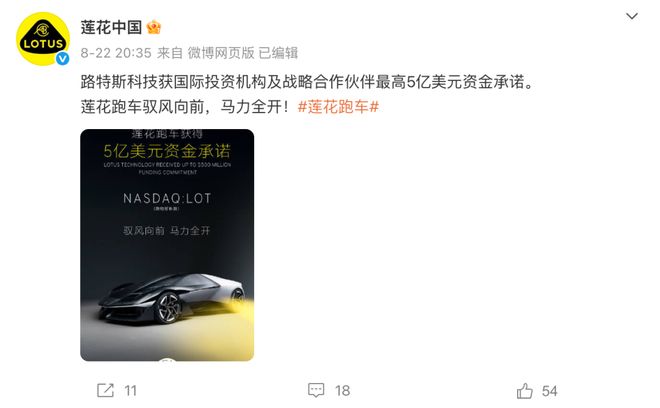
Core Viewpoint - Lotus has secured a total funding commitment of up to $500 million (approximately 3.7 billion RMB) from international investment institutions and strategic partners, including a $300 million (approximately 2.15 billion RMB) convertible note agreement with ATW Partners and a $200 million (approximately 1.6 billion RMB) credit facility from Geely [1][4]. Group 1 - Lotus Cars, known for its high-performance sports cars, was founded in 1952 and has undergone a transformation into an electric vehicle brand since its acquisition by Geely in 2017 [4]. - The company aims to complete its transition to electrification and intelligence by 2028, coinciding with its 80th anniversary [4]. - Lotus has established a global market presence with sales regions in Europe, China, the Americas, the Middle East, and Asia-Pacific [4]. Group 2 - In early 2025, Lotus rebranded itself in the Chinese market as "Lotus Cars," and launched new models ELETRE and EMEYA with significant price reductions, which led to customer dissatisfaction [7]. - The company announced a change in leadership, with Mao Jingbo stepping down as China President to become Chief Sales Officer, while Qin Peiji took over the role [8]. - Despite being a renowned luxury sports car brand, Lotus has faced challenges with sales performance, reporting a 20.8% decline in sales in China for 2024, with total deliveries of 12,065 vehicles [9]. Group 3 - Lotus is currently in a loss-making position compared to competitors like Ferrari and Porsche, which have higher brand recognition and sales [11]. - The new funding from ATW Partners is seen as a vote of confidence in Lotus's ongoing business development and transformation efforts [11].
中国工程机械智能化进阶 “无人工地”照进现实
Zheng Quan Shi Bao· 2025-08-24 18:37
Core Viewpoint - The Chinese construction machinery industry is undergoing a significant digital and green transformation, with companies like Zoomlion leading the way in autonomous and intelligent construction equipment [1] Group 1: Technological Advancements - The operation of concrete pump trucks has been simplified to a single joystick control, reducing the complexity from seven handles to one, enhancing precision and safety [2] - Zoomlion's autonomous construction equipment includes various machines such as concrete pump trucks, cranes, and excavators, all capable of self-operation and coordination [3] - The transition to electric-powered machinery has resulted in quieter operations, contributing to a more pleasant working environment [3] Group 2: Efficiency and Productivity - The implementation of intelligent construction systems has led to a 90% reduction in task briefing time, a 28% decrease in waiting time, and a 30% shortening of construction cycles, with labor efficiency increasing by 300% [5] - The integration of AI models is being explored to enable machines to autonomously interpret and execute tasks based on natural language commands [5] Group 3: Safety and Worker Welfare - The shift towards automation and intelligent machinery aims to enhance worker safety by removing them from hazardous environments, allowing them to focus on higher-skilled tasks [6] - The development of smart mining solutions has significantly improved safety and efficiency in extreme working conditions, such as those found in northern metal mines [6] Group 4: Future Outlook - Upcoming major projects, such as the Yaxia Hydropower Station and the New Tibet Railway, will require advanced construction techniques in challenging environments, emphasizing the need for green and digital solutions [6]

深读100:美联储9月降息“大局已定”?
Mei Ri Jing Ji Xin Wen· 2025-08-24 14:30
Group 1 - The Federal Reserve Chairman Powell's speech at Jackson Hole is interpreted as a clear signal for a rate cut in September, leading to a rise in U.S. stocks and a decline in U.S. Treasury yields [1] - There are significant divisions within the Federal Reserve, with dovish, hawkish, and centrist factions, creating uncertainty about future policy directions [1] Group 2 - Analysis of fiscal data from the first seven months of 2025 shows a pronounced "investment in people" characteristic, with notable increases in spending on health, social security, and employment, as well as in cultural, tourism, and education services [1] - Related expenditures may further increase as policies are implemented [1] Group 3 - Joint venture automakers are beginning to show results in their transformation, with companies like GAC Toyota making strides in electrification, such as the launch of the Platinum Smart 3X, and planning for the Platinum Smart 7 and a new Vellfire model [1] - This dual strategy of electrification and updating existing products may serve as a model for other joint venture automakers [1] Group 4 - Major players in the marinated food sector, including Juewei, Zhou Hei Ya, and Jiujiu Ya, are collectively seeking transformation due to slowing growth in the marinated food market [1] - Juewei has launched "Juewei Plus" to sell a diverse range of products, Zhou Hei Ya has introduced "3 Jin Ban" for hot marinated fast food, and Jiujiu Ya is upgrading its stores to "Hot Pot Fresh Marinated" [1]