资产荒

Search documents
保险视角如何展望下半年市场?
2025-07-19 14:02
Summary of Conference Call Records Industry Overview - The records primarily discuss the **insurance industry** in China, focusing on market conditions, economic factors, and the implications for insurance companies and their investment strategies [1][2][3][17]. Key Points and Arguments Economic Conditions - Since September 2024, the **Chinese economy** has shown continuous improvement, although financial data has recently shown signs of decline, particularly in real estate sales [1][3]. - The main contradiction in the macro economy for 2025 is the **insufficient effective demand** and relatively excessive capacity, characterized by weak consumption and strong manufacturing [2]. Interest Rates and Market Dynamics - The **cost of interbank funds** is decreasing at a slower rate than general interest rates, posing challenges for market yield declines [4]. - The expectation is for a **loose funding environment** in the future, with short-term interest rates having room to decline, particularly from June to August [5]. - Insurance institutions are experiencing a decline in liability costs, with the expected rate potentially dropping from **2.5% to 2.0%**, enhancing the attractiveness of long-term local government bonds [6]. Risks and Market Behavior - Major risks include potential **policy stimulus** exceeding expectations, leading to divergences in long-term logic, and a strong stock market potentially accelerating the shift of funds from the bond market to equities [7]. - The **insurance sector** is facing dual anxieties of asset scarcity and interest rate risk, prompting adjustments in investment strategies [8]. Investment Strategies - Insurance companies are adjusting their positions based on liability dynamics and increasing participation in trading, while also utilizing interest rate derivatives to hedge against long-term interest rate risks [8]. - The rapid growth of traditional insurance premiums is attributed to the faster decline in deposit rates compared to insurance product yields, making insurance products more attractive [13][11]. Future Outlook - The outlook for premium income in the second half of the year is uncertain, with expectations of potential rate cuts but no clear indication of whether this will occur [20]. - The relationship between deposits, the stock market, and insurance products is characterized by **substitutability**, where declining deposit rates could lead to increased investment in insurance products, while strong stock market performance could divert funds away from insurance [22][23]. Regulatory and Accounting Considerations - Attention is needed on variables such as **credit spreads**, **term spreads**, and the impact of new accounting standards (IFRS 9) on asset classification and reporting, which will influence asset allocation strategies [16]. Additional Important Insights - The **insurance industry** is increasingly favoring equity assets, with a reported increase in stock holdings by 1% in the first quarter of 2025, reflecting a shift towards lower volatility dividend stocks [18]. - The influx of insurance premiums in mid-2024 led to a subsequent decline in expected premium inflows, highlighting the fixed nature of potential buyers and total premium volume [21]. This summary encapsulates the critical insights from the conference call records, providing a comprehensive overview of the current state and future outlook of the insurance industry in China.
从“资产荒”角度看“内卷”的深层原因
李迅雷金融与投资· 2025-07-19 06:51
Group 1 - The article discusses the concept of "anti-involution" and its significance in the context of supply-side structural reforms, emphasizing the need to analyze the root causes of involution to effectively address it [1] - The capital market is experiencing two main trends: a decline in risk appetite and a decrease in risk-free investment returns, leading to an "asset shortage" phenomenon [1][2] - The yield on China's 10-year government bonds dropped to a record low of 1.55% in April, indicating a persistent "asset shortage" that affects both capital markets and the real economy [1] Group 2 - The profit margins of large-scale manufacturing enterprises have been declining, with profit rates falling from 5.35% in 2021 to 4.25% in the first five months of 2024 [2][5] - The revenue generated per 100 yuan of assets for large-scale manufacturing enterprises has decreased from 107 yuan in 2022 to 85.2 yuan in the first five months of 2024 [2][5] - The phenomenon of "involution" in competition is characterized by price wars among enterprises, leading to increased volume without corresponding revenue or profit growth [5] Group 3 - The export price index for China's goods has dropped by 15% from January 2023 to September 2024, indicating a significant decline compared to other emerging economies [8] - The average accounts receivable period for large-scale manufacturing enterprises has increased from 54 days in 2022 to 71.7 days in the first five months of 2024, reflecting financial pressures [11] - The capacity utilization rate for large-scale manufacturing enterprises has decreased from 75.8% in 2022 to 74.2% in the first half of 2024, highlighting the oversupply situation [12] Group 4 - The increase in manufacturing investment has outpaced overall investment growth since 2021, with manufacturing investment growth rates exceeding overall rates by 8.6 to 6 percentage points from 2021 to 2024 [15] - Local governments are incentivized to boost manufacturing investment to meet GDP targets, leading to potential overcapacity in certain sectors [21][23] - The manufacturing sector has seen significant investment in new industries, with production in solar batteries, lithium batteries, and electric vehicles exceeding global demand [26] Group 5 - Consumer spending is closely tied to income expectations, with urban non-private unit average wage growth slowing from 6.7% in 2022 to 2.8% in 2024 [29][30] - The high savings rate in China, at 42.49% in 2023, reflects a preference for low-risk assets over riskier investments, contributing to the "asset shortage" [39][40] - The income distribution disparity, where the top 20% of households account for 45.5% of disposable income, hampers overall consumption growth [35][46] Group 6 - The article draws parallels between the current "anti-involution" movement and the supply-side structural reforms of a decade ago, highlighting the need for a shift in focus from supply-side measures to stimulating consumer demand [56][62] - The current economic environment differs significantly from that of ten years ago, with reduced potential in real estate demand and a more cautious consumer sentiment [57][58] - The strategies for "anti-involution" should include reducing excess capacity, minimizing ineffective investments, and increasing household income to stimulate consumption [62]


央妈突发释放暖意!7月19日,下周a股会怎么走?
Sou Hu Cai Jing· 2025-07-18 18:35
Group 1 - The central bank conducted a 1.4 trillion yuan reverse repurchase operation, marking a new high for single-day injections in three months, alleviating market concerns about "asset scarcity" [1] - Social financing data at the end of June exceeded expectations, indicating that the effects of implemented monetary policies will continue to manifest [1] - The Shanghai Composite Index's performance is distorted due to significant gains in bank stocks, while sectors like new energy, traditional pharmaceuticals, and old consumption have not recovered to 2021 levels, suggesting potential for future rebounds [1] Group 2 - Major indices closed in the green, with technology stocks, particularly in AI and robotics, showing unexpected strength, while banks faced selling pressure [3] - The performance of technology stocks indicates a positive sentiment from investors, suggesting that there is no urgency to cash out despite some pressure [3] - The banking sector's rebound is not seen as offering value, while low-priced consumer stocks like liquor are experiencing a rotation [4] Group 3 - The Shanghai Composite Index rose by 0.50%, reaching a new closing high for the year, with the Shenzhen Component and ChiNext Index also showing gains [7] - The market's large-cap blue-chip stocks performed strongly, with only a few declines among the top market capitalizations, indicating robust market strength [7] - Technical analysis suggests that the index is approaching a key resistance level at 3555 points, with volume being a critical factor for potential breakout or pullback [7]
银行股上涨的市场结构性因素探讨
Zheng Quan Shi Bao· 2025-07-18 17:10
Core Viewpoint - The recent surge in bank stocks has become a focal point in the stock market, driven by structural market factors and institutional investment, despite a generally weak market environment [1][2][3]. Group 1: Market Performance - The bank industry index increased by approximately 40% from October 2022 to July 2023, significantly outperforming the broader market [2]. - By mid-July, the bank index surpassed 2300 points, representing a 140% increase since October 2022 [3]. Group 2: Investment Dynamics - Institutional investors have primarily driven the investment in bank stocks, attracted by high dividend yields and stable performance, while individual investors have been less active [2][3]. - The investor structure has shifted, with long-term investors entering the market alongside active trading investors, enhancing price elasticity and contributing to the popularity of bank stocks [4]. Group 3: Regulatory and Policy Support - Regulatory measures, including the intervention of state-owned entities to increase holdings in major banks, have supported the upward trend in bank stocks [2][3]. - A series of policies aimed at boosting the capital market, particularly those facilitating liquidity for financial institutions, have further benefited bank stocks [3].
含权理财半年考:可转债、公募REITs成收益引擎
2 1 Shi Ji Jing Ji Bao Dao· 2025-07-18 15:40
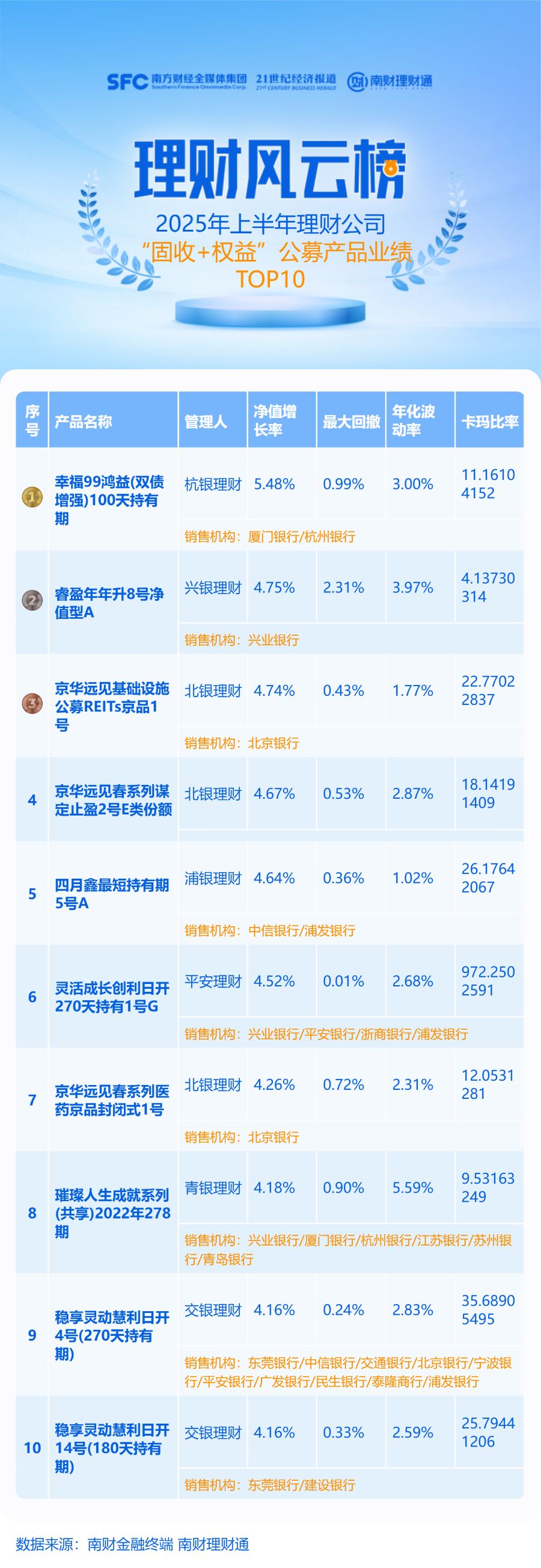
Overall Performance - In the first half of 2025, the bond market entered a high volatility phase, while the A-share market showed a mild upward trend. The "fixed income +" products promoted by bank wealth management performed well, with one product yielding over 5% and five products yielding over 4.5% [4] - Among the top ten "fixed income + equity" products, Beiyin Wealth Management stood out with three products making the list, while Jiaoyin Wealth Management had two products. Other products came from five different wealth management companies [4] - The top-ranked product, "Happiness 99 Hongyi (Double Bond Enhancement) 100-Day Holding Period" from Hangyin Wealth Management, achieved a net value growth rate of 5.48% [4] Highlighted Product Analysis - The top product, "Happiness 99 Hongyi (Double Bond Enhancement) 100-Day Holding Period," is a medium-risk public fixed income product with a minimum holding period of 100 days. Its high yield is primarily attributed to investments in convertible bonds, alongside fixed income and equity assets [5][6] - The second-ranked product, "Ruiying Year-on-Year Growth No. 8," is a one-year fixed income product that has seen a significant drop in total shares, down over 65% from the previous year. However, it rebounded in 2025 with a net value growth rate of 5.42% due to a shift towards more active management and increased equity positions [6][9] - The third-ranked product, "Jinghua Vision Infrastructure Public REITs," benefited from the strong performance of the public REITs market, achieving a net value growth rate of 4.74%. The product primarily invests in short-duration credit bonds and REITs [10] Market Performance - In the first half of 2025, the A-share market showed a mixed performance, with the North Exchange market being the standout performer, as the North Certificate 50 Index rose by 38.72%. The broader indices, such as the Shanghai Composite Index and Shenzhen Component Index, increased by 2.76% and 0.48%, respectively [14] - Traditional cyclical and financial sectors became safe havens for funds, with the non-ferrous metals, banking, and defense industries leading in gains [14] Product Performance - Industry-specific products yielded strong returns, with five industry index theme products from Huaxia Wealth Management entering the top ten, focusing on precious metals and micro-growth styles, both exceeding 25% in gains [14] - The product "Sunshine Red Infrastructure Public REITs Preferred No. 1" from Everbright Wealth Management achieved third place, with over 80% of its assets allocated to public REITs, benefiting from stable cash flow returns amid low bond yields [14]
杭州银行上半年净利增至116亿,遭遇股东逢高“清仓”
Nan Fang Du Shi Bao· 2025-07-18 12:23
Core Viewpoint - Hangzhou Bank reported its first half of 2025 earnings forecast, showing revenue growth of 3.9% and net profit growth of 16.7%, despite a slight decline in return on equity (ROE) due to dilution from convertible bond conversions [2][3][5]. Financial Performance - For the first half of 2025, Hangzhou Bank achieved revenue of 20.093 billion yuan, up 3.9% from 19.34 billion yuan in the same period of 2024 [4]. - The net profit attributable to shareholders was 11.662 billion yuan, reflecting a 16.7% increase from 9.996 billion yuan year-on-year [4]. - Total assets reached 2.24 trillion yuan, a 12.6% increase, with loans amounting to 1.01 trillion yuan, also up 12% [4][5]. - The weighted average ROE was 9.5%, down 0.24 percentage points compared to the previous year [4][5]. Loan and Asset Growth - Hangzhou Bank's loan growth rate significantly outpaced the national average, with a 12% increase compared to the central bank's reported 7.1% growth in RMB loans [4][5]. - The bank's lending is concentrated in the economically developed Yangtze River Delta region, with corporate loans making up 63.6% of total loans, particularly in infrastructure-related sectors [4]. Impact of Convertible Bonds - The completion of the convertible bond conversion resulted in 14.994 billion yuan worth of bonds being converted into shares, diluting ROE but enhancing core tier 1 capital adequacy ratio [6]. - The core tier 1 capital adequacy ratio was projected to increase by 0.7 percentage points to 9.8% following the conversion [6]. Shareholder Actions - China Life Insurance announced plans to reduce its stake in Hangzhou Bank by 0.7%, raising concerns about the bank's stock valuation [7][8]. - The stock price of Hangzhou Bank has increased by 15.1% in the first half of 2025, contributing to a total rise of 79.6% since last year [7]. - The exit of Australia and New Zealand Banking Group, a long-term shareholder, further indicates shifts in shareholder composition [8].


日度策略参考-20250718
Guo Mao Qi Huo· 2025-07-18 06:50
Report Industry Investment Ratings - **Bullish**: Polycrystalline Silicon, Palm Oil, Soybean (MO1), Pulp [1] - **Bearish**: Copper, Aluminum, Alumina, Zinc, Stainless Steel, Cotton, Manganese Silicon, Pure Metal, Soda Ash, Corn (C01), Crude Oil, Fuel Oil, HK, BR Rubber, PTA, Ethylene Glycol, Short Fiber, Styrene, Fertilizer, PVC, Chlor - Alkali, LPG, Container Shipping on European Routes [1] - **Neutral (Oscillating)**: Stock Index, Treasury Bond, Gold, Silver, Nickel, Tin, Industrial Silicon, Carbonate Lithium, Rebar, Hot - Rolled Coil, Iron Ore, Silicomanganese, Coking Coal, Coke, Rapeseed Oil, Sugar, Corn (C09), Live Pig, Energy Chemicals (including various sub - items), etc. [1] Core Views - The stock index is expected to oscillate strongly in the short term due to the market's increased willingness to allocate equity assets and positive market sentiment [1] - The bond futures are favored by the asset shortage and weak economy, but the short - term interest rate risk prompted by the central bank restricts the upward space [1] - Gold is expected to mainly oscillate in the short term due to market uncertainties, while the strengthening dollar may suppress silver prices [1] - Copper prices have a risk of supplementary decline, aluminum and alumina prices are expected to oscillate weakly, and zinc prices are under pressure [1] - Nickel and stainless steel prices oscillate, and attention should be paid to supply and macro - changes [1] - Tin prices have short - term support but a risk of a downward - moving center in the long term [1] - Some commodities like polycrystalline silicon are bullish, while others such as manganese silicon are bearish, and most commodities are in an oscillating state due to various factors including supply - demand relationships, cost support, and market sentiment [1] Summary by Categories Macro - Financial - **Stock Index**: The reaction of the recent stock index to negative news is significantly dull, with strong trading volume and sentiment. The market's willingness to allocate equity assets increases, and market sentiment is boosted by "anti - involution" and real - estate policy expectations. It is expected to oscillate strongly in the short term [1] - **Treasury Bond**: Asset shortage and weak economy are beneficial to bond futures, but the central bank's short - term reminder of interest rate risks restricts the upward space [1] Precious Metals - **Gold**: Market uncertainties remain, and the price is expected to mainly oscillate in the short term [1] - **Silver**: The strengthening dollar may suppress the price [1] Non - Ferrous Metals - **Copper**: US inflation rebound and potential copper tariff implementation in August bring a risk of supplementary decline in copper prices [1] - **Aluminum and Alumina**: High aluminum prices suppress downstream demand, inventory rises, and prices oscillate weakly; alumina has a good profit, with rising production and inventory, and its price also oscillates weakly [1] - **Zinc**: The weakening of interest - rate cut expectations and the gradual realization of inventory - accumulation expectations put pressure on zinc prices [1] - **Nickel**: The interest - rate cut expectation weakens, and the price oscillates. There is a short - term opportunity to short on rallies, and long - term surplus pressure exists [1] - **Stainless Steel**: The interest - rate cut expectation falls, raw - material prices weaken, inventory increases, and attention should be paid to production and raw - material changes [1] - **Tin**: Short - term fundamentals are supported, but there is a risk of a downward - moving price center in the long term [1] Industrial Metals - **Industrial Silicon**: Supply decreases in the north and increases in the south, demand from polycrystalline silicon increases marginally but may decrease later, and market sentiment is high [1] - **Polycrystalline Silicon**: Bullish due to no supply reduction and high market sentiment [1] - **Carbonate Lithium**: Supply does not decrease, downstream replenishment is mainly by traders, and market sentiment is high [1] Building Materials - **Rebar and Hot - Rolled Coil**: Strong furnace materials provide valuation support, and prices oscillate [1] - **Iron Ore**: Commodity sentiment is good, but fundamentals are marginally weakening, and prices oscillate [1] - **Manganese Silicon**: Short - term production increases, demand is okay, supply - demand is relatively loose, and prices are under pressure [1] - **Silicomanganese**: Production increases slightly, supply - demand is relatively balanced, and prices oscillate [1] Agricultural Products - **Palm Oil**: Bullish due to expected international demand growth, an upward - adjusted reference price in Malaysia, and short - term exhaustion of negative factors [1] - **Rapeseed Oil**: Australian rapeseed may enter the domestic market, Sino - Canadian trade frictions continue, and domestic rapeseed inventory is low [1] - **Cotton**: There are trade - negotiation and weather premiums in US cotton in the short term, and macro - uncertainties are strong in the long term. The domestic cotton - spinning industry is in the off - season, and prices are expected to oscillate weakly [1] - **Sugar**: Brazil's 2025/26 sugar production is expected to reach a record high, and the weakening of crude oil may affect the sugar - production ratio [1] - **Corn**: The old - crop inventory is tightening, but downstream procurement is cautious. New - season corn has a good yield and lower production costs [1] - **Soybean**: There are expectations of increased Chinese purchases of US soybeans, and the import cost supports the price, which is expected to oscillate strongly [1] - **Pulp**: Affected by strong commodity sentiment and low valuation, it is expected to rise in the short term [1] - **Live Pig**: The inventory is being repaired, the slaughter weight is increasing, and the futures price is stable [1] Energy and Chemicals - **Crude Oil and Fuel Oil**: With the cooling of the Middle East geopolitical situation, OPEC+ is expected to increase production, and short - term consumption in Europe and the US is strong, so prices oscillate [1] - **HK and BR Rubber**: HK has a weakening downstream demand and strong supply - release expectations; BR rubber has cost - end support from partial device overhauls [1] - **PTA and Ethylene Glycol**: PTA supply contracts, but crude oil is strong, and polyester downstream load remains high; ethylene glycol has a large expected arrival volume later, but overseas supply may contract [1] - **Short Fiber and Styrene**: Short - fiber factories have more overhauls and low warehouse - receipt registration; styrene device load recovers, and the basis weakens [1] - **Fertilizer**: Domestic demand is average, but export expectations improve in the second half of the year [1] - **PVC and Chlor - Alkali**: PVC has a good market sentiment but faces seasonal supply pressure; chlor - alkali has a repaired comprehensive profit and more expected warehouse receipts [1] - **LPG**: Crude - oil support is insufficient, it is in the seasonal off - season for demand, and the price oscillates weakly [1] Shipping - **Container Shipping on European Routes**: It is in a pattern of stable reality and weak expectations, with the freight rate expected to peak in mid - July and show an arc - top trend [1]
“资产荒”背景下权益市场价值凸显,500质量成长ETF(560500)整固蓄势,康弘药业领涨成分股
Sou Hu Cai Jing· 2025-07-18 06:04
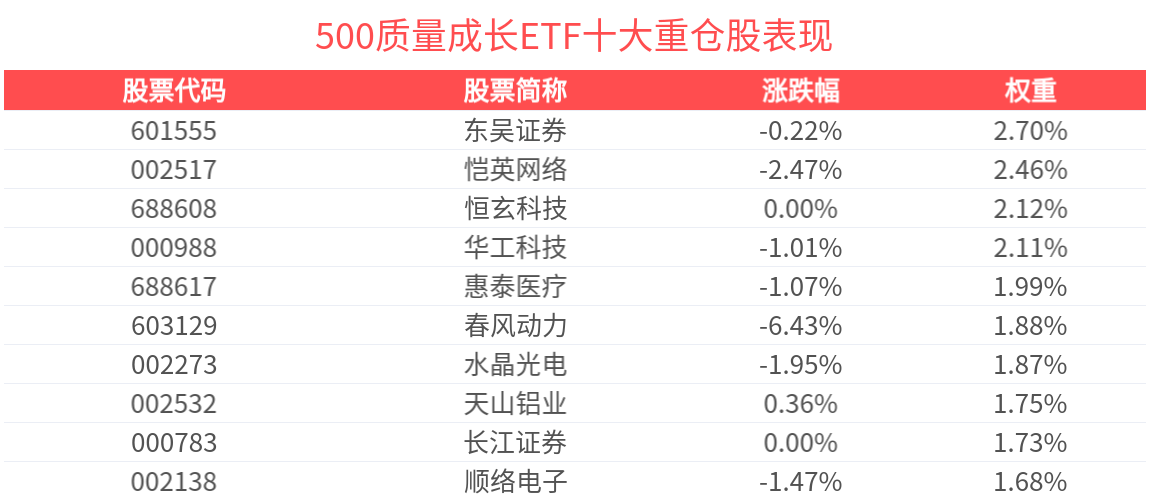
Core Viewpoint - The China Securities 500 Quality Growth Index has shown a decline of 0.54% as of July 18, 2025, with mixed performance among constituent stocks, indicating a volatile market environment [1] Group 1: Market Performance - The top-performing stocks include Kanghong Pharmaceutical, which rose by 4.66%, and Qilu Bank, which increased by 3.30%, while Chunfeng Power led the decline with a drop of 6.43% [1][4] - The China Securities 500 Quality Growth ETF has been adjusted, with the latest price at 1 yuan [1] Group 2: Analyst Insights - Several foreign investment banks have expressed optimism about the Chinese market, with Citigroup upgrading the ratings for Chinese and Korean markets to "overweight" despite macroeconomic fluctuations [1] - CICC's report highlights the value of equity markets amid an "asset shortage," suggesting a positive outlook for the second half of the year, although short-term uncertainties remain [1] Group 3: Index Composition - The China Securities 500 Quality Growth Index consists of 100 high-profitability, sustainable, and cash-rich companies selected from the broader China Securities 500 Index [2] - As of June 30, 2025, the top ten weighted stocks in the index account for 20.42% of the total index, with Dongwu Securities and Kaiying Network being the largest constituents [2]




宏观金融数据日报-20250718
Guo Mao Qi Huo· 2025-07-18 03:24
Report Summary 1. Market Interest Rates - DR001 closed at 1.46% with a -0.49bp change, DR007 at 1.52% with -0.68bp [3] - GC001 closed at 1.13% with -37.00bp, GC007 at 1.47% with -6.50bp [3] - SHBOR 3M closed at 1.56% with -0.20bp, LPR 5 - year at 3.50% with 0.00bp [3] - 1 - year treasury closed at 1.35% with -0.50bp, 5 - year at 1.51% with -0.25bp [3] - 10 - year treasury closed at 1.66% with 0.00bp, 10 - year US treasury at 4.46% with -4.00bp [3] 2. Central Bank Operations - The central bank conducted 450.5 billion yuan of 7 - day reverse repurchase operations, with 90 billion yuan of reverse repurchases maturing, resulting in a net injection of 360.5 billion yuan [3] - This week, there are 425.7 billion yuan of reverse repurchases maturing in the central bank's open market, with 84.7 billion yuan maturing on Friday. The central bank's reverse repurchases continued to increase, signaling care for the capital market [4] 3. Stock Index Market - **Index Performance**: The CSI 300 rose 0.68% to 4034.5, the SSE 50 rose 0.12% to 2744.3, the CSI 500 rose 1.08% to 6082.5, and the CSI 1000 rose 1.14% to 6535.7 [5] - **Sector Performance**: Most industry sectors closed higher. Aerospace, biological products, electronic components, medical services, communication equipment, consumer electronics, energy metals, and chemical pharmaceuticals led the gains, while the precious metals sector led the losses [5] - **Market Analysis**: With a calm macro - news background, the stock index continued to rise, and market trading volume further increased. The large - and small - cap stocks showed a differentiated trend, with small - cap stocks performing strongly. In the short term, the stock index is expected to fluctuate strongly [5] - **Reasons for Strength**: The "asset shortage" and "national team" support increase the willingness to allocate equity assets. The "anti - involution" and the Politburo meeting at the end of July strengthen policy expectations and boost market sentiment [5] 4. Futures Contracts - **Volume and Open Interest**: IF volume increased by 5.4% to 105,631, and open interest increased by 2.9% to 263,172; IH volume increased by 5.2% to 52,058, and open interest increased by 3.6% to 94,545; IC volume decreased by 1.2% to 99,016, and open interest increased by 0.1% to 223,761; IM volume decreased by 1.0% to 195,970, and open interest increased by 1.6% to 331,365 [5] - **Basis**: IF basis was 33.39% for the next - quarter contract, 3.58% for the current - month contract, 3.21% for the next - month contract, and 3.52% for the current - quarter contract; IH basis was - 1.86% for the next - quarter contract, 1.04% for the current - month contract, 0.29% for the next - month contract, and 0.04% for the current - quarter contract; IC basis was 10.73% for the next - quarter contract, 0.39% for the current - month contract, 9.79% for the next - month contract, and 9.02% for the current - quarter contract; IM basis was 13.42% for the next - quarter contract, - 7.42% for the current - month contract, 12.68% for the next - month contract, and 11.99% for the current - quarter contract [5]
中金:系统梳理银行股投资
中金点睛· 2025-07-17 23:49
Core Viewpoint - The article discusses the recent rise in bank stocks, exploring the underlying reasons and future sustainability of this trend, focusing on asset allocation, funding dynamics, and the stability of bank earnings [1][5]. Group 1: Recent Rise in Bank Stocks - The rise in Chinese bank stocks can be attributed to three main factors: balance sheet repair, profit improvement, and a leverage bull market. The current phase is characterized by balance sheet repair, driven by the progress in financial risk management [2][6]. - The improvement in asset quality is evident, with a notable decrease in the net bad debt generation rate, indicating healthier balance sheets and a corresponding increase in valuations [2][10]. - The market perception of bank stocks has shifted, recognizing their earnings stability rather than traditional cyclical volatility, which has led to increased investment from various financial institutions [3][4]. Group 2: Funding Dynamics and Asset Allocation - The "asset shortage" phenomenon has driven a shift in funding allocation towards high-dividend assets, including bank stocks, as investors seek to compensate for low yields in a low-interest-rate environment [3][4]. - Insurance companies and asset management companies are increasingly investing in bank stocks due to their stable dividend yields, which meet their asset allocation needs [4][9]. - The comparison of bank stocks with other sectors reveals that banks offer a unique combination of high dividend yields and large market capitalization, making them attractive to institutional investors [4][9]. Group 3: Future Sustainability and Growth Potential - The sustainability of the recent rise in bank stocks is supported by their current valuation levels, which remain below historical averages, suggesting that there is still room for growth [6][7]. - The convergence of dividend yields among different types of banks indicates a trend towards stability and reduced risk premiums, enhancing the attractiveness of bank stocks [6][12]. - The potential for further appreciation in bank stock prices is linked to successful debt restructuring and improved investor confidence in the sustainability of smaller banks [6][7]. Group 4: Stock Selection Criteria - Preference is given to H-shares over A-shares due to tax advantages for insurance investments and higher dividend yields in the Hong Kong market [9]. - Stocks with high and stable dividend yields, particularly from large banks, are favored for their consistent profit expectations [9]. - The selection of bank stocks should also consider performance stability, which is influenced by factors such as liability capacity and organizational efficiency [9].