套期保值

Search documents
弘元绿能: 期货和衍生品交易内控制度(2025年9月)
Zheng Quan Zhi Xing· 2025-09-05 16:34
Core Points - The company has established a system to regulate futures and derivatives trading, aiming to control risks and enhance investment returns while protecting the interests of the company and its shareholders [1][2][4] - The system applies to the company and its wholly-owned and controlling subsidiaries, with specific exceptions outlined [1][2] - The company is prohibited from using raised funds for futures and derivatives trading, focusing instead on hedging activities related to specific risks [2][4] Group 1: Trading Regulations - Futures trading refers to transactions involving futures contracts or standardized options, while derivatives trading includes swaps, forwards, and non-standardized options [1][2] - The company must establish internal control systems for futures and derivatives trading, including investment decision-making, business operations, and risk control [4][5] - The board of directors must approve futures and derivatives trading decisions, ensuring compliance with internal control procedures [5][6] Group 2: Risk Management - The company is required to form a working group for futures and derivatives trading, composed of professionals in investment decision-making, business operations, and risk control [6][8] - The working group must assess business risks and develop strict decision-making procedures and monitoring measures [6][8] - The company must set appropriate stop-loss limits and monitor market price changes to manage risks effectively [7][8] Group 3: Information Disclosure - The board of directors must disclose relevant documents to the stock exchange after making decisions on futures and derivatives trading [18][19] - The company must provide detailed information about the trading purpose, instruments, and expected risks when engaging in futures and derivatives trading [19][20] - Any significant losses or deviations from expected outcomes must be reported promptly, ensuring transparency in trading activities [20][21]

新疆众和: 新疆众和股份有限公司2025年第五次临时股东大会会议资料
Zheng Quan Zhi Xing· 2025-09-04 09:12
Core Viewpoint - The company plans to implement a hedging strategy for its subsidiary to mitigate the risks associated with fluctuating alumina prices, as it prepares for the launch of a new alumina production project in 2026 [1][2][3] Meeting Details - The fifth extraordinary general meeting of shareholders is scheduled for September 12, 2025, with both on-site and online voting options available [1] - The meeting will include the election of voting personnel, discussion of the hedging proposal, shareholder speeches, and the announcement of voting results [1] Hedging Proposal - The proposal involves the subsidiary, Fangchenggang Company, engaging in alumina hedging to stabilize profits against price volatility [2][3] - The project is expected to produce 2.4 million tons of alumina annually, with sales commencing in the first half of 2026 [1] Financial Aspects - Fangchenggang Company will utilize its own funds for the hedging activities, with a maximum margin requirement of 1.152 billion yuan and a maximum contract value of 9.6 billion yuan on any trading day [2][3] - The hedging activities will be limited to a maximum of 2.4 million tons of alumina over the next 12 months [3] Risk Management - The company emphasizes that the hedging strategy will strictly avoid speculative trading and will be aligned with actual production needs [2][4] - A comprehensive risk management framework will be established to address potential liquidity risks and operational errors [4][5] Accounting Treatment - The company will adhere to relevant accounting standards for financial instruments and hedging activities, ensuring proper financial reporting and compliance [5]

碳酸锂市场交易逻辑将逐步切换到现实基本面
Qi Huo Ri Bao· 2025-09-03 23:33
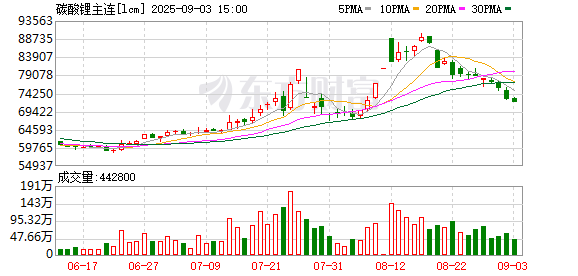
Group 1 - The core viewpoint of the articles highlights the recent decline in lithium carbonate futures prices, which fell below 72,000 yuan/ton after peaking above 90,000 yuan/ton due to easing supply concerns and profit-taking [2] - As of September 2, the futures warehouse receipts for lithium carbonate stood at 32,007 contracts, with downstream production and sales showing strong performance, particularly in lithium iron phosphate and ternary precursor production [3] - The lithium carbonate production reached a new high of 85,000 tons in August, marking a 5% month-on-month increase and a 39% year-on-year increase, driven by the growth in spodumene extraction [3] Group 2 - The basic data indicates a slight decrease in lithium carbonate weekly production by 0.56% to 19,000 tons, with a weekly operating rate of 54% for smelting enterprises [2] - The weekly inventory of lithium carbonate decreased by 0.29% to 141,100 tons, with upstream inventory down by 7.49% to 43,300 tons, while midstream and downstream inventories saw slight increases [2] - To manage price volatility, downstream enterprises can utilize futures tools for hedging, such as using put and call options to stabilize raw material procurement costs [4]

通达股份的“期货经”:巧借衍生工具 解锁豫企降本之道
Qi Huo Ri Bao Wang· 2025-09-02 16:58
Core Viewpoint - A profound transformation is occurring in Henan, focusing on the construction of a modern industrial system, where companies like Tongda Cable Co., Ltd. are leveraging the futures market to manage risks and seize opportunities amid commodity price fluctuations [2][3]. Company Overview - Tongda Cable, founded in 1987 and listed in 2011, has been a leader in the cable industry for nearly 40 years, specializing in the production and sales of cables, precision processing of aircraft components, and aluminum-based composite materials [3]. - The company has an annual production capacity of over 100,000 tons for ultra-high voltage cables and 50,000 kilometers for power and high-end cables, contributing to major projects like the 1000kV transmission line [3]. Challenges Faced - The company faces significant challenges due to raw material costs, with electrolytic aluminum and cathode copper accounting for over 70% of production costs [4]. - Price volatility of these metals, influenced by supply-demand dynamics and macroeconomic factors, has led to substantial risks, particularly when contracts are won based on current prices but delivered months later [4]. Risk Management Strategy - Since 2007, Tongda Cable has utilized futures tools, starting with aluminum and later expanding to copper, to hedge against price fluctuations [6]. - The company has developed a comprehensive risk management framework, including a specialized internal control system, a professional team, and strict risk management protocols [8]. Recent Developments - In response to rising aluminum prices in late 2024, the company quickly implemented a hedging strategy by purchasing call options, resulting in a profit of 44,440 yuan, effectively mitigating the impact of rising raw material costs [7]. - Tongda Cable has been recognized as a best practice case for risk management in futures by the China Listed Companies Association and has been approved as a service base for integrating finance and industry [6][11]. Industry Collaboration - The company emphasizes collaboration within the supply chain, moving from a focus on price to technology and service, enhancing customer engagement from the design phase of projects [10]. - Tongda Cable is also establishing a strategic supplier evaluation system to strengthen partnerships and improve communication regarding hedging tools and market analysis [11]. Conclusion - Tongda Cable's experience exemplifies how companies in Henan are effectively utilizing futures and derivative tools to manage price risks, stabilize operations, and achieve high-quality development in line with national industrial goals [11].


挺价意愿渐强,猪价维持震荡
Hua Tai Qi Huo· 2025-09-02 07:51
1. Report Industry Investment Rating - The investment rating for both the pig and egg markets is "Cautiously Bearish" [3][5] 2. Core Views - For the pig market, although the expected reduction in pig slaughter next week due to short - term supply adjustment may make spot and near - term contract prices firmer, the overall oversupply situation remains unchanged, having little impact on 2026 pig contracts and being favorable for hedging demand to participate at high prices. The current reduction in supply has increased compared to the end of June and July, which needs continuous monitoring [2] - For the egg market, with school stocking completed and tourism and catering demand decreasing, and due to the reduced consumption of end - products of food companies, food companies are purchasing cautiously. The inventory of cold - storage eggs has weakened market confidence, and the supply - side pressure has made the festival boost this year obviously weak [4] 3. Summary by Related Catalogs Pig Market Market News and Important Data - Futures: The closing price of the live hog 2511 contract yesterday was 13,625 yuan/ton, up 70 yuan/ton (+0.52%) from the previous trading day [1] - Spot: In Henan, the price of external ternary live hogs was 14.17 yuan/kg (unchanged); in Jiangsu, it was 14.36 yuan/kg, up 0.31 yuan/kg; in Sichuan, it was 13.63 yuan/kg, up 0.20 yuan/kg. The national average wholesale price of pork on September 1 was 20.01 yuan/kg, up 0.4% from last Friday [1] Market Analysis - The short - term supply adjustment may lead to firmer spot and near - term contract prices, but the overall oversupply pattern persists, having little impact on 2026 contracts [2] Strategy - Cautiously bearish [3] Egg Market Market News and Important Data - Futures: The closing price of the egg 2510 contract yesterday was 2,921 yuan/500 kilograms, down 18 yuan (-0.61%) from the previous trading day [3] - Spot: In Liaoning, the egg spot price was 3.20 yuan/jin (unchanged); in Shandong, it was 3.15 yuan/jin (unchanged); in Hebei, it was 2.80 yuan/jin, up 0.09 yuan. On September 1, the national production - link inventory was 0.73 days, down 0.19 days, and the circulation - link inventory was 1.00 days, down 0.05 days [3] Market Analysis - With the end of school stocking and the decline in tourism and catering demand, and the cautious purchasing of food companies, the overall demand is declining. Cold - storage egg inventory has weakened market confidence, and the supply - side pressure has made the festival boost weak [4] Strategy - Cautiously bearish [5]
以创新服务为中小纸企保驾护航
Qi Huo Ri Bao Wang· 2025-09-02 00:50
Core Insights - The low concentration of the domestic household paper industry leads to numerous small and medium-sized enterprises (SMEs) facing challenges in pricing power, price assessment, and risk hedging tools [1][2] - Guotai Junan Futures has developed a "industry ecosystem + cooperative hedging" service plan to help SMEs manage risks associated with raw material price fluctuations [1][3] Industry Challenges - SMEs in the household paper sector struggle with weak bargaining power and lack of brand advantages, resulting in squeezed profit margins due to rising pulp prices while facing difficulties in raising product prices [1][3] - The reliance on local supplier quotes and fragmented industry information leads to delayed responses to global supply and demand dynamics, causing missed opportunities for low-cost procurement [1][2] Solutions Provided - Guotai Junan Futures employs a phased strategy to assist SMEs, starting with familiarizing them with the spot market and gradually introducing them to risk management tools [2][3] - The company offers customized services, explaining the principles and operational processes of hedging, and addressing concerns regarding the feasibility of hedging with futures contracts [2][3] Implementation of Hedging - A specific SME, referred to as Company A, engaged in a cooperative hedging model with Guotai Junan to manage raw material price risks, successfully securing necessary pulp supplies while mitigating price volatility [3][4] - In May 2023, Company A identified a favorable time to build inventory due to low pulp prices and entered into a cooperation agreement with Guotai Junan, purchasing 0.2 million tons of needle pulp and 0.8 million tons of broadleaf pulp [3] Risk Management Framework - Guotai Junan Futures has created a comprehensive risk management solution tailored for SMEs, utilizing standardized services and promoting an ecosystem that connects various stakeholders in the industry [4] - The company aims to enhance SMEs' understanding and trust in derivative products through knowledge sharing and real-world case demonstrations, ultimately improving the overall risk resilience of the industry [4]

四川福蓉科技股份公司关于全资子公司开展套期保值业务的公告
Shang Hai Zheng Quan Bao· 2025-09-01 21:42
Core Viewpoint - The company aims to mitigate raw material price fluctuation risks through futures hedging, ensuring stable operations [2][4]. Group 1: Transaction Overview - The subsidiary, Fujian Furongyuan Recycling Resources Development Co., Ltd., plans to conduct aluminum futures hedging for the year 2025 [4][15]. - The trading instrument will be futures contracts, specifically for aluminum ingots, with a maximum margin amounting to RMB 4.8 million [3][5]. - The trading will take place on the Shanghai Futures Exchange [7]. Group 2: Approval Process - The board of directors approved the hedging proposal during meetings held on September 1, 2025, with unanimous votes in favor [10]. Group 3: Risk Analysis - The company acknowledges several risks associated with futures trading, including market risk, operational risk, liquidity risk, internal control risk, and technical risk [11][12]. Group 4: Risk Control Measures - The subsidiary will align hedging activities with its production needs, ensuring that futures contracts match the pricing periods of physical goods [13]. - Strict internal controls will be implemented to manage funds and ensure compliance with the approved margin limits [14]. - A reporting and internal audit mechanism will be established to oversee the hedging activities and ensure adherence to company policies [14]. Group 5: Impact on the Company - Engaging in commodity hedging will allow the company to leverage the price and risk hedging functions of the futures and options markets, thereby stabilizing production costs [15].

多维赋能 全方位提升产业服务能力
Qi Huo Ri Bao Wang· 2025-09-01 17:43
Group 1 - The core viewpoint of the news is the training organized by Zhengzhou Commodity Exchange to enhance the research capabilities of cotton and cotton yarn futures analysts, focusing on industry needs and market dynamics [1][4] - Approximately 160 analysts from futures companies, risk management subsidiaries, and industry chain enterprises participated in the training, which covered various aspects such as spot market trends, futures business rules, and risk management practices [1][4] - The training included insights from industry experts, providing a comprehensive understanding of the cotton textile industry's current situation and future trends, highlighting challenges such as insufficient terminal demand and pressure on corporate profits [1][2] Group 2 - The improvement of futures business rules is essential for ensuring stable market operations and enhancing the efficiency of futures functions, with key revisions including adjustments to delivery price spreads and optimization of quality inspection fees [2] - From January to July 2025, the cotton yarn futures market saw significant growth, with an average daily trading volume of 6,837 contracts, a 109% year-on-year increase, and an average daily open interest of 19,700 contracts, a 323% increase [2] - The training emphasized innovative risk management tools, with practical applications of "basis trading and options" discussed, showcasing how these strategies can help enterprises mitigate price decline risks and optimize hedging effects [2][3] Group 3 - The training also focused on constructing a market research framework that combines industry and macroeconomic drivers, emphasizing the need for a dynamic analysis of supply-demand balance and economic cycles [3] - Analysts expressed that the training broadened their perspectives and enhanced their ability to serve real enterprises, integrating macroeconomic conditions and industry status into their market assessments [4] - The overall goal of the training is to improve analysts' understanding and application of futures tools, thereby supporting the cotton and cotton yarn industries in pricing and risk management, contributing to high-quality development [4]
福蓉科技: 关于全资子公司开展套期保值业务的公告
Zheng Quan Zhi Xing· 2025-09-01 16:10
Core Viewpoint - The company aims to mitigate raw material price volatility risks and ensure operational stability through aluminum futures hedging activities [1][2]. Group 1: Transaction Overview - The transaction purpose is to effectively prevent or mitigate raw material price fluctuations, ensuring stable operations [1]. - The trading instrument involved is aluminum ingots, with a maximum margin amount set at RMB 4.8 million [2]. - The funding source for the transaction will be the company's own funds [2]. - The trading venue is the Shanghai Futures Exchange, and the trading period will commence upon approval of the hedging activities [2]. Group 2: Approval Process - The proposal for the hedging activities was approved unanimously by the board's audit committee and the board of directors [2]. Group 3: Risk Analysis - Market risk arises from potential asymmetric price movements between futures and spot markets, which could negate the hedging effect [3]. - Operational risk may occur if trading personnel do not follow established procedures or fully understand derivative information [3]. - Liquidity risk could arise from insufficient market activity, making it difficult to execute trades [3]. - Internal control risk is associated with the complexity of futures trading and potential inadequacies in the internal control system [3]. - Technical risk may stem from incomplete computer systems affecting trading operations [3]. Group 4: Risk Control Measures - The company will align hedging activities with its production needs, limiting futures trading to aluminum ingots [4]. - The company will manage its own funds prudently for hedging activities, adhering to the approved margin limits [4]. - The company will monitor futures trading closely and select appropriate contract months to avoid liquidity risks [4]. - Professional personnel will be employed, and strict authorization and segregation of duties will be established to enhance risk management [4]. - A reporting and internal audit mechanism will be established to oversee the hedging activities and ensure compliance with board authorizations [5]. Group 5: Impact on the Company - Engaging in commodity hedging activities will allow the company to utilize the price and risk hedging functions of the futures and options markets, thereby stabilizing production costs [5].
金价再上历史高位,黄金暴涨背后:一位投资者的十年坚守与30倍回报传奇
Sou Hu Cai Jing· 2025-08-31 13:10
Group 1 - The core viewpoint is that international gold prices have reached historical highs, driven by multiple factors including expectations of interest rate cuts by the Federal Reserve, geopolitical tensions, and ongoing gold purchases by global central banks [1][3][5] - Gold futures in New York hit $3518.5 per ounce, marking the third challenge of the $3500 level since 2025, with previous peaks at $3509.9 and $3534 per ounce [1][3] - In August, international gold prices saw a cumulative increase of 5.002%, the best monthly performance since April [3] Group 2 - The expectation of a 25 basis point interest rate cut by the Federal Reserve is a primary driver of rising gold prices, with a nearly 90% probability of a cut in September [3][5] - Geopolitical instability, particularly the escalating conflict between Russia and Ukraine, has led investors to seek safe-haven assets like gold [3][5] - A weaker US dollar has also supported the rise in gold prices, as there is typically an inverse relationship between the dollar's strength and gold prices [3] Group 3 - Global central banks, including those in China and Turkey, are increasing their gold reserves, which reflects a recognition of gold's value retention and sends a positive signal to the market [5] - Several international financial institutions are bullish on gold prices, with UBS raising its 2026 price target to $3700 per ounce and Bank of America predicting a rise to $4000 per ounce [5][12] - Concerns over the independence of the Federal Reserve have also contributed to the upward pressure on gold prices [5] Group 4 - Successful long-term investment cases in gold highlight the value of patience and strategic positioning, as seen in the example of an investor who achieved over 30 times returns by holding onto shares of China National Gold [7] - Gold plays a crucial role in asset allocation, providing a hedge against market volatility and helping to stabilize asset values during financial crises [8] - Companies are increasingly allocating portions of their liquid assets to gold to mitigate currency fluctuation risks, demonstrating gold's importance in corporate finance strategies [8] Group 5 - Various investment strategies in gold cater to different investor profiles, with long-term strategies suitable for risk-averse investors, while experienced investors may prefer short-term trading strategies [9] - Hedging strategies are particularly relevant for companies involved in gold production and trade, allowing them to lock in costs and reduce price volatility risks [9] Group 6 - Current market conditions suggest that there are no significant bearish factors for gold, with major financial institutions raising their price targets for gold in the coming years [12] - The ongoing upward trend in gold prices is likely to continue for several weeks, contingent on whether the Federal Reserve implements the anticipated interest rate cuts [11][12]