
戴维斯双击

Search documents
财信证券晨会纪要-20250714
Caixin Securities· 2025-07-13 23:55
Market Overview - The A-share market shows a mixed performance with the Shanghai Composite Index closing at 3510.18, up 0.01%, while the Shenzhen Component Index increased by 0.61% to 10696.10 [2][3] - The total market capitalization of the Shanghai Composite Index is 681061 billion, with a PE ratio of 12.56 and a PB ratio of 1.30 [3] Financial Insights - The report indicates a positive outlook for several companies, with Dongpeng Beverage expected to achieve a revenue growth of 35-38% and a profit increase of 33-42% in the first half of 2025 [36] - Zhujiang Beer anticipates a net profit growth of 15-25% for the same period, reflecting a stable performance in the beverage sector [38] - Liugong is projected to see a net profit increase of 20-30% in the first half of 2025, driven by domestic market recovery and product upgrades [40] Industry Dynamics - The EV battery sector is highlighted, with EVTank reporting an expected shipment of 100 million large cylindrical batteries in 2024, and global production capacity exceeding 6 billion [31] - Chery Automobile has announced a patent for a companion robot, indicating innovation in the automotive sector [29] - Shanghai Pudong is focusing on key technologies to accelerate the gathering of critical component manufacturers, enhancing the local industrial ecosystem [34] Company Tracking - Long Cable Technology has won a bid for a cable accessory framework procurement project worth 97.165 million RMB, showcasing its competitive position in the cable accessory industry [43] - Step by Step High is expected to turn a profit in the first half of 2025, with a projected net profit of 9-13 million RMB, marking a significant turnaround [45] Economic Policies - The report mentions the implementation of ten key livelihood projects in Hunan Province, with a total investment of 571.64 billion RMB, aimed at improving public welfare [46]
【十大券商一周策略】3500点后,A股咋走?7月,不错!8—9月,风险较大!
券商中国· 2025-07-13 15:03
Group 1 - The current market is transitioning from a stock market to an incremental market, with A-shares experiencing high volatility in certain sectors while manufacturing sectors remain undervalued [1] - The "anti-involution" narrative is compared to the "Belt and Road" initiative, suggesting that it will help stimulate low-performing sectors in the context of increased capital inflow [1] - The valuation gap in Hong Kong stocks is becoming apparent, with insurance funds likely to expand their investment scope, indicating a favorable time to increase allocations to Hong Kong stocks [1] Group 2 - The "anti-involution" policy is expected to anchor the basic expectations of the midstream manufacturing sector, with short-term investment opportunities becoming more apparent [2] - The passing of the "Big and Beautiful" bill in the U.S. is expected to enhance fiscal stimulus, reducing the risk of a deep recession and improving visibility for China's supply-demand dynamics by 2026 [2] - The market has already begun to reflect a "bull market atmosphere," with the Shanghai Composite Index breaking through key levels, enhancing risk appetite and spreading profit-making effects [2] Group 3 - A-share market performance has been strong, driven by the upward trend in U.S. stocks and the positive impact of technology leaders reaching new highs [3] - The "anti-involution" policy is expected to alleviate domestic price pressures, with the upcoming earnings season providing a favorable environment for stocks with positive earnings forecasts [3] - The overall earnings improvement rate for A-shares is higher than the same period last year, indicating structural opportunities in high-growth TMT sectors and competitive midstream manufacturing [3] Group 4 - The "transformation bull market" is gaining momentum, driven by a systematic reduction in market discount rates and a favorable shift in economic structure [4] - The willingness of investors to accept risk is increasing, suggesting that the market may consolidate before making new highs [4] - Short-term focus should be on the "anti-involution" theme, with a rotation towards growth sectors continuing [4] Group 5 - Investment strategies should focus on three main areas: AI technology breakthroughs, consumer stock valuation recovery, and the rise of undervalued assets [5] - The recovery cycle in consumer stocks is supported by low valuations, declining interest rates, and policy catalysts, indicating potential opportunities in the sector [5] Group 6 - The capital return in A-shares is expected to stabilize and recover due to the "anti-involution" policy and the cessation of debt contraction [6] - The combination of domestic manufacturing recovery and overseas capital return will enhance the attractiveness of A-shares compared to other markets [6] - Recommended investment strategies include focusing on upstream resource products and capital goods that benefit from both domestic and international trends [6] Group 7 - The current market conditions resemble those of 2014, with a significant disconnect between market performance and earnings [7] - The "anti-involution" policy is seen as a positive signal, although its impact may be weaker than previous real estate policy shifts [7] - The market is expected to experience a similar trend to the second half of 2014, but tactical breakthroughs may not be smooth [7] Group 8 - The A-share index has recently surpassed 3500 points, with financial sectors and technology themes driving market momentum [8] - The market's valuation has recovered from the bottom, indicating that further gains will require increased trading volume [8] - Structural opportunities are abundant, with a focus on stable dividend assets, resource products, and new technology sectors [8] Group 9 - The core drivers of the current market breakthrough include rising policy expectations, the "anti-involution" investment theme, and improved trading activity [9] - July is viewed as a favorable window for investment, with a focus on TMT, non-bank financials, and military sectors [9] - The AI computing sector's performance is closely tied to the strong results of benchmark U.S. stocks, influencing A-share valuations [9] Group 10 - The market is in a new bullish phase, with investor sentiment improving and incremental capital entering the market [10] - The "anti-involution" policy is expected to alleviate income stagnation, potentially leading to a new phase of market growth [10] - Investment strategies should focus on sectors related to the "anti-involution" theme, stable currencies, and sectors with positive earnings forecasts [10]

稀土永磁板块集体大涨 八大概念股盘点(名单)
Zheng Quan Zhi Xing· 2025-07-11 07:50
Group 1 - The rare earth permanent magnet sector showed significant activity, with the sector index rising by 5.64% and several stocks, including Northern Rare Earth (600111) and China Rare Earth (000831), hitting the daily limit [1] - Northern Rare Earth announced a projected net profit increase of 1882.54% to 2014.71 million by the first half of 2025, driven by market stabilization, increased production and sales, and cost reduction efforts [1] - The global market size for rare earth permanent magnets is expected to reach approximately $17 billion in 2024 and $27 billion in 2025, indicating substantial growth potential for the industry [1] Group 2 - Northern Rare Earth is the largest supplier of light rare earth products in China and globally, focusing on rare earth raw materials, functional materials, and some end-use products [2] - China Rare Earth primarily engages in the production and operation of rare earth oxides and offers technology research and consulting services [3] - Shenghe Resources has a diverse range of rare earth products, including both light and heavy rare earths [4] - Jiuwu Hi-Tech specializes in the development of membrane separation technology for ion-type rare earth mining and the research of rare earth leachate pretreatment processes [4] - Baotou Steel's main products include rare earth concentrates and fluorite [5] - Jinchuan Magnetics is a leading supplier of high-performance rare earth permanent magnet materials in the new energy and energy-saving sectors [6] - Guangsheng Nonferrous Metals focuses on rare earth mining, smelting separation, deep processing, and non-ferrous metal trading [7] - China Nonferrous Metal Industry's Technology is a leader in lead-zinc smelting and rare earth separation technologies in China [8]



估值洼地+产业变革,资金抢筹布局港股科技板块,港股科技ETF(513020)连续5日净流入总额超3亿元
Mei Ri Jing Ji Xin Wen· 2025-07-11 01:41
Group 1 - The core viewpoint is that the Hong Kong technology sector is currently at a convergence of "valuation trough" and "industrial transformation," with increasing investment interest driven by policy, technology, and capital factors [1] - The Hong Kong technology ETF (513020) has seen a net inflow of over 300 million yuan over the past five days, indicating strong investor interest [1] - Bloomberg analysts expect the EPS of the Hang Seng Technology Index to rise year-on-year from 2025 to 2027, suggesting a potential "valuation recovery" and "profit growth" scenario [1] Group 2 - Southbound funds and foreign capital are providing liquidity support for the Hong Kong market, enhancing the investment environment for the technology sector [1] - The index tracked by the Hong Kong technology ETF consists of up to 50 high-quality companies selected from the technology sector listed under the Stock Connect program, reflecting the overall performance of investable technology companies [1] - Investors without stock accounts can consider the Cathay CSI Hong Kong Stock Connect Technology ETF linked funds (015740 and 015739) for exposure to this sector [1]
CPI超预期!食品饮料板块反弹,未来有大机会吗?
格隆汇APP· 2025-07-09 10:01
Core Viewpoint - China's CPI turned positive in June, increasing by 0.1% year-on-year, which is better than the expected 0% and significantly improved from May's -0.1% [1] Group 1: CPI and Market Reaction - Food, tobacco, and alcohol prices rose by 0.1% year-on-year, contributing approximately 0.03 percentage points to the CPI increase [2] - The food and beverage sector experienced a collective rebound, with industry gains reaching 1.2% at one point, and significant net inflows into sub-sectors like liquor [2] - Notable stock movements included Jiaotong Angli (600530.SH) hitting the daily limit, while Babi Food (605338.SH) and Huangtai Liquor (000995.SH) saw maximum intraday gains exceeding 7% [2] Group 2: Investment Insights - Analysts from Citic Securities suggest that the "anti-involution" policy will benefit traditional industries, with a focus on consumer sectors like dairy, home goods, and feed [2] - Guangfa Securities believes that the liquor industry's dividend yield is significantly advantageous compared to the ten-year government bond yield, indicating strategic allocation value at this stage [2] - Ping An Securities highlights that liquor companies are innovating low-alcohol products to meet new consumer demands, while beverage consumption is shifting towards solution-oriented models [3] Group 3: Market Volatility and Opportunities - The food and beverage sector has experienced significant valuation volatility, with fluctuations reaching 25% due to factors like "consumption downgrade" and "new consumption" [3] - This volatility presents both risks and opportunities; understanding the fundamentals and market sentiment is crucial for investors [4] - The sector is expected to see a dual recovery in valuation and earnings, potentially leading to a "Davis Double" effect [6] Group 4: Future Outlook - The food and beverage sector is viewed as having substantial opportunities, with expectations of continued economic growth in China, particularly as it transitions to a consumption-driven economy [6] - The research institute emphasizes the importance of selecting stocks with high success probabilities and good holding experiences, utilizing a combination of subjective analysis and quantitative assessment [6] - Investors are encouraged to explore potential high-growth stocks within the food and beverage sector, such as Guizhou Moutai and Shanxi Fenjiu, and to consider new collaborations like that of Jiu Gui Jiu and Pang Dong Lai [7]




120亿!南向单日流入阶段新高,港股蓄势待发
Jin Rong Jie· 2025-07-08 03:19
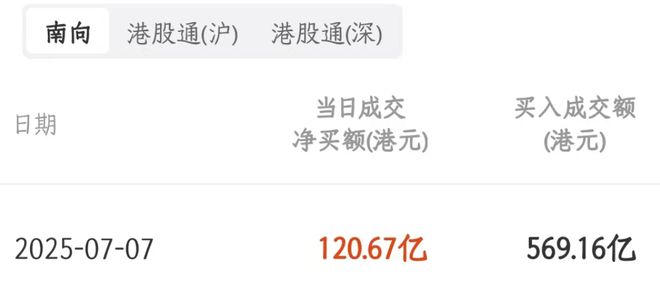
Group 1 - The core viewpoint is that the competition among Meituan, Alibaba, and JD in the food delivery sector is intense, leading to significant stock price pressure, with Meituan's stock nearly halving from its peak, JD's stock dropping below its April low, and Alibaba approaching its yearly low, indicating a "three defeats all hurt" scenario [1] - On July 7, net purchases of Hong Kong stocks exceeded 12 billion, marking the first time since May 27 that net purchases surpassed 10 billion, suggesting a potential bottom-fishing opportunity for tech leaders in Hong Kong [1][3] - Analysts predict a potential "valuation repair" and "earnings growth" for the Hang Seng Tech Index from 2025 to 2027, indicating a favorable time to position for this upward movement [3] Group 2 - The Hong Kong Tech 50 ETF (159750) tracks the Hong Kong Tech Index and has seen over a 24% increase this year, with significant growth in scale since early March [5] - As of July 7, the latest P/E ratio for Hong Kong tech is 20.27, which is at a low historical percentile, suggesting it is cheaper than 97% of the time in the past decade, indicating a strong willingness for southbound capital to invest at low levels [6] - The Hong Kong Dividend Low Volatility ETF (520550) has shown resilience during market fluctuations, achieving a 19% increase since its inception on January 15, 2025, and has attracted significant net inflows recently [10][12] Group 3 - The ETF structure allows for monthly dividend assessments, with a maximum of 12 cash inflows per year, supporting reinvestment and providing a cost advantage for long-term holding [12] - A strategy of building positions in the Hong Kong Tech 50 ETF (159750) while using the Hong Kong Dividend Low Volatility ETF (520550) as a defensive measure may help mitigate short-term risks while capitalizing on potential tech sector gains [14]
港股科技股多数上涨,港股科技30ETF(513160)涨超1%,机构:港股科技配置价值逐渐凸显
Sou Hu Cai Jing· 2025-07-08 02:02
Group 1 - The core viewpoint is that the Hong Kong stock market, particularly the technology sector, is experiencing significant improvements in liquidity and investment potential, with a notable increase in both trading volume and new listings [2][3]. - The Hong Kong Technology 30 ETF (513160) has seen a net inflow of over 170 million yuan in the past five days, indicating strong investor interest [2]. - The Hang Seng Index has risen by 20% in the first half of 2025, marking the largest increase in points for any first half of the year [2]. Group 2 - The Hong Kong technology sector is currently viewed as being in a "valuation trough" and is positioned for potential recovery due to favorable policies, technological advancements, and capital influx [3]. - The price-to-earnings ratio (PE-TTM) of the Hang Seng Technology Index is approximately 20 times, which is below the 9th percentile since July 27, 2020, suggesting a high potential for valuation recovery [3]. - Analysts predict that the earnings per share (EPS) of the Hang Seng Technology Index will increase year-on-year from 2025 to 2027, indicating a potential "valuation recovery" and "earnings growth" scenario [3].
“戴维斯双击”黄金机遇!港股科技ETF(513020)低位布局正当时
Sou Hu Cai Jing· 2025-07-07 03:30
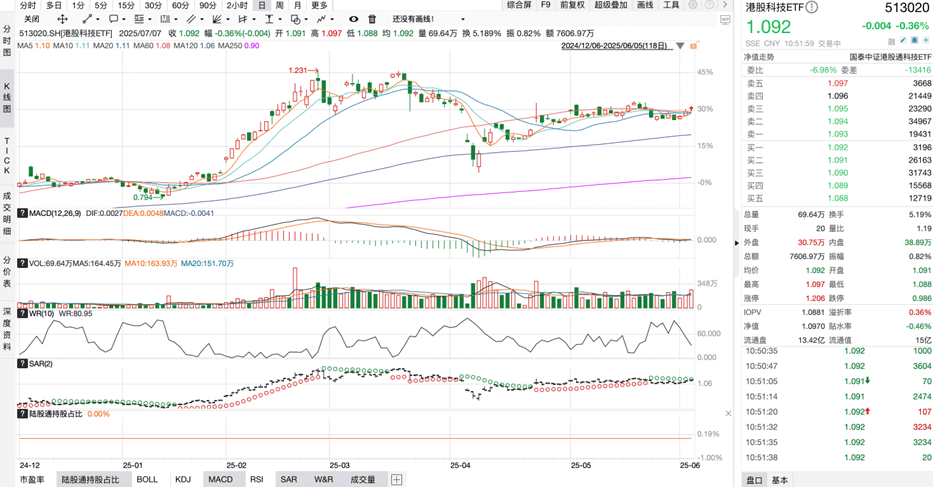
Core Viewpoint - The Hong Kong technology sector is at a convergence of "valuation trough" and "industry transformation," with policy, technology, and capital factors significantly enhancing its investment value [3]. Group 1: Market Performance - The Hong Kong Technology ETF (513020) has seen a year-to-date increase of approximately 30%, although it has recently been fluctuating around the price range of 1.09 [1]. - As of July 7, 2025, the CSI Hong Kong Technology Index has achieved a return of 29.04% year-to-date, outperforming the Hang Seng Technology Index and the Hong Kong Internet Index, which recorded returns of 16.24% and 24.30% respectively [3]. Group 2: Valuation and Growth Potential - The current price-to-earnings ratio (PE-TTM) of the CSI Hong Kong Technology Index is 20.92, which is at the 20.92 percentile of its historical range, indicating a relatively low valuation level with higher safety margins and potential for appreciation [5]. - Bloomberg consensus forecasts suggest that the EPS of the Hang Seng Technology Index will continue to rise annually from 2025 to 2027, supporting the potential for "valuation recovery" and "profit growth" in the sector [3]. Group 3: Investment Opportunities - Investors interested in the Hong Kong technology sector can consider the Hong Kong Technology ETF (513020) for investment opportunities, while those without stock accounts may look into the Hong Kong Technology ETF feeder funds [6].
瞄准科技与医药板块 私募频频调研
Shang Hai Zheng Quan Bao· 2025-07-06 14:56
Core Insights - Private equity firms are increasingly focusing on the technology and pharmaceutical sectors, viewing them as key investment areas [1][3] - In June, private equity managers conducted a total of 1,769 research visits to 387 listed companies, with significant interest in electronic, pharmaceutical, and mechanical equipment sectors [2][3] Group 1: Industry Focus - The technology and pharmaceutical sectors are the most frequently researched areas by private equity firms, with the electronic industry receiving 275 visits and the pharmaceutical industry receiving 266 visits [3] - Notable companies such as Maiwei Biotech received the highest number of visits, totaling 51, indicating strong interest from major private equity firms [2] Group 2: Investment Strategies - Leading private equity firms are not only conducting research but are also actively investing in technology and pharmaceutical sectors, with a focus on new consumption, innovative drugs, and technology stocks [4] - There is a growing optimism regarding the innovative drug sector, with many firms increasing their holdings in this area due to favorable market conditions and the potential for overseas licensing deals [4] Group 3: Market Sentiment - Private equity firms are exhibiting a bullish sentiment towards the Chinese market, with an overall stock position index of 74.62%, indicating a strong investment stance [5] - Among large private equity firms, 52.99% are fully invested (over 80% allocation), reflecting confidence in the market's structural opportunities [5]

恒生港股通科技主题指数:参与港股科技板块的投资利器
HTSC· 2025-07-06 10:55
Quantitative Models and Construction Methods - **Model Name**: Hang Seng Stock Connect Hong Kong Technology Theme Index (HSSCITI.HI) **Model Construction Idea**: The index focuses on the TMT (Technology, Media, and Telecommunications) sector, ensuring high "technology purity" by excluding industries such as pharmaceuticals, home appliances, and automobiles, which may dilute the thematic investment returns[2][28][29] **Model Construction Process**: 1. The index selects stocks listed in Hong Kong that qualify for Southbound trading under the Stock Connect program[34] 2. It focuses on companies in the technology sector, including software, hardware, semiconductors, and internet services, while excluding non-core technology industries[29][34] 3. The index uses free-float market capitalization weighting, with individual stock weight capped at 10%[34] 4. The index is rebalanced semi-annually to ensure alignment with its thematic focus[34] **Model Evaluation**: The index demonstrates a high level of thematic focus, capturing the growth potential of the TMT sector while avoiding the risks associated with unrelated industries[29][34] Model Backtesting Results - **Hang Seng Stock Connect Hong Kong Technology Theme Index**: - 1-year annualized return: 55.90% - 3-year annualized return: 8.83% - Comparative performance: Outperformed the Hang Seng Index, which had 1-year and 3-year annualized returns of 36.31% and 3.55%, respectively[43] Quantitative Factors and Construction Methods - **Factor Name**: Technology Sector Focus **Factor Construction Idea**: The factor emphasizes the concentration of investments in the TMT sector to maximize exposure to technology-driven growth opportunities[29][34] **Factor Construction Process**: 1. Stocks are selected based on their classification within technology-related industries such as software, hardware, and semiconductors[29][34] 2. Non-technology sectors like pharmaceuticals, home appliances, and automobiles are excluded to maintain thematic purity[29][34] 3. The weighting scheme ensures a balanced representation of sub-sectors within the TMT domain, with significant allocations to internet platforms, hardware, and software companies[29][33] **Factor Evaluation**: The factor effectively captures the growth dynamics of the technology sector while minimizing exposure to unrelated industries, enhancing the thematic investment appeal[29][34] Factor Backtesting Results - **Technology Sector Focus Factor**: - Sector allocation: Information Technology (66.55%), Consumer Discretionary (18.25%), Communication Services (15.20%)[33] - Sub-sector allocation: Hardware (27.35%), Software (25.75%), Semiconductors (13.45%), Media (14.42%)[31][33] - Top contributors: Internet platform companies (e.g., Tencent, Alibaba, Meituan) accounted for approximately 44% of the index weight[29][32]