
滞胀

Search documents
日本通胀持续升温:食品价格飙升成主因 工资增长滞后加剧消费萎缩困境
Xin Hua Cai Jing· 2025-07-18 08:06
Core Economic Indicators - Japan's core Consumer Price Index (CPI) excluding fresh food rose by 3.3% year-on-year in June, reaching 111.4, marking the seventh consecutive month of inflation above 3% [1] - The increase in food prices, particularly grains and processed foods, remains the primary driver of inflation, with ordinary japonica rice prices soaring nearly 100% and coffee beans rising by 40.2% [1] Economic Challenges - Wage growth has lagged behind inflation, with average wage growth at only 1.8%, leading to a decline in household consumption willingness and potentially exacerbating a "stagflation" cycle [2] - Over 60% of households have reduced non-essential spending, indicating a significant impact on consumer behavior due to rising living costs [2] Policy Responses - Government measures, such as gasoline retail subsidies, have slightly eased inflationary pressures by lowering energy costs, while a reduction in public high school tuition has contributed to a 0.2 percentage point decrease in CPI [1][2] - The Bank of Japan is expected to maintain its ultra-loose monetary policy despite inflation exceeding its 2% target, as weak wage growth and global economic slowdown present a dilemma for policymakers [2] Future Outlook - Analysts suggest that Japan must balance controlling imported inflation, stimulating wage growth, and resolving trade disputes to avoid the looming threat of stagflation impacting economic recovery [3]
野村全球宏观主管Rob Subbaraman:美国滞胀风险或再现
Zhong Guo Ji Jin Bao· 2025-07-17 09:56
Core Viewpoint - The risk of stagflation in the U.S. economy is re-emerging, with inflation expected to rise and economic growth to slow down in the second half of the year [1][2]. Group 1: Inflation Drivers - Tariff impacts are not fully realized yet, as U.S. companies imported heavily in Q1 to avoid high tariffs, leading to high inventories. Once these inventories are depleted, companies will have to resume imports, likely passing tariff costs onto consumers [2]. - Immigration policies have tightened, leading to labor shortages in key sectors such as construction, agriculture, and elder care, which may push up wage levels and contribute to inflationary pressures [2]. - Moderate fiscal policy expansion is anticipated to contribute 0.4 to 0.5 percentage points to GDP growth over the next 12 months, increasing inflation risks [2]. Group 2: Economic Growth Projections - U.S. GDP growth is projected to be below trend levels, with estimates of 1.3% for this year and 1.2% for next year [3]. Group 3: Long-term Fiscal Concerns - The rapid passage of the "Big and Beautiful" bill, which makes the temporary personal income tax cuts from 2017 permanent, is expected to increase the budget deficit by over $3 trillion over the next decade. This is unusual given the already low unemployment rate [5]. - The U.S. budget deficit is projected to remain above 6% of GDP in the coming years, with government debt reaching about 100% of GDP, and interest payments consuming 3% to 4% of GDP, which is unsustainable [5]. - Changes in the buyer structure of U.S. debt, with reduced purchases from foreign central banks and increased sensitivity from private investors, may lead to greater volatility in bond yields [5]. Group 4: Global Economic Outlook - Other regions are expected to experience slower growth but easing inflation, providing more room for central banks to cut rates. Asian exports are anticipated to decline further in the second half of the year, while Germany's fiscal and infrastructure spending may take time to support economic growth [6]. Group 5: Currency and Monetary Policy - The Nomura team holds a "soft dollar" stance due to stagflation pressures in the U.S., despite current interest rate differentials favoring the U.S. The dollar is considered significantly overvalued, and the persistent trade deficit may limit its performance [7]. - Concerns about the potential appointment of a "shadow Fed chair" by Trump could add uncertainty to monetary policy, as this individual might influence market expectations and complicate the current Fed chair's policy-making [8].
特朗普突然改口?没打算让美联储主席走人,说到底还是怕美元崩了
Sou Hu Cai Jing· 2025-07-17 09:32
Group 1 - President Trump has publicly criticized Federal Reserve Chairman Powell multiple times, indicating dissatisfaction with his performance and suggesting the possibility of dismissal [1][3] - Trump's economic advisor Hassett claimed that the President has the authority to fire Powell, citing mismanagement of a renovation project that saw costs rise from $1.9 billion to $2.5 billion [1] - Powell defended the renovation as necessary for safety and emphasized the constitutional protection of the Federal Reserve's independence [1] Group 2 - Trump has not planned to fire Powell but retains the option, criticizing Powell for not lowering interest rates [3] - Current economic data does not support a rate cut, and Trump's tariffs are causing price increases in consumer goods, which could lead to inflation exceeding 5% by 2026 [3] - The Federal Reserve prioritizes stabilizing the U.S. economy and the dollar over political pressures, as yielding to such pressures could undermine its credibility [5] Group 3 - Powell's resistance to political pressure is seen as a defense of professional rationality against short-sighted political demands [8] - Trump's motivation for requesting rate cuts is to reduce interest payments on the national debt of $36 trillion, which could create a false economic prosperity ahead of midterm elections [8] - The independence of the Federal Reserve is crucial for global economic stability, and any political interference could lead to significant financial repercussions [8]

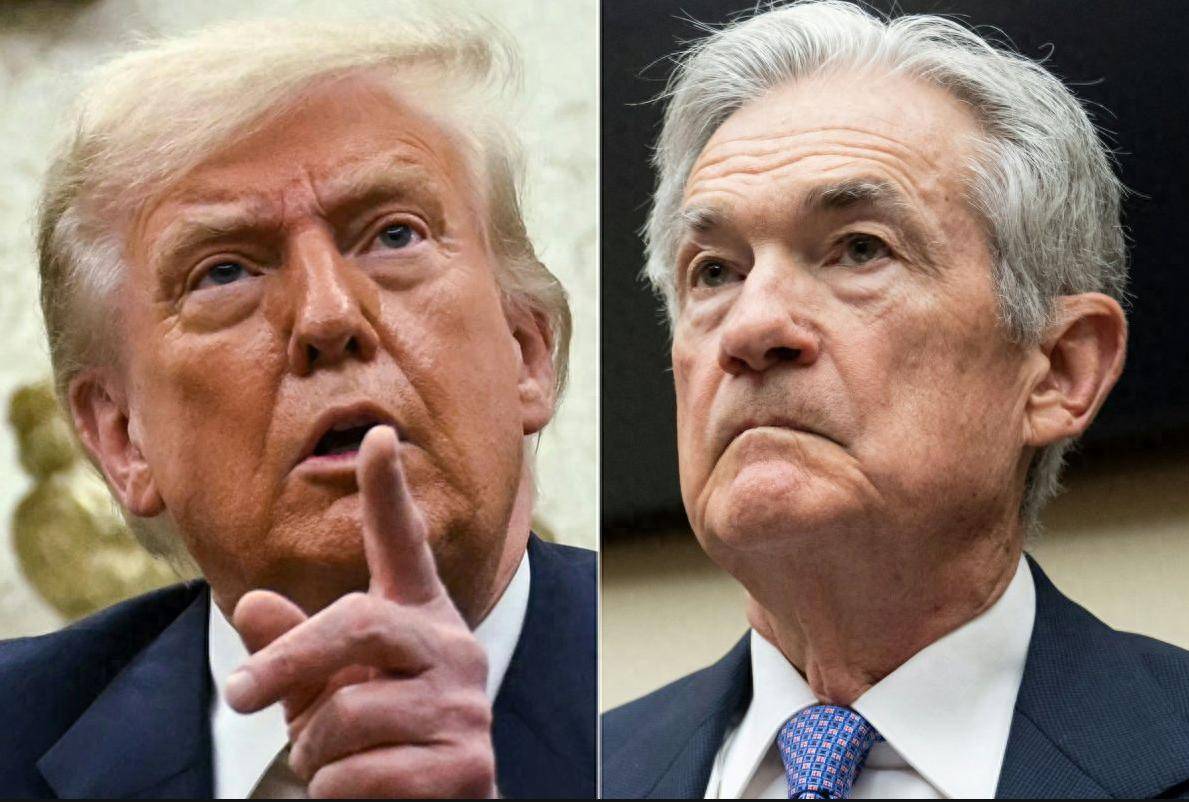
野村全球宏观主管Rob Subbaraman:美国滞胀风险或再现
中国基金报· 2025-07-17 09:22
Core Viewpoint - The risk of stagflation in the U.S. economy is re-emerging, with inflation expected to rise and economic growth slowing down in the second half of the year. The Federal Reserve is likely to be cautious regarding interest rate cuts, which may occur later and be smaller than market expectations [2][3]. Group 1: Causes of Rising Inflation - The impact of tariffs is not fully realized yet, as U.S. companies imported significantly in the first quarter to avoid high tariffs, leading to high inventory levels. Once these inventories are depleted, companies will need to import again, potentially passing on tariff costs to consumers [4]. - Stricter immigration policies have led to labor shortages in key sectors such as construction, agriculture, and elder care, which may drive up wage levels and contribute to inflationary pressures [4]. - Moderate fiscal policies are expected to contribute 0.4 to 0.5 percentage points to GDP growth in the next 12 months, increasing inflation risks [4]. Group 2: Economic Growth Projections - U.S. GDP growth is projected to be below trend levels, with estimates of 1.3% for this year and 1.2% for next year [5]. Group 3: Long-term Fiscal Concerns - The rapid passage of the "Big and Beautiful" bill, which makes the 2017 temporary personal income tax cuts permanent, is expected to increase the budget deficit by over $3 trillion in the next decade. This level of fiscal stimulus is unusual given the already low unemployment rate [8]. - The U.S. government debt has reached about 100% of GDP, with interest payments consuming 3% to 4% of GDP, which is unsustainable. The buyer structure of U.S. debt has shifted, with foreign central banks reducing their purchases, leading to increased volatility in bond yields [8]. - Long-term solutions to the debt issue may require fiscal consolidation, which could involve spending cuts, tax increases, or new tax sources. Alternatively, forced purchases of more government bonds or quantitative easing by the Federal Reserve could lead to inflation [8]. Group 4: Global Economic Outlook - Outside the U.S., other regions are expected to experience slower growth but easing inflation, providing more room for central banks to cut rates. Asian exports are anticipated to decline further in the second half of the year, while Germany's fiscal and infrastructure spending may take time to support economic growth [9]. - The Nomura team holds a "soft dollar" stance due to stagflation pressures in the U.S., despite current interest rate differentials favoring the U.S. The dollar is considered significantly overvalued, and the persistent trade deficit will constrain its performance [9]. Group 5: Monetary Policy Uncertainty - The potential for the Federal Reserve to maintain low interest rates could lead to rising inflation, causing foreign investors to lose confidence in U.S. assets, which may result in higher long-term interest rates and a weaker dollar [11]. - The possibility of appointing a "shadow Federal Reserve Chair" by Trump could create additional uncertainty in monetary policy, complicating the current Fed Chair Powell's role and the FOMC's decision-making process [11].

启牛学堂解析:美联储政策观望与金融市场展望
Sou Hu Cai Jing· 2025-07-16 09:33
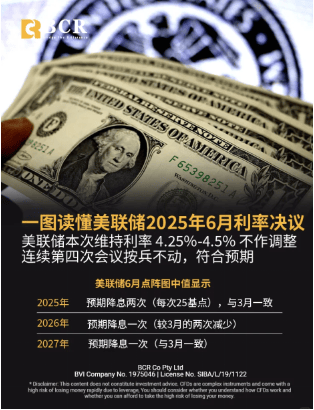
Group 1 - The Federal Reserve maintained interest rates in June, reflecting a cautious approach amid uncertainties related to Trump's policies, opting to wait for clearer signals for potential rate cuts [1][3] - The Fed's description of economic uncertainty changed from "further increasing" to "somewhat decreasing but still high," indicating a slightly more optimistic outlook while remaining vigilant [1] - Economic forecasts show a downward revision in GDP, an upward revision in unemployment rate, and an upward revision in inflation, suggesting a more complex financial landscape in the second half of the year [1][5] Group 2 - The dot plot indicates a downward adjustment in the Fed's rate cut expectations for 2026, reflecting a more cautious stance on future economic trends [3] - Fed Chair Powell's post-meeting remarks were hawkish, noting that while job growth has slowed, the unemployment rate remains low, and he anticipates significant inflationary pressures in the coming months [3] - Following the FOMC decision, U.S. Treasury yields rose while the stock market declined, with market expectations for rate cuts in September and December contrasting with the Fed's cautious outlook [3][5] Group 3 - The likelihood of a rate cut in September is considered low, with the Fed likely to maintain a wait-and-see approach due to persistent inflation risks and a slow rise in unemployment [5] - Factors such as tariffs affecting consumer prices and ongoing geopolitical tensions in the Middle East may contribute to upward pressure on inflation [6] - Despite an upward trend in initial jobless claims, seasonal factors are likely influencing this increase, necessitating close monitoring of future jobless claims data [6]
海外观察:美国2025年6月CPI数据:关税冲击初显,三季度或难降息
Donghai Securities· 2025-07-16 07:01
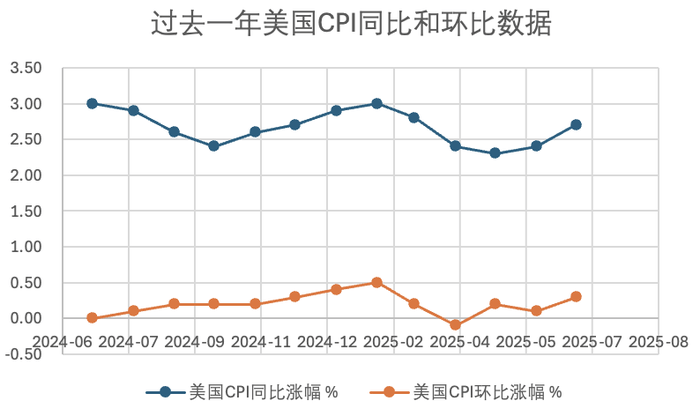
Inflation Data - The U.S. June CPI year-on-year increased to 2.7%, matching expectations, while the previous value was 2.4%[2] - Month-on-month CPI rose by 0.3%, consistent with expectations, compared to a previous value of 0.1%[2] - Core CPI year-on-year was 2.9%, slightly below the expected 3.0%, and the previous value was 2.8%[2] Economic Implications - The rise in overall inflation is attributed to increased energy prices, tariff impacts, and expectations from new fiscal legislation[2] - The core CPI's slight underperformance is influenced by weak new car sales and a cooling housing market[2] - The risk of "stagflation" in the U.S. economy is increasing due to the divergence between inflation data and weak non-farm private employment figures[2] Energy Prices - Energy prices rebounded due to geopolitical tensions, with energy goods prices changing from -2.4% to 1.0% month-on-month[2] - Energy service prices maintained a high growth rate, increasing from 0.4% to 0.9% month-on-month[2] Tariff Effects - Core goods prices increased year-on-year from 0.3% to 0.7%, with clothing being a major contributor[2] - The month-on-month change in core goods prices rose from 0.0% to 0.2%[2] Housing Market - The housing market continues to cool, with housing prices year-on-year decreasing from 3.9% to 3.8%[2] - The NAHB housing market index fell to 32, the lowest point in 2023[2] Market Expectations - Following the CPI release, market expectations for a rate cut by the Federal Reserve in Q3 have diminished, with a 53.5% probability for a rate cut in September[4] - The strong inflation data does not support a rate cut, increasing the likelihood of the Fed having to choose between stabilizing employment and controlling inflation[2]
特朗普关税对通胀的影响开始显现,美国经济滞胀风险上升
Sou Hu Cai Jing· 2025-07-16 05:11
Core Viewpoint - The inflation effects of Trump's tariffs are becoming evident, with the latest data showing an acceleration in the Consumer Price Index (CPI) in June, indicating that tariff costs are being passed from businesses to consumers, potentially leading to stagflation in the U.S. economy [1][5][9] Economic Indicators - In June, the CPI rose by 2.7% year-on-year, an increase of 0.3 percentage points from May, and a month-on-month rise of 0.3%, up by 0.2 percentage points from the previous month [1][6] - The "super core inflation," which excludes food, energy, and housing, increased by 0.12% month-on-month in June, significantly higher than the previous two months' increases of 0.01% and 0.07% [1][6] Tariff Impact - The tariffs introduced on April 2 have begun to affect prices, particularly in sectors like furniture and toys, which are sensitive to tariff changes [5][6] - Analysts suggest that the impact of tariffs on inflation was initially muted due to inventory buffers, but as these buffers deplete, the inflationary effects will become more pronounced [6][9] Consumer and Business Costs - Goldman Sachs estimates that businesses will pass approximately 70% of the tariff costs onto consumers, with the remaining 30% absorbed by businesses and foreign exporters [7] - The annual inflation expectations among the public have risen to 4.9%, with long-term expectations reaching 3.9%, the highest since 1993 [8] Economic Growth Projections - The U.S. GDP growth is expected to slow significantly, with various institutions revising their forecasts downwards for 2025, indicating a potential growth rate of 1.3% to 1.7% [9][10] - The Federal Reserve may face constraints on its ability to lower interest rates due to rising inflation pressures, with the next potential rate cut not expected until September [9][10]
世界黄金协会:下半年金价或陷横盘震荡 滞胀风险下潜在涨幅或达15%
智通财经网· 2025-07-16 03:44
Group 1 - The World Gold Council's mid-year outlook report indicates that if economists and market participants' macroeconomic predictions are accurate, gold prices may experience a sideways trend in the second half of the year, with some upward potential [1] - Historical experience shows that economic performance rarely aligns perfectly with consensus forecasts, suggesting uncertainty in future gold price movements [1] - If economic and financial conditions worsen, along with increased stagflation pressures and escalating geopolitical tensions, safe-haven demand could drive gold prices up by 10%-15% [1] - Conversely, if global conflicts are resolved broadly and sustainably, gold may retrace 12%-17% of its gains this year, although this scenario is currently considered unlikely [1] - The World Gold Council anticipates that global central bank demand for gold will remain strong in 2025, despite a potential decline from record levels, still expected to exceed the average of 500-600 tons per year prior to 2022 [1] - The report emphasizes that pressures related to the US dollar may persist, and discussions about the end of the "American exceptionalism" narrative could become a focal point for investors [1] - Overall, these conditions position gold as a net beneficiary, although some positive factors are already reflected in current gold prices [1] Group 2 - In June, the US Consumer Price Index (CPI) rose by 2.7% year-on-year, exceeding the 2.4% increase in May and aligning with economists' expectations [2] - Typically, gold performs best in low-interest-rate environments, making it more attractive compared to interest-bearing assets like bonds [2] - The main gold futures contract for July delivery on the New York Commodity Exchange fell by 0.6%, settling at $3,329.80 per ounce, while the main silver futures contract dropped by 1.6%, closing at $37.834 per ounce [2]
割肉?死扛?加仓?中州期货金国强拆解黄金抉择:回调是“鱼尾行情”,建议降低杠杆逢低布局
Hua Xia Shi Bao· 2025-07-15 12:58
面对下跌,普通投资者现在该怎么做?是止损,持有,还是买入?金国强建议:降低杠杆、逢低布局 (而非追高或恐慌割肉),利用期权保护,现货选ETF,以定投思维持有。 避险退潮与降息预期推迟 金国强指出,本轮金价下跌受两大核心因素驱动。一是避险情绪消退,加沙、俄乌等热点地区局势降 温,市场风险偏好回升。中美日内瓦谈判达成阶段性共识,特朗普政府对等关税政策引发的避险情绪退 潮。二是美联储降息预期弱化,美国6月非农新增就业14.7万人超预期,失业率降至4.1%,通胀数据稳 定,导致7月降息概率跌破10%,延迟至9月后。 期货市场上,主力合约多空双方力量对比发生了哪些关键转折?这些变化是不是揭示了市场情绪的转 变?金国强认为,从期货市场信号来看,机构高位减持,牛市进入"鱼尾阶段"。 资金动向揭示了市场情绪转变。金国强表示,国内外机构同步高位减持。国内期货市场,主力多头持仓 从峰值3万手减至1.3万手,净持仓占比从40%降至33%;海外市场,COMEX黄金管理基金净多持仓占 比从29%降至13%(4月前),5月后反弹至20%,但总持仓量持续萎缩。 本报(chinatimes.net.cn)记者张玫 北京报道 期货市场常被视为 ...

最痛一击来了?特朗普对欧关税或引爆美国滞胀!
Jin Shi Shu Ju· 2025-07-15 11:03
随着通胀温和、失业率稳定以及美股重回历史高点,特朗普似乎毫无理由收敛其全球对等关税野心。但 8月1日即将生效的30%对欧关税,或将首次给美国消费者和企业带来经济学家长期担忧的毁灭性打击。 "关税税率越高,滞胀风险就越大,"联博经济学家埃里克·维诺格拉德(Eric Winograd)指出。作为彼 此最大贸易伙伴,美欧供应链一旦断裂,破坏力将远超此前任何一轮关税。欧盟委员会主席冯德莱恩警 告,新关税将"破坏跨大西洋关键供应链,损害双方企业、消费者和患者的利益"。 尽管企业通过提前囤货暂时缓解了冲击,但库存耗尽后终将面临抉择——是将成本转嫁给愈发谨慎的消 费者,还是通过裁员来维持利润? 白宫经济顾问哈塞特却坚称"数据未见负面影响",并援引内部研究称进口商品价格自2月以来持续下 降。这种"数据爱国主义"论调遭专家质疑——毕竟最具杀伤力的关税尚未落地。 TS Lombard首席经济学家史蒂文·布利茨(Steven Blitz)指出:"这本质是企业利润税,最终总要有人买 单。"在某个时候,企业将耗尽其现有库存,这意味着它们将不得不以更高的价格进口新的供应。 更棘手的是,美联储正陷入通胀与增长的双重困局。尽管市场预期9月可 ...