
自主可控

Search documents
2026年,你的钱该放哪里?一份“哑铃型”配置指南
Ge Long Hui· 2025-11-18 04:27
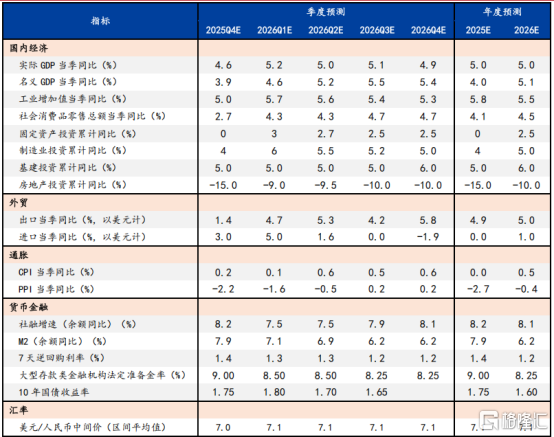
Group 1 - The core viewpoint for 2026 asset direction emphasizes "policy efforts and the rise of new momentum, with A-shares remaining the core battlefield, but structure being more important than position" [1] - In 2026, the macro environment is characterized by a "comprehensive effort period" for policies, with GDP targets expected to remain around 5%, and monetary easing and fiscal expansion as the main themes [1][2] - Key economic indicators for 2026 include a projected actual GDP growth of 5.0%, nominal GDP growth of 5.1%, and a retail sales growth of 4.5% [2][3] Group 2 - The export growth for 2026 is expected to be around 5%, with a recovery in exports to the U.S. and highlights in the "Belt and Road" initiative and AI industry chain [3][4] - The investment strategy suggested is a "barbell strategy," focusing on both growth and consumption, with a moderate rotation in between [5][6] - The technology growth sector is highlighted, focusing on "new momentum" such as AI, new energy, and self-controlled technologies, supported by the "14th Five-Year Plan" [4][5] Group 3 - The consumption sector is seen as a key area for structural recovery in 2026, with specific attention to sectors like medical services, aviation, home appliances, and non-alcoholic beverages, which show strong earnings growth and low valuations [7][8] - The "招商上证消费80ETF联接C" is recommended as a long-term investment tool for exposure to the consumer sector, with a focus on stable earnings and low fees [7][8] - The "招商中证白酒指数C" is identified as a stable investment in the consumer sector, with strong performance expected leading up to the Spring Festival [8][9]

存储市场迎价格上涨周期,半导体设备ETF(159516)大涨超3%
Sou Hu Cai Jing· 2025-11-18 03:05
Group 1 - The semiconductor equipment ETF (159516) has seen a significant increase of over 3% on November 18, with a year-to-date share growth of over 160%, reaching a scale of over 6.2 billion yuan, ranking first among similar products [1][7] - The storage market is currently experiencing a notable price increase cycle driven by explosive growth in enterprise-level storage demand due to AI applications and a structural supply tightness in traditional storage products [3] - Major storage manufacturers, including Samsung, SK Hynix, Kioxia, and Micron, have reduced NAND Flash supply in the second half of this year, which may prolong the tight supply situation and further drive up NAND prices [3] Group 2 - The "domestic substitution" trend has become a necessity in the semiconductor industry, creating a stable domestic market for equipment and materials companies, which can withstand global cyclical fluctuations [4] - The storage chip industry is entering a new upcycle, supporting the high-quality development of the digital economy, and companies achieving technological breakthroughs in key areas are likely to outperform expectations [4] - The semiconductor equipment ETF (159516) is positioned to benefit from the increasing importance of semiconductor equipment amid escalating geopolitical tensions and the expansion of advanced process and storage production [5] Group 3 - The semiconductor equipment ETF (159516) tracks the CSI Semiconductor Materials and Equipment Theme Index, representing the fundamental progress in the equipment and materials sector [5] - Key companies within the semiconductor equipment ETF include Zhongwei Company (17.29% weight), Northern Huachuang (13.46% weight), and Tuojing Technology (6.05% weight), among others [6]

招商证券:存储景气上行价格涨幅扩大 设备等受益于下游扩产趋势
智通财经网· 2025-11-18 02:17
Core Viewpoint - The report from China Merchants Securities indicates an optimistic outlook for AI-related companies like NVIDIA and AMD, with NVIDIA projecting $500 billion in revenue from its Blackwell and Rubin series products over the next five quarters [1] - AMD achieved a record high revenue in Q3 2025 and anticipates a compound annual growth rate (CAGR) of over 60% for its data center business [1] Group 1: AI and Semiconductor Industry Outlook - NVIDIA and AMD are both optimistic about AI expectations, with NVIDIA's upcoming products expected to significantly boost revenue [1] - AMD's Q3 2025 revenue reached a historical peak, with strong growth anticipated in the data center segment [1] Group 2: Market Trends and Price Movements - The semiconductor index in A-shares underperformed compared to the Philadelphia Semiconductor Index and the Taiwan Semiconductor Index in October 2025, with declines of 5.96% and 3.53% respectively [2] - Since Q3 2025, there has been a comprehensive price increase in DRAM and NAND, with October seeing accelerated price hikes due to rising demand from AI servers [5] Group 3: Demand and Supply Dynamics - Demand in certain consumer electronics sectors is recovering, driven by innovations in AI and automotive applications, with global smartphone shipments increasing by 2.6% year-on-year in Q3 2025 [3] - The supply side shows a recovery in capacity utilization rates, with TSMC reporting strong demand for AI data centers and SMIC achieving a capacity utilization rate of 95.8% in Q3 2025 [4] Group 4: Sales Performance - Global semiconductor sales reached $64.97 billion in September 2025, reflecting a year-on-year increase of 25.1% [6] - Sales in the Americas and Asia-Pacific regions showed significant growth, with the Americas up 30.6% year-on-year and Asia-Pacific up 47.9% [6] Group 5: Industry Chain Tracking - The storage sector is experiencing an upward trend in prices, benefiting from downstream expansion trends, while demand for advanced processes remains robust [7] - TSMC anticipates that AI demand will exceed expectations, projecting a CAGR of over 45% from 2024 to 2029 [7]



国内冷链智能装备“小巨人”今日申购
2 1 Shi Ji Jing Ji Bao Dao· 2025-11-17 23:25
Group 1: New Stock Subscription and Listings - A new stock subscription for Jingchuang Electric (920035.BJ) is available, while three new stocks are listed: Nanfang Digital (301638.SZ), Hengkong New Materials (688727.SH), and Beikang Testing (920160.BJ) [1] Group 2: Jingchuang Electric Overview - Jingchuang Electric specializes in the R&D, production, and sales of cold chain equipment smart controllers, monitoring recorders, and environmental detection instruments, and is recognized as a national high-tech enterprise [2] - The company has established subsidiaries in the USA, UK, and Brazil, and has entered the supply chains of major refrigeration equipment manufacturers like Panasonic and Haier [2] - As of November 17, Jingchuang Electric holds a market share of 13.13% in China's cold chain temperature and humidity control market, ranking first domestically, and 4.64% globally [3] Group 3: Nanfang Digital Overview - Nanfang Digital provides comprehensive digital construction solutions for the power energy sector, focusing on digital transformation and maintaining grid safety [4] - The company has developed key technologies, including the "Dihong" IoT operating system and the "Fuxi" power-specific main control chip, contributing to the domestic energy control field [4] Group 4: Hengkong New Materials Overview - Hengkong New Materials focuses on the R&D and industrial application of key materials for integrated circuits, particularly in photolithography materials [6] - The company's self-produced product sales revenue has increased from 12,357.89 million in 2022 to 34,418.93 million in 2024, with a rising proportion of total revenue [6][7] Group 5: Beikang Testing Overview - Beikang Testing, established in 2016, is a leading institution in the R&D and service of non-ferrous metal inspection and testing technology [9] - The company is involved in the formulation of numerous national and international standards in the field of mineral and metal testing [9][10]
野村高挺:政策支持、流动性和产业升级是驱动A股后续上涨的核心动力
Cai Jing Wang· 2025-11-17 14:48
Group 1 - The core drivers for the future rise of A-shares are policy support, liquidity, and industrial upgrading [1] - A-share valuations have become high after nearly a year of expansion, but the equity risk premium (ERP) remains at a reasonable level due to the decline in the risk-free interest rate [1] - The long-term total factor productivity upgrade and technological transformation outlined in China's 14th Five-Year Plan will continue to catalyze structural market trends, although improvements in the earnings fundamentals still depend on enhanced policies [1] Group 2 - Before confirming improvements in the fundamentals, liquidity remains the key driver for the market [1] - The core themes for A-shares in the coming year are expected to be AI, self-control, and high value-added exports [1]
可转债周报:新券高定价,收益如何获取?-20251117
SINOLINK SECURITIES· 2025-11-17 14:14
Core Viewpoints - The issuance of new convertible bonds has been relatively low this year, with less than 50 bonds issued and a total scale of less than 500 billion, leading to a scarcity that has attracted market attention [12][14] - New bonds listed since July have closed above 140, indicating strong market demand, and the pricing strategy for new bonds is crucial for obtaining returns [2][12] - Two main strategies for institutions to gain returns from new bonds include buying on the second day after listing and participating in rights offerings [2][27] Market Review - The stock market has been experiencing fluctuations, with the Shanghai Composite Index and ChiNext Index showing declines of 0.18% and 3.01% respectively, indicating a technical pressure around the 4000-point mark [34] - The consumer sector has shown strength, while technology stocks have faced significant pullbacks, influenced by CPI/PPI data and external market conditions [34][55] - The convertible bond market has seen a rise in the index, with the average transaction volume increasing, reflecting a high valuation environment [44][47] Convertible Bond Investment Strategy - The current valuation of convertible bonds is at a high level, with the average premium rate for bonds priced between 90-110 at approximately 30.06%, indicating limited upward momentum [47][55] - A neutral overall view is suggested, with a focus on trading opportunities as the premium rate approaches around 26% [55] - Specific sectors to watch include high-growth areas such as non-ferrous metals, electronics, battery storage, and military industries, as well as themes like AI computing and solid-state batteries [55] Primary Market Tracking - Recently, one new bond was issued, and several companies have received approvals for bond issuance, indicating ongoing activity in the convertible bond market [56][58]
摩尔线程(688795):注册制新股纵览:自研全功能GPU,AI智算加速成长可期
Shenwan Hongyuan Securities· 2025-11-17 13:08
Investment Rating - The report assigns a rating based on the AHP score, with a score of 3.39 indicating a position in the upper-middle tier of the AHP model for the Sci-Tech Innovation Board [8][11]. Core Insights - The company focuses on the research, design, and sales of self-developed full-function GPUs, with a strategic shift towards high-margin, high-performance segments, particularly in AI computing [11][19]. - The company has achieved significant advancements in GPU architecture, enabling breakthroughs in computing power and product performance that meet international standards [19][20]. - The AI chip market in China is projected to reach 1.3368 trillion yuan by 2029, with a compound annual growth rate of 53.7% from 2025 to 2029, indicating substantial growth potential for the company [19][24]. Summary by Sections 1. AHP Score and Expected Allocation Ratio - The AHP score for the company is calculated at 3.39, placing it in the 56.1% percentile of the AHP model, indicating a strong position in the market [8][10]. 2. Highlights and Features of the New Stock 2.1 Core Team and Self-Developed GPU Architecture - The core team comprises professionals with extensive experience from leading international companies, focusing on self-developed full-function GPUs [11][15]. 2.2 Full-Function GPU Achievements - The company has developed a comprehensive product system that includes AI computing, cloud computing, and personal computing applications, with significant revenue growth expected from AI computing products [11][19]. 2.3 Capitalizing on AI and Graphics Opportunities - The company plans to invest in the development of next-generation AI training and inference chips, graphics chips, and AI SoC chips, aiming to strengthen its product performance and technology barriers [24][26]. 3. Comparable Company Financial Metrics 3.1 Revenue and Profit Trends - The company’s revenue is projected to grow significantly, with estimates of 0.46 billion yuan in 2022, increasing to 7.02 billion yuan by the first half of 2025, while net losses are expected to narrow [28][30]. 3.2 R&D Expenditure Trends - R&D expenses have been increasing, with the company spending 11.16 million yuan in 2022 and 5.57 million yuan in the first half of 2025, indicating a strong commitment to innovation [34][36]. 3.3 Profitability and Debt Levels - The company’s gross margin has improved significantly, with a gross margin of 70.71% in 2024, while the debt-to-asset ratio has been relatively high, indicating potential financial risks [39][40]. 4. Fundraising Projects and Development Vision - The company plans to raise funds for the development of new AI training and inference chips, graphics chips, and AI SoC chips, which are expected to enhance its competitive position in the GPU market [42][43].
日发精机:深化高端装备布局 助力制造业自主可控
Zheng Quan Ri Bao· 2025-11-17 08:15
Core Viewpoint - The domestic high-end equipment market share is steadily increasing as local companies accelerate technological breakthroughs, transitioning from "catching up" to "keeping pace" and even "leading" in key areas [1][3]. Group 1: Industry Trends - The domestic high-end equipment manufacturing sector is experiencing significant advancements, with companies achieving breakthroughs in cost, efficiency, and precision [1]. - The trend towards "self-controllable" capabilities in the industry is being driven by the rapid development of domestic high-end equipment [3]. Group 2: Company Developments - The company, Rifa Precision Machinery, is focusing on high-end equipment manufacturing, particularly in industrial mother machines and CNC machine tools, serving sectors such as aerospace, engineering machinery, new energy vehicles, and humanoid robots [3]. - The company's self-developed thread grinding machine has a cost that is only one-tenth to one-thirtieth of international competitors, while meeting international standards for precision and efficiency [1].

电子行业周报:中芯国际三季度产能利用率与ASP双增,百度公布昆仑芯五年路线图-20251117
Donghai Securities· 2025-11-17 07:29
Investment Rating - The report suggests a positive outlook for the semiconductor industry, highlighting structural opportunities in AI computing, AIOT, semiconductor equipment, key components, and rising storage prices [4][5]. Core Insights - Semiconductor company SMIC reported a significant increase in capacity utilization and average selling price (ASP) by 3.8% quarter-on-quarter, indicating a continued recovery in the semiconductor industry. The company expects to maintain full production in the traditionally slow fourth quarter, projecting annual revenue to exceed $9 billion [4][10]. - Baidu announced its new AI model, Wenxin 5.0, and the Kunlun chips M100 and M300, marking a strategic acceleration in AI capabilities. The company plans to maintain a "five years, five chips" strategy, with significant product launches scheduled through 2030 [4][11]. - The electronic industry has shown signs of demand recovery, with storage chip prices rising unexpectedly and domestic production efforts exceeding expectations [4][5]. Summary by Sections Industry News - SMIC's Q3 revenue reached 23.82 billion yuan, a 7.8% increase quarter-on-quarter, with a capacity utilization rate of 95.8% and a projected revenue of over $9 billion for the year [10]. - Major NAND flash manufacturers, including Samsung and SK Hynix, are planning to increase NAND prices and reduce production, with SanDisk raising contract prices by up to 50% [11]. - Baidu's new Kunlun chips are set to enhance AI computing capabilities, with the M100 launching in early 2026 and the M300 in early 2027 [11][12]. Market Performance - The electronic sector underperformed the market, with the Shenzhen 300 index down 1.08% and the Shenwan electronic index down 4.77%, indicating a challenging market environment [17][19]. - The semiconductor sub-sector saw a decline of 3.97%, while electronic components dropped by 9.25%, reflecting broader market pressures [19][20]. Investment Recommendations - The report recommends focusing on companies benefiting from strong domestic and international demand in the AIOT sector, such as Lexin Technology and Hanguang Technology, as well as those involved in AI innovation and semiconductor equipment [5].


20cm速递|科创板100ETF(588120)飘红,科技或支撑指数韧性
Mei Ri Jing Ji Xin Wen· 2025-11-17 05:39
Group 1 - The core viewpoint is that the ongoing transformation in technology is leading to a shift in industry weightings, resulting in a decline in the reference significance of historical relative valuations, while sectors like electronics continue to drive valuation upgrades in the tech field [1] - The phenomenon of valuation differentiation is expected to persist in the A-share market, with limited downside potential for the index [1] - The easing of China-US trade tensions has prompted both countries to embark on long-term self-sufficient industrial chain security construction, which will benefit themes related to self-sufficiency in the long run [1] Group 2 - The "14th Five-Year Plan" emphasizes investment in self-sufficiency and the commercialization of emerging industries such as commercial aerospace, satellites, 6G, and low-altitude robotics, which are expected to have a positive impact on A-shares [1] - Investors are advised to increase their focus on self-sufficiency themes in both China and the US, particularly in military trade, AI infrastructure, commercial aerospace, 6G infrastructure, and industrial control/office/AI software [1] - The Science and Technology Innovation Board 100 ETF (588120) tracks the Science and Technology Innovation 100 Index (000698), which has a daily fluctuation limit of 20%, reflecting the overall performance of 100 representative listed companies in the Science and Technology Innovation Board [1]