
去美元化

Search documents
西南期货早间评论-20260211
Xi Nan Qi Huo· 2026-02-11 02:03
1. Report Industry Investment Ratings No relevant content provided. 2. Core Views of the Report - The macro - economic recovery momentum needs to be strengthened, and the monetary policy is expected to remain loose. There is still some pressure on treasury bond futures, and caution is advised [6]. - The domestic economy is stable, but the recovery momentum is weak, and corporate profit growth is at a low level. However, domestic asset valuations are low, and there is room for repair. The stock index fluctuation center is expected to gradually move up, and previous long positions can be held [9]. - The global trade - financial environment is complex. The trend of "de - globalization" and "de - dollarization" is beneficial to the allocation and hedging value of gold, but the recent sharp rise in precious metals has led to a significant increase in speculative sentiment. It is recommended to exit long positions and wait and see [11]. - The supply - demand pattern of steel products and iron ore is weak, and they may continue the weak shock pattern in the short - term. Investors can pay attention to the opportunity of buying on dips and manage positions carefully [14][16]. - The supply - demand pattern of coking coal and coke is complex. They may continue the shock pattern in the medium - term, and investors can pay attention to the opportunity of buying at low levels [19]. - The overall over - supply pressure of ferroalloys continues, but the cost support is gradually strengthening. After the price drops, attention can be paid to the long - position opportunities in the low - level range [21]. - The negotiation between the US and Iran is complex, and geopolitical risks still exist. The capital is still bullish on crude oil prices, and the rebound of crude oil is expected to continue [24]. - The tight supply of Singapore fuel oil has eased, but the rebound of crude oil at the cost end drives the fuel oil price to rebound, and there is still room for the fuel oil price to rise [27]. - As the Spring Festival approaches, the demand for polyolefins will decrease significantly, and cautious operation is recommended before the festival [29]. - Synthetic rubber may show a relatively strong shock trend, and attention should be paid to the resumption of logistics and infrastructure construction after the Lantern Festival and the inventory destocking rate of tire enterprises [31]. - Natural rubber may show a shock trend, and positions should be controlled before the festival [34]. - PVC may show a relatively strong shock trend, and the key to price and inventory lies in the demand recovery after the Spring Festival [36]. - Urea may show a shock - strong trend, and attention should be paid to Indian tenders, domestic policies, and the recovery rhythm of downstream demand after the festival [39]. - PX may be mainly in shock adjustment in the short - term, and cautious participation is recommended, paying attention to the fluctuation risk of overseas crude oil during the Spring Festival [42]. - PTA may be in shock operation in the short - term, and it is recommended to operate carefully, paying attention to oil price changes [43]. - Ethylene glycol may maintain a shock - bottoming pattern in the short - term, and it is recommended to operate carefully, paying attention to port inventory and supply changes [45]. - Short - fiber is still trading based on the cost - end logic before the festival, and it is recommended to wait and see carefully, paying attention to cost changes and downstream pre - holiday stocking [46]. - Bottle chips are expected to follow the cost - end operation, and cautious participation is recommended before the festival, paying attention to the implementation of maintenance devices [49]. - The fundamentals of soda ash are still loose, and it should be treated with caution [50]. - The fundamentals of glass are still loose, and it is expected to be in shock before the festival, paying attention to the risk of returning to the fundamentals [51]. - The seasonal characteristics of caustic soda are significant, and although the disk rose yesterday, the fundamentals of the middle and lower reaches have not improved significantly, so it should be treated with caution [54]. - Pulp is expected to have limited fluctuations before the festival due to factors such as inventory accumulation and weak terminal demand [57]. - The price of lithium carbonate has short - term support, but the short - term fluctuation may increase, and risk control is necessary [58]. - Copper prices may be weakly adjusted before the festival due to weakening market sentiment and fundamentals [60]. - Aluminum prices may be under pressure as speculative funds leave the market this month [62]. - Zinc prices will enter an adjustment period as market sentiment cools and zinc ingots accumulate [64]. - Lead prices may show a weak shock trend due to the weak supply - demand pattern [66]. - Tin prices have support below, but short - term fluctuations may intensify, and risk control is necessary [67]. - Nickel is still in an oversupply pattern, and attention should be paid to relevant Indonesian policies [69]. - For soybean meal, attention can be paid to long - position opportunities in the low - cost support range; for soybean oil, it is advisable to wait and see after the price leaves the low - cost range [71]. - For palm oil, attention can be paid to the opportunity of buying on dips [73]. - For rapeseed meal and rapeseed oil, it is recommended to wait and see temporarily [76]. - Cotton prices are expected to be strong in the medium - and long - term, but there is pressure on the domestic market in the short - term, and it is recommended to wait and see before the festival [79]. - Sugar prices are expected to be weak in the medium - term [83]. - Apple prices are expected to be strong in the medium - and long - term, and it is recommended to wait and see before the festival and go long in batches after the price pulls back [84]. - For live pigs, it is recommended to wait and see before the festival as the supply may still face pressure after the festival [87]. - For eggs, it is recommended to wait and see before the festival and go short at high prices after the festival [88]. - Corn and corn starch may follow the corn market, and patience is needed to wait for the release of supply pressure after the festival [91]. - The fundamentals of logs are under pressure, and attention should be paid to overseas quotes, holiday progress, and shipping dynamics [95]. 3. Summaries According to the Directory Treasury Bonds - On the previous trading day, the closing performance of treasury bond futures was divided. The central bank carried out 311.4 billion yuan of 7 - day reverse repurchase operations, with a net investment of 205.9 billion yuan. The central bank will continue to implement a moderately loose monetary policy. It is expected that treasury bond futures still have some pressure, and caution is advised [5][6]. Stock Index - On the previous trading day, stock index futures rose and fell differently. The market regulatory authorities approved a batch of important national standards. The domestic economy is stable, but the recovery momentum is weak. The stock index fluctuation center is expected to gradually move up, and previous long positions can be held [8][9]. Precious Metals - On the previous trading day, the gold and silver main contracts fell. The "de - globalization" and "de - dollarization" trends are beneficial to the value of gold, but the recent sharp rise has led to a significant increase in speculative sentiment. It is recommended to exit long positions and wait and see [11]. Rebar and Hot - Rolled Coil - On the previous trading day, rebar and hot - rolled coil futures showed a weak shock. In the medium - term, the price is dominated by the industrial supply - demand logic. The demand for rebar is declining year - on - year, and the supply pressure still exists. The price may continue the weak shock pattern, and investors can pay attention to the opportunity of buying on dips [13][14]. Iron Ore - On the previous trading day, iron ore futures fluctuated and sorted out. The demand for iron ore is at a low level, and the port inventory is rising. The supply - demand pattern is weak, and it may continue the shock pattern in the short - term. Investors can pay attention to the opportunity of buying on dips [16]. Coking Coal and Coke - On the previous trading day, coking coal and coke futures continued to pull back. The supply of coking coal may decrease in the later period, and the demand for coke is weak. They may continue the shock pattern in the medium - term, and investors can pay attention to the opportunity of buying at low levels [18][19]. Ferroalloys - On the previous trading day, the manganese - silicon and silicon - iron main contracts fell. The supply of ferroalloys is still in a loose state, but the cost support is gradually strengthening. After the price drops, attention can be paid to the long - position opportunities in the low - level range [21]. Crude Oil - On the previous trading day, INE crude oil oscillated upward. The negotiation between the US and Iran is complex, and geopolitical risks still exist. The capital is still bullish on crude oil prices, and the rebound of crude oil is expected to continue. Investors can pay attention to the long - position opportunity of the main crude oil contract [22][24]. Fuel Oil - On the previous trading day, fuel oil oscillated upward. The tight supply of Singapore fuel oil has eased, but the rebound of crude oil at the cost end drives the fuel oil price to rebound, and there is still room for the fuel oil price to rise. Investors can pay attention to the long - position opportunity of the main fuel oil contract [26][27]. Polyolefins - On the previous trading day, the price of polyolefins declined. As the Spring Festival approaches, the demand will decrease significantly, and cautious operation is recommended before the festival [29]. Synthetic Rubber - On the previous trading day, the synthetic rubber main contract rose. It may show a relatively strong shock trend, and attention should be paid to the resumption of logistics and infrastructure construction after the Lantern Festival and the inventory destocking rate of tire enterprises [31]. Natural Rubber - On the previous trading day, the natural rubber main contract rose. It may show a shock trend, and positions should be controlled before the festival [34]. PVC - On the previous trading day, the PVC main contract fell. It may show a relatively strong shock trend, and the key to price and inventory lies in the demand recovery after the Spring Festival [36]. Urea - On the previous trading day, the urea main contract fell. It may show a shock - strong trend, and attention should be paid to Indian tenders, domestic policies, and the recovery rhythm of downstream demand after the festival [39]. PX - On the previous trading day, the PX main contract rose. It may be mainly in shock adjustment in the short - term, and cautious participation is recommended, paying attention to the fluctuation risk of overseas crude oil during the Spring Festival [40][42]. PTA - On the previous trading day, the PTA main contract rose. It may be in shock operation in the short - term, and it is recommended to operate carefully, paying attention to oil price changes [43]. Ethylene Glycol - On the previous trading day, the ethylene glycol main contract fell. It may maintain a shock - bottoming pattern in the short - term, and it is recommended to operate carefully, paying attention to port inventory and supply changes [44][45]. Short - Fiber - On the previous trading day, the short - fiber main contract rose. It is still trading based on the cost - end logic before the festival, and it is recommended to wait and see carefully, paying attention to cost changes and downstream pre - holiday stocking [46]. Bottle Chips - On the previous trading day, the bottle - chip main contract rose. It is expected to follow the cost - end operation, and cautious participation is recommended before the festival, paying attention to the implementation of maintenance devices [47][49]. Soda Ash - On the previous trading day, the soda - ash main contract fell. The fundamentals are still loose, and it should be treated with caution [50]. Glass - On the previous trading day, the glass main contract fell. The fundamentals are still loose, and it is expected to be in shock before the festival, paying attention to the risk of returning to the fundamentals [51]. Caustic Soda - On the previous trading day, the caustic - soda main contract rose. The seasonal characteristics are significant, and although the disk rose yesterday, the fundamentals of the middle and lower reaches have not improved significantly, so it should be treated with caution [53][54]. Pulp - On the previous trading day, the pulp main contract fell. The inventory continues to accumulate, the terminal demand is weak, and it is expected to have limited fluctuations before the festival [55][57]. Lithium Carbonate - On the previous trading day, the lithium - carbonate main contract rose. The price has short - term support, but the short - term fluctuation may increase, and risk control is necessary [58]. Copper - On the previous trading day, the Shanghai copper main contract fell. The market sentiment has declined, and the fundamentals have weakened. The copper price may be weakly adjusted before the festival [59][60]. Aluminum - On the previous trading day, the Shanghai aluminum main contract was flat, and the alumina main contract fell. The alumina cost support is not strong, and the aluminum price may be under pressure this month [62]. Zinc - On the previous trading day, the Shanghai zinc main contract rose. The zinc market shows a pattern of weak supply and demand, and the zinc price will enter an adjustment period [64]. Lead - On the previous trading day, the Shanghai lead main contract rose. The lead market shows a pattern of weak supply and demand, and the lead price may show a weak shock trend [65][66]. Tin - On the previous trading day, the Shanghai tin main contract rose. The supply - demand pattern is tight, and the tin price has support below, but short - term fluctuations may intensify, and risk control is necessary [67]. Nickel - On the previous trading day, the Shanghai nickel main contract rose. Nickel is still in an oversupply pattern, and attention should be paid to relevant Indonesian policies [68][69]. Soybean Oil and Soybean Meal - On the previous trading day, the soybean - meal and soybean - oil main contracts fell. The supply of soybeans is relatively loose, the demand for soybean meal continues to grow moderately, and the demand for soybean oil has improved slightly. For soybean meal, attention can be paid to long - position opportunities in the low - cost support range; for soybean oil, it is advisable to wait and see after the price leaves the low - cost range [70][71]. Palm Oil - The Malaysian palm - oil market fell. The inventory in Malaysia is still at a high level, and the export has declined. The domestic palm - oil inventory is at a medium - to - high level. It is recommended to pay attention to the opportunity of buying on dips [72][73]. Rapeseed Meal and Rapeseed Oil - The Canadian rapeseed futures rose. The export volume of Canadian rapeseed is expected to decline, while the export volume of rapeseed oil and rapeseed meal is expected to increase. The domestic rapeseed - meal and rapeseed - oil inventories are in different states. It is recommended to wait and see temporarily [74][76]. Cotton - On the previous trading day, domestic Zhengzhou cotton oscillated. The USDA February supply - demand report is bearish, but the domestic supply is expected to be tight in the future, and the demand has resilience. The cotton price is expected to be strong in the medium - and long - term, but there is pressure on the domestic market in the short - term. It is recommended to wait and see before the festival [77][79]. Sugar - On the previous trading day, Zhengzhou sugar rebounded slightly. The Indian sugar production is expected to increase strongly, and the domestic market is facing the dual supply pressure of domestic new sugar and imported sugar. It is expected to be weak in the medium - term [81][82]. Apple - On the previous trading day, domestic apple futures oscillated. The current inventory is at a low level in recent years, and the new - season apple production and quality have declined. It is expected to be strong in the medium - and long - term. It is recommended to wait and see before the festival and go long in batches after the price pulls back [84]. Live Pigs - On the previous trading day, the live - pig main contract fell. The overall supply exceeds demand, and the consumption boost is limited before the Spring Festival. The supply may still face pressure after the festival. It is recommended to wait and see before the festival [86][87]. Eggs - On the previous trading day, the egg main contract rose. The egg supply in February is expected to remain at a relatively high level. It is recommended to wait and see before the festival and go short at high prices after the festival [88]. Corn and Corn Starch - On the previous trading day, the corn and corn - starch main contracts rose. The supply pressure of corn is still large, but the demand is strong. Corn starch may follow the corn market, and patience is needed to wait for the release of supply pressure after the festival [89][91]. Logs - On the previous trading day, the log main contract fell. The shipping volume has returned to normal, but the downstream demand is weakening. The fundamentals are under pressure, and attention should be paid to overseas quotes, holiday progress, and shipping dynamics [92][95].
期货市场交易指引2026年02月11日-20260211
Chang Jiang Qi Huo· 2026-02-11 02:03
Report Industry Investment Ratings - The report does not explicitly provide an overall industry investment rating. However, it offers trading suggestions for various futures products, including "long - term bullish and buy on dips", "range trading", "temporary wait - and - see", etc. Core Viewpoints - The report analyzes the market conditions of multiple futures products in different sectors, including macro - finance, black building materials, non - ferrous metals, energy chemicals, cotton - spinning industry chain, and agricultural livestock. It provides trading strategies based on factors such as supply - demand relationship, cost, and market sentiment for each product. Summary by Directory Macro - Finance - **Stock Index**: Medium - to long - term bullish, suggest buying on dips. Overseas rebound and reduced liquidity shock disturbances may lead to a slightly bullish and volatile trend [1][6]. - **Treasury Bonds**: Expected to trade in a range. Despite institutional demand for holding bonds during the holiday, factors like resistance at the 60 - day moving average, upcoming important meetings, and bond supply uncertainties contribute to the range - bound movement [6]. Black Building Materials - **Coking Coal**: Short - term trading is recommended. The coal market shows short - term fluctuations, with price increases driven by factors like price adjustments by Shenhua and local inventory - building demand, but the sustainability of the price increase is limited [7][8]. - **Rebar**: Range trading. The price is currently trading in a range, with low static valuation and weakening cost support. It is recommended to trade with light positions before the holiday [8]. - **Glass**: Suggest buying on dips. Although there are still upward pressure and industry rumors, the futures price has dropped to a relatively low level again, and it is expected to be slightly bullish in the future [9][10]. Non - Ferrous Metals - **Copper**: High - level range - bound. General traders are advised to reduce trading positions before the holiday, while hedgers are recommended to increase the hedging coverage rate. The copper market is affected by macro factors, with concerns about AI bubbles and geopolitical issues. The supply and demand situation is complex, and the price is expected to stabilize in a range [11]. - **Aluminum**: High - level range - bound. It is recommended to strengthen observation. The supply of electrolytic aluminum is increasing, while the downstream demand is weakening. The overall market sentiment is still bullish on non - ferrous metals, and it is advisable to reduce positions before the holiday [13]. - **Nickel**: Range - bound. It is recommended to wait and see. The reduction of Indonesia's nickel ore quota has boosted the price, but the current market has fully priced in this factor, and the fundamental situation is weak [15]. - **Tin**: Range trading. The supply of tin ore is tight, and the downstream consumption maintains rigid demand. It is expected to continue to trade in a range, and attention should be paid to the resumption of supply and the recovery of downstream demand [16][17]. - **Gold and Silver**: Range trading. Affected by factors such as Trump's nomination of the new Fed chairman and changes in the US economic data, the medium - term price center of both has shifted upwards, but the short - term is in an adjustment state [17][18]. - **Lithium Carbonate**: Range - bound. The supply and demand situation is complex, with issues such as the suspension of mines in Yichun and the increase in South American lithium salt imports. It is expected to continue to trade in a range [18]. Energy Chemicals - **PVC**: Low - level wide - range trading. The supply is high, the domestic demand is weak, but the valuation is low. Attention should be paid to export policies and cost fluctuations [20]. - **Caustic Soda**: Low - level range - bound. Temporarily wait and see. The demand is weak, and the supply pressure is high. Attention should be paid to supply - side maintenance and production cuts [20]. - **Styrene**: Range trading. There is a rebound supported by factors such as export increase and device maintenance, but the valuation is high, and it is recommended to be cautious when chasing the rise [22]. - **Rubber**: Range trading. Before the holiday, the market is affected by both bullish and bearish factors, and the price is expected to be slightly bullish and volatile [22]. - **Urea**: Range trading. The supply is increasing, the demand from compound fertilizer enterprises is rising, and the inventory is at a relatively low level compared to the same period last year. The price is expected to trade in a range [23]. - **Methanol**: Range trading. The domestic supply is decreasing, the demand from methanol - to - olefins is weakening, and the traditional downstream demand is also weak. The price in some regions is relatively strong due to geopolitical and port arrival factors [25]. - **Polyolefins**: Weakly bearish and volatile. The downstream demand is weakening during the pre - holiday off - season, the supply is still high, and the inventory is accumulating. It is recommended to short on rallies [26]. - **Soda Ash**: Temporarily wait and see. The supply is in surplus, the cost is rising, and the market expectation is poor. It is advisable to leave the market and observe for the time being [27]. Cotton - Spinning Industry Chain - **Cotton and Cotton Yarn**: Volatile adjustment. The global cotton supply - demand situation is improving, but the internal - external price difference is suppressing the domestic market. It is recommended to be cautious in the short term and optimistic in the long term [28]. - **Apples**: Range - bound. The overall market in the producing areas is stable, and the trading volume of some varieties is average [28]. - **Jujubes**: Range - bound. The purchase price in the producing areas is based on quality, and the market is stable [29]. Agricultural Livestock - **Pigs**: Bottom - building. Partially take profits on short positions before the Spring Festival and adopt a strategy of shorting on rebounds. The short - term supply exceeds demand, and the long - term price trend depends on factors such as capacity reduction [29]. - **Eggs**: Rebound from a low level. Before the holiday, the market is volatile, and it is recommended to be cautious when shorting. Pay attention to the supply situation in the medium - to long - term [31]. - **Corn**: Limited upside. In the short term, be cautious when chasing the rise, and grain - holding entities can hedge on rebounds. The medium - to long - term supply - demand pattern is relatively loose [32][33]. - **Soybean Meal**: Low - level range - bound. For the M2605 contract, pay attention to the support at 2700 yuan/ton, and short on rebounds. The market is affected by factors such as South American production and domestic demand [33]. - **Oils and Fats**: High - level range - bound. Suggest buying on dips and pay attention to position risks before the holiday. The market situation of different oils is different, with soybean oil relatively strong and palm oil and rapeseed oil relatively weak [34][39].
首席点评:非农数据临阵预警
Shen Yin Wan Guo Qi Huo· 2026-02-11 01:50
Report Industry Investment Rating - The report provides a cautious view on various commodities, with some marked as "cautiously bearish" and others as "cautiously bullish". For example, crude oil, methanol, etc., are marked as "cautiously bearish", while gold, silver, etc., are marked as "cautiously bullish" [4]. Core Viewpoints - The report analyzes multiple aspects including economic data, geopolitical events, and market trends. It mentions that the US is at a critical stage of its economic cycle, and the global market is affected by various factors such as US employment data, geopolitical negotiations, and supply - demand changes in different industries [1][5]. - In the commodity market, different commodities have different trends. For example, precious metals are expected to return to an upward trend in the long - term, while the short - term is affected by data announcements; the crude oil market is influenced by geopolitical negotiations and supply changes [2][3]. Summary by Directory 1. Chief Comment - US API crude oil inventory increased by 13.4 million barrels last week. US soybean export inspection volume decreased by 14% week - on - week but increased by 3% year - on - year. As of February 5, 2026, the weekly US soybean export inspection volume was 1,136,099 tons. The total US soybean export inspection volume in the 2025/26 season reached 23,136,299 tons, a year - on - year decrease of 34.4%. The US non - farm employment data to be released this Wednesday is expected to show an increase of 69,000 in non - farm employment in January, with the unemployment rate remaining at 4.4%. Futures markets mostly rose at night, with propylene up over 2% and glass down over 1% [1]. 2. Key Varieties Precious Metals - Precious metals are in a consolidation phase. The market is waiting for US employment and inflation data, which may affect subsequent interest rate cut expectations. After a sharp rise in January, precious metals had a significant shock. In the long - term, factors such as de - dollarization, geopolitical risks, and central bank gold purchases still support the upward trend of gold. The central bank of China has increased its gold holdings for 15 consecutive months. It is recommended to wait and see for silver due to its high volatility and relatively low gold - silver ratio [2]. Crude Oil - SC crude oil rose 0.21% at night. Iran and the US held indirect negotiations in Muscat. The negotiation started well, and both sides agreed to continue. Kazakhstan's oil export volume in February may drop by up to 35% due to the slow recovery of the Tengiz oil field [3]. Stock Index - US stock indexes were mixed. The stock index rose slightly the previous trading day, with the media sector leading the rise and the real estate sector leading the fall. The market turnover was 2.12 trillion yuan. The margin trading balance increased by 523 million yuan on February 9. In February, the market is expected to continue the phased upward trend, but the potential impact of overseas market fluctuations during the Spring Festival should be noted [3]. 3. Main News of the Day International News - Ray Dalio warned that the US is at the "fifth stage" of the imperial cycle, on the verge of order collapse and conflict. He suggested that gold should account for 5% - 15% of the investment portfolio [5]. Domestic News - The People's Bank of China will continue to implement a moderately loose monetary policy, use various policy tools such as reserve requirement ratio cuts and interest rate cuts, and carry out regular treasury bond trading operations [6]. Industry News - An article in Qiushi emphasized the importance of cultivating future industries for high - quality development [7]. 4. Daily Returns of Overseas Markets - The report provides the daily returns of various overseas markets on February 9 and 10, including the S&P 500, European STOXX50, etc. Some indexes and commodities rose, while others fell [8]. 5. Morning Comments on Main Varieties Financial - **Stock Index**: The stock index is expected to continue the phased upward trend in February, but the potential impact of overseas market fluctuations during the Spring Festival should be noted [9]. - **Treasury Bonds**: Treasury bonds fluctuated narrowly. The central bank will continue to implement a moderately loose monetary policy. The market expects the new Fed chairman's policy to be a combination of interest rate cuts and balance - sheet reduction. The bond futures price is expected to stabilize, and cautious operation is recommended before the Spring Festival [10][11]. Energy and Chemicals - **Crude Oil**: SC crude oil rose 0.21% at night. Iran - US negotiations started well, and Kazakhstan's oil export volume may decline [12]. - **Methanol**: Methanol fell 0.09% at night. The operating rate of coal - to - olefin plants increased, and the methanol inventory in coastal areas decreased [13]. - **Natural Rubber**: Natural rubber rebounded slightly. The domestic production area is in the off - season, and the supply elasticity is weak. The demand side supports the stable operation of all - steel tire production. It is expected to fluctuate and adjust before the Spring Festival [14]. - **Polyolefins**: Polyolefin futures rebounded slightly. The market focuses on supply improvement and macro factors. It is recommended to control positions before the Spring Festival [15]. - **Glass and Soda Ash**: Glass futures declined, and soda ash futures also fell. The glass supply - demand situation is gradually improving, and the supply of soda ash is slightly shrinking. It is recommended to control positions before the Spring Festival [16]. - **Precious Metals**: Precious metals are in a consolidation phase. They are affected by US data announcements. In the long - term, gold is expected to rise, and it is recommended to wait and see for silver [17]. - **Copper**: Copper prices rose 0.17% at night. The concentrate supply is tight, and the copper price may enter an adjustment phase [18]. - **Zinc**: Zinc prices rose 0.08% at night. The zinc concentrate processing fee decreased, and the zinc price may follow the overall trend of non - ferrous metals [19]. - **Aluminum**: The Shanghai aluminum market was flat at night. The aluminum production rate is high, but the downstream demand is weakening, and the inventory is accumulating. In the long - term, low inventory and stable demand support the price [20]. - **Lithium Carbonate**: The production and production plan of lithium carbonate decreased, and the inventory decreased. The market sentiment is weak, and it is recommended to pay attention to trading opportunities after volatility reduction [21]. Black Metals - **Coking Coal and Coke**: The prices of coking coal and coke rebounded at night. The supply of coking coal decreased slightly, and the demand growth is limited. After the Spring Festival, factors such as iron - making production, mine operation, and import policies should be noted [22]. - **Steel**: Steel production decreased slightly, and the inventory increased. The construction downstream demand is weakening. The steel market is in a situation of weak supply and demand, and the price is expected to be weak and volatile [23]. - **Iron Ore**: The global iron ore shipment increased slightly, and the port inventory continued to rise. The steel mill's demand for iron ore is expected to be based on on - demand replenishment, and the iron ore price is expected to be weak and volatile [24]. Agricultural Products - **Protein Meal**: The prices of soybean meal and rapeseed meal rose at night. The Brazilian soybean harvest is progressing, and the US soybean price is under pressure. The domestic soybean meal price is also affected by high inventory and sufficient supply expectations [25]. - **Oils and Fats**: Oils and fats were weak at night. The palm oil inventory in Malaysia decreased, and the production decreased. The palm oil price is supported by inventory reduction but restricted by crude oil prices. It is expected to fluctuate in the short - term [26][27]. - **Sugar**: The sugar price continued to fluctuate. The global sugar supply is in an oversupply situation, and the domestic sugar supply is increasing seasonally. The sugar price is expected to fluctuate in the short - term [28]. - **Cotton**: The cotton price maintained a range - bound trend. The textile factory's restocking is coming to an end, and the cotton price is expected to fluctuate. Attention should be paid to the implementation of direct subsidy policies [29]. - **Hogs**: The hog futures market continued to be weak. The supply in the spot market exceeds demand, and the price is expected to be under pressure in the short - term [30]. Shipping Index - **Container Shipping to Europe**: The EC index fell 4.57%. The spot freight rate in February is relatively stable, and the market is expected to be volatile before the Spring Festival. After the Spring Festival, the impact of export demand and price increase letters should be noted [31].
2026年02月11日申万期货品种策略日报-铂、钯:申万期货品种策略日报-铂、钯-20260211
Shen Yin Wan Guo Qi Huo· 2026-02-11 01:39
1. Report Industry Investment Rating - The report maintains a bullish outlook on platinum and palladium [4]. 2. Core View of the Report - The long - term core logic for platinum and palladium remains unchanged, but short - term fluctuations are intensified due to technical corrections and Fed personnel changes. Despite short - term disturbances, the long - term bullish logic remains intact, though there are risks associated with the nomination process and external market corrections [4]. 3. Summary by Relevant Content Futures Market - **Platinum Futures**: For pt2606, pt2608, and pt2610, the current prices are 537.50, 532.00, and 526.00 respectively, with price changes of - 2.70, - 0.05, and - 0.90, and price change rates of - 0.50%, - 0.01%, and - 0.17% respectively. The trading volumes are 5828, 161, and 120, and the open interests are all 12175 [1]. - **Palladium Futures**: For pd2606, pd2608, and pd2610, the current prices are 429.05, 430.00, and 424.15 respectively, with price changes of - 4.60, 0.60, and - 3.90, and price change rates of - 1.06%, 0.14%, and - 0.91% respectively. The trading volumes are 3046, 31, and 15, and the open interests are all 4146 [1]. Spot Market - **Platinum Spot**: The previous closing price of Shanghai platinum was 549.47 yuan/gram, with a price increase of 5.48 yuan/gram and a price change rate of 0.010%. The previous closing price of London platinum was 2120.00 US dollars/ounce, with a price increase of 25.00 US dollars/ounce and a price change rate of 0.012%. The previous closing prices of Zhou Dafu and Lao Fengxiang platinum were 836.00 yuan/gram and 960.00 yuan/gram respectively, with price changes of 31.00 yuan/gram and 0.00 yuan/gram, and price change rates of 0.039% and 0.000% respectively [1]. - **Palladium Spot**: The previous closing price of Chinese palladium was 426.00 yuan/gram, with a price increase of 6.00 yuan/gram and a price change rate of 0.014%. The previous closing price of Russian palladium was 4234.85 rubles/gram, with a price increase of 8.26 rubles/gram and a price change rate of 0.002% [1]. Inventory - **Platinum Inventory**: The current NYMEX inventory is 583,369.21 ounces, a decrease of 63071.6 ounces compared to the previous value. The current NYMEX registered warehouse receipts are 325,763.41 ounces, a decrease of 874.5 ounces compared to the previous value. The current trading volume on the Gold Exchange is 16.5044 million yuan, a decrease of 35.389 million yuan compared to the previous value, and the trading volume is 30.00 kilograms, a decrease of 66.0 kilograms compared to the previous value [1]. - **Palladium Inventory**: The current NYMEX inventory is 190,873.50 ounces, with no change compared to the previous value. The current NYMEX registered warehouse receipts are 148,317.64 ounces, with no change compared to the previous value [1]. Related Derivatives - **Precious Metal Futures**: For Shanghai gold futures (2604, 2606, 2608), the current prices are 1121.22, 1123.96, and 1126.54 respectively, with price decreases of 4.72, 4.82, and 4.70 compared to the previous closing prices. For Shanghai silver futures (2604, 2606, 2608), the current prices are 20284.00, 19711.00, and 19365.00 respectively, with price decreases of 589, 464, and 481 compared to the previous closing prices [1]. Macroeconomic News - **Fed Policy**: The Fed maintains the benchmark interest rate at 3.50% - 3.75%, pausing after three consecutive 25 - basis - point rate cuts, which is in line with market expectations. Fed Chair candidate Waller supports a 25 - basis - point rate cut, consistent with Trump - nominated director Milan [2]. - **Fed Chair Nomination**: Trump nominates former Fed governor Kevin Warsh as the next Fed chair, but the nomination needs Senate approval. Some senators oppose the nomination [2]. - **China's Economic Data**: In January 2026, China's manufacturing market demand tightened, but production remained in an expansionary state, and the industrial structure continued to optimize. The manufacturing PMI was 49.3%, a decrease of 0.8 percentage points from the previous month. The PMIs of the equipment manufacturing and high - tech manufacturing industries were 50.1% and 52% respectively, showing stable and positive development [2]. - **Payment System Meeting**: The People's Bank of China held a payment and settlement work meeting in 2026, aiming to promote the high - quality development of the modern payment system, including accelerating the construction of the RMB cross - border payment system, strengthening supervision, and improving service quality [3]. Market Analysis and Strategy - **Short - term Disturbances**: As of February 2, 2026, NYMEX platinum and palladium prices have corrected by 21.5% and 16.9% respectively since the end of January. The main disturbance is Trump's nomination of Kevin Warsh as the next Fed chair. Warsh's policy stance is dovish but less than expected, and the short - term strengthening of the US dollar after the nomination announcement has dragged down platinum and palladium prices. There are uncertainties in the nomination process and subsequent policy independence, leading to continued short - term monetary policy expectation games [4]. - **Long - term Support**: The judicial investigation of Powell has shaken the US dollar's credit, and the global central bank gold - buying trend continues. The de - dollarization trend highlights the reserve value of platinum and palladium. Geopolitical risks in Greenland provide periodic support. The expectation of a Fed rate cut in June remains unchanged, and the long - term loose environment provides support. On the industrial side, there is a clear supply - demand gap for platinum, and the supply of palladium is rigid, with strong demand support [4].
关键词 新旧背离
Qi Huo Ri Bao Wang· 2026-02-11 01:37
Group 1 - The core change in the commodity market is the divergence between "green metals" (copper, lithium, nickel) and traditional energy sources (crude oil, coal), with the former experiencing a tight balance of "rigid supply + explosive demand" and the latter facing "loose supply + slowing demand" [1] - The structural differentiation in the market is driven by global carbon neutrality goals, which have increased the demand for "green metals" while exploration and development of these resources are severely insufficient, with capacity release cycles lasting 5 to 10 years [1] - The current global macroeconomic environment resembles a recovery phase rather than an overheating phase, with commodity performance driven by demand growth from the AI technology revolution rather than traditional economic overheating [2] Group 2 - The mechanism of commodity rotation has changed significantly, with global supply chains shifting from "efficiency-first" globalization to "security-first" regionalization, where resource country policies are becoming price-dominant factors [2] - Examples include Indonesia's nickel and tin export restrictions, frequent policy adjustments in Chile's copper mines, and nationalization efforts in Bolivia and Ecuador for lithium, all of which are altering traditional supply-demand dynamics [2] - The transfer of China's processing capacity to Southeast Asia and the Middle East, along with the push for "domestic manufacturing" in the US, is creating a regional supply-demand closed loop, leading to increased price volatility and independent regional characteristics [2]
宝城期货贵金属有色早报(2026年2月11日)-20260211
Bao Cheng Qi Huo· 2026-02-11 01:28
投资咨询业务资格:证监许可【2011】1778 号 宝城期货贵金属有色早报(2026 年 2 月 11 日) 时间周期说明:短期为一周以内、中期为两周至一月 | 品种 | | 短期 | 中期 | 日内 | 观点参考 | 核心逻辑概要 | | --- | --- | --- | --- | --- | --- | --- | | 黄金 | 2604 | 震荡 | 震荡 | 震荡 偏弱 | 观望 | 短期恐慌抛售暂缓,去美元化长 期趋势不变 | | 铜 | 2603 | 震荡 | 震荡 | 震荡 偏弱 | 观望 | 国内供应收缩给予铜价支撑 | 说明: 1.有夜盘的品种以夜盘收盘价为起始价格,无夜盘的品种以昨日收盘价为起始价格,当日日盘收盘价为终点价格, 计算涨跌幅度。 2.跌幅大于 1%为弱势,跌幅 0~1%为震荡偏弱,涨幅 0~1%为震荡偏强,涨幅大于 1%为强势。 3.震荡偏强/偏弱只针对日内观点,短期和中期不做区分。 ◼ 品种观点参考 主要品种价格行情驱动逻辑—商品期货 品种:黄金(AU) 日内观点:震荡偏弱 中期观点:震荡 参考观点:观望 核心逻辑:昨日金价呈现震荡运行,纽约金维持在 5000 美元上方 ...
非农数据临阵预警:申万期货早间评论-20260211
申银万国期货研究· 2026-02-11 00:40
Group 1: Oil Market Insights - API data indicates a significant increase in US crude oil inventories by 13.4 million barrels last week [1] - Indirect negotiations between Iran and the US in Muscat have shown positive initial outcomes, with both parties agreeing to continue discussions [3] - Kazakhstan's oil exports may decline by up to 35% in February due to slow recovery from a fire at the Tengiz oil field [3] Group 2: Agricultural Products - US soybean export inspections decreased by 14% week-on-week but increased by 3% year-on-year, totaling 1,136,099 tons [1] - Cumulative soybean export inspections for the 2025/26 season reached 23,136,299 tons, reflecting a year-on-year decrease of 34.4% [1] - Brazil's soybean harvest rate reached 17.4%, up from 11.2% the previous week, indicating ongoing harvest pressure [27] Group 3: Employment and Economic Indicators - Non-farm payroll data is expected to show an increase of 69,000 jobs in January, with the unemployment rate projected to remain at 4.4% [1] - A significant downward revision of 911,000 jobs for the previous year is anticipated, which may impact hiring trends [1] - The White House's economic advisor has stated that lower employment data should not cause panic [1] Group 4: Financial Market Overview - US stock indices showed mixed results, with the media sector leading gains while the real estate sector lagged [4] - Financing balance increased by 523 million yuan to 26,475.69 billion yuan as of February 9 [4] - The market outlook for February remains positive, supported by seasonal recovery and policy benefits from the "14th Five-Year Plan" [4] Group 5: Precious Metals - Precious metals are in a phase of consolidation as the market awaits US employment and inflation data, which may influence future interest rate expectations [2][18] - The recent volatility in precious metals has been attributed to profit-taking following a rapid increase in prices since January [18] - Long-term factors supporting gold, such as de-dollarization and central bank purchases, remain intact, with expectations for gold to return to a steady upward trend [18] Group 6: Domestic Monetary Policy - The People's Bank of China plans to continue implementing a moderately loose monetary policy, utilizing various tools to maintain liquidity [8] - The central bank's report indicates that adjustments in residents' asset allocation will eventually return to the banking system, ensuring liquidity stability [8]


黄金“过山车”式行情难平复
Jing Ji Ri Bao· 2026-02-10 22:15
Core Viewpoint - The international precious metals market continues to exhibit volatile "roller coaster" trends in 2026, with gold prices experiencing significant fluctuations driven by geopolitical risks, monetary policy expectations, and speculative capital [1][2][3]. Group 1: Market Performance - In January, the London spot gold price surged from $4,500/oz to a historical peak of $5,598.75/oz, marking a monthly increase of over 24% [1]. - By the end of January, gold experienced a sharp decline, with a single-day drop of 9%, the largest since 1980, reaching a low of $4,440/oz [1]. - As of February 4, gold prices rebounded, surpassing $5,050/oz, indicating a quick recovery in market sentiment [1]. Group 2: Influencing Factors - Geopolitical risks and uncertainties, such as tensions between the U.S. and Iran, have significantly contributed to the rising prices of gold and silver [2]. - In 2025, global gold investment demand reached a record 2,175 tons, with a net increase of 801 tons in gold ETF holdings, particularly in the SPDR Gold Shares, which reached approximately 1,085 tons by January 16 [2]. - Market expectations suggest that the Federal Reserve may initiate a rate-cutting cycle, with a 78% probability of two rate cuts within the year, enhancing gold's appeal as a "non-yielding asset" [2]. Group 3: Technical Analysis - On February 3, gold prices recorded the largest single-day increase since November 2008, with the relative strength index (RSI) rebounding above 50, indicating a return to rational market sentiment [3]. - Major investment banks, including JPMorgan and Deutsche Bank, have raised their gold price targets, with Deutsche Bank reaffirming a target of $6,000/oz [3]. - JPMorgan Private Bank has set a target of $6,150/oz by the end of 2026, driven by emerging market central banks increasing their gold reserves [3]. Group 4: Valuation Perspective - Current gold prices remain within a reasonable range, with a structural change in valuation frameworks as gold's "monetary attributes" gain importance [4]. - UBS suggests that if geopolitical risks escalate sharply, gold prices could reach $7,200/oz within the year, while a stable Fed policy could see a downward target of $4,600/oz [4]. - The total value of existing gold is approximately $38.2 trillion, comparable to the total U.S. Treasury debt of $38.5 trillion, indicating gold's enhanced status in the global monetary system [4]. Group 5: Risks and Market Dynamics - Short-term volatility risks are pronounced, with profit-taking and quantitative selling pressures creating a feedback loop of selling [5]. - The Federal Reserve's monetary policy expectations are fluctuating, with potential impacts on gold prices as market anticipations shift [6]. - A temporary easing of geopolitical risks, such as renewed nuclear negotiations between the U.S. and Iran, may lead to a shift in market sentiment away from gold towards equities [6]. Group 6: Long-term Outlook - The ongoing "de-dollarization" process and the structural demand for gold from global central banks, along with the anticipated Fed rate cuts, continue to support the long-term outlook for gold [7].
国际金价上蹿下跳
Xin Lang Cai Jing· 2026-02-10 17:50
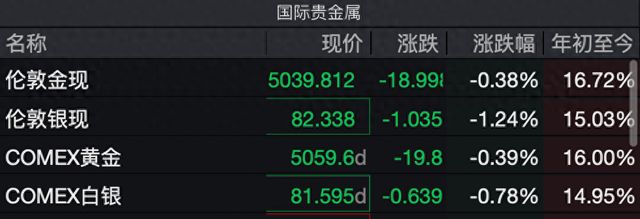
来源:智通财经 现货黄金价格重回5000美元上方,现货白银价格重新站上80美元。 继2月9日亚市盘中突破5000美元后,当日现货黄金价格继续上涨,收盘交投于5060美元/盎司附近。不 过,2月10日开盘后现货黄金再度出现回调,一度跌破5000美元,截至发稿跌0.38%,报5039.812美元/ 盎司;现货白银同样在大幅震荡,2月9日一度大涨8%站上83美元,截至发稿报82.338美元/盎司,跌 1.24%。 | 国际贵金属 | | | | --- | --- | --- | | 名称 | 现价 涨跌 | 涨跌幅 年初至今 | | 伦敦金现 | 5039.812 -18.991 -0.38% 16.72% | | | 伦敦银现 | 82.338 -1.035 | -1.24% 15.03% | | COMEX黄金 | 5059.6d -19.8 | -0.39% 16.00% | | COMEX白银 | 81.595d -0.639 | -0.78% 14.95% | 消息面上,本周是美国重磅经济数据的窗口期,陆续会公布非农数据和CPI,市场预估美国即将发布疲 软的就业报告,从而提高美联储降息预期。美国白宫国家 ...
黄金的长期趋势仍然坚实,黄金ETF国泰(518800)连续4日资金净流入23亿元,资金抢筹布局
Mei Ri Jing Ji Xin Wen· 2026-02-10 17:30
Group 1 - The long-term trend for gold remains solid, with significant inflows into gold ETFs, specifically the Cathay Gold ETF (518800), which saw a net inflow of 2.3 billion yuan over four consecutive days, indicating strong demand for gold investments [1] - In the U.S. economic landscape, the ISM manufacturing PMI for January was reported at 52.6, indicating a return to the expansion zone, surpassing expectations of 48.5 and the previous value of 47.9 [1] - The U.S. labor market showed signs of weakness, with the ADP employment change for January at 22,000, lower than the previous figure of 41,000 and the expected 48,000 [1] Group 2 - The ongoing increase in gold reserves by the People's Bank of China marks the 15th consecutive month of accumulation, with reserves reported at 7.419 million ounces (approximately 2,307.567 tons) as of the end of January, reflecting a month-on-month increase of 40,000 ounces (about 1.24 tons) [1] - The backdrop of monetary expansion and fiscal deficit monetization challenges the U.S. dollar credit system, while global geopolitical instability drives the diversification of asset reserves, enhancing the demand for gold as a safe-haven asset [2] - The combination of a Federal Reserve interest rate cut cycle, increasing overseas uncertainties, and a global trend towards de-dollarization supports the outlook for gold prices, positioning gold as a potential new pricing anchor [2]