全球货币体系重构

Search documents
涨疯了!2025金银双双刷新纪录,白银137%涨幅领跑,市场担忧利多耗尽?|2025中国经济年报
Sou Hu Cai Jing· 2025-12-23 06:36
Core Viewpoint - The international gold and silver prices have reached historical highs in 2025, with gold at $4500 per ounce (up 71% year-to-date) and silver at $69.81 per ounce (up 137% year-to-date), indicating a strong bull market for precious metals [2][6]. Group 1: Gold Price Dynamics - Gold prices surged significantly in 2025, driven by factors such as U.S. tariffs increasing demand for gold as a safe haven, ongoing Russia-Ukraine conflict, and continuous purchases by global central banks [3][4]. - The price of gold experienced a 30% increase from January to mid-April, followed by a period of consolidation until mid-August, where it remained stable despite geopolitical tensions [3]. - From mid-August to mid-October, gold prices rose by 26% as the Federal Reserve initiated a rate cut cycle and U.S.-China tariff disputes escalated, leading to a market environment favoring gold [4]. Group 2: Silver Price Dynamics - Silver prices have outperformed gold, with a year-to-date increase of 137%, compared to gold's 71%, driven by a return to the gold-silver ratio and inflationary trading [6][7]. - The first half of the year saw silver prices rise alongside gold, but after April, concerns over tariff escalations shifted market dynamics, leading to increased inventory pressures [6]. - A significant increase in silver prices occurred from July to December, with an 87% rise attributed to factors such as the Federal Reserve's rate cut expectations and renewed demand in the photovoltaic sector [7]. Group 3: Future Outlook for Precious Metals - The market anticipates that the bull market for precious metals will continue into 2026, driven by factors such as global monetary system restructuring, ongoing debt cycles, and geopolitical tensions [8][9]. - The expectation of continued fiscal and monetary policy easing in the U.S. is seen as a foundational support for rising gold prices, with potential federal deficits increasing [9]. - Despite potential challenges in the supply-demand structure for silver, historical trends suggest that silver will continue to follow gold's upward trajectory, benefiting from cyclical demand and high elasticity [11].

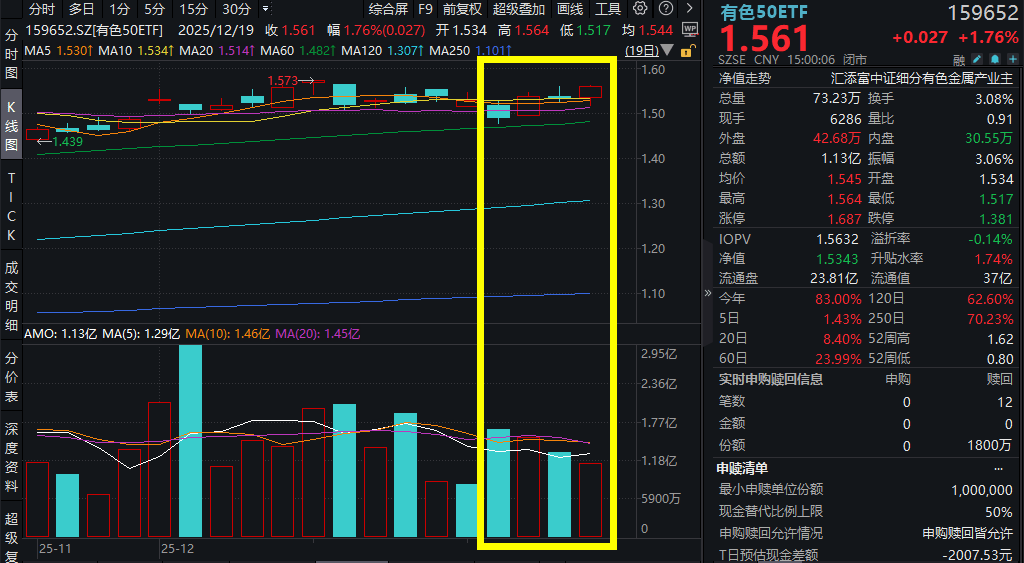
国内唯一、亚洲最大,山东海底发现巨型金矿!紫金矿业翻红,有色50ETF(159652)涨近2%!机构:通胀缓解+宽松预期,有色金属行情可期
Sou Hu Cai Jing· 2025-12-19 10:24
Core Viewpoint - The A-share market has shown significant recovery, with over 4,400 stocks rising, particularly in the non-ferrous metals sector, where the Non-Ferrous 50 ETF (159652) increased by 1.76% [1] Non-Ferrous Metals Sector Performance - The majority of the Non-Ferrous 50 ETF constituent stocks experienced gains, with notable increases such as Yun Aluminum Co. (000807) rising by 6.48%, and other companies like Northern Rare Earth, Huayou Cobalt, and China Aluminum seeing increases of over 3% [3] - The top ten constituent stocks of the Non-Ferrous 50 ETF include companies like Sanfour New Materials, Jialong Aluminum, and Northern Rare Earth, with varying performance metrics [4] Domestic and International News Impact - A significant domestic discovery of a giant underwater gold mine in Laizhou City, with proven gold reserves exceeding 3,900 tons, accounting for approximately 26% of the national total [5] - Internationally, U.S. inflation data showed a lower-than-expected increase in the core Consumer Price Index (CPI), leading to heightened expectations for Federal Reserve interest rate cuts, which positively influenced global commodity markets [6] Characteristics and Importance of Non-Ferrous Metals - Non-ferrous metals encompass all metals excluding ferrous metals, including precious metals (gold), industrial metals (copper, aluminum), energy metals (lithium), and rare earths, playing a crucial role in the economy [8] - Copper is highlighted as a key industrial metal, often referred to as the "doctor of the economy," and is increasingly recognized as essential in the AI era [9] Investment Outlook for Precious Metals - The outlook for gold remains positive due to factors such as declining real interest rates, ongoing central bank purchases, and the potential for a global debt crisis reshaping economic order [12][14] - Predictions indicate that gold prices could exceed $4,500 per ounce in the first quarter of next year, with long-term forecasts suggesting prices could reach $5,000 to $6,000 by 2026 [15] Copper Market Dynamics - The copper market is characterized by both supply rigidity and vulnerability, with increasing demand driven by traditional and emerging sectors, including AI and renewable energy [16] - Forecasts indicate a growing global copper supply-demand gap, with prices expected to rise significantly, potentially reaching $12,000 per ton by the end of the year [19] Non-Ferrous 50 ETF Advantages - The Non-Ferrous 50 ETF (159652) offers comprehensive exposure to various metal sectors, with a high concentration of copper (31%) and gold (14%), making it a leading choice for investors [21] - The ETF has demonstrated superior performance with a cumulative return leading its peers, driven by earnings rather than valuation expansion, indicating a strong investment experience [22][23]

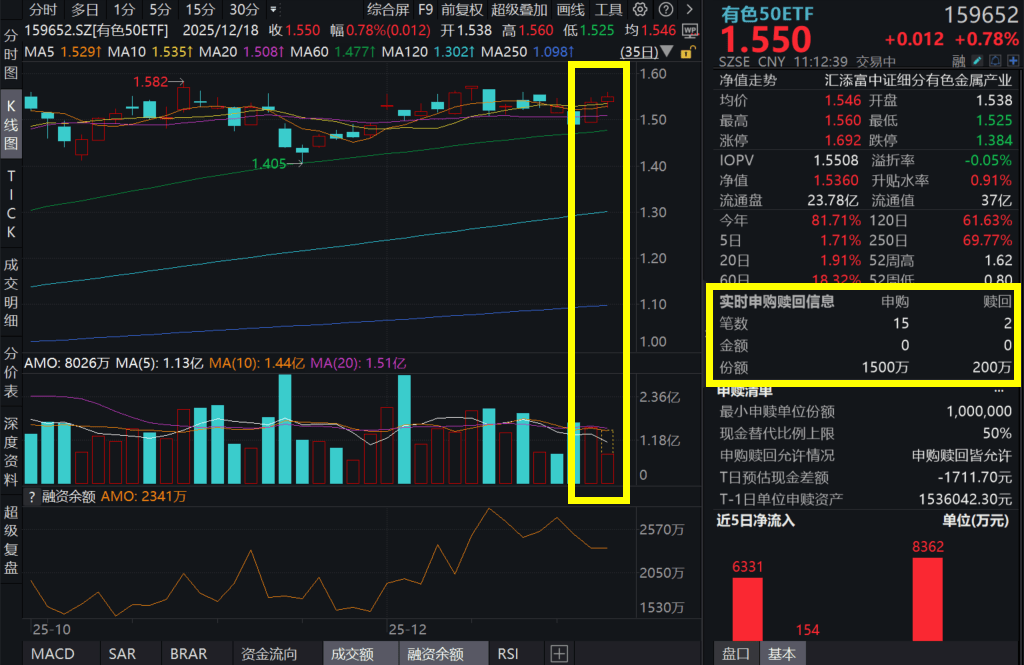
碳酸锂期货续涨超2%!华友钴业涨超4%,获8万吨“超级订单”!有色50ETF(159652)冲击两连阳,盘中强势吸金超2000万!金、铜后市怎么看?
Sou Hu Cai Jing· 2025-12-18 03:52
Core Viewpoint - The A-share market is experiencing an upward trend, particularly in the non-ferrous metals sector, driven by significant capital inflows and positive price dynamics in the sector [1][3]. Group 1: Market Performance - The non-ferrous 50 ETF (159652) saw a slight increase of 0.78%, aiming for a second consecutive day of gains, with over 20 million yuan in capital inflow during the trading session [1]. - Over the past five days, the non-ferrous 50 ETF attracted more than 120 million yuan in investments, indicating strong market interest [1]. Group 2: Key Stocks and Announcements - Major stocks within the non-ferrous 50 ETF index experienced gains, with Huayou Cobalt rising over 4% and Shandong Gold increasing by over 2%, influenced by an 80,000-ton "super order" [3][5]. - Huayou Cobalt announced a binding memorandum with a well-known international client to supply a total of 79,600 tons of ternary precursor products [5]. - Luoyang Molybdenum announced plans to acquire 100% equity in EQX's LatAm and Luna Gold Corp. for approximately 10.15 billion USD, equivalent to over 7.1 billion yuan [5]. Group 3: Industry Trends - Lithium carbonate futures surged again, following a previous increase of 7%, reflecting ongoing bullish sentiment in the market [6]. - The Jiangxi Yichun Natural Resources Bureau plans to revoke 27 mining rights, which could tighten lithium supply and support domestic lithium carbonate prices [8]. - The non-ferrous metals sector is seen as crucial for economic recovery and technological advancements, with copper being highlighted as a key indicator of economic health [9]. Group 4: Investment Opportunities - The non-ferrous 50 ETF (159652) is positioned to benefit from a super cycle in non-ferrous metals, covering a wide range of metals including gold, copper, aluminum, lithium, and rare earths [24][26]. - The ETF has a leading concentration of "gold and copper content," with copper accounting for 31% and gold for 14% of its index [26]. - The index has shown a cumulative return of 86.28% since 2022, driven by earnings rather than valuation expansion, indicating a favorable investment environment [28].





机构看金市:12月10日
Xin Hua Cai Jing· 2025-12-10 04:31
Group 1: Market Trends and Analysis - The spot silver price has surpassed $60 per ounce, reaching a new high, driven by low supply elasticity, low inventory, strong ETF demand, and a strong willingness for physical delivery [1] - Concerns over tariff risks have led to significant silver shipments to the U.S., exacerbating liquidity tensions in the London market, while rising risk aversion has pushed silver prices to new highs [2] - The expectation of a 25 basis point rate cut by the Federal Reserve is priced in, with key focus on guidance for rate cuts in the first half of 2026 and the appointment of a new Fed chair [1][2] Group 2: Long-term Outlook for Precious Metals - Precious metals are expected to remain a long-term asset allocation choice due to the deterioration of the U.S. dollar credit system and global monetary system restructuring [2] - State Street anticipates gold prices will likely consolidate between $4,000 and $4,500 per ounce in 2026, despite a potential slowdown in price increases next year [3] - The ongoing global debt increase, persistent inflation, and rising long-term yields make gold an attractive hedge asset [3] Group 3: Short-term Price Dynamics - Silver prices are expected to experience a correction before reaching new highs, influenced by changing market dynamics and a decrease in demand from India post-festival season [3] - The one-month borrowing rate for silver in London has exceeded 6.5%, indicating tight supply expectations [2] - The gold-silver ratio is showing signs of slight overselling, suggesting potential volatility in silver prices while maintaining an optimistic outlook [3]
2025黄金投资年度盘点及未来金价展望
Xin Lang Cai Jing· 2025-12-02 13:16
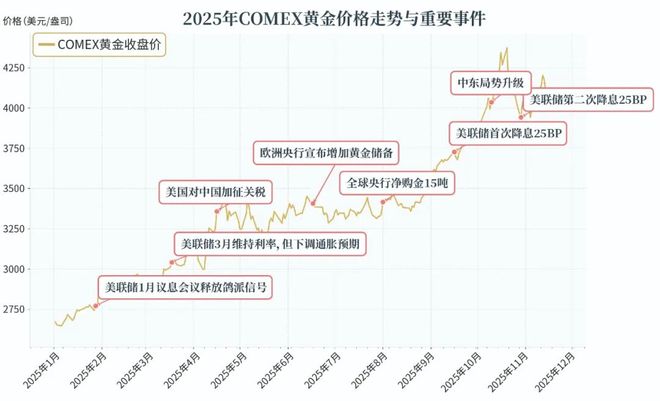
Core Viewpoint - The global gold market experienced a significant bull market in 2025, with international gold prices reaching historic highs, driven by macroeconomic factors, geopolitical tensions, and increased demand from central banks [1][3]. Group 1: 2025 Gold Market Review - In 2025, gold prices surged from approximately $2,650 per ounce at the beginning of the year to over $4,300 per ounce, marking a historic increase [1][4]. - Key events influencing gold prices included the Federal Reserve's dovish signals, geopolitical conflicts, and substantial central bank purchases [3][5]. - The COMEX gold price reached $4,200 per ounce in October 2025, driven by heightened global risk aversion due to conflicts in the Middle East [4][5]. Group 2: Factors Driving Gold Prices - **Monetary Policy**: The Federal Reserve's shift from tightening to easing monetary policy significantly impacted gold prices, with expectations of continued rate cuts [4][7]. - **Geopolitical Risks**: Increased geopolitical tensions, including the ongoing Russia-Ukraine conflict and Middle Eastern instability, heightened demand for gold as a safe-haven asset [5][8]. - **Central Bank Purchases**: Central banks continued to accumulate gold, with net purchases reaching 634 tons in the first three quarters of 2025, driven by diversification strategies and risk hedging [5][9]. - **Market Sentiment**: The surge in gold prices was accompanied by increased trading volumes, indicating strong investor sentiment and capital inflows into gold [5][6]. Group 3: Future Gold Price Outlook - **Macroeconomic Environment**: Continued monetary easing and concerns over U.S. debt levels are expected to support gold prices in the long term [7][8]. - **Geopolitical Landscape**: The ongoing geopolitical risks are likely to maintain gold's appeal as a hedge against uncertainty [8][9]. - **Supply and Demand Dynamics**: Central banks are expected to continue purchasing gold, with a projected average net purchase of 80 tons in 2025 and 70 tons in 2026 [9][10]. - **Technical Analysis**: Gold prices are anticipated to fluctuate between $4,300 and $4,600 per ounce by December 2025, with potential upward movement towards $5,200 per ounce in early 2026 [10][11]. Group 4: Institutional Predictions - Major financial institutions have set optimistic price targets for gold, with forecasts ranging from $4,500 to $5,055 per ounce by the end of 2026 [12][13].
牛市继续?明年黄金或涨至4800美元/盎司,白银铂金机会凸显 | 2025大盘点
Sou Hu Cai Jing· 2025-11-19 09:40
Core Insights - The global gold market in 2025 has experienced a significant bull market characterized by a "stair-step breakthrough and pullback" pattern, with gold prices reaching a historical peak of $4,380 per ounce in October before retreating below $4,000 in early November, and currently trading above $4,100, marking an annual increase of over 50%, the strongest performance since 1979 [1][2][3] Price Movement Analysis - Gold prices began the year at $2,800 per ounce, rising to $3,420 by the end of March, a quarterly increase of 22.1%, the best performance since Q2 2016 [1] - In Q2, gold prices fluctuated between $3,400 and $3,600, supported by an 11% drop in the US dollar index, while global gold ETF holdings increased by 187 tons [2] - Q3 saw a surge in demand, with total gold demand reaching 1,313 tons and total value at $146 billion, driven by a 47% increase in investment demand [2] - In Q4, gold prices peaked at $4,380 per ounce in mid-October but retreated to around $3,968 due to market corrections and a rebound in the dollar index [2] Driving Factors Behind Gold Prices - The current bull market in gold is driven by three core factors: geopolitical risks, central bank purchases, and global liquidity [3][4] - Geopolitical tensions, particularly the Russia-Ukraine conflict and Middle East instability, have heightened demand for gold as a safe-haven asset [3] - Central banks have significantly increased gold reserves, with net purchases of 634 tons in the first three quarters of 2025, reflecting concerns over the US dollar's credibility [4][5] Investment Demand Dynamics - Private sector investment demand has surged, with Q3 global gold investment demand reaching 537 tons, a 47% year-on-year increase, driven by ETF purchases and physical gold demand [5] - The demand for gold bars and coins reached 316 tons in Q3, with significant contributions from India and China [5] Macroeconomic Influences - Macroeconomic factors such as the Federal Reserve's policy shift, global debt pressures, and geopolitical risks are key drivers for gold prices [6] - The Federal Reserve's recent interest rate cuts and the decline in the dollar index have further supported gold's appeal [6] - Rising global debt levels and inflation concerns position gold as a valuable asset for hedging against economic instability [6] Future Outlook for Precious Metals - Analysts predict that 2026 will see a "high-level fluctuation with long-term positive trends" for precious metals, with gold potentially reaching $4,500 to $4,800 per ounce [7] - Other precious metals like silver and platinum are also expected to show significant investment value, driven by industrial demand and market dynamics [8] - The overall strategy for 2026 suggests a shift from "gold dominance" to a more balanced allocation across various precious metals [8][9]
金价迎来重大拐点!11月13日信号明确,黄金市场恐将深度变盘
Sou Hu Cai Jing· 2025-11-14 05:22
Core Viewpoint - The recent surge in gold prices is driven by institutional investment rather than short-term speculation, indicating a significant shift in market dynamics [1][3][5]. Group 1: Market Dynamics - International spot gold prices have fluctuated around $4188 per ounce, with domestic gold T D prices reaching 956.65 yuan per gram, marking a daily increase of 1.31% [1]. - On November 12, the global largest gold ETF increased its holdings by 0.28 tons, bringing total holdings to 1046.64 tons, suggesting institutional confidence in the market [1][3]. - In the first three quarters of 2024, China's gold ETF saw an increase of 79.015 tons, a year-on-year growth of 164.03%, while global gold ETFs added 619 tons with a capital inflow of $640 billion [3]. Group 2: Institutional Investment - The shift in the Federal Reserve's policy, with two rate cuts in 2025, has led to increased institutional investment in gold, as lower interest rates reduce the opportunity cost of holding gold [5][9]. - Predictions indicate a high probability of another rate cut by the Federal Reserve in December, which is expected to further stimulate capital inflows into gold [5]. - Central banks globally have shown a strong demand for gold, with net purchases reaching 220 tons in Q3 2025, a 28% increase from the previous quarter, indicating a long-term commitment to gold [5][7]. Group 3: Geopolitical and Economic Factors - Geopolitical risks have heightened demand for gold as a safe haven, with ongoing conflicts contributing to market uncertainty [7]. - The inverse relationship between gold and the US dollar has become more pronounced, with a weakening dollar driving gold prices higher [9]. - Technical analysis shows that gold prices have broken through key resistance levels, indicating a potential for sustained upward movement [9][11]. Group 4: Investment Strategy - Investors are advised to monitor institutional flows and avoid high-leverage trading, with a recommended allocation of gold in asset portfolios kept within 10-20% [11]. - The current market conditions suggest that short-term pullbacks in gold prices may present buying opportunities, especially as long-term bullish factors remain intact [11].
中金公司:当前A股整体估值相对合理
Xin Hua Cai Jing· 2025-11-13 02:21
Group 1 - The core viewpoint of the report is that the overall valuation of A-shares is relatively reasonable and not overvalued [1] - As of November 4, 2025, the P/E TTM of the CSI 300 is approximately 14.2 times, compared to 25.5 times for the S&P 500, 23.8 times for the Nikkei 225, 19.3 times for the French CAC 40, 17.4 times for the MSCI Asia-Pacific, and 17.2 times for the German DAX, indicating that A-share valuations remain low in an international comparison [1] - The current dividend yield of the CSI 300 is about 2.5%, which is attractive compared to the approximately 1.8% yield of ten-year government bonds [1] - The market capitalization of A-shares relative to China's GDP is about 77%, which is low compared to other major global markets, such as approximately 230% for the U.S. and 180% for Japan [1] - The total market capitalization of A-shares to M2 ratio is approximately 35.6%, close to the historical average of 35.7%, suggesting a "repair" in valuation rather than overvaluation [1] Group 2 - The report indicates that Chinese stock assets face a historical opportunity due to the global monetary system's restructuring, with asset revaluation potentially still in its early stages [2] - The restructuring of the global monetary order may prompt global funds to reallocate in two ways: diversification, where investors seek alternatives to the U.S. dollar, and fragmentation, where previously globally allocated funds return to their respective markets [2] - If policies are appropriately addressed, the international status of the renminbi is expected to improve, and renminbi assets may benefit from the global fund reallocation [2] - The forces of the global monetary order's restructuring and the resulting changes in capital flows may outweigh the fundamental strengths of any single country or market [2]

中金 | 深度布局“十五五”:策略篇
中金点睛· 2025-11-12 23:26
Core Viewpoint - The "15th Five-Year Plan" emphasizes the importance of capital market reforms to promote high-quality development, focusing on enhancing the inclusiveness and adaptability of the capital market system, and improving the coordination between investment and financing functions [1][11][12]. Group 1: Key Tasks and Measures - The China Securities Regulatory Commission (CSRC) outlines key tasks for the "15th Five-Year Plan" period, including the active development of direct financing through equity and bonds, fostering high-quality listed companies, and creating a more attractive environment for long-term investments [1][11]. - The plan aims to enhance the scientific and effective regulation of the capital market, steadily expand high-level institutional openness, and create a standardized, inclusive, and vibrant capital market ecosystem [1][11][12]. Group 2: Market Outlook - The capital market is expected to show a "long-term" and "steady" trend during the "15th Five-Year Plan" period, driven by government emphasis on capital market development and the fundamental strengths of Chinese assets [1][20]. - The overall valuation of A-shares is considered reasonable and not overvalued, with the current P/E ratio of the CSI 300 at approximately 14.2x, compared to higher ratios in other major markets [22][24]. Group 3: Structural Opportunities - Key sectors to watch include digital technology, space economy, high-end manufacturing, domestic consumption, and biotechnology, which align with the policy directions of developing new productive forces and expanding domestic demand [1][24]. - The focus on technological innovation and self-reliance is expected to drive significant investment opportunities in these sectors, particularly in areas like AI, quantum technology, and advanced manufacturing [1][24]. Group 4: Financial Ecosystem and Investor Engagement - The plan emphasizes the need for a more attractive long-term investment environment, promoting the development of institutional investors and enhancing the role of long-term capital in stabilizing the market [15][19]. - Measures to improve investor protection and enhance market transparency are also highlighted, aiming to build a more robust legal framework and encourage a culture of innovation and risk tolerance [19][20].

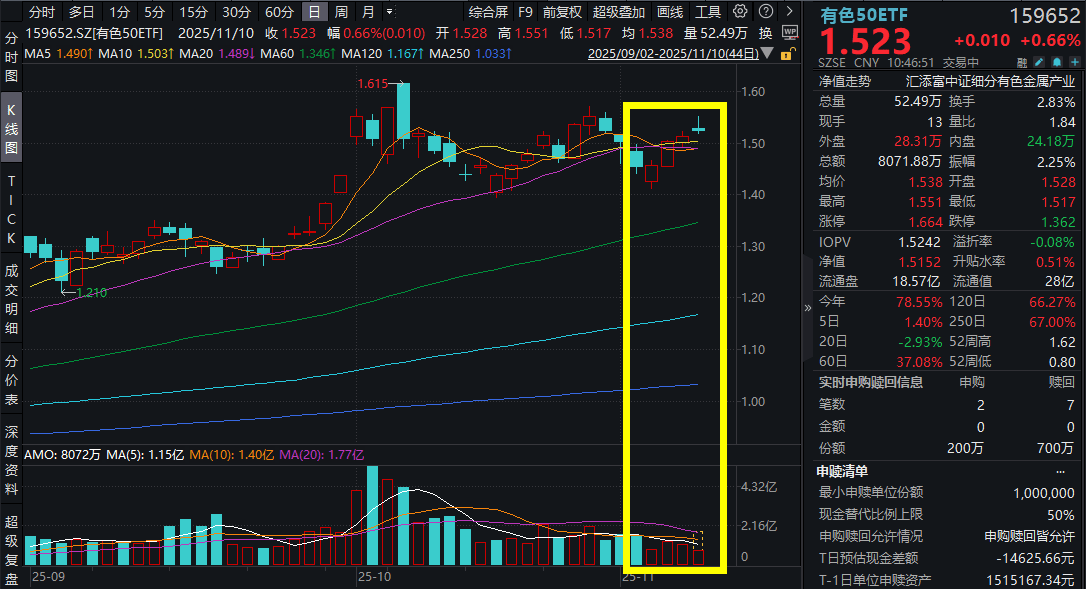
国城矿业涨停,31亿巨资“买矿”!有色50ETF(159652)放量冲高,一度涨超2%!供给端挺价持续,铜价中枢有望上行!
Sou Hu Cai Jing· 2025-11-10 03:36
Core Viewpoint - The news highlights the performance of the Nonferrous Metal ETF (159652) and its underlying index components, indicating a mixed performance among major stocks, with some experiencing significant gains while others faced declines [1][2]. Group 1: ETF Performance - The Nonferrous Metal ETF (159652) closed at 1.523, with a slight increase of 0.66% [1]. - The ETF's trading volume was 524,900, with a turnover rate of 2.83% [1]. - The ETF's net asset value (NAV) was reported at 1.5152, with a premium/discount rate of 0.51% [1]. Group 2: Component Stocks - Major stocks such as Guocheng Mining and Ganfeng Lithium saw significant increases, with Guocheng Mining hitting the daily limit [2]. - The stock of China Aluminum and Shandong Gold also rose by over 2% [2]. - In contrast, stocks like Northern Rare Earth and Huayou Cobalt experienced declines [2]. Group 3: Market Sentiment and Economic Indicators - The Federal Reserve's recent statements indicate a shift in interest rate expectations, with a decrease in the likelihood of rate cuts in December and January [3]. - The market is awaiting a liquidity turning point, which could impact precious metal prices positively in the future [4]. Group 4: Industrial Metal Insights - The supply side for industrial metals remains tight, with ongoing disruptions in copper mining affecting prices positively [5]. - The aluminum market is expected to enter an upward cycle due to a projected shortage, with recent price increases noted [5]. Group 5: Investment Opportunities - The Nonferrous Metal ETF (159652) is highlighted as a leading investment option due to its high "gold and copper content" and concentration in strategic metals [6]. - The ETF's index has shown a cumulative return of 131% since 2022, driven by earnings rather than valuation expansion [8].