减税政策

Search documents
特朗普,签了!被批“劫贫济富”:剥夺穷人的食物和医疗,却为亿万富翁提供大量的税收减免...
雪球· 2025-07-05 04:49
Group 1 - The "Big and Beautiful" Act, signed by President Trump, aims to extend tax cuts for corporations and individuals, with a significant focus on reducing corporate taxes [3] - The Act is projected to incur over $4.5 trillion in spending costs over the next decade, with an increase in the deficit by nearly $3.3 trillion and a $5 trillion increase in the debt ceiling [3] - Critics argue that the Act disproportionately benefits high-income individuals and corporations while cutting social welfare programs, leading to significant reductions in healthcare coverage for low-income Americans [5][6] Group 2 - The Act represents a dramatic shift in U.S. economic and fiscal policy compared to the Biden administration, reversing many of the social welfare expansions and clean energy initiatives [5] - The Congressional Budget Office estimates that nearly 12 million people could lose their healthcare coverage as a result of the new law [6] - Discussions among financial analysts suggest that the expansion of the fiscal deficit may support economic stability in the short term, while also raising concerns about long-term debt sustainability [9]

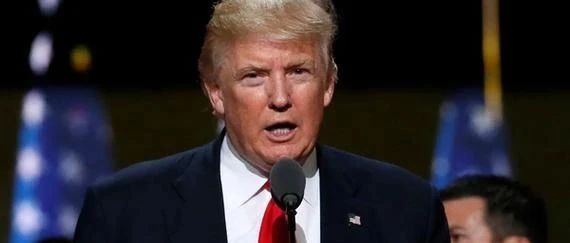
刚刚,特朗普签署“大而美”税收和支出法案
Zheng Quan Shi Bao Wang· 2025-07-04 23:52
Group 1 - The "Big and Beautiful" tax and spending bill was signed into law by President Trump on July 4, which has been controversial due to cuts in federal aid, increased long-term debt, and tax reductions for the wealthy and large corporations [1][2] - The bill passed the House of Representatives with a narrow margin of 218 votes in favor and 214 against, with all Democratic members opposing it and two Republican members joining the opposition [1][2] - The core of the bill is to extend the $4.5 trillion tax cut policy enacted during Trump's first term and includes $350 billion in investments for national security and immigration enforcement [2] Group 2 - The bill allocates over $8.6 billion to enhance the U.S. Coast Guard's icebreaker fleet in the Arctic to strengthen U.S. dominance in the region [2] - To offset tax revenue losses, the bill proposes cuts to $1.2 trillion in Medicaid and food stamp programs and significantly eliminates green energy tax credits [2] - According to the Congressional Budget Office, the U.S. debt is projected to increase by approximately $3 trillion over the next decade, resulting in 11.8 million people losing health insurance [2]
特朗普夸赞“非凡胜利”,民主党抨击“劫贫济富”,“大而美”法案通过或影响美中期选举
Huan Qiu Shi Bao· 2025-07-04 22:46
Core Points - The U.S. House of Representatives passed the "Big and Beautiful" bill aimed at extending tax cuts and significantly reducing social security programs, which has sparked protests among some American citizens [1][3] - President Trump hailed the bill as a "remarkable victory" and a "declaration of independence from national decline," coinciding with the 250th anniversary of the U.S. [1][3] Legislative Details - The bill, comprising approximately 900 pages, integrates Republican priorities and was passed with a narrow margin of 218 votes in favor and 214 against, with all Democrats opposing it and two Republicans joining them [3][4] - The core of the bill extends Trump's $4.5 trillion tax cut policy and includes $350 billion in investments for national security and immigration, as well as funding for missile defense systems [4] - To offset tax revenue losses, the bill proposes cuts to $1.2 trillion in Medicaid and food stamp programs and eliminates green energy tax credits [4] Political Reactions - Republican leaders described the bill as the most comprehensive conservative reform in modern history, while Democrats criticized it as a "robbery from the poor to give to the rich" [5] - Internal divisions within the Republican Party were highlighted during the voting process, with some members expressing dissatisfaction with parts of the bill [5] - A Quinnipiac University poll indicated only 29% of voters support the bill, with 55% opposed, suggesting potential political repercussions for Republicans in future elections [6]
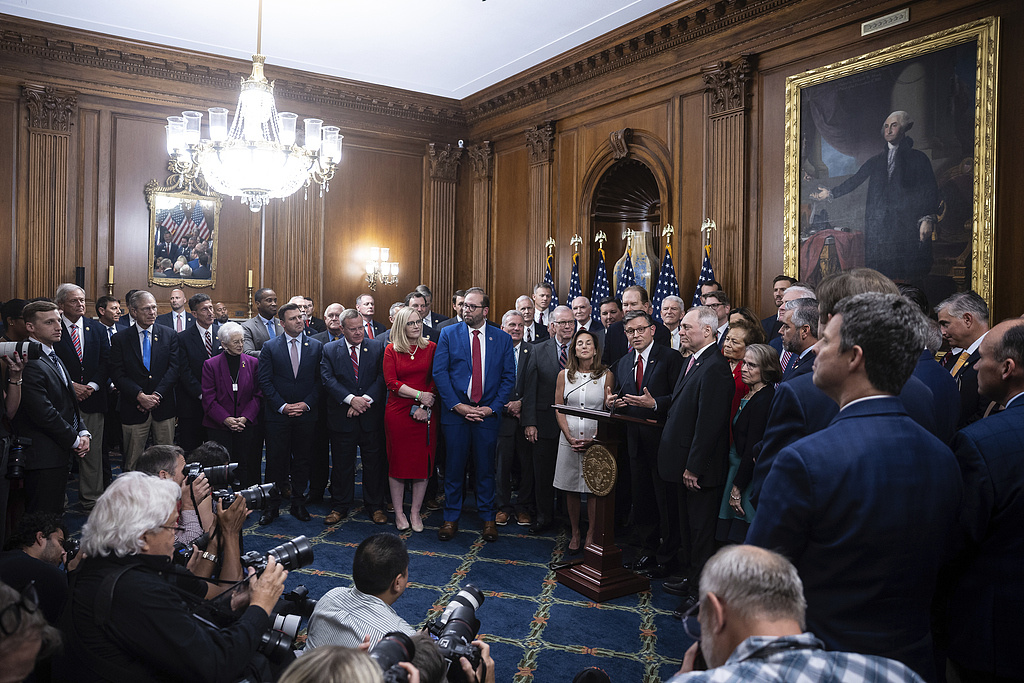
特朗普签署税收与支出法案为法律
news flash· 2025-07-04 21:59
Core Points - The article discusses the signing of a $3.4 trillion budget bill by President Trump on July 4, which extends tax cuts and provides temporary new tax measures for tipped workers while allocating funds to combat illegal immigration [1] Group 1 - The budget bill amounts to $3.4 trillion [1] - The bill extends existing tax cut policies [1] - New temporary tax measures are introduced specifically for tipped workers [1] - The bill includes funding aimed at addressing illegal immigration [1]
特朗普把“大而美”法案作为美国独立日献礼?
首席商业评论· 2025-07-04 11:44
Core Points - The "One Big Beautiful Bill Act" is a significant budget plan that has caused a deep divide between the two major political parties in the U.S. and even within the Republican Party itself [1][6][21] Tax Policy - The act includes tax cuts for all income groups, with wealthier individuals benefiting the most. It permanently extends the tax cuts from the 2017 tax reform, reducing corporate tax rates from 35% to 21% and personal income tax rates up to 37% [2][3] - New tax exemptions include tips and overtime pay for service industry workers, benefiting millions of low-income earners. However, it imposes additional taxes on countries with "unfair foreign taxes," potentially leading to trade conflicts [2][3] Social Welfare Cuts - To offset the revenue loss from tax cuts, the act proposes cuts to social welfare programs, including Medicaid and food assistance programs [3][4][5] - Medicaid will see stricter work requirements, potentially resulting in 2 million low-income individuals losing their health insurance. Additionally, funding for rural hospitals will be reduced by over 20%, risking closures [4] - The age limit for food assistance (SNAP) eligibility will be raised from 54 to 64, cutting $230 billion in funding and affecting 2.3 million elderly individuals [5] Debt and Fiscal Adjustments - The act necessitates an increase in the federal debt ceiling by $5 trillion, with a projected deficit increase of $3.3 trillion over the next decade [8] - Spending adjustments include a $1.2 trillion reduction in healthcare, welfare, and clean energy subsidies, while increasing defense spending by $150 billion and border security by $465 billion [8] Energy and Industrial Policy - The act terminates clean energy subsidies, including tax credits for electric vehicles and renewable energy projects, while supporting traditional energy sources [8] - It includes provisions that prevent projects involving "foreign adversaries" from receiving tax credits, compelling U.S. companies to sever ties with Chinese supply chains [8] Political Dynamics - The act has led to significant political conflict, with Democrats opposing it vehemently, while some Republicans also express concerns over its implications [21][24] - The passage of the act was contentious, with a narrow margin in both the House and Senate, highlighting the deep divisions within Congress [18][20] Conclusion - The act represents a critical moment in U.S. fiscal policy, with potential long-term implications for social welfare, taxation, and political dynamics, as it awaits the President's signature [16][17]

巨富金业:特朗普将签署“大而美”法案-万亿减税落地
Sou Hu Cai Jing· 2025-07-04 09:58
当地时间7月4日美国独立日当天,总统特朗普将签署备受争议的"大而美"税收与支出法案,标志着其任内最重大的经济政策胜利。该法案以微 弱优势通过国会两院表决,核心条款包括延长企业和个人减税措施、削减社会福利支出并提高债务上限。尽管法案被批评加剧贫富分化和财政 赤字,但市场对短期经济刺激的预期推动美股高开,美元指数升至97附近,而黄金价格则因美债收益率攀升和美元走强承压,现货黄金在3330 美元/盎司附近震荡。 一、法案核心内容与通过历程 "大而美"法案是特朗普2025年重返白宫后推动的标志性立法,其核心目标是通过减税和财政支出调整刺激经济。法案主要内容包括: 无限期延长企业税减免:将企业所得税最高税率维持在21%,并取消替代性最低税,预计未来十年为企业节省4.5万亿美元。 个人税调整:提高遗产税和赠予税免税额,加班费和小费收入免税,但医疗补助和食物援助计划(SNAP)的资格要求被收紧,预计削减近1.5 万亿美元社会福利支出。 债务扩张:联邦债务上限提高5万亿美元,未来十年赤字预计增加3.3万亿美元,美国国债规模将突破40万亿美元。 参议院于7月1日以51:50的微弱优势通过,副总统万斯投下关键一票;众议院于3日以 ...
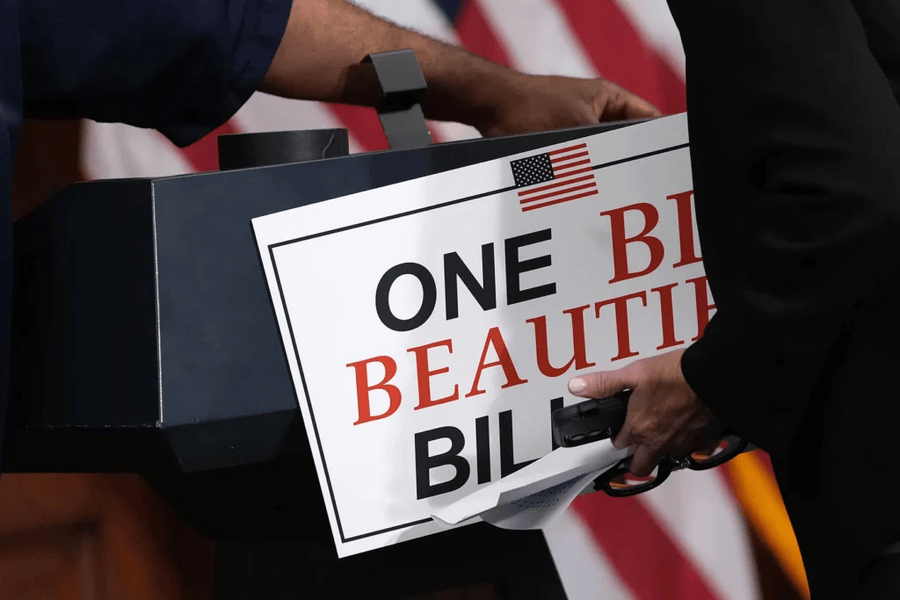
让特朗普和马斯克吵得不可开交 “大而美”法案究竟是啥?| 国际识局
Zhong Guo Xin Wen Wang· 2025-07-02 16:02
参议院惊险过关共和党内部矛盾显现 当地时间1日上午,美国参议院历经22小时通宵"马拉松"投票,最终以副总统万斯投下决定性一票,以 51票对50票的结果,惊险通过美国总统特朗普力推的"大而美"法案。 肯塔基州参议员兰德·保罗、北卡罗来纳州参议员汤姆·蒂利斯和缅因州参议员苏珊·柯林斯三位共和党人 投下反对票,而此前持保留态度的阿拉斯加州参议员丽莎·穆尔科夫斯基最终选择支持法案。 英国《金融时报》在报道中指出,投票结果显示出共和党内部存在明显分歧。 报告特别指出,法案中关于乡村医院关停的条款可能导致部分地区的医疗服务可及性下降。 法案的争议性还体现在其立法程序上。民主党人提出的多项修正案,包括删除乡村医院关停条款、恢复 食品援助等内容,均被共和党以党派票数否决,这种强硬立场进一步激化了两党对立。 引发美政坛激烈争斗马斯克反对增添变数 另一方面,民主党方面则保持高度团结,该党47名参议员一致反对该法案。 法案通过后,特朗普立即在"真相社交"平台发声,敦促众议院共和党人"无视作秀者",争取在7月4日独 立日假期前完成表决。他写道:"按计划推进——在你们和家人享受7月4日假期前完成它!" 白宫方面对法案前景表示乐观,发言 ...
美国“大而美法案”表决进展及两院分歧
LIANCHU SECURITIES· 2025-07-02 12:24
Group 1: Legislative Progress - The "Big and Beautiful Act" narrowly passed in the Senate with a vote of 51:50 and will be sent to the House for a final vote[1] - The Senate version of the bill differs significantly from the House version submitted in May, necessitating a return to the House for a new vote[1] - House Speaker Mike Johnson aims to pass the bill before July 4[1] Group 2: Budgetary Differences - The Senate's revised budget plan is projected to increase the deficit by $3.4 trillion, compared to the House's $2.4 trillion increase[2] - Including interest costs, the Senate's total potential debt impact is $3.94 trillion, while the House's is $2.97 trillion[2] - The Senate version proposes a $5 trillion increase in the debt ceiling, while the House version suggests a $4 trillion increase[2] Group 3: Key Issues and Risks - Major points of contention between the two chambers include Medicaid cuts, SNAP reductions, and the SALT deduction cap[2] - Internal divisions within the Republican Party may affect the speed and success of the bill's passage[4] - The potential for the House to reject the revised Senate version remains, depending on the extent of disagreements[3]
美国参议院通过“大而美”法案,3.3万亿债务炸弹将引发众议院激战
Jin Shi Shu Ju· 2025-07-01 23:51
Core Points - The Senate narrowly passed a comprehensive tax and spending bill proposed by Trump, which is referred to as an "economic nuclear bomb" due to its significant tax cuts and social safety net reductions, while increasing military and immigration enforcement spending, leading to a projected $3.3 trillion increase in national debt [1][2] - The bill has been sent to the House for a final vote, but some Republican lawmakers have publicly opposed the Senate version [1] Summary by Sections Key Provisions of the Bill - Extension of Trump's 2017 tax cuts - New tax benefits for tip income and overtime pay - Increased budget for military and immigration enforcement - Reduction of approximately $930 billion in Medicaid and food assistance for low-income individuals - Repeal of several green energy incentives from the previous Biden administration - The bill highlights divisions among Republicans regarding the $36.2 trillion national debt and raises the federal debt ceiling by $5 trillion [2] Legislative Process and Challenges - The Senate passed the bill with a 51-50 vote, with Vice President Vance casting the tie-breaking vote; three Republican senators voted against it alongside all Democratic senators [3] - The final version included provisions to secure support from Senator Lisa Murkowski, such as additional food assistance for certain states and $50 billion in funding for rural hospitals [3] - The House, with a narrow Republican majority of 220-212, is expected to have a contentious vote, with Trump planning to engage deeply in lobbying efforts [3] Reactions and Implications - Billionaire Elon Musk criticized the bill for excessive spending and pledged to support challengers to current Republican lawmakers in the midterm elections [4] - Democratic leaders condemned the bill as the largest theft in U.S. healthcare history, claiming it would deprive hungry children of food [4] - The Tax Foundation indicated that the primary beneficiaries of the Senate version of the bill would be the top 1% of earners with incomes exceeding $663,000 in 2025 [5] - Independent analyses suggest that tightening food and healthcare eligibility will significantly reduce income for impoverished populations, with an estimated 12 million people losing healthcare coverage [6]
美股三个月暴涨10万亿美元创纪录,特朗普"大而美"法案本周关键投票
Jin Rong Jie· 2025-07-01 01:17
Group 1: Market Performance - The three major U.S. stock indices experienced a strong rebound after hitting a low in April, with the S&P 500 and Nasdaq indices reaching new historical highs [1] - The S&P 500 index saw a market capitalization increase of over $10 trillion in less than three months, marking the shortest record for the index to recover from a drop of more than 15% to a new high [1] - Historical data indicates that July is typically one of the best-performing months for U.S. stocks, prompting investors to closely monitor upcoming key events [1] Group 2: Legislative Developments - The "Big and Beautiful" bill, strongly advocated by Trump, is facing a critical vote in the Senate, with the White House aiming for its signing before July 4 [3] - The bill passed the House with a narrow margin of 215 to 214 votes and is currently under Senate review, where it advanced with a procedural vote of 51 to 49 [3] - The Congressional Budget Office projects that the bill will increase federal debt by $3.3 trillion over the next decade and proposes raising the federal debt ceiling by $5 trillion, a historic increase [3] Group 3: Trade Policy and Market Impact - Trump's announcement to suspend trade negotiations with Canada led to a significant short-term drop in U.S. stocks, highlighting the market's sensitivity to trade negotiation news [4] - The 90-day tariff suspension period is set to expire on July 9, with Trump indicating no intention to extend it [4] - The current market environment is characterized by "extreme policy uncertainty," with potential pressures on the U.S. economy from tariff policies manifesting as price increases, declining corporate profits, or reduced business investment [4]