
加息预期

Search documents
日元疲软提振加息预期 日本国债收益率攀升至上世纪末以来新高
智通财经网· 2025-12-22 06:52
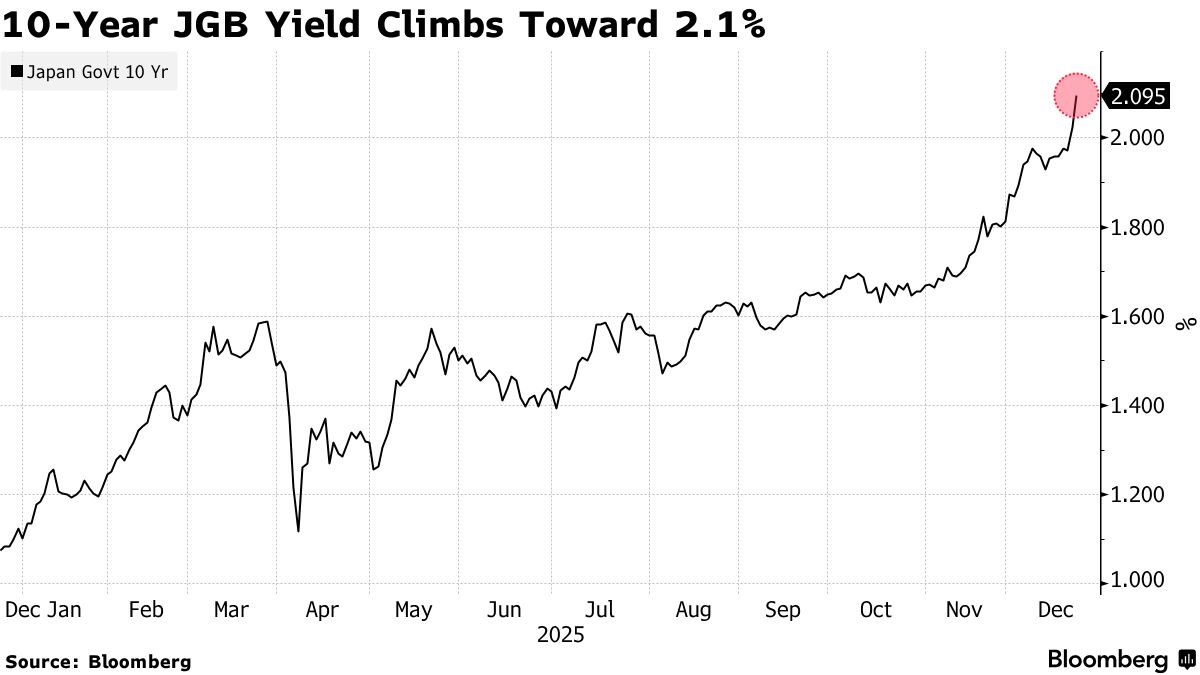
Group 1 - Japanese government bonds continued to decline due to market speculation that the Bank of Japan may need to raise interest rates more significantly to curb the weakening yen [1][3] - The yield on Japan's 10-year government bonds rose by 7.5 basis points to 2.095%, the highest level since February 1999, while the 2-year bond yield increased by 3 basis points to 1.12%, the highest since 1997 [1][3] - The Bank of Japan raised the benchmark interest rate by 25 basis points to 0.75%, the highest level in 30 years, but traders were disappointed by the lack of clear guidance on future monetary tightening [3][4] Group 2 - The depreciation of the yen is a major concern for the Japanese government, with expectations that Prime Minister Fumio Kishida will allow further rate hikes to address the yen's weakness, contributing to a flattening of the yield curve [4] - Concerns are growing regarding the Japanese government's budget and bond issuance plans for the fiscal year 2026, with expectations of increased issuance to cover fiscal gaps [4][5] - The Japanese government approved a supplementary budget of 18.3 trillion yen for fiscal year 2025, with over 60% of the funding sourced from new bond issuances, raising concerns about the sustainability of fiscal policies [5][6] Group 3 - Rising short- and long-term bond yields are expected to increase the debt interest burden on the Japanese government, with projections indicating that interest payments could double within three years [5] - The Ministry of Finance anticipates that the 10-year bond yield will reach 2.5% by 2028, leading to an increase in debt interest from 7.9 trillion yen last year to 16.1 trillion yen by 2028 [5] - The International Monetary Fund (IMF) has expressed confidence in Japan's management of potential fiscal risks, despite ongoing concerns about the implications of continued large-scale bond issuance [6]

日本:11月核心CPI同比升3.0%,加息预期增强
Sou Hu Cai Jing· 2025-12-19 06:04
Core Insights - Japan's core Consumer Price Index (CPI) rose by 3.0% year-on-year in November, reaching 112.5, marking the 51st consecutive month of increase [1] - The primary drivers of inflation include food prices, along with increases in housing repairs and electricity costs [1] - The Japanese government's fiscal policies, led by Prime Minister Sanae Takaichi, are contributing to the depreciation of the yen, raising concerns about further inflation [1] - Japan's core inflation rate has remained above the central bank's 2% target for 44 consecutive months, reinforcing market expectations for a potential interest rate hike by the Bank of Japan [1]
日本10年期国债:12月19日首破2%,加息预期升温
Sou Hu Cai Jing· 2025-12-19 05:16
Core Viewpoint - Japan's 10-year government bond yield has surpassed 2% for the first time since 2006, driven by rising interest rate expectations and fiscal concerns following the Bank of Japan's decision to raise the benchmark interest rate to its highest level in 30 years [1] Group 1 - The recent increase in Japan's government bond yield is attributed to renewed fiscal worries and heightened expectations for interest rate hikes [1] - The Bank of Japan's Governor, Kazuo Ueda, has indicated that the central bank will take action, leading to increased bets on tightening monetary policy [1] - The government led by Prime Minister Sanae Takaichi is perceived as willing to tolerate interest rate increases [1] Group 2 - The Chief Cabinet Secretary of Japan stated earlier this week that the specifics of monetary policy should be determined by the central bank [1]
国际银窄幅震荡 欧央行降息周期进入尾声
Jin Tou Wang· 2025-12-18 04:13
Group 1 - The current international silver price is trading above $66.00, with a recent high of $66.50 and a low of $65.54, indicating a short-term oscillating trend [1] - The European Central Bank (ECB) is nearing the end of its current rate-cutting cycle, with experts suggesting a growing possibility of rate hikes in the medium term [2] - ECB Executive Board member Isabel Schnabel indicated a preference for considering rate hikes rather than further cuts, reflecting increasing concerns about economic growth and inflation [2] Group 2 - The breakout above the $64.00 resistance level is seen as a key trigger for silver bulls, validating a positive short-term outlook [3] - The Relative Strength Index (RSI) on the hourly chart shows a neutral to bullish state, while the daily chart indicates an overbought condition [3] - The upward slope of the 100-hour Simple Moving Average (SMA) suggests that any corrective declines are likely to attract buying interest, maintaining the upward trend for silver [3]
邦达亚洲:美元指数持续下滑 黄金受益小幅收涨
Xin Lang Cai Jing· 2025-12-17 08:59
Group 1 - Federal Reserve Governor Milan reiterated that the Fed's policy stance imposes unnecessary restrictions on the economy, suggesting that the "underlying" inflation level is close to the Fed's target after excluding "phantom inflation" [1][6][7] - Milan emphasized that U.S. households' pain from recent inflation is reasonable, stating that while prices are at higher levels, they have stabilized, and monetary policy should reflect this reality [1][6] - He warned that maintaining unnecessary tight policies could lead to unemployment, asserting that underlying inflation is running below 2.3%, within the target range of 2% [1][6][7] Group 2 - S&P Global reported that U.S. business activity continued to expand in December, but the pace of expansion slowed to the lowest in six months, with a cost input measure reaching a three-year high [2][7] - The preliminary Markit PMI data for December showed a composite PMI of 53, below the expected 53.9 and previous 54.2, with manufacturing PMI at 51.8 and services PMI at 52.9, both lower than expectations [2][7] - Despite the slowdown, the survey data indicates a projected annualized GDP growth rate of about 2.5% for the fourth quarter, although growth has decelerated for two consecutive months [2][7]
刚刚,猛烈抛售!加息,突传大消息!
券商中国· 2025-12-17 07:59
Core Viewpoint - The Japanese government bond market is experiencing significant sell-offs, with the 10-year bond yield reaching its highest level since June 2007, driven by rising interest rate expectations from the Bank of Japan and concerns over the government's fiscal policies [1][3][5]. Group 1: Rising Bond Yields - The 10-year Japanese government bond yield peaked at 1.978%, nearing the psychological 2% barrier not breached in nearly 20 years [1][3]. - Analysts attribute the continuous rise in yields to the Bank of Japan's increasing interest rate hike expectations [1][5]. Group 2: Bank of Japan's Rate Hike Expectations - The market anticipates a 25 basis point rate hike in the upcoming policy meeting, raising short-term rates from 0.5% to 0.75%, the highest in 30 years [5]. - Bank of Japan Governor Kazuo Ueda is expected to emphasize the commitment to further rate increases, with the pace depending on the economic response to each hike [5]. Group 3: Government Fiscal Policies - Prime Minister Fumio Kishida's expansionary fiscal policies are raising concerns about Japan's fiscal discipline, contributing to the pressure on government bonds [8]. - The approved supplementary budget for fiscal year 2025 amounts to 18.3 trillion yen, with over 60% of the funding sourced from new bond issuances [9]. - The supplementary budget is the largest post-pandemic, aimed at addressing rising prices and promoting economic growth, with significant allocations for subsidies and defense spending [9].

STARTRADER:澳元连跌五日,受加息预期与国内数据影响
Sou Hu Cai Jing· 2025-12-17 03:18
Group 1 - The Australian dollar (AUD) has declined against the US dollar (USD) for the fifth consecutive day, fluctuating around 0.6630 [1] - Expectations for an interest rate hike by the Reserve Bank of Australia (RBA) are rising, which may limit the decline of the AUD and provide support [3] - The Commonwealth Bank of Australia and National Australia Bank have raised their interest rate hike expectations, suggesting that the RBA will initiate tightening policies earlier than previously predicted [3] Group 2 - Market pricing indicates a 28% probability of an RBA rate hike in February and nearly 41% in March, with the August hike fully priced in [3] - Economic data shows a mixed picture: the manufacturing PMI rose from 51.6 to 52.2, while the services PMI fell from 52.8 to 51.0, indicating resilience in the industrial sector but a weakening overall economic growth momentum [3] - November employment data revealed a stable unemployment rate of 4.3%, below the 4.4% market expectation, but a decrease of 21,300 jobs, significantly lower than the expected increase of 20,000 [3] Group 3 - The AUD/USD exchange rate is significantly influenced by the USD, which is currently fluctuating around 98.20 [4] - Divergent economic data from the US shows non-farm payrolls increased by 64,000, slightly above expectations, but the unemployment rate rose to 4.6%, the highest since 2021 [4] - The mixed economic data has led to internal disagreements within the Federal Reserve regarding the policy path for 2026, affecting the USD and indirectly impacting the AUD [4] Group 4 - China's economic data also indirectly affects the AUD, with November retail sales growing by 1.3%, below the 2.9% expectation, and fixed asset investment declining by 2.6%, greater than the anticipated 2.3% [4] - The AUD/USD is currently within an upward channel, maintaining a bullish structure [5] - The exchange rate is fluctuating near the nine-day exponential moving average (EMA), with short-term momentum appearing neutral [7] Group 5 - If the exchange rate holds above the support level of 0.6620, a rebound is possible; however, a drop below this support may lead to testing the six-month low of 0.6414 [7] - Key resistance levels include the three-month high of 0.6685 and the high of 0.6707 since October 2024, with a potential test of the upper boundary of the upward channel at 0.6740 [7]

日银决议前瞻 汇债市屏息日元区间博弈中
Jin Tou Wang· 2025-12-17 02:25
Core Viewpoint - The focus of the global currency and bond markets is on the upcoming Bank of Japan monetary policy decision, with expectations of a 25 basis point rate hike to 0.75% [1] Group 1: Currency Market - The USD/JPY exchange rate is currently at 154.858, down 0.22% for the day, indicating a cautious market sentiment ahead of the policy decision [1] - The USD/JPY has shown a clear downward trend, recently breaking below the key psychological level of 155.00, influenced by both fundamental and technical factors [2] - Key resistance levels for USD/JPY are at 155.438 (Bollinger Band middle line) and 156.263 (Bollinger Band upper line), while support levels are at 154.613 (Bollinger Band lower line) and 154.342 (recent low) [3] Group 2: Bond Market - The 10-year Japanese government bond yield is currently at 1.951%, having slightly decreased by 0.15% for the day, with a previous high of 1.976% [1] - The 10-year bond yield is exhibiting a range-bound trading pattern, with resistance levels at 1.976 (previous high) and 1.991 (Bollinger Band upper line), and support levels at 1.941 (Bollinger Band middle line) and 1.891 (Bollinger Band lower line) [3] - The MACD indicator for the 10-year bond yield shows a DIFF value of 0.032 and a DEA value of 0.038, indicating a weak bullish trend with insufficient momentum [2]
美国11月非农数据新增就业超预期
Dong Zheng Qi Huo· 2025-12-17 00:49
1. Report Industry Investment Ratings There is no information about industry investment ratings in the provided content. 2. Core Views of the Report - The US November non - farm payroll data showed an unexpected increase in new jobs, but the unemployment rate rose, wage growth was below expectations, and the US dollar index weakened [1][19]. - A - share and Hong Kong stock markets had a unilateral decline, possibly due to the stricter tax assessment of high - tech enterprises. High - valuation stocks were under pressure, and the market correction was a way to relieve the pressure. The national team would still support the market later [2][15]. - The positive macro - narrative was difficult to be falsified in the short term, making the bond market a weak asset. However, the problem of the fragile micro - trading structure should improve in early next year [3][25]. - The price of Indonesian low - calorie thermal coal on December 16 was weak. The port coal price fell below 750 yuan and was expected to continue to decline until mid - January, with the port 5500 - calorie coal price potentially testing the key point around 700 yuan [4][27]. - The merger of Anglo American and Teck Resources was approved by Canada. The weakening of the US November non - farm data supported copper prices, but there were still concerns about the short - term fundamentals, and copper prices were likely to continue to fluctuate at a high level [5][47]. - US API crude oil inventories decreased significantly, but oil prices continued to fall due to concerns about oversupply [6][56]. 3. Summaries According to Relevant Catalogs 3.1 Financial News and Comments 3.1.1 Macro Strategy (Gold) - In November, non - farm employment increased by 64,000, slightly exceeding the expected 45,000, but the unemployment rate unexpectedly rose to 4.6%, the highest since September 2021. The December preliminary value of the US S&P Global Manufacturing PMI was 51.8 (expected 52.1, previous value 52.2), and the Services PMI preliminary value was 52.9 (expected 54, previous value 54.1). Gold prices fluctuated and closed down. The market's expectation of a January interest rate cut slightly increased, but more data was needed to verify the weakening of the employment market. Short - term gold prices continued to fluctuate [11][12]. - Investment advice: Gold prices are volatile, and attention should be paid to the回调 risk of silver [13]. 3.1.2 Macro Strategy (Stock Index Futures) - A - share and Hong Kong stock markets had a unilateral adjustment. A - share major indexes declined, with the ChiNext Index falling more than 2%. The Shanghai Composite Index fell 1.11%, the Shenzhen Component Index fell 1.51%, and the ChiNext Index fell 2.1%. The Hang Seng Index fell 1.54%, and the Hang Seng Tech Index fell 1.74%. The decline might be related to the stricter tax assessment of high - tech enterprises, and high - valuation stocks faced pressure. The subsequent national team would support the market [14][15]. - Investment advice: Allocate long positions in each stock index evenly [16]. 3.1.3 Macro Strategy (Foreign Exchange Futures (US Dollar Index)) - Trump opposed the view that the Fed chairman cannot be a close friend. Trump will "soon" announce the Fed chairman candidate and will interview Fed Governor Christopher Waller this Wednesday. The US November non - farm data showed an unexpected increase in new jobs, but the unemployment rate rose to 4.6%, and wage growth was below expectations. The US dollar index weakened [17][19]. - Investment advice: The US dollar index is expected to weaken [20]. 3.1.4 Macro Strategy (US Stock Index Futures) - The US November Markit Composite PMI hit a six - month low. In November, non - farm employment increased slightly better than expected, but the unemployment rate rose to a new high since September 2021, indicating a continuous cooling of the labor market. The November data had a large error due to the government shutdown, and more data was needed to verify the weakening speed of the employment market. This employment data had limited impact on boosting the US stock market, and the recent weakness of the US stock market mainly stemmed from concerns about the sustainability of AI capital expenditure. - Investment advice: Short - term volatility remains difficult to reduce, and the US stock market is expected to fluctuate at a high level [23]. 3.1.5 Macro Strategy (Treasury Bond Futures) - The central bank conducted 135.3 billion yuan of 7 - day reverse repurchase operations on December 16, with a net investment of 18 billion yuan. The TL trend diverged from the stock market, T, and active bonds. The positive macro - narrative was difficult to be falsified in the short term, making the bond market a weak asset, but the problem of the fragile micro - trading structure should improve in early next year. - Investment advice: The odds of going long for trading positions are high, but the probability of success is low. It is recommended to pay attention to the right - hand side long - entry opportunities [26]. 3.2 Commodity News and Comments 3.2.1 Black Metal (Thermal Coal) - On December 16, the price of Indonesian low - calorie thermal coal was weak. The port coal price fell below 750 yuan and was expected to continue to decline. Supply pressure eased, and demand weakened after the previous replenishment. Considering seasonal pressure, the overall coal price was expected to decline until mid - January, with the port 5500 - calorie coal price potentially testing the key point around 700 yuan. - Investment advice: The port coal price is expected to continue to decline until mid - January, with the port 5500 - calorie coal price potentially testing the key point around 700 yuan [27]. 3.2.2 Black Metal (Iron Ore) - Fenix Resources planned to increase its iron ore production target to 420 - 480 million tons in the 2026 fiscal year, 470 - 530 million tons in the 2027 fiscal year, and 540 - 600 million tons in the 2028 fiscal year. Iron ore prices continued to fluctuate weakly, and the fundamentals were weak. However, supported by rigid demand for molten iron and low inventory, there was still sporadic buying. The supply - demand pressure was gradually increasing, and the market was concerned about policy changes after January 1. - Investment advice: Iron ore prices will continue to fluctuate weakly. The market is concerned about policy changes such as port storage fees and steel export licenses after January 1 [28]. 3.2.3 Agricultural Products (Soybean Meal) - On December 16, the成交 ratio of imported soybean auctions decreased slightly. In October, Brazilian factories processed 4.39 million tons of soybeans. Due to the expectation of a bumper harvest in South America and concerns about US soybean exports, CBOT soybeans continued to fall, and CBOT soybean oil also declined, affecting domestic oils. The domestic soybean meal futures price maintained a weak oscillation. The supply of raw materials was abundant. - Investment advice: The cost of imported soybeans in China has decreased, and the soybean meal inventory is high. The soybean meal May contract is recommended to be shorted on rallies [30]. 3.2.4 Agricultural Products (Corn Starch) - The domestic corn starch spot market price was generally stable. Some enterprises slightly lowered prices to stimulate downstream purchasing. The market trading atmosphere was average, and the demand was weak. The theoretical profit of starch enterprises remained good. - Investment advice: In the short term, the price difference between corn flour may not have a fundamental basis for a large deviation from the processing cost. It may widen again after approaching the previous low [32]. 3.2.5 Agricultural Products (Corn) - On December 16, the domestic corn price was stable with a weak trend. The price of deep - processed corn in the Northeast and North China was mainly stable, and the port price decreased slightly. Affected by the expected policy auctions and the expected acceleration of farmers' sales, the spot price weakened slightly, and the futures price continued to decline. - Investment advice: In the medium - to - long - term, the price difference between 3 - 7 and 3 - 9 is expected to show a reverse spread during the farmers' grain - selling season. In the medium - to - short - term, a short - selling strategy on rallies for 03 and 05 contracts is recommended. In the medium - to - long - term, pay attention to the long - entry opportunities on dips for 07 and 09 contracts, but the unilateral strategy should be more based on drivers [34]. 3.2.6 Agricultural Products (Soybean Oil/Rapeseed Oil/Palm Oil) - From December 1 - 15, the production of Malaysian palm oil decreased by 2.97% month - on - month. The oil market was still weakly oscillating. For palm oil, the production decline was limited, and the supply pressure could only be relieved if the decline increased or export data improved. Soybean and rapeseed oils currently lacked further drivers. - Investment advice: Although the high - frequency data of Malaysian palm oil production turned negative, the supply pressure in the producing area has not been released. It is not yet the time for unilateral long - entry. Consider selling out - of - the - money put options [37]. 3.2.7 Agricultural Products (Hogs) - Juxing Agriculture and Animal Husbandry's controlling shareholder pledged 18 million shares. Tiankang Bio planned to acquire a 51% stake in Xinjiang Qiangdu Animal Husbandry for 1.275 billion yuan. The pig industry was in a loss - making range, and there was no clear signal of large - scale production capacity reduction. In the short term, the spot price depends on the supply side, and the main contract is expected to continue to oscillate. In the medium - to - long - term, if deep losses and the epidemic resonate, the far - month contracts may have a valuation repair window. - Investment advice: Hold short positions in the near - month contracts cautiously and gradually pay attention to the medium - to - long - term layout opportunities for far - month contracts at low levels [38]. 3.2.8 Non - ferrous Metals (Lead) - On December 15, the [LME0 - 3 lead] was at a discount of $51.52 per ton. The first batch of lead ingots from the Xinjiang Huoshaoyun lead - zinc mine project was officially launched. Anhui Fuyang launched a Level II emergency response, and local regenerative lead smelters cut production by 50%. LME lead and Shanghai lead both oscillated and declined. The supply of regenerative lead may be under pressure, and the demand is gradually weakening. - Investment advice: Unilaterally, pay attention to short - selling opportunities on rallies in the short term. For arbitrage, wait and see [41]. 3.2.9 Non - ferrous Metals (Zinc) - On December 15, the [LME0 - 3 zinc] was at a discount of $31.61 per ton. The first - phase ignition trial operation of Zhongkuang Resources' Tsumeb smelter was carried out. Nyrstar reached an agreement with Korea Zinc on the acquisition of assets in Tennessee. LME zinc inventories increased significantly, the contango structure appeared, and the delivery risk weakened. Domestic smelters' production cuts were gradually realized, and zinc demand was generally strong. - Investment advice: Unilaterally, pay attention to mid - term long - entry opportunities on dips. For arbitrage, hold long positions in the month - spread positive arbitrage; maintain the internal - external reverse arbitrage strategy [43]. 3.2.10 Non - ferrous Metals (Copper) - The merger of Anglo American and Teck Resources was approved by Canada. Peru's copper production in October increased by 4.8% year - on - year. Korea Zinc planned to invest $7.4 billion in building a smelter in the United States. The weakening of the US November non - farm data supported copper prices, but there were concerns about the short - term fundamentals. - Investment advice: Unilaterally, copper prices are likely to continue to fluctuate at a high level. Maintain a long - entry strategy on dips. For arbitrage, wait and see [47]. 3.2.11 Non - ferrous Metals (Nickel) - LME nickel inventories decreased by 84 tons, and SHFE nickel futures warrants increased by 821 tons. The Fed's dovish statement boosted risk appetite, but the US economy was highly dependent on AI investment. Indonesia gave a 30 - day grace period to enterprises that did not apply for RKAB, and the supply may not be disrupted before January. The price of nickel ore is high, and the cost of Indonesian iron plants is in a loss state. The demand for nickel sulfate is expected to decrease. - Investment advice: In the short term, the disk is expected to run weakly at a low level. Do not chase short positions. Wait for a rebound to lay out short positions. In the mid - term, pay attention to Indonesia's contraction of RKAB quotas and cooperate with some call options [50]. 3.2.12 Non - ferrous Metals (Lithium Carbonate) - Li - FT Power acquired Winsome Resources for approximately $86.8 million. The central economic work conference may support the power demand. The resumption of the Xiawo mine may be postponed to mid - January. The supply of lithium carbonate is expected to increase, and the inventory decline rate will slow down. The downstream purchasing willingness has decreased, and the production of cathode materials has declined. - Investment advice: In the short term, the strong inventory decline trend and the delay of the large - factory resumption support the bullish sentiment. After the resumption, combined with the decline in off - season demand, the inventory decline rate will slow down and turn to inventory accumulation. The disk may face a correction. In the long - term, adopt a long - entry strategy on dips [53]. 3.2.13 Non - ferrous Metals (Tin) - On December 15, the [LME0 - 3 tin] was at a premium of $50 per ton. Domestic tin inventories continued to accumulate. Indonesia's tin exports in November increased significantly. The supply of tin ore from Myanmar is increasing, and the production of the Bisie mine in Congo (Kinshasa) is expected to increase. The spot market trading is dull, and the demand is weak. - Investment advice: Tin prices are expected to continue to fluctuate at a high level in the short term. Be vigilant against the risk of price decline due to the easing of geopolitical unrest or capital outflow [55]. 3.2.14 Energy Chemicals (Crude Oil) - US API crude oil inventories decreased by 9.322 million barrels in the week ending December 12, but gasoline and refined oil inventories increased. Oil prices continued to fall due to concerns about oversupply, and the possible progress in Russia - Ukraine negotiations also reduced the risk premium. - Investment advice: Oil prices are expected to oscillate weakly in the short term [57]. 3.2.15 Energy Chemicals (Carbon Emissions) - The closing price of CEA on December 16 was 58.71 yuan per ton, up 1.4% from the previous day. After the release of the quota allocation plan for three major industries, the impact of the carry - over policy on the CEA price was mainly emotional. In the short term, the market will oscillate horizontally. - Investment advice: The CEA price will oscillate in the short term [60]. 3.2.16 Energy Chemicals (Soda Ash) - The price of soda ash in the northwest market fluctuated slightly on December 16. Some enterprises' prices decreased. The production of soda ash enterprises was stable, and the inventory did not change much. Downstream demand was average, and the market was in an oversupply situation. - Investment advice: In the capacity expansion cycle, maintain a bearish view on soda ash in the medium term. Short far - month contracts on rallies [62]. 3.2.17 Energy Chemicals (Float Glass) - The price of float glass in the Hubei market on December 16 was flat. The glass disk oscillated slightly. The production and sales of original sheet manufacturers in many places were weak, and the inventory pressure was high. The glass market was still in an oversupply situation. - Investment advice: Although there have been many cold repairs of float glass production lines since November, the glass market is still oversupplied. In the medium term, short on rallies [63]. 3.2.18 Shipping Index (Container Freight Rates) - MSC proposed an acquisition offer to ZIM, and Hapag - Lloyd is also a competitor. The market is uncertain about the January shipping capacity supply and price increase. If the MSK's new cabin opening quotation does not exceed market expectations, consider short - selling opportunities on rallies. - Investment advice: Pay attention to the MSK's new cabin opening quotation. If it does not significantly exceed market expectations, consider short - selling opportunities on rallies [65].
NAB呼应花旗作出强硬预期:澳洲联储2026年加息两次
Jin Rong Jie· 2025-12-16 02:35
Core Viewpoint - National Australia Bank (NAB) has a more aggressive outlook on the Reserve Bank of Australia's (RBA) interest rate forecast, predicting two rate hikes of 25 basis points in 2026, starting in February and followed by a second hike in May, contrasting sharply with current market pricing which anticipates rates to remain unchanged for an extended period [1] Group 1 - NAB cites persistent inflation risks and some resilience in the domestic economy as driving forces behind the RBA's potential return to tightening policy, despite widespread expectations that the policy rate has peaked [1] - This perspective aligns with a similar warning issued by Citigroup earlier in the week, which cautioned that if inflation proves to be stubborn, the RBA may take further action, indicating that the market may be underestimating this risk [1]

