
宏观政策

Search documents
铁矿石:供需持续宽松,建议空配为主
Hua Bao Qi Huo· 2026-02-05 02:39
晨报 铁矿石 铁矿石: 供需持续宽松 建议空配为主 整理 投资咨询业务资格: 从业资格号:F3059924 投资咨询号:Z0002978 电话:010-62688526 需求方面:国内需求小幅回落但高于去年同期,主因是国内钢厂检修后常规复产增多,但钢 材价格走弱导致钢厂利润水平环比回落,且钢厂盈利水平低于去年同期,终端需求处于季节性淡 季,预计短期铁矿石需求仍保持弱势。 原材料:程 鹏 库存方面:钢厂端进口矿库存持续回升加速,钢厂春节节前季节性补库进入末端,补库支撑 作用边际减弱;港口库存仍保持累积态势且处于近五年最高水平,叠加现货价格走弱,预期短期 港口库存累积压力仍保持高压态势。同时,注意贸易受限库存的潜在抛售风险。 原材料: 冯艳成 观点:宏观面驱动有所减弱,短期铁矿石供需矛盾持续积累,补库需求对价格支撑力度持续 减弱,虽然供给进入淡季但同比保持高增,价格高度仍受产业链利润限制且补库需求驱动已经进 入最后阶段,短期价格高点已经出现,建议反弹空配为主。 有色金属:于梦雪 从业资格号:F3078638 投资咨询号:Z0018248 电话:010-62688555 从业资格号:F3038114 投资咨询号:Z ...
成材:情绪降温,震荡偏弱
Hua Bao Qi Huo· 2026-02-04 05:11
Group 1 - Report's investment rating for the industry: Not provided - Core view of the report: The finished products are expected to operate in a weak and volatile manner [2][4] Group 2 - Policy news: The 14th central document guiding the "Three Rural Issues" since the 18th National Congress of the Communist Party of China was released on February 3, and the State Council Safety Committee Office issued an emergency notice to strengthen safety production work. The People's Bank of China will conduct an 800 billion yuan outright reverse repurchase operation on February 4, 2026. As of January 31, 20 cities have introduced 21 property market relaxation policies [3] - Market performance and reasons: The finished products trended lower yesterday due to the recent decline of precious metals and non - ferrous metals in the commodity market, weakening the black sector. With the approaching Spring Festival, the spot market is calming down, and the futures price may operate in a weak and volatile manner [3] - Later concerns: Macro - policies and downstream demand [4]
国债期货日报:PMI超预期,国债期货涨跌分化-20260203
Hua Tai Qi Huo· 2026-02-03 05:20
Report Summary 1. Report Industry Investment Rating No investment rating information is provided in the report. 2. Core Viewpoints - The bond market oscillates between stable growth and easing expectations. Influenced by the stock market, the Political Bureau meeting signaled loose monetary policy, the LPR remained unchanged, and the Fed's rate - cut expectations and global trade uncertainties increased the uncertainty of foreign capital inflows. Short - term attention should be paid to policy signals at the end of the month [3]. 3. Summary by Directory I. Interest Rate Pricing Tracking Indicators - **Price Indicators**: China's CPI (monthly) had a 0.20% month - on - month increase and a 0.80% year - on - year increase; China's PPI (monthly) had a 0.20% month - on - month increase and a - 1.90% year - on - year decrease [9]. - **Monthly Economic Indicators**: Social financing scale was 442.12 trillion yuan, with a month - on - month increase of 2.05 trillion yuan (+0.47%); M2 year - on - year growth was 8.50%, with a month - on - month increase of 0.50% (+6.25%); Manufacturing PMI was 49.30%, with a month - on - month decrease of 0.80% (-1.60%) [10]. - **Daily Economic Indicators**: The US dollar index was 97.61, up 0.49 (+0.50%); The offshore US dollar to RMB exchange rate was 6.9411, down 0.011 (-0.16%); SHIBOR 7 - day was 1.49, down 0.10 (-6.01%); DR007 was 1.49, down 0.10 (-6.40%); R007 was 1.68, up 0.17 (+11.44%); The 3 - month inter - bank certificate of deposit (AAA) was 1.58, unchanged (+0.00%); The AA - AAA credit spread (1Y) was 0.09, unchanged (+0.00%) [11]. II. Overview of the Treasury and Treasury Futures Market The report provides multiple charts showing the trends and proportions related to the treasury futures market, including the closing prices, price changes, precipitation of funds, positions, and net positions of various treasury futures varieties [13][14][18]. III. Overview of the Money Market Liquidity The report presents charts on the inter - bank pledged repurchase transaction statistics, local government bond issuance, the spread between China Development Bank bonds and treasury bonds, treasury bond issuance, Shibor interest rate trends, and the yield trends of inter - bank certificates of deposit (AAA) [24][27][29]. IV. Spread Overview The report shows the trends of inter - period spreads of various treasury futures varieties and the spreads between spot bond term spreads and futures cross - variety spreads through multiple charts [34][35][37]. V. Two - Year Treasury Futures The report includes charts on the implied interest rate and the maturity yield of the two - year treasury futures main contract, the IRR of the TS main contract and the funding rate, and the three - year basis and net basis trends of the TS main contract [43][45]. VI. Five - Year Treasury Futures The report provides charts on the implied interest rate and the maturity yield of the five - year treasury futures main contract, the IRR of the TF main contract and the funding rate, and the three - year basis and net basis trends of the TF main contract [47][55]. VII. Ten - Year Treasury Futures The report offers charts on the implied yield and the maturity yield of the ten - year treasury futures main contract, the IRR of the T main contract and the funding rate, and the three - year basis and net basis trends of the T main contract [56][57]. VIII. Thirty - Year Treasury Futures The report contains charts on the implied yield and the maturity yield of the thirty - year treasury futures main contract, the IRR of the TL main contract and the funding rate, and the three - year basis and net basis trends of the TL main contract [62][67]. 4. Strategies - **Unilateral**: As the repurchase rate declines, the prices of treasury futures oscillate [4]. - **Arbitrage**: Pay attention to the decline of the 2603 basis [4]. - **Hedging**: There is medium - term adjustment pressure, and short - sellers can use far - month contracts for moderate hedging [4].
焦炭日报:短期偏震荡-20260202
Guan Tong Qi Huo· 2026-02-02 11:02
Group 1: Report Industry Investment Rating - The short - term investment rating for the coke industry is "sideways" [1] Group 2: Core View of the Report - The supply - demand pattern of coke is directly affected by upstream coking coal costs, downstream steel demand, and macro - policy guidance. Currently, the comprehensive inventories of coking coal and coke continue to rise, and the overall supply - demand is weak. Downstream steel mills' pre - holiday restocking is nearing the end, leading to a further decline in coke demand. However, coking plants are in continuous losses, with strong price - increase intentions. There are still expectations for subsequent policies at the macro - level. Overall, the market is under pressure due to the news of the Fed nomination. In the short term, it will mainly show wide - range fluctuations, and a low - buying strategy can be considered. Attention should be paid to the support near the previous low and the resistance near the previous high [2] Group 3: Summary by Related Contents Coke Inventory - As of January 30, the comprehensive coke inventory increased by 133,000 tons to 1.01235 billion tons, reaching a 7 - and - a - half - month high, with a year - on - year decline of 3.44% [1] Profit - The average profit per ton of coke for 30 independent coking plants nationwide is - 55 yuan/ton. The average profit of Shandong quasi - first - grade coke turned positive to 2 yuan/ton, that of Hebei quasi - first - grade coke is 0 yuan/ton, that of Shanxi quasi - first - grade coke is - 41 yuan/ton, and that of Inner Mongolia second - grade coke is - 92 yuan/ton [1] Downstream Demand - This week, the blast furnace operating rate of 247 steel mills increased by 0.32% week - on - week to 79%, 1.02% higher than the same period last year. The profitability rate decreased by 1.3% week - on - week to 39.39%. The blast furnace iron - making capacity utilization rate slightly dropped to 85.47%, and the daily average pig iron output decreased by 1,200 tons week - on - week to 2.2798 million tons [1] Upstream Coking Coal - As the Spring Festival approaches, there is an expectation of a decline in supply. The coking coal inventory in mines decreased by 72,000 tons to 2.672 million tons. The comprehensive coking coal inventory increased by 460,000 tons week - on - week to 28.6434 million tons, and the year - on - year decline narrowed to 8.57% [1] News - US President Trump officially nominated former Fed governor Kevin Warsh as the next Fed chair to replace Powell whose term ends in May. The nomination of Warsh as Fed chair triggered hawkish expectations, causing violent fluctuations in the financial market. The official manufacturing PMI in January was 49.3%, a 0.8 - percentage - point decline from the previous month [2]
碳酸锂:区间震荡企稳,聚焦供需紧平衡,成材:重心下移偏弱运行
Hua Bao Qi Huo· 2026-02-02 03:38
Report Industry Investment Rating - Not provided Core Viewpoints - The lithium carbonate market is expected to stabilize in a range, with a focus on the tight supply - demand balance [1][3] Summary by Related Catalogs Market Performance - Last week, the main contract of lithium carbonate futures showed a volatile downward trend, closing at the daily limit of 148,200 yuan/ton. The net short position of the main funds continued, the持仓 structure was divided, market divergence increased, the advantage of long - positions concentrated towards the top, and overall gaming intensified. Registered warehouse receipts increased by 420 tons to 30,211 tons. The SMM average price of electric carbon was 160,500 yuan/ton. Upstream lithium salt producers' willingness to sell single orders continued to weaken, while some downstream material factories had a strong willingness to purchase at relatively low prices, and market inquiries and transactions were active [1] Fundamentals - **Supply**: Last week, the raw material market generally rose. The SMM total weekly operating rate of lithium carbonate was 49.5% (-1.49%), and the operating rates of all processes except for salt lakes decreased. The SMM total output was 21,569 tons (-648 tons), a month - on - month decrease of 2.92% [2] - **Demand**: There was a significant structural differentiation in demand. Last week, the SMM lithium iron phosphate output increased by 1.0% month - on - month with increased inventory accumulation; the ternary output decreased by 1.1% month - on - month with gradually decreasing inventory. The output of power cells decreased slightly last week. As of January 18, the penetration rate of new energy vehicle sales by SMM rose to 55.6%. Energy - storage cells performed strongly, with both production and sales booming and low inventory [2] - **Inventory**: Last week, the SMM four - location sample social inventory decreased by 5.6% (-2,450 tons) month - on - month, the sample weekly inventory decreased by 1.3% (-1,414 tons) month - on - month. The total inventory days increased to 28.5 days, the downstream inventory days increased to 10.8 days, and the inventory days of upstream and other links decreased, showing a significant inventory structure differentiation [2] Macro - policy - **Demand - side**: Multiple incentives such as automobile trade - in subsidies and battery export tax - rebate policies stimulate terminal consumption and improve macro - liquidity [3] - **Supply - side**: On January 15, the National Development and Reform Commission proposed to introduce management measures for the comprehensive utilization of new energy vehicle power batteries, which will improve the recycling threshold and eliminate backward production capacity, optimizing the domestic supply structure in the long - term and raising the cost support center [3] - **Industrial planning**: The Qinghai Salt Lake Industry Plan, the key points of the "15th Five - Year Plan" for energy storage, and a series of deployments in the Central Economic Work Conference form synergistic benefits to support long - term supply - demand balance [3] - **Macro - environment**: The central bank's structural interest rate cut indirectly strengthens the long - term macro - positive atmosphere [3]
本周热点前瞻2026-02-02
Guo Tai Jun An Qi Huo· 2026-02-02 01:38
Report Summary 1. Report Industry Investment Rating - Not provided in the content. 2. Core Viewpoints - The report provides a weekly hot - spot preview, listing important economic data releases and central bank decisions in the week of February 2 - 7, 2026, and analyzing their potential impacts on different futures markets [2][3]. 3. Summary by Relevant Catalogs This week's key concerns - On February 2 at 09:45, Markit will release China's January SPGI manufacturing PMI; at 23:00, the US ISM will release the US January ISM manufacturing PMI [2]. - On February 4 at 21:15, the US ADP will release January ADP employment change [2]. - On February 5 at 20:00, the Bank of England will announce the interest rate decision, meeting minutes and monetary policy report; at 21:15, the European Central Bank will announce the interest rate decision [2]. - On February 6 at 21:30, the US Bureau of Labor Statistics will release the January non - farm payroll report [2]. - On February 7, the People's Bank of China will announce China's January foreign exchange reserves and gold reserves [2]. This week's hot - spot preview February 2 - China's January SPGI manufacturing PMI is expected to be 50.3 (previous value 50.1). A slight increase may help industrial and stock index futures rise and suppress treasury bond futures [3]. - The US January ISM manufacturing PMI is expected to be 48.3 (previous value 47.9). A slight increase may help non - ferrous metals, crude oil and related futures rise and suppress precious metal futures [4]. February 3 - The Reserve Bank of Australia will announce the interest rate decision and monetary policy statement at 11:30, and its governor will hold a press conference at 12:30. The Australian cash rate is expected to be raised by 25 basis points to 3.85% [5]. - The EU Statistics Bureau will release the euro - area January CPI preliminary value at 18:00. The expected euro - area January harmonized CPI annual rate - unadjusted preliminary value is 1.7% (previous value 1.9%), and the core harmonized CPI annual rate - unadjusted preliminary value is expected to be 2.3% (same as previous value) [6]. - The Federal Reserve will release the US December 2025 industrial output monthly rate at 22:00, with a previous monthly rate of 2.7% [8]. February 4 - The National Bureau of Statistics will release the prices of important production materials in the circulation field in late January at 9:30, covering 9 categories and 50 products [9]. - Markit will release China's January SPGI services PMI (expected 51.5, previous value 52.0) and SPGI composite PMI (expected 51.2, previous value 51.3) at 09:45. A slight decrease may suppress stock index and commodity futures and help treasury bond futures [10]. - The US ADP will release January ADP employment change at 21:15. The expected new employment is 45,000 (previous value 41,000). A slight increase may help non - ferrous metals, crude oil and related commodity futures rise and suppress precious metal futures [11]. - The US ISM will release the US January ISM non - manufacturing PMI at 23:00. The expected value is 53.3 (previous value 54.4). A decrease may help precious metal futures rise [12]. - The US EIA will release the EIA crude oil inventory change for the week ending January 30 at 23:30. A continued decline may help crude oil and related commodity futures rise [13]. February 5 - The Bank of England will announce the interest rate decision, meeting minutes and monetary policy report at 20:00, and its governor will hold a press conference at 20:30. The UK central bank base rate is expected to remain at 3.75% [14]. - The European Central Bank will announce the interest rate decision at 21:15, and its governor will hold a press conference at 21:45. The euro - area main refinancing rate, deposit facility rate and marginal lending rate are expected to remain at 2.15%, 2% and 2.4% respectively [15]. - The US Department of Labor will release the initial jobless claims for the week ending January 31 at 21:30. The expected value is 212,000 (previous value 209,000). A slight increase may help precious metal futures rise and suppress other industrial futures [16]. February 6 - The US Bureau of Labor Statistics will release the January non - farm payroll report at 21:30. The expected seasonally adjusted new non - farm employment is 70,000 (previous value 50,000), the unemployment rate is 4.4% (same as previous value), and the average hourly wage monthly rate is 0.3% (same as previous value). An increase in new non - farm employment may suppress precious metal futures and help other industrial futures [17][18]. - The University of Michigan will release the preliminary value of the US February consumer confidence index at 23:00. The expected value is 55 (previous value 56.4). A decrease may suppress non - ferrous metals, crude oil and related commodity futures and help precious metal futures [19]. February 7 - The People's Bank of China will announce China's January foreign exchange reserves and gold reserves. The December 2025 foreign exchange reserves were $3,357.87 billion, and the gold reserves were 74.15 million ounces [20].
国泰海通:1月PMI淡季回落,价格回升
Ge Long Hui· 2026-02-01 03:53
本文来自格隆汇专栏:梁中华宏观研究 作者: 侯欢、梁中华 投资要点 本月制造业PMI淡季回落,需求待提振,扩产较谨慎。受大宗商品涨价影响,价格指数明显回升。此外,服务业景气平稳,建筑业活 跃度还需政策呵护。 2026年1月份,制造业PMI为49.3%,比上月下降0.8个百分点。建筑业商务活动指数为48.8%,比上月下降4.0个百分点;服务业商务活 动指数为49.5%,比上月下降0.2个百分点。 制造业PMI:淡季回落。为了缓解春节假期因素的扰动,国泰海通证券把本月PMI与近年春节前一个月对比。结果发现,本月PMI不及 近年同期平均水平,降幅强于季节性。一方面,企业规模分化加剧,大型企业PMI仍位于扩张区间, 中、小型企业PMI在收缩区间低位 运行。另一方面,经济结构转型加快。高技术制造业PMI连续两个月位于较高水平,装备制造业保持在扩张区间。相比之下,消费品 行业和高耗能行业处于收缩区间,景气水平有所回落。 需求有待提振,扩产较为谨慎。2026年1月份,生产指数为50.6%,虽然高于临界点,但是比上月下降1.1个百分点,除了淡季因素的影 响,还与需求的回落有关。同期,新订单、新出口订单指数分别为49.2%、4 ...


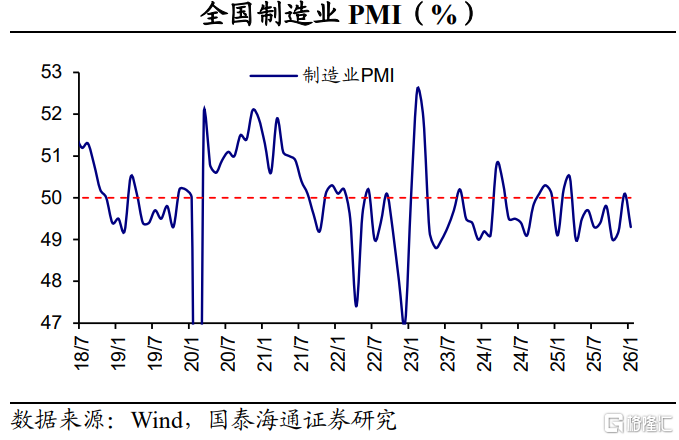
2026 年 1 月 PMI 数据点评:PMI 淡季回落,价格回升
GUOTAI HAITONG SECURITIES· 2026-01-31 13:34
Group 1: Manufacturing PMI Insights - In January 2026, the manufacturing PMI was 49.3%, a decrease of 0.8 percentage points from the previous month[9] - The production index was 50.6%, down 1.1 percentage points, indicating cautious expansion due to demand decline[16] - New orders and new export orders indices were 49.2% and 47.8%, respectively, both declining by 1.6 and 1.2 percentage points[16] Group 2: Price and Inventory Trends - The main raw materials purchase price index rose to 56.1%, an increase of 3.0 percentage points, while the factory price index reached 50.6%, marking the first time in 20 months above the critical point[19] - Raw material inventory and finished goods inventory indices were 47.4% and 48.6%, respectively, indicating a decrease in raw material stock[21] Group 3: Non-Manufacturing Sector Performance - The service sector's business activity index was stable at 49.5%, with significant divergence among industries[22] - The construction sector's business activity index fell to 48.8%, down 4.0 percentage points, reflecting seasonal slowdowns[24] Group 4: Economic Outlook and Risks - The macroeconomic policy is expected to be more proactive, with a focus on boosting overall demand and ensuring spending increases[27] - A risk remains in the real estate sector, where demand needs to be stimulated[28]
财政金融协同,精准扩内需
2 1 Shi Ji Jing Ji Bao Dao· 2026-01-31 01:37
Core Viewpoint - The Chinese government has introduced a series of significant policies aimed at creating a favorable fiscal and financial environment for the start of the 14th Five-Year Plan, with a focus on optimizing existing policies and enhancing support for key sectors and small and medium-sized enterprises (SMEs) [1][2]. Monetary Policy - The People's Bank of China announced eight policy measures on January 15, which include lowering the interest rates of structural monetary policy tools to reduce the cost of funds for banks, encouraging them to lend at lower rates to key areas such as small and micro enterprises, technological innovation, and green transformation [1]. - The introduction of a dedicated 1 trillion yuan relending facility for private enterprises signals strong governmental support, aiming to improve liquidity for SMEs and stimulate investment and employment [2]. Fiscal Policy - The Ministry of Finance and other departments have launched a loan interest subsidy policy for SMEs, which directly lowers financing costs through fiscal subsidies, targeting small and micro private enterprises and focusing on critical sectors for national industrial chain security [2]. - The personal consumption loan interest subsidy policy has been optimized to enhance consumer spending, particularly through credit card installment plans, which are more accessible than traditional personal loans [3]. Policy Optimization - Future adjustments to the SME loan interest subsidy policy may include extending the duration and increasing the loan limits, as well as expanding the support to include working capital loans in key sectors [4]. - The optimization of policies for service sector loans and personal consumption loans will focus on improving precision in policy design, enhancing execution efficiency, and ensuring coordination among related policies [5]. Collaborative Efforts - The integration of fiscal and monetary policies is emphasized, with fiscal policy acting as a catalyst to lower risks and provide incentives for financial resources to enter specific sectors, while monetary policy ensures that funds are effectively directed to SMEs and consumption [5].
马年元月金属涨势震撼:铜价“狂飙”领衔涨1820元/吨,市场格局重塑进行时!
Xin Lang Cai Jing· 2026-01-30 05:09
Core Viewpoint - The metal market in January 2026 is characterized by significant volatility, particularly in copper prices, driven by macroeconomic policies, geopolitical conflicts, and industrial transformations [1][2]. Group 1: Copper Market Dynamics - Copper prices experienced extreme fluctuations, starting with a high opening at 108,280 yuan/ton before a sharp decline due to profit-taking by bulls [2]. - Three main factors driving the surge in copper prices include: 1. Macroeconomic conditions with the Federal Reserve maintaining interest rates and the dollar dropping below 96, creating expectations for looser monetary policy [2]. 2. Supply constraints from major producers like Glencore and Antofagasta, with anticipated declines in copper output by 2025 [2]. 3. Increased demand from emerging sectors such as AI and photovoltaics, although actual market transactions remain weak due to high prices and pre-holiday inventory management [3]. Group 2: Other Metals Overview - Aluminum prices surged due to speculative trading but are expected to enter a correction phase as demand weakens ahead of the holiday season, despite low inventory levels providing some support [5]. - Zinc prices are influenced by a weaker dollar and geopolitical tensions, but the supply-demand balance is weak, with excess refining capacity and subdued downstream consumption [6]. - Lead prices are under pressure from macroeconomic factors and weak demand, with a potential for further declines as pre-holiday stockpiling ends [7]. - Nickel prices are experiencing a weak trend due to seasonal demand slowdown, although long-term support exists from supply constraints in Indonesia [8]. - Tin prices have shown volatility but are supported by long-term demand growth in sectors like AI and electric vehicles, despite short-term production slowdowns [9].
