
期货价格

Search documents
PVC期价连续拉升 拐点是否出现?
Qi Huo Ri Bao· 2025-12-17 00:22
Core Viewpoint - The PVC market has been under pressure since 2025 due to increased supply and decreased demand, with prices hitting a nearly 10-year low. Recent price increases lack strong driving forces, and future price recovery will depend on policy effects and export conditions [1]. Supply Summary - In 2025, the PVC market will see an additional capacity of 2.2 million tons, with a net increase of 2.05 million tons, bringing total capacity to 29.93 million tons, a year-on-year increase of 7.35%. Ethylene-based capacity will account for 80% of this [1]. - From January to November, domestic PVC production reached 22.32 million tons, a year-on-year increase of 4.35%, with ethylene-based production growing by 11.48% [1]. - The operating rate for PVC powder is currently at 78.39%, down 0.62 percentage points from the previous week, indicating a reduction in production due to safety and production task considerations [1]. Inventory Summary - As of December 12, domestic PVC social inventory stood at 1.0593 million tons, with East and South China warehouses at historically high levels for this time of year. Despite the peak season, inventory levels have not decreased effectively [2]. - The pressure from high inventory levels remains a core factor affecting prices, with both social and enterprise inventories being high [2]. Demand Summary - Demand for PVC is weak, heavily reliant on the real estate and infrastructure sectors, which have seen significant declines in new construction and investment [3]. - From January to November, new housing starts fell by 20.5%, and real estate development investment decreased by 15.9%, limiting the demand pull for PVC [3]. - The operating rates for downstream pipe and profile production are below 40%, indicating further weakening demand as the Spring Festival approaches [3]. Export Summary - PVC powder exports increased by 49% year-on-year to 3.23 million tons from January to October, while exports of PVC products fell by 11.5% [4]. - The domestic price advantage for PVC powder has improved order intake, but rising shipping costs may hinder significant export volume increases [4]. - Expectations for a 15% increase in PVC exports in the first half of next year could help alleviate domestic oversupply pressures [4]. Short-term and Mid-term Outlook - The PVC market continues to face supply-demand imbalances, with price increases lacking core driving forces. However, the current market valuation is at historical lows, and potential unplanned maintenance due to losses may limit price declines [5]. - In the mid-term, supply-demand contradictions are expected to gradually ease as more companies may reduce production and extend maintenance periods due to ongoing profit declines [2][5].
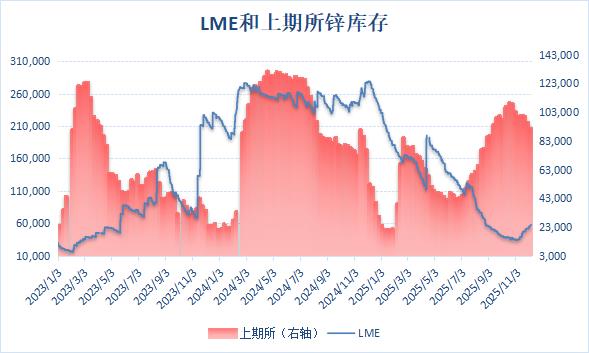
伦锌库存增至逾三个月新高 沪锌库存刷新近三个月最低位
Wen Hua Cai Jing· 2025-12-09 05:35
Group 1 - The core point of the article highlights the contrasting trends in zinc inventories between the London Metal Exchange (LME) and the Shanghai Futures Exchange (SHFE), with LME inventories reaching a three-month high while SHFE inventories hit a three-month low [1][2][3]. Group 2 - LME zinc inventory increased to 57,750 tons, marking a rise from previous levels and reaching the highest point in over three months [1]. - SHFE zinc inventory decreased by 4.17% to 91,916 tons, representing the lowest level in nearly three months [1]. - The data indicates that declining inventories in domestic and international exchanges generally support price increases, while rising inventories may exert downward pressure on prices [3].

(2025年12月8日)白银期货价格今日行情查询
Jin Tou Wang· 2025-12-08 02:44
打开APP,查看更多高清行情》 金投白银网提供今日白银期货价格走势_今天白银期货价格走势(2025年12月8日) 今日白银期货价格查询(2025年12月8日) | 名称 | 最新价 | 最高价 | 最低价 | 昨收价 | | --- | --- | --- | --- | --- | | 沪银主力 | 13660.00 | 13918.00 | 13572.00 | 13687.00 | 金投白银网(http://ag.cngold.org)为您提供最新白银期货价格、白银期货合约、白银期货交易以及白银期 货走势,更多白银期货行情敬请关注:白银期货专栏 备注:以上白银的价格仅供参考,请以官方报价为准。如对白银投资有疑问可咨询本站客服。 ...
豆粕:若无意外利多,盘面偏弱;豆一:现货偏强,盘面偏弱
Guo Tai Jun An Qi Huo· 2025-12-07 09:32
Report Summary 1. Report Industry Investment Rating No investment rating for the industry is provided in the report. 2. Core Viewpoints - In the week of 12.01 - 12.05, US soybean futures prices mainly declined due to the extension of China's purchase time and lack of expected positive factors. Domestic soybean meal futures prices first rose and then fell, while soybean No.1 futures prices were weak. - In the coming week (12.08 - 12.12), it is expected that the prices of Dalian soybean meal and soybean No.1 will fluctuate weakly. [2][6] 3. Summary by Relevant Catalogs International Soybean Market - **China's Purchase of US Soybeans**: On December 5, China purchased 462,000 tons of US soybeans (for delivery in the 2025/26 season). Although the event itself is positive, it is lower than expected and has limited incentive for US soybeans. [2] - **Brazilian Soybean Import Cost**: As of the week of December 5, the average weekly CNF premium of Brazilian soybeans for February 2026 delivery increased, the average import cost slightly increased, and the average crushing profit on the futures market also increased. [2] - **Brazilian Soybean Planting**: As of the week of November 27, the planting progress of 2025/26 Brazilian soybeans was 89%, lower than about 91% in the same period last year. Rainfall distribution was uneven, causing drought in some areas, but it's hard to conclude a yield decline. [2] - **Argentine Soybean Planting**: As of the week of December 4, the planting progress of 2025/26 Argentine soybeans was about 44.7%, lower than about 54% in the same period last year, mainly due to excessive moisture in central Buenos Aires. [2] - **South American Weather Forecast**: In the next two weeks (December 6 - December 19), precipitation in the main soybean - producing areas of Brazil will be slightly higher and the temperature will be lower; precipitation in the main soybean - producing areas of Argentina will be lower and the temperature will be basically normal. Overall, the weather in the producing areas is not a big problem. [2] Domestic Soybean Meal Spot Market - **Trading Volume**: The weekly trading volume of soybean meal increased. As of the week of December 5, the average daily trading volume of soybean meal in major domestic oil mills was about 140,000 tons, compared with about 120,000 tons in the previous week. [3] - **Pick - up Volume**: The weekly pick - up volume of soybean meal slightly decreased. As of the week of December 5, the average daily pick - up volume of soybean meal in major oil mills was about 184,000 tons, compared with about 188,000 tons in the previous week. [3] - **Basis**: The weekly average basis of soybean meal (Zhangjiagang) increased to about 143 yuan/ton, compared with about - 10 yuan/ton in the previous week and about 198 yuan/ton in the same period last year. [4] - **Inventory**: The inventory of soybean meal increased both weekly and year - on - year. As of the week of November 28, the inventory of soybean meal in major domestic oil mills was about 1.08 million tons, with a weekly increase of about 6% and a year - on - year increase of about 45%. [4] - **Crushing Volume**: The weekly soybean crushing volume decreased, and it is expected to increase next week. As of the week of December 5, the domestic weekly soybean crushing volume was about 2.06 million tons, and the operating rate was about 57%. Next week (December 6 - December 12), the crushing volume is expected to be about 2.21 million tons, and the operating rate will be 61%. [4] Domestic Soybean No.1 Spot Market - **Soybean Price**: The price of soybean No.1 was stable with a slight increase. In the Northeast, the purchase price of clean soybeans increased by 40 yuan/ton; in the Inner Pass region, the price was flat; and in the sales areas, the price was also flat. [5] - **State Reserve Purchase**: There were no new purchase points for the state reserve. After the opening of purchases at Suihua and Harbin direct - controlled depots, the price was higher than other depots in the province, but there were still few trucks delivering soybeans. [5] - **Farmer's Selling Sentiment**: The increase in the purchase price in the Northeast产区 loosened farmers' reluctance to sell, but the market's acceptance of the increased - price soybeans was average. Later in the week, some large trading entities slightly lowered the purchase price due to rumors of state reserve sales. [5] - **Sales Area Demand**: The pattern of "better in the north and stable in the south" in the sales area demand continued. In the north, the demand for soy products increased due to lower temperatures, and the trading speed of Northeast soybeans was fair; in the south, the demand for edible soybeans did not improve significantly, and the trading speed was normal but slow. [5]
原木期货日报-20251201
Guang Fa Qi Huo· 2025-12-01 05:45
Report Summary 1. Report Industry Investment Rating - No investment rating information is provided in the report. 2. Core View of the Report - The spot price of logs has been adjusted downward, with the prices of various specifications generally dropping by 10 - 20 yuan per cubic meter. The arrival volume at ports on the supply side continues to rise, and the port inventory is higher than in the past two years. Although the outbound volume remains resilient, it will face pressure in the future. Currently, the futures price is at a relatively low level, and cost support limits the downside. Overall, the reality of the 01 contract is weak, and the willingness to take delivery is low. The futures market is expected to run weakly [3][4]. 3. Summary by Relevant Catalog Futures and Spot Prices - On November 28th, the prices of log futures contracts LG2601, LG2605 remained unchanged, while LG2603 increased by 2.0 yuan to 776.5 yuan, with a gain of 0.26%. The 01 - 03 spread decreased by 2.0 to -11.5, and the 03 - contract basis decreased by 2.0 to -26.5. The prices of various types of spot logs at ports such as Rizhao and Taicang remained unchanged [2]. - The CFR prices of 4 - meter medium - grade A radiata pine and 11.8 - meter spruce in the external market also remained unchanged on November 28th compared to previous dates [2]. Cost: Import Cost Calculation - On November 28th, the RMB - US dollar exchange rate was 7.071 yuan, and the import theoretical cost was 806.36 yuan, a decrease of 0.28 yuan from the previous day, with a change of 0% [2]. Supply: Monthly - In October, the port shipping volume was 201.3 million cubic meters, an increase of 24.7 million cubic meters or 13.99% compared to September. The number of ships at the port (New Zealand → China, Japan, South Korea) was 54, an increase of 8 or 17.39% compared to the previous period [2]. Inventory: Main Port Inventory (Weekly) - As of November 21st, the total domestic coniferous log inventory was 303 million cubic meters, an increase of 8 million cubic meters compared to the previous week. The inventory in Shandong was 195.4 million cubic meters, an increase of 11.1 million cubic meters; the inventory in Jiangsu was 83.18 million cubic meters, a decrease of 0.5 million cubic meters [2][3]. Demand: Daily Average Outbound Volume (Weekly) - As of November 21st, the daily average outbound volume of logs was 6.44 million cubic meters, a decrease of 0.12 million cubic meters compared to the previous week. The outbound volume in Shandong was 3.59 million cubic meters, a decrease of 0.08 million cubic meters; the outbound volume in Jiangsu was 2.36 million cubic meters, a decrease of 0.08 million cubic meters [2][3]. Forecast of Arrival at Ports - From November 24th to November 30th, 2025, the number of pre - arriving New Zealand log ships at 13 Chinese ports was 6, a decrease of 7 compared to the previous week, a week - on - week decrease of 54%; the total arrival volume was about 21.7 million cubic meters, a decrease of 20.1 million cubic meters compared to the previous week, a week - on - week decrease of 48% [3].
《金融》日报-20251201
Guang Fa Qi Huo· 2025-12-01 01:32
Report Summary 1. Report Industry Investment Rating - No information provided in the reports. 2. Core Views - The reports present daily data on various financial products including stock index futures spreads, bond futures spreads, precious metals futures and spot prices, and container shipping industry indices. These data provide insights into market trends and price movements of different financial instruments. 3. Summary by Relevant Catalogs Stock Index Futures Spreads - **Price Differences**: On December 1, 2025, the IF spot - futures spread was -20.86, the IC spot - futures spread was -57.35, and the IM spot - futures spread was 73.41. There were also various inter - period spreads and cross - product ratios presented, such as the IC/IF ratio at 1.5478 [1]. Bond Futures Spreads - **IRR and Basis**: As of November 28, 2025, the IRR of some bonds had certain changes. For example, the TF basis was 1.5719, the T basis was 1.4880, and the TL basis was 1.8420. There were also inter - period spreads and cross - product spreads among different bond futures contracts [2]. Precious Metals Futures and Spot - **Price Changes**: On November 28, 2025, domestic futures prices of precious metals like AU2602 increased by 0.71% to 953.92 yuan/gram, AG2602 rose by 1.61% to 12727 yuan/kilogram. In the foreign market, COMEX gold increased by 1.44% to 4256.40 dollars/ounce. There were also data on spot prices, basis, and price ratios [3]. Container Shipping Industry - **Index Movements**: As of November 24, 2025, the SCFIS (European route) increased by 20.75% to 1639.37 points, while the SCFIS (US West route) decreased by 10.54% to 1107.85 points. There were also data on shipping rates, futures prices, and fundamental data such as global container shipping capacity supply and port - related indicators [5].
豆粕:关注中方采购美豆情况,盘面震荡,豆一,关注中美贸易情绪,盘面震荡
Guo Tai Jun An Qi Huo· 2025-11-30 11:21
Report Investment Rating No relevant information provided. Core View - In the next week (December 1 - 5, 2025), the prices of Dalian soybean meal and soybean futures are expected to fluctuate. Attention should be continuously paid to China's purchases of US soybeans. For soybean meal, there is currently no other driving force, and the focus is on China's purchases of US soybeans. Additionally, it is reported that China and the US are about to sign a soybean trade agreement, so the progress of this event should be monitored. For soybeans, the spot price is stable. The increase in state - reserve purchase points and the slight increase in the purchase price of some protein soybeans have a positive impact on the spot market. The disk situation depends on Sino - US trade sentiment [1][5]. Summary by Related Contents 1. Futures Price Changes Last Week (November 24 - 28, 2025) - US soybean futures prices rose slightly. From a weekly K - line perspective, in the week of November 28, the main January 2026 contract of US soybeans had a weekly increase of 0.95%, while the main January 2026 contract of US soybean meal had a weekly decrease of 0.38%. - Domestic soybean meal futures prices were slightly stronger, and soybean futures prices were neutral. In the week of November 28, the main m2601 contract of soybean meal had a weekly increase of 1.06%, and the main a2601 contract of soybeans had a weekly decrease of 0.02% [1]. 2. International Soybean Market Fundamentals Last Week (November 24 - 28, 2025) - China continued to purchase US soybeans, which was positive for US soybeans. From November 24 to 28, China purchased a total of about 435,000 tons of US soybeans (all for delivery in the 2025/26 season). - The import cost of Brazilian soybeans decreased slightly week - on - week, with a neutral impact. As of the week of November 28, the average CNF premium of Brazilian soybeans for February 2026 delivery increased week - on - week, the average import cost decreased slightly week - on - week, and the average margin of disk crushing increased slightly week - on - week. - The planting progress of Brazilian soybeans was still slow, with a slightly positive impact. As of the week of November 20, the sowing progress of Brazilian soybeans in the 2025/26 season was 81%, compared with 71% in the previous week and about 86% in the same period last year. Irregular rainfall in most soybean plantations in the Brazilian Cerrado limited the sowing progress and raised concerns about yields. - The planting progress of Argentine soybeans was slow, with a slightly positive impact. As of the week of November 19, the planting progress of Argentine soybeans in the 2025/26 season was about 24.6%, compared with about 35.8% in the same period last year. - The weather forecast for the main soybean - producing areas in South America: In the next two weeks (November 28 - December 12), precipitation in the main soybean - producing areas of Brazil will be low, and the temperature will be "partially high (November 28 - December 2) and mostly normal"; precipitation in the main soybean - producing areas of Argentina will be basically normal (high at the end of November and decreasing in early December), and the temperature will fluctuate around the average. Overall, the weather in the producing areas is not a major issue, with a neutral impact [1]. 3. Domestic Soybean Meal Spot Market Situation Last Week (November 24 - 28, 2025) - **Trading volume**: The trading volume of soybean meal decreased week - on - week. As of the week of November 28, the average daily trading volume of soybean meal in major domestic oil mills was about 120,000 tons, compared with about 240,000 tons in the previous week. - **Pick - up volume**: The pick - up volume of soybean meal decreased slightly week - on - week. As of the week of November 28, the average daily pick - up volume of soybean meal in major oil mills was about 188,000 tons, compared with about 190,000 tons in the previous week. - **Basis**: The basis of soybean meal decreased slightly week - on - week. As of the week of November 28, the weekly average basis of soybean meal (Zhangjiagang) was about - 10 yuan/ton, compared with about 3 yuan/ton in the previous week and about 153 yuan/ton in the same period last year. - **Inventory**: The inventory of soybean meal increased both week - on - week and year - on - year. As of the week of November 21, the inventory of soybean meal in major domestic oil mills was about 1.02 million tons, with a week - on - week increase of about 14% and a year - on - year increase of about 49%. - **Crushing volume**: The weekly crushing volume of soybeans decreased, and it is expected to decrease next week. As of the week of November 28, the weekly crushing volume of domestic soybeans was about 2.2 million tons (2.33 million tons in the previous week and 1.89 million tons in the same period last year), with an operating rate of about 61% (64% in the previous week and 54% in the same period last year). Next week (November 29 - December 5), the expected crushing volume of soybeans in oil mills is about 2.14 million tons (1.66 million tons in the same period last year), with an operating rate of 59% (47% in the same period last year) [2][3]. 4. Domestic Soybean Spot Market Situation Last Week (November 24 - 28, 2025) - **Soybean price**: The soybean price was stable. The net - grain purchase price of soybeans in some parts of Northeast China was in the range of 3,960 - 4,080 yuan/ton, the net - grain purchase price in some parts of Inner China was in the range of 4,860 - 5,060 yuan/ton, and the selling price of Northeast edible soybeans in the sales area was in the range of 4,460 - 4,680 yuan/ton, all remaining unchanged from the previous week. - **State - reserve purchase**: The number of state - reserve purchase points continued to increase, and the purchase price of some protein soybeans was raised, which had a positive impact on the spot market. Two new state - reserve purchase points were added on November 28, and the purchase price of some protein soybeans increased. - **Farmer and trader behavior**: Farmers in the Northeast production area were reluctant to sell, and traders had slow buying and selling. Many grass - roots farmers showed obvious reluctance to sell, waiting for price increases. Most traders reported slow procurement and slow sales. - **Market demand**: The demand in the northern sales area increased, while that in the southern area was stable. In the northern market, the sales of Northeast soybeans were acceptable due to the increase in demand for soy products caused by the drop in temperature. In the southern region, the sales were slow, and there were no new signs of demand for terminal soy products in many places [4].
生猪:去库节点来临,近端压力扩大
Guo Tai Jun An Qi Huo· 2025-11-27 01:52
Report Summary 1. Report Industry Investment Rating - No industry investment rating provided in the report. 2. Core View - The report focuses on the hog market, indicating that the inventory reduction node has arrived, and the near - term pressure is expanding. The trend strength is - 1, suggesting a bearish view on the market [1][3]. 3. Summary by Related Content Hog Fundamental Data - **Spot Prices**: The Henan spot price is 11,430 yuan/ton, down 50 yuan/ton; the Sichuan spot price is 11,550 yuan/ton, down 50 yuan/ton; the Guangdong spot price is 11,760 yuan/ton, down 400 yuan/ton [2]. - **Futures Prices**: The price of hog 2601 is 11,540 yuan/ton, up 125 yuan/ton; hog 2603 is 11,365 yuan/ton, up 70 yuan/ton; hog 2605 is 12,060 yuan/ton, up 65 yuan/ton [2]. - **Trading Volume and Open Interest**: The trading volume of hog 2601 is 92,861 lots, an increase of 40,389 lots compared to the previous day, and the open interest is 128,058 lots, a decrease of 2,774 lots. For hog 2603, the trading volume is 41,967 lots, an increase of 23,281 lots, and the open interest is 124,616 lots, an increase of 2,786 lots. For hog 2605, the trading volume is 22,335 lots, an increase of 11,915 lots, and the open interest is 69,132 lots, an increase of 1,973 lots [2]. - **Price Spreads**: The basis of hog 2601 is - 110 yuan/ton, down 175 yuan/ton; the basis of hog 2603 is 65 yuan/ton, down 120 yuan/ton; the basis of hog 2605 is - 630 yuan/ton, down 115 yuan/ton. The spread between hog 1 - 3 is 175 yuan/ton, up 55 yuan/ton; the spread between hog 3 - 5 is - 695 yuan/ton, up 5 yuan/ton [2]. Trend Intensity - The trend intensity is - 1, with a range of [-2, 2]. - 2 represents the most bearish view, and 2 represents the most bullish view [3].
原木期货日报-20251126
Guang Fa Qi Huo· 2025-11-26 03:10
1. Report Industry Investment Rating - The document does not provide an industry investment rating. 2. Core View of the Report - The log futures are currently in a low - level oscillation. Last week, the spot price was adjusted downward. The supply side has a continuous increase in arrivals, and inventory accumulation is putting significant pressure on the market. Demand remains resilient. The valuation of the futures contract is relatively low, and the significant inversion between domestic and foreign prices forms a certain support for import costs. Overall, in the context of a weak fundamental situation, the log futures market is expected to continue to oscillate at the bottom [3]. 3. Summary According to Related Catalogs Futures and Spot Prices - **Futures Prices**: On November 25, the prices of log 2601, log 2603, and log 2605 were 764.5, 777.0, and 792.0 respectively, with decreases of - 0.46%, - 0.26%, and - 0.38% compared to November 24 [2]. - **Spot Prices**: The spot prices of various types of logs in ports such as Rizhao and Taicang remained unchanged on November 25 compared to November 24, with a 0.00% change [2]. - **Cost**: The RMB - US dollar exchange rate on November 25 was 7.094 yuan, a decrease of 0.01 yuan compared to November 24, and the import theoretical cost was 808.91 yuan, a decrease of 1.28 yuan [2]. Supply - **Monthly Supply**: In October, the port throughput was 201.3 million cubic meters, a 13.99% increase compared to September. The number of departing ships from New Zealand to China, Japan, and South Korea was 54, a 17.39% increase compared to the previous period [2]. - **Inventory**: As of November 21, the total inventory of domestic coniferous logs was 303 million cubic meters, an 8 - million - cubic - meter increase compared to November 14, with a 2.71% increase. The inventory in Shandong and Jiangsu also had corresponding changes [2][3]. Demand - The daily average outbound volume of logs in China decreased by 0.12 million cubic meters from November 14 to November 21, a 2% decrease. The daily average outbound volume in Shandong and Jiangsu also decreased [3]. Forecast - From November 24 to November 30, 2025, the number of pre - arriving New Zealand log ships at 13 Chinese ports was 6, a 54% week - on - week decrease, and the arrival volume was about 21.7 million cubic meters, a 48% week - on - week decrease [3].
原木期货日报-20251125
Guang Fa Qi Huo· 2025-11-25 05:13
Group 1: Report Investment Rating - No investment rating information is provided in the report. Group 2: Core View - Last week, the log futures remained in a low - level oscillation, and the spot price decreased. The supply side saw a continuous increase in arrivals, inventory accumulated, and the market was under significant pressure. Demand continued to show resilience. The current valuation of the futures was relatively low, and the significant inversion between domestic and foreign prices provided some support for import costs, limiting the downward space of the futures. Overall, in the context of a weak fundamental situation, the log futures are expected to continue to oscillate at the bottom [3][4]. Group 3: Summary by Relevant Catalogs Futures and Spot Prices - **Futures Prices**: On November 24th, compared with November 21st, the price of log 2601 was 768.0, down 0.5 or - 0.07%; log 2603 was 779.0, up 1.5 or 0.19%; log 2605 was 795.0, up 1.5 or 0.19%. The 01 - 03 spread was - 11.0, down 2.0; the 01 - 05 spread was - 27.0, down 2.0; the 03 - contract basis was - 29.0, down 1.5; the 01 - contract basis was - 18.0, up 0.5 [2]. - **Spot Prices**: The prices of various types of logs at ports such as Rizhao Port and Taicang Port remained unchanged on November 24th compared with November 21st. The CFR prices of radiata pine 4 - meter medium A and spruce 11.8 - meter also remained unchanged [2]. - **Import Cost**: On November 24th, the RMB - US dollar exchange rate was 7.106, down 0.01 or 0% compared with November 23rd; the import theoretical cost was 810.19, down 0.83 or 0% [2]. Supply - **Monthly Supply**: In October, the port shipment volume was 201.3 million cubic meters, up 24.7 million cubic meters or 13.99% compared with September. The number of departing ships from New Zealand to China, Japan, and South Korea was 54.0, up 8.0 or 17.39% [2]. - **Inventory**: As of November 21st, the total inventory of domestic coniferous logs was 303 million cubic meters, up 8 million cubic meters or 2.71% compared with November 14th. In Shandong, it was 206.5 million cubic meters, up 11.1 million cubic meters or 5.68%; in Jiangsu, it was 83.18 million cubic meters, down 0.5 million cubic meters or - 0.57% [2][3]. Demand - As of November 21st, the daily average出库 volume of logs in China was 6.44 million cubic meters, down 0.12 million cubic meters or - 2% compared with November 14th. In Shandong, it was 3.59 million cubic meters, down 0.08 million cubic meters; in Jiangsu, it was 2.36 million cubic meters, down 0.08 million cubic meters [3]. Forecast of Arrivals - From November 24th to November 30th, 2025, the number of pre - arriving ships of New Zealand logs at 13 ports in China was 6, 7 less than last week, a week - on - week decrease of 54%; the total arrival volume was about 21.7 million cubic meters, 20.1 million cubic meters less than last week, a week - on - week decrease of 48% [3].