
估值修复

Search documents
钢铁板块,持续拉升
第一财经· 2025-07-21 02:40
Core Viewpoint - The steel sector is experiencing a significant rally, with several companies reaching their daily price limits, indicating strong market sentiment and potential investment opportunities [1] Industry Developments - The China Iron and Steel Association held a meeting on July 15 to discuss the "14th Five-Year Plan" for the steel industry, emphasizing the need to control capacity increases and facilitate exits from the market to prevent overcapacity risks [1] - The meeting highlighted the importance of establishing a new capacity governance mechanism to maintain a healthy competitive environment in the steel industry [1] Market Outlook - According to Minsheng Securities, policies aimed at stabilizing growth and reducing competition pressure on tail-end capacities are expected to optimize crude steel supply, leading to a potential recovery in steel companies' profitability [1] - Xinda Securities forecasts a stable improvement in the steel industry's structure, noting that some companies are currently undervalued, presenting structural investment opportunities, particularly for high-margin special steel firms and leading companies with strong cost control [1]



天风证券:如何看待银行股价和基本面的背离?
智通财经网· 2025-07-19 09:55
Core Viewpoint - The banking sector is currently under pressure, but the market's preference for high dividend strategies is driving a notable upward trend in bank stocks. The release of policy dividends, along with increased participation from insurance funds, active funds, and passive funds, is expected to provide stable incremental capital for bank stocks, enhancing the sustainability of valuation recovery [1][2]. Group 1: Current Banking Fundamentals - The banking sector's fundamentals are still under pressure but show signs of marginal improvement. The net interest margin is expected to decline significantly less in 2025 due to the expiration of high-interest liabilities and a slowdown in loan pricing declines. The estimated net interest margins for state-owned and joint-stock banks are projected to be 1.34% and 1.55%, respectively, down 12 and 9 basis points from the end of 2024 [2]. - The asset quality is expected to improve while remaining stable. As of Q1 2025, the non-performing loan ratio for commercial banks was recorded at 1.51%, only slightly up by 1 basis point from the end of 2024. The provision coverage ratio stands at 208%, down 3.06 percentage points, indicating ample room above the regulatory requirement of 150% [2]. Group 2: Valuation Recovery and Market Dynamics - The core logic driving the current market rally is the valuation recovery fueled by the funding environment. This trend is expected to continue, supported by low interest rates and an asset shortage, which highlight the advantages of high dividends and quasi-fixed income characteristics of bank stocks. As of July 11, the banking sector's dividend yield was 4.87%, significantly enhancing its investment appeal due to stable dividends and sound operations [3]. - Continuous inflow of incremental capital is driving a noticeable recovery in bank stock valuations. Policies such as the introduction of mid- to long-term capital into the market and new regulations for public funds have significantly increased the demand for bank stock allocations. As of July 11, the banking sector's price-to-book (PB) ratio was 0.75, indicating substantial room for recovery towards a PB of 1 [3].





A股唯一可媲美英伟达的板块,变天在即?
财富FORTUNE· 2025-07-16 13:01
Core Viewpoint - The banking sector has emerged as a standout performer in the A-share market this year, with a market capitalization increase of over 2 trillion yuan, drawing comparisons to the tech giant Nvidia [1] Group 1: Performance and Valuation - As of July 16, the bank ETF (512800) tracking the China Securities Bank Index has risen 36% over the past year, with a year-to-date increase of over 19%, significantly outperforming the CSI 300 and Shanghai Composite Index [2] - The core logic supporting the banking sector's performance includes policy-driven insurance fund allocation, institutional demand for high dividends, and expectations for valuation recovery [2] - Current bank sector valuations are low, with a price-to-book (PB) ratio around 0.7, which is at the 39th percentile over the past decade, and a dividend yield of approximately 4%, making it attractive compared to the 10-year government bond yield of about 1.6% [2] Group 2: Risks and Market Sentiment - Recent market movements indicate increasing divergence in sentiment, with the banking sector experiencing a pullback after three consecutive days of decline from July 14 to 16, leading to some investors being trapped in high positions [3] - A significant signal of caution emerged when China Life, a major shareholder, announced plans to fully divest its 0.70% stake in Hangzhou Bank within three months, interpreted as a warning against the current high valuations of bank stocks [3] - The logic for bearish sentiment is based on the risks of overheating and the potential for a breakdown in the supportive "club" of institutional investors, as some bank stocks have surged over 40% this year, creating substantial profit-taking opportunities [4] Group 3: Market Dynamics and Future Outlook - The average dividend yield of the four major banks has dropped to 3.85%, nearing a decade-low, raising concerns about the attractiveness of bank stocks [4] - The banking sector is facing unprecedented challenges, with net interest margins historically falling below non-performing loan rates, posing a serious threat to long-term profitability [4] - As bank stocks face pressure, leading tech stocks have surged, indicating a reallocation of funds from banks to growth sectors, suggesting a potential shift in market dynamics [4][5] - While the banking sector still has support from low valuations and potential incremental capital, the signs of overheating, reduced insurance fund holdings, and fundamental pressures indicate that its leading position may be under significant challenge [5]

银行板块年内涨幅超15%,大股东减持套现加剧顶部担忧
Di Yi Cai Jing· 2025-07-16 12:52
Core Viewpoint - The A-share banking sector is experiencing significant pressure, with concerns about a potential peak following substantial gains in stock prices, particularly after major shareholders began to reduce their holdings [1][2]. Group 1: Market Performance - As of July 16, 2023, the Shenwan Banking Index has recorded a year-to-date increase of 15.20%, with all 42 A-share listed banks showing gains, and some like Xiamen Bank and Shanghai Pudong Development Bank exceeding 30% [1]. - The average dividend yield for A-share listed banks has dropped to approximately 3.8%, down from 5.01% a year ago, indicating a significant increase in valuation levels [5]. - The price-to-earnings (PE) ratio of the China Securities Banking Index has risen to 7.4 times, the highest since April 2018 [5]. Group 2: Shareholder Actions - China Life Insurance plans to completely divest its 5,078,940 shares in Hangzhou Bank, representing 0.7% of the bank's total equity, marking its fourth reduction since 2021 [3]. - Other banks, such as Changsha Bank and Qilu Bank, have also seen major shareholders announce plans to reduce their stakes due to personal financial strategies [3]. - Conversely, some shareholders have chosen to increase their stakes, with New China Life Insurance acquiring shares from Commonwealth Bank of Australia, becoming the fourth largest shareholder in Hangzhou Bank [4]. Group 3: Industry Outlook - Industry experts express mixed views on the future of the banking sector, with some highlighting the resilience of banks despite pressures on net interest margins, while others warn of overheating risks due to rapid price increases [2][6]. - The banking sector's return on equity (ROE) has fallen below 10%, primarily due to slowing credit growth and ongoing pressure on net interest margins [6]. - Long-term investment value in bank stocks remains positive, with expectations of asset quality improvement and continued appeal for long-term funds due to stable dividends [7].

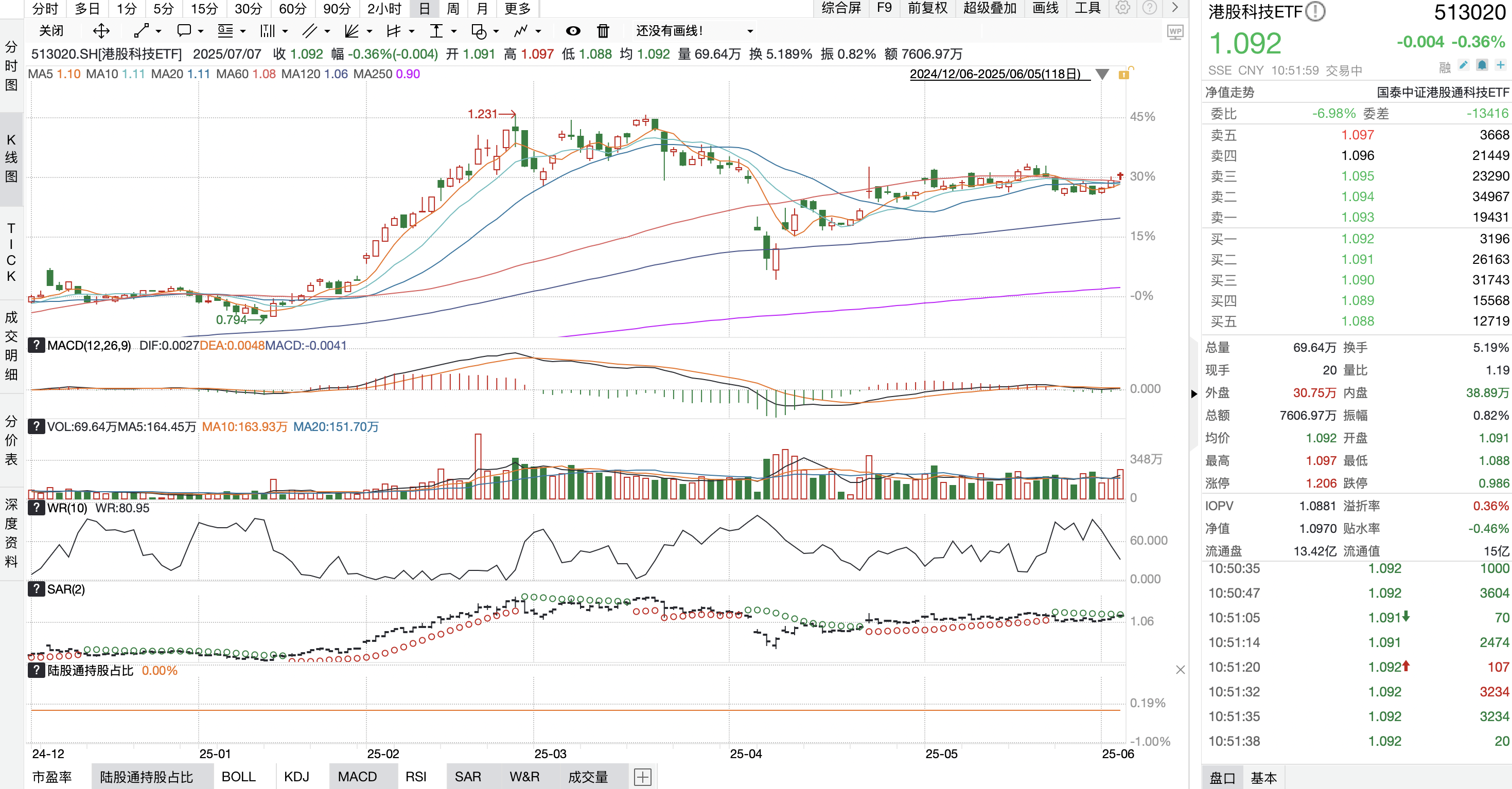
港股科技板块午后领涨,港股科技ETF(513020)涨超1.5%,连续5日流入超3.7亿元
Mei Ri Jing Ji Xin Wen· 2025-07-16 06:37
Group 1 - The Hong Kong technology sector is at a convergence point of "valuation trough" and "industry transformation," with policy, technology, and capital driving significant enhancement in allocation value [1] - Southbound funds and foreign capital are improving the liquidity of the sector, while dual benefits from industrial support and capital market reforms are boosting market confidence from both profitability and valuation perspectives [1] - Bloomberg consensus forecasts indicate that the EPS of the Hang Seng Technology Index is expected to maintain an upward trend from 2025 to 2027, suggesting a potential "valuation repair" and "profit growth" scenario, referred to as a Davis double-click [1] Group 2 - The Hong Kong Technology ETF (code: 513020) tracks the Hong Kong Stock Connect Technology Index (code: 931573), which selects up to 50 quality companies from the technology sector listed within the Stock Connect range [1] - The index aims to comprehensively reflect the overall performance of securities of technology companies that can be invested through the Stock Connect channel, with constituent stocks showing significant growth potential and market volatility characteristics [1] - Investors without stock accounts can consider the Cathay CSI Hong Kong Stock Connect Technology ETF Initiator Link C (015740) and Link A (015739) [1]
钢材:估值修复 或转入震荡走势
Jin Tou Wang· 2025-07-16 02:17
Core Viewpoint - The steel market is experiencing a mixed trend with stable spot prices and weakening futures, indicating a complex supply-demand dynamic in the industry [1][6]. Supply - July production continues to decline, with a total drop of 9,000 tons from May's peak, including a reduction of 50,000 tons in pig iron and a decrease of 40,000 tons in scrap steel consumption [3]. - The current pig iron production is at 2.398 million tons, while scrap steel consumption remains stable at 505,000 tons [3]. - The total production of the five major steel products decreased by 124,400 tons to 8.72 million tons, with rebar production down by 40,000 tons to 2.167 million tons and hot-rolled coil production down by 50,000 tons to 3.232 million tons [3]. - The annual production growth rate is expected to remain at 3.3% due to high base effects from the previous year [3]. Demand - The apparent demand for the five major steel products remains stable, with a slight decrease in May compared to April, but June and July demand did not decline further, indicating better-than-expected seasonal demand [4]. - The apparent demand for the five major products decreased by 122,000 tons to 8.73 million tons [4]. - In July, hot-rolled coil production exceeded apparent demand, while rebar production was slightly below apparent demand [4]. Inventory - Recent production trends are closely following apparent demand, with inventory levels fluctuating accordingly [5]. - The inventory of the five major products decreased by 3,500 tons to 13.4 million tons, with rebar inventory down by 50,000 tons to 5.4 million tons, while hot-rolled coil inventory increased by 6,000 tons to 3.457 million tons [5]. - The supply-demand balance remains stable, with both supply and demand decreasing for rebar, while hot-rolled coil shows a slight inventory increase [5]. Cost and Profit - The cost side shows that coking coal production in Shanxi is gradually recovering, but recent restocking by traders has kept spot prices strong [2]. - Iron ore shipments in June have led to a slight increase in inventory, but the price of iron ore remains resilient due to expectations of a significant reduction in pig iron production [2]. - Profit margins from high to low are currently: steel billet > hot-rolled coil > rebar > cold-rolled [2]. Market Sentiment - The market sentiment is showing signs of improvement, with traders restocking and demand for spot steel improving slightly [6]. - The next macro observation window is the Politburo meeting at the end of July, which could influence market dynamics [6]. - Current price levels for rebar at 3,100 yuan and hot-rolled coil at 3,300 yuan are critical, with potential resistance levels at 3,220 yuan for rebar and 3,350 yuan for hot-rolled coil [6].
英伟达点燃港股科技!港股科技ETF(513020)年内飙涨30%
Mei Ri Jing Ji Xin Wen· 2025-07-16 02:10
Group 1 - The core viewpoint of the articles highlights the ongoing recovery and growth potential of the Hong Kong technology sector, driven by favorable policies, technological advancements, and increased capital inflow [4][6]. - The Hong Kong Technology ETF (513020) has shown a year-to-date increase of approximately 30%, indicating strong market interest and performance [1][4]. - The Hang Seng Technology Index is expected to see a gradual increase in EPS from 2025 to 2027, suggesting a positive outlook for profitability and valuation recovery in the sector [4]. Group 2 - The recent surge in U.S. tech stocks, particularly driven by Nvidia's significant market cap increase, has positively influenced Chinese concept stocks, reflecting a broader trend in the tech market [3]. - The Hong Kong Technology ETF closely tracks the CSI Hong Kong Stock Connect Technology Index, which includes a balanced selection of tech companies across various sectors such as internet, semiconductors, and biotechnology [4]. - The CSI Hong Kong Stock Connect Technology Index has achieved a 37.54% increase year-to-date as of July 7, outperforming other indices like the Hang Seng Technology Index and the Hong Kong Internet Index [4].

保利发展(600048):短期业绩表现承压,长期关注估值修复
Changjiang Securities· 2025-07-15 10:12
Investment Rating - The investment rating for the company is "Buy" and is maintained [9]. Core Views - Short-term performance is under pressure, but there is a long-term focus on valuation recovery. The cyclical pressure continues to suppress short-term performance, but the company is expected to maintain a certain scale in the future. The excellent pricing of convertible bonds indicates that the company's intrinsic value is gradually being recognized. The company has ample land reserves and is actively revitalizing inefficient inventory, accelerating asset optimization, and consolidating its leading position in the industry, with long-term valuation expected to recover [2][6]. Summary by Sections Financial Performance - In the first half of 2025, the company achieved revenue of 116.8 billion yuan, a decrease of 16.1%. The total profit was 9.9 billion yuan, down 29.6%, and the net profit attributable to shareholders was 2.7 billion yuan, a decline of 63.1% [6]. Market Position - The company remains the industry leader with a sales amount of 145.2 billion yuan in the first half of 2025, down 16.2%, and a sales area of 7.14 million square meters, down 25.2%. The average price per square meter increased by 12.0% to 20,300 yuan. The company actively expanded its investment, acquiring land worth 50.9 billion yuan, an increase of 303.7% [6][11]. Debt and Capital Structure - The company successfully issued 8.5 billion yuan in convertible bonds with a first-year coupon rate of 2.20%, indicating strong investor confidence in the company's asset revaluation and leading position. The successful issuance of long-term convertible bonds further optimizes the company's debt structure [6][11]. Future Outlook - Despite the cyclical downturn affecting short-term performance, the company is expected to maintain a certain scale. The projected net profits for 2025, 2026, and 2027 are 4.3 billion yuan, 4.3 billion yuan, and 5.0 billion yuan, respectively, with corresponding P/E ratios of 22.4, 22.9, and 19.4 [6][11].

南向流入高股息方向金额占总额1/3,场内孤品·香港银行LOF(501025)今年涨幅27%
Xin Lang Cai Jing· 2025-07-15 03:19
Group 1 - The core viewpoint is that the Hong Kong banking sector is experiencing strong performance driven by favorable policies and capital inflows, with the Hong Kong Bank LOF (501025) up 27% year-to-date, leading its category [1] - The Hong Kong Bank LOF has seen over 200 million in net inflows in the last 20 trading days, with total net inflows exceeding 350 million since the beginning of the year, indicating significant growth in scale [1] - The new regulatory framework for insurance companies emphasizes long-term investment strategies, which may further enhance the attractiveness of the banking sector for long-term capital [1][2] Group 2 - Southbound capital continues to favor high-dividend sectors, with 31 billion USD flowing into Hong Kong's high-dividend stocks this year, driven by a 20%+ discount of H-shares compared to A-shares and stable dividend attributes [1] - Financial policies are becoming more flexible, and the current bank sector dividend yields remain attractive, suggesting potential for continued inflows from long-term and passive funds [2] - The HK Bank Index (930792) has shown positive performance, with key stocks like Hang Seng Bank and Standard Chartered experiencing notable increases [2]
广发期货《黑色》日报-20250714
Guang Fa Qi Huo· 2025-07-14 09:21
1. Report Industry Investment Rating - No information about the industry investment rating is provided in the reports. 2. Core Views Steel Industry - This week, steel price fluctuations increased again, with significant increases in rebar and hot-rolled coil prices and a weakening of the basis. The black prices started to stabilize in June due to environmental inspections and production cuts in coking coal. Market sentiment improved in July, leading to a general increase in commodities. The fundamentals show that weekly steel production decreased with the decline in apparent demand, and inventory remained flat in July, indicating a balanced supply and demand situation. In the second half of the year, demand is likely to decline, and the supply will remain abundant, resulting in insufficient price increase momentum. Currently, low inventory and improved market sentiment support valuation repair trading, but the upward elasticity of actual demand is limited. The next macro observation window is the Politburo meeting at the end of July. [1] Iron Ore Industry - Last week, the iron ore 09 contract showed a strong upward trend. Fundamentally, the global iron ore shipment volume decreased week-on-week, while the arrival volume at 45 ports slightly increased. The subsequent average arrival volume is expected to continue to decline. On the demand side, due to increased steel mill maintenance and production restrictions in Tangshan, the pig iron output decreased from its high level but remained at around 240,000 tons per day. In the short term, the resilience of pig iron production will be maintained. Although the terminal demand faces the risk of weakening in the off-season, the current export rush provides some support. In the future, the pig iron output in July will continue to decline, with an average expected to be maintained at 230,000 - 240,000 tons, and steel mill profits will continue to improve. In the short term, iron ore will fluctuate strongly. It is recommended to buy on dips for single-side operations and conduct a 9 - 1 calendar spread long operation. [4] Coke and Coking Coal Industry - Last week, the coke and coking coal futures showed strong upward trends. For coke, the fourth round of price cuts was implemented on June 23, and the market expects the first round of price increases to be implemented soon. On the supply side, some coal mines and coking plants have resumed production, but the overall production recovery is slow. On the demand side, due to environmental production restrictions in Tangshan, the operating rates of independent coking plants and blast furnaces decreased slightly. In July, the pig iron output may remain at 230,000 - 240,000 tons per day. For coking coal, the spot market showed a bottoming - out and rebound trend. The overall production recovery of coal mines was slow, and the supply was still in short supply. The price of imported Mongolian coal rebounded slightly, and the port inventory pressure decreased. It is recommended to conduct a calendar spread long operation for both coke and coking coal and buy on dips for single - side operations. [7] 3. Summary by Catalog Steel Industry Steel Prices and Spreads - Rebar and hot - rolled coil prices in different regions and contracts increased to varying degrees. For example, the spot price of rebar in East China increased from 3190 yuan/ton to 3220 yuan/ton, and the spot price of hot - rolled coil in East China increased from 3280 yuan/ton to 3300 yuan/ton. [1] Cost and Profit - The prices of steel billets and plate billets increased, and the costs of different types of steel production also changed. The profits of steel products in different regions showed varying degrees of increase, such as the East China hot - rolled coil profit increasing by 50 yuan/ton to 223 yuan/ton. [1] Supply - The daily average pig iron output decreased by 1.2 tons to 239.8 tons, a decrease of 0.5%. The production of five major steel products decreased by 12.4 tons to 872.7 tons, a decrease of 1.4%. The production of rebar and hot - rolled coil also decreased. [1] Inventory - The inventory of five major steel products remained basically unchanged, with a slight decrease in rebar inventory and a slight increase in hot - rolled coil inventory. [1] Transaction and Demand - The building materials trading volume decreased by 1.5 tons to 10.1 tons, a decrease of 12.7%. The apparent demands of five major steel products, rebar, and hot - rolled coil all decreased. [1] Iron Ore Industry Price and Spread - The basis of different iron ore varieties for the 09 contract changed, with some increasing and some decreasing. The 5 - 9 spread increased by 0.5 to - 47.0, an increase of 1.1%, and the 9 - 1 spread decreased by 0.5 to 27.5, a decrease of 1.8%. [4] Supply - The weekly arrival volume at 45 ports increased by 120.9 tons to 2483.9 tons, an increase of 5.1%, while the global shipment volume decreased by 362.7 tons to 2994.9 tons, a decrease of 10.8%. The national monthly import volume decreased by 500.3 tons to 9813.1 tons, a decrease of 4.9%. [4] Demand - The daily average pig iron output of 247 steel mills decreased by 1.0 tons to 239.8 tons, a decrease of 0.4%. The national monthly pig iron and crude steel production increased slightly. [4] Inventory - The inventory at 45 ports decreased by 56.8 tons to 13765.89 tons, a decrease of 0.4%, while the imported iron ore inventory of 247 steel mills increased by 61.1 tons to 8979.6 tons, an increase of 0.7%. [4] Coke and Coking Coal Industry Price and Spread - The prices of coke and coking coal futures increased, and the basis of different contracts decreased. For example, the coke 09 contract increased by 23 yuan/ton to 1520 yuan/ton, and the coking coal 09 contract increased by 16 yuan/ton to 897 yuan/ton. [7] Supply - The daily average coke production of the full - sample coking plants and 247 steel mills decreased. The weekly production of raw coal and clean coal in Fenwei sample coal mines increased slightly. [7] Demand - The pig iron output of 247 steel mills decreased by 1.0 tons to 239.8 tons, a decrease of 0.4%. The daily average coke production of the full - sample coking plants and 247 steel mills also decreased. [7] Inventory - The total coke inventory increased slightly, with a significant decrease in the coking plant inventory and an increase in the port inventory. The coking coal inventory of Fenwei coal mines decreased, while the inventories of the full - sample coking plants and ports increased. [7]