关税政策

Search documents
非农前,黄金上演拉锯战!
Sou Hu Cai Jing· 2026-02-10 09:36
Group 1: Gold and Silver Market - Spot gold surged by $91.82, an increase of 1.85%, closing at $5057.89, while currently trading around $5051 [1] - Spot silver experienced a daily increase of over 7%, reaching a high of $83.414 before closing at $83.341, and is now trading around $82.51 [1] Group 2: U.S. Stock Market - U.S. stock indices closed higher, with the Dow Jones Industrial Average up 0.04%, marking a historical high, while the Nasdaq and S&P 500 rose by 0.9% and 0.47% respectively [2] - The rebound in U.S. stocks is viewed as a "super dip repair," with future performance dependent on key economic data [10] Group 3: Federal Reserve Insights - Federal Reserve Governor Stephen Milan stated that the impact of Trump's tariff policy on the economy is "quite limited," countering the view that tariffs are ultimately borne by U.S. consumers [5] - The probability of a 25 basis point rate cut by the Fed by March is 17.7%, with an 82.3% chance of maintaining current rates [5] Group 4: Japanese Stock Market - The Nikkei 225 index reached a historical high, up 2.77% to 57926.07 points, following a significant rise of over 2000 points in the previous trading session [7] - The surge in Japanese stocks is attributed to the ruling coalition's victory in the House of Representatives elections, which is expected to lead to continued market momentum [8] Group 5: Geopolitical Tensions - The U.S. has issued warnings for ships to stay clear of Iranian waters amid rising tensions in the region, particularly concerning the Strait of Hormuz [11] - A joint statement from eight countries condemned Israel's recent policies in the West Bank, indicating escalating geopolitical tensions [16]

家电行业2025年报业绩前瞻:以旧换新催化延续,海外产能陆续达产出口链盈利改善
Shenwan Hongyuan Securities· 2026-02-10 09:31
Investment Rating - The report maintains a positive outlook on the home appliance industry, particularly for major players in the white goods sector, indicating a favorable investment environment for 2025 [3][5][6]. Core Insights - The home appliance sector is expected to benefit from the continuation of the "trade-in" policy and improvements in overseas production capacity, leading to enhanced profitability in the supply chain [2][5]. - The report highlights three main investment themes: 1. **Dividend**: Major white and black appliance companies are characterized by low valuations, high dividends, and stable growth, providing a high margin of safety and significant elasticity in stock prices [6][7]. 2. **Technology**: Core component manufacturers are transitioning into emerging tech fields such as robotics and semiconductor cooling, seeking cross-industry growth [7]. 3. **Export**: Recovery in export demand and sustained domestic sales of new products, particularly in the small appliance sector, are expected to drive growth [7]. Summary by Sections 1. White Goods and Components - In 2025, the air conditioning sector is projected to produce 195.37 million units, a 3% year-on-year decline, while sales are expected to reach 198.39 million units, down 1% year-on-year, with domestic sales increasing by 1% [5][13]. - The average price of white goods is declining due to high base effects from the trade-in policy, with air conditioning prices dropping by 13% year-on-year [23][24]. 2. Kitchen Appliances - The kitchen appliance sector is experiencing a recovery driven by real estate and trade-in policies, with online sales of range hoods and gas stoves increasing by 7.9% and 1.7% respectively in 2025 [33][34]. - Major companies like Boss Electric and Vatti are leveraging trade-in policies to boost sales, with Boss Electric maintaining a leading market share in range hoods [35][36]. 3. Small Appliances - The small appliance sector is seeing a revival due to the trade-in policy, with significant growth in cleaning appliances, although overall market consumption remains subdued [6][7]. - Companies like Roborock and Ecovacs are expected to benefit from high demand for new products, with projected revenue growth of 34% and 12% respectively in Q4 2025 [5][7]. 4. New Displays and Lighting - The emerging display sector is at a turning point, while the lighting industry is anticipated to see growth as it awaits market recovery [6][7]. - Companies like Hisense and OP Lighting are expected to experience revenue declines in Q4 2025, with projections of -10% and -2% respectively [6][7]. 5. Investment Highlights - The report recommends a combination of leading white goods companies such as Haier, Midea, and Gree, along with Hisense, as they are currently undervalued and offer stable growth prospects [6][7]. - The report also emphasizes the importance of component manufacturers adapting to new technologies and markets, with companies like Huaxiang and Sanhua expected to see significant growth in their respective sectors [7][29][30].





特朗普定“KPI”!沃什要带美国GDP冲15%?
Sou Hu Cai Jing· 2026-02-10 08:03
美联储新任主席提名刚落定,特朗普再度发表重磅言论。 当地时间周一,特朗普直接将沃什与15%经济增速关联,盛赞沃什"是位非常优秀的人选"。 与此同时,他再次表达对现任美联储主席鲍威尔的不满,直言当初选择他是"犯了大错"。 GDP增速有望达到15%? 特朗普此次大放豪言,本质上仍是为其降息诉求铺路。 此前,他曾明确表示"若沃什曾主张加息,自己绝不会提名他",并调侃若沃什之后不降息,他将会起诉 对方。 眼下中期选举将至,特朗普直接将经济压力"转移"到还没上任的沃什身上。 此前,他曾表示在2029年离开白宫前,道琼斯工业指数将达到10万点,而降息正是实现这一目标的关键 抓手。 "若沃什能胜任本职,美国经济增速有望达到15%,我认为甚至不止于此。" 早前,美国白宫经济顾问哈塞特表示,预计2025年美国GDP增速将从5%略微放缓至4.5%,今年经济增 速或将超过3%。 拉长时间维度来看,自20世纪50年代以来,美国GDP增速仅有少数几次突破15%,过去50年平均年增长 率也仅为2.8%。 显而易见,"15%增速"这一目标更像是特朗普的政治诉求,其核心是希望沃什上任后推行宽松货币政 策、持续降息,在中期选举前为经济注入动力 ...
【UNFX财经事件】创高之后谨慎升温 华尔街等待非农与通胀验证
Sou Hu Cai Jing· 2026-02-10 03:44
UNFX 2月10日讯 随着美联储官员公开讨论特朗普关税政策,华尔街主要股指在达到近期高点后转入整 理阶段。投资者关注焦点集中在关税对消费和通胀的实际影响,以及劳动力市场放缓是否反映经济降 温,这些因素将与即将公布的美国非农就业与CPI数据共同决定政策预期调整方向。 在政策争议和通胀不确定性交织下,美股整体走势趋于温和。周一常规交易中,道指小幅上涨并刷新收 盘纪录,标普500与纳指在科技股推动下延续升势。盘后交易阶段,美国股指期货整体小幅回落,标普 500、纳指100及道指期货均下跌约0.1%。除科技板块外,交投清淡,显示投资者在关键宏观数据公布 前谨慎调整仓位。 白宫国家经济委员会主任凯文·哈塞特提前对市场预期进行引导,指出未来几个月新增就业人数下降主 要反映人口增速放缓的结构性因素,而非经济动能减弱。市场预计1月美国非农新增就业约6.9万人,失 业率维持4.4%。哈塞特表示,生产率提升使维持失业率稳定所需的"盈亏平衡就业增速"下降,就业数据 解读标准发生调整。 从市场定价角度看,关税是否继续对通胀形成上行压力,以及就业数据是否支持宽松货币政策,都需要 即将公布的非农和CPI数据验证。结果将直接影响市场对2 ...
【UNforex财经事件】美股创新高后趋稳 关税与数据成再定价焦点
Sou Hu Cai Jing· 2026-02-10 03:44
UNforex 2月10日讯 随着美联储官员就特朗普政府关税政策公开表态,华尔街主要股指在刷新阶段性高 点后进入整理状态。关税对通胀和消费端的实际影响、劳动力市场放缓是否意味着经济动能降温,正与 即将公布的美国非农就业和CPI数据一道,成为市场重新评估政策预期的核心变量。 在政策分歧与通胀讨论交织的背景下,美股表现趋于克制。周一美股常规交易时段,道琼斯工业平均指 数小幅上涨并刷新收盘纪录,标普500指数与纳斯达克指数在科技股反弹带动下延续升势。进入盘后交 易后,美国股指期货整体小幅回落,标普500、纳斯达克100及道指期货均回调约0.1%。除科技板块 外,其余板块交投偏淡,反映出投资者在关键宏观数据公布前不愿显著增加风险敞口。 在周三非农就业报告公布前,白宫国家经济委员会主任凯文·哈塞特提前对市场预期进行引导。他表 示,未来几个月新增就业人数的下降,主要反映人口增长放缓背景下的结构性变化,而非经济动能减 弱。根据市场一致预期,1月美国非农新增就业人数约为6.9万人,失业率预计维持在4.4%。哈塞特指 出,在生产率提升加快的情况下,维持失业率稳定所需的"盈亏平衡就业增速"已明显下降,就业数据的 解读框架正在发生 ...
美联储理事米兰:关税影响有限 今年需降息超100基点 美元下跌暂未实质影响货币政策
Sou Hu Cai Jing· 2026-02-10 02:42
当地时间2月9日,美联储理事斯蒂芬·米兰公开就美国关税政策、美元走势及降息前景作出多项表态。 米兰表示,美国的关税政策对经济的影响"相当有限"。他同时反驳了经济学界的普遍观点,即关税最终 将以更高物价的形式由美国民众承担,而非由出口国以压缩利润率的方式消化。米兰指出,关税与其他 政府政策调整相结合,有助于改善政府财政的长期前景,关税收入对于减少基本赤字将起到显著作用。 目前美国关税政策的合法性正处于最高法院审理进程中,存在被推翻的可能性。 当日,米兰在波士顿大学奎斯特罗姆商学院的演讲中谈及美元走势时称,美元目前的下跌幅度"对消费 者通胀的影响并不大",只有在跌幅非常剧烈的情况下才会产生实质影响。他补充道,"我认为到目前为 止,它还没有对货币政策产生实质性的影响"。 同日,美国亚特兰大联储主席博斯蒂克称,他已观察到市场对美元的信心出现动摇,就业数据的波动不 定是美联储保持政策谨慎的另一个原因。 此前米兰曾就降息政策前景表态,认为潜在通胀并非当前经济的核心问题,经济层面未出现过多强劲的 价格压力,美联储今年需要降息超过100个基点,他同时表示期待候任美联储主席凯文·沃什履职后的表 现。 另据央视新闻消息,美国国会 ...
STARTRADER星迈:道指创历史新高 黄金白银跳水 美联储重磅发声
Sou Hu Cai Jing· 2026-02-10 00:40
近期全球金融市场呈现明显分化态势,道琼斯工业平均指数创下历史新高,黄金、白银等贵金属价格则 出现跳水波动,与此同时,美联储多位官员接连发声,就货币政策、劳动力市场及美元走势等核心议题 表态,引发全球投资者广泛关注。 在此背景下,美联储多位官员接连重磅发声,释放出关键货币政策信号。当地时间2月6日,旧金山联储 主席玛丽·戴利表示,为应对美国劳动力市场的疲软状况,美联储今年可能还需要进行1次或2次降息操 作。她指出,当前美国劳动者面临物价上涨侵蚀工资、新增就业机会稀缺的困境,若劳动力市场持续疲 软,实施进一步货币宽松政策将是合理选择,同时警告企业若需求不及预期,可能出现更多裁员现象。 美东时间2月9日,美联储多位官员进一步补充表态。美联储理事斯蒂芬·米兰表示,特朗普政府的关税 政策对美国经济影响相当有限,且关税收入有助于改善政府财政长期前景,反驳了"关税由美国民众承 担"的普遍观点。针对当日美元指数大跌0.84%、跌破97关口的走势,米兰称,当前美元下跌幅度尚未 对货币政策产生实质性影响,对消费者通胀的影响也较为温和。同日,亚特兰大联储主席博斯蒂克则表 示,他已开始看到人们对美元的信心产生质疑,而就业数据的波动不 ...

关税战正在“斩杀”美国农民
Xin Lang Cai Jing· 2026-02-09 16:13
Core Viewpoint - The letter from 27 agricultural leaders highlights the severe negative impact of the Trump administration's tariff policies on the U.S. agricultural sector, describing a doubling of farm bankruptcies and a deteriorating agricultural economy [1][2]. Group 1: Economic Impact - The letter indicates that U.S. farmers are facing unprecedented economic challenges, with only about half of farms expected to be profitable this year [2][3]. - Agricultural production costs have remained at historical highs, while crop prices have plummeted to historical lows, leading to nearly $100 billion in losses across the sector [3]. - The U.S. is experiencing a historic agricultural trade deficit, contrasting sharply with previous years of record trade surpluses and farm income [2]. Group 2: Market Share and Competition - The market share of U.S. soybeans in global exports has dropped from 47% in 2018 to just 24.4%, indicating a significant loss of competitiveness [2]. - Other agricultural products are similarly affected, with countries like Brazil and Argentina capitalizing on the U.S.'s declining market presence [2]. - The letter emphasizes that the U.S. is no longer viewed as a reliable supplier in the global market [2]. Group 3: Call to Action - The agricultural leaders urge Congress to immediately eliminate tariffs on agricultural inputs and restore stability to the agricultural economy [2][3]. - There is a consensus among agricultural organizations that urgent assistance is needed to stabilize the rural economy and protect farming communities [3]. - The letter reflects a growing concern that the chaotic policy environment is hindering U.S. farmers' ability to compete globally [3].
特朗普关税隐患将爆发?诺贝尔经济奖得主:今年美国经济恐陷衰退
Sou Hu Cai Jing· 2026-02-09 12:41
Group 1 - The core viewpoint is that Trump's tariff policy is disrupting global economic order and may lead the US economy into recession this year, according to Nobel laureate economist Maskin [1][3][5] - Maskin emphasizes that high tariffs are not a good idea as they reduce bilateral trade volume and can lead to negative consequences for both parties involved, with the US facing significant backlash as the tariff imposer [3][5] - Historical context is provided by Maskin, referencing the economic crisis of the 1930s, where high tariffs contributed to the Great Depression, suggesting that current high tariffs could lead to similar economic isolation [3][5] Group 2 - Maskin warns that the potential impact of high tariffs could worsen inflation and lead to unemployment and living difficulties for Americans, predicting a high likelihood of recession based on various indicators [5][7] - Despite the negative implications, Trump has benefited from tariffs by using them as leverage to compel other countries to lower tariffs on US goods and increase purchases, making it unlikely for him to repeal these tariffs [5][7] - The increased costs of imported goods due to high tariffs will ultimately be passed on to American consumers, resulting in higher prices for products [7]

再翻一倍?特朗普豪言:我任期结束前,道指将站上10万点
凤凰网财经· 2026-02-09 12:40
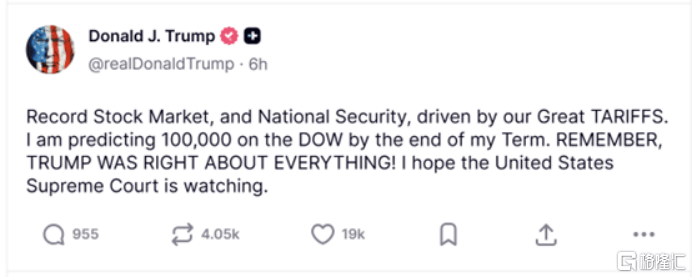
Core Viewpoint - President Trump predicts that the Dow Jones Industrial Average will reach 100,000 points by January 2029, attributing the stock market's rise to his tariff policies [1][3]. Group 1: Stock Market Performance - The Dow Jones Index recently surpassed the 50,000 points milestone for the first time [2]. - Trump claims that the stock market's record performance is driven by the "great tariff policy" implemented during his administration [3]. - He expressed confidence that the Dow will double again before the end of his term [3]. Group 2: Economic Implications of Tariff Policies - Trump asserts that his tariff policies will benefit the U.S. economy, although economists argue that the costs of tariffs are primarily borne by American consumers and businesses, not foreign exporters [6]. - A study from the Kiel Institute for the World Economy indicates that approximately 96% of tariff costs are shouldered by Americans [6]. Group 3: Contrasting Views - Trump's optimistic predictions about the stock market significantly diverge from institutional consensus, with Wall Street analysts forecasting only about an 11% increase in the S&P 500 index for the year [12]. - Despite Trump's claims of achieving a 100% increase in the stock market, analysts remain skeptical of such projections [12].