新消费

Search documents
港股收盘|恒指涨0.65% 大金融板块走强
Xin Lang Cai Jing· 2025-10-21 10:13
Group 1 - The Hang Seng Index closed at 26,027.55 points, up 0.65% [1] - The Hang Seng Tech Index closed at 6,007.94 points, up 1.26% [1] - The financial sector showed strength, with China Life Insurance rising over 6% [1] Group 2 - The new consumption concept faced a decline, with Pop Mart falling over 8% [1]


炸裂!泡泡玛特Q3整体收益同比增长245%-250%,海外收益增365%-370%
美股IPO· 2025-10-21 10:03
泡泡玛特2025年第三季度整体收益同比增长245%-250%,其中海外收益增长365%-370%,美洲市场爆发式增长超1265%。尽管增速惊人,但由于增 速较上半年放缓,投资者担忧公司增长神话能否持续,导致泡泡玛特港股周二大跌超8.1%。 随着Labubu系列的全球风靡,泡泡玛特三季度在中国大陆和海外市场的收益均实现了强劲增长。其中,美洲市场表现尤为突出,实现了超过12倍的爆 发式增长。 泡泡玛特港股周二大跌8.1%,创下自4月初以来的最大单日跌幅, 成为恒生中国企业指数中表现最差的成分股。有分析认为,在经历了上半年的爆炸 式增长后,部分投资者对这家消费明星企业的前景正转向谨慎。尽管泡泡玛特股价今年迄今的涨幅仍接近180%,远超同期大盘约28%的涨幅,但市场 的忧虑情绪已然显现。 增长预期回调,投资者担忧增长神话降温 21日,泡泡玛特公告, 2025年第三季度整体收益较2024年同期增长245%-250%。 其中,中国收益同比增长185%-190%,海外收益同比增长 365%-370%。 从渠道来看,中国线上渠道增速(300%-305%)远超线下(130%-135%),显示数字化转型成效显著。 海外市场表现来 ...


老板被抓、强制退市,600亿水果帝国崩了
商业洞察· 2025-10-21 09:24
Core Viewpoint - The article discusses the rise and fall of Hong Jiu Fruit, highlighting the lessons that can be learned from its rapid decline after a brief period of success in the consumer industry [4][6]. Group 1: The Rise of Hong Jiu Fruit - Hong Jiu Fruit was once celebrated as "China's first fruit stock," achieving a market capitalization of HKD 60 billion and selling 25 million durians in 2022, accounting for nearly 10% of the national market share [8][9]. - The company reported revenues of CNY 15.08 billion and a net profit of CNY 1.452 billion in 2022, with a staggering year-on-year net profit growth of 405% [8]. Group 2: The Fall of Hong Jiu Fruit - The company faced a sudden halt in trading in March 2024 due to its inability to disclose its 2023 financial report, leading to an indefinite suspension [9][12]. - In April 2024, KPMG resigned as the auditing firm, revealing that Hong Jiu had made CNY 34.2 billion in prepayments to newly registered shell suppliers, which raised significant red flags [9][10]. Group 3: Common Pitfalls in the Consumer Industry - The first pitfall identified is a "self-destructive" cash flow model, where Hong Jiu's operational cash flow had a cumulative net outflow of CNY 4.06 billion from 2019 to 2022, with a further CNY 314 million deficit in the first half of 2023 [16][17]. - The second pitfall is family governance leading to a lack of oversight, where key positions were filled by relatives, allowing for unchecked financial decisions, such as the approval of CNY 34.2 billion in prepayments without proper risk control [18][20]. - The third pitfall involves misjudging consumer trends, as Hong Jiu continued to focus on high-end imported fruits while the market shifted towards more affordable options, resulting in significant losses [24][25]. - The fourth pitfall is the erosion of trust, as the founders engaged in questionable practices, such as secretly selling shares and misleading employees about the company's status [28][30]. Group 4: Lessons for the Consumer Industry - Companies should prioritize cash flow management before scaling operations, conducting regular cash flow pressure tests to avoid financial crises [33][34]. - It is essential to break away from family governance structures early on by introducing external oversight and professional management to ensure accountability [35]. - Understanding consumer trends should be a continuous effort, with regular market analysis and consumer research to adapt to changing preferences [36]. Group 5: Conclusion - The story of Hong Jiu Fruit serves as a cautionary tale for the consumer industry, emphasizing that sustainable growth requires careful management of cash flow, governance, and consumer trust [37][38].

商贸零售行业点评:受国补边际效应减弱、中秋假期错位等影响,9月社零增速放缓
Guolian Minsheng Securities· 2025-10-21 07:34
证券研究报告 行业研究|行业点评研究|商贸零售 受国补边际效应减弱、中秋假期错位等 影响,9 月社零增速放缓 请务必阅读报告末页的重要声明 glzqdatemark1 2025年10月21日 邓文慧 郭家玮 SAC:S0590522060001 SAC:S0590525030001 请务必阅读报告末页的重要声明 1 / 4 证券研究报告 |报告要点 国家统计局发布社零数据,9 月份,社零总额为 4.20 万亿元,同比增长 3.0%。其中,除汽车 以外的消费品零售额为 3.73 万亿元,同比增长 3.2%;限额以上单位消费品零售额 1.78 万亿 元,同比增长 2.3%。 |分析师及联系人 行业研究|行业点评研究 glzqdatemark2 2025年10月21日 商贸零售 受国补边际效应减弱、中秋假期错位等影响, 9 月社零增速放缓 投资建议: 强于大市(维持) 上次建议: 强于大市 相对大盘走势 -10% 7% 23% 40% 2024/10 2025/2 2025/6 2025/10 商贸零售 沪深300 相关报告 1、《商贸零售:7 月社零同比+3.7%,环比有 所回落》2025.08.16 2、《商贸 ...
中国银河证券:食品饮料行业迎来修复,优先关注新消费方向
Xin Hua Cai Jing· 2025-10-21 01:31
Core Insights - The report from China Galaxy Securities indicates a market style switch in early October, leading to a recovery in the food and beverage index, with snacks, beer, and health products showing significant gains [1] - Looking ahead to late October, the focus will shift to Q3 earnings reports, with companies in the new consumption sector expected to perform well, highlighting potential investment opportunities in high-performing stocks and sectors [1] - For Q4 2025, two key themes are suggested: first, a year-end valuation switch focusing on new consumption companies with solid fundamentals; second, attention to cyclical sectors with low valuations and supply clearing, as PPI improvements gradually transmit to CPI [1]

【长江策略戴清团队】1020港股日评:中美释放贸易缓和信号,港股修复
Xin Lang Cai Jing· 2025-10-20 14:42
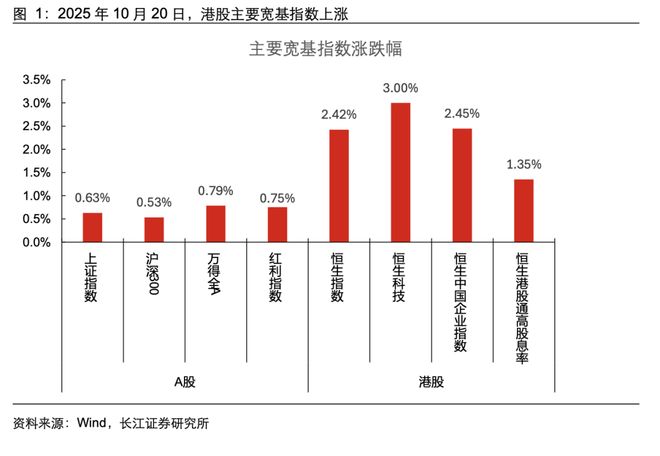
来源:市场投研资讯 (来源:市场投研资讯) ⭕事件描述 港股市场方面,恒生指数上涨2.42%报25858.83,恒生科技上涨3.00%报5933.17,恒生中国企业指数上 涨2.45%报9232.67,恒生港股通高股息率指数上涨1.35%。A股市场方面,上证指数上涨0.63%,沪深 300上涨0.53%,万得全A上涨0.79%,红利指数上涨0.75%。 行业主题方面:中信港股通一级行业中,商贸零售(+3.93%)、机械(+2.89%)、传媒(+2.86%)领 涨,有色金属(-0.46%)、基础化工(-0.04%)领跌。 概念方面: 人民币升值指数(+6.36%)、航空指数(+5.64%)、民航机场指数(+5.45%)领涨,黄金 珠宝指数(-3.64%)、在线教育指数(-2.85%)、贵金属指数(-2.53%)领跌。 ⭕ 事件评论 2025 年 10 月 20 日,港股市场大市成交额达到2391.6 亿港元,南向资金净卖出 26.70亿港元。 港股主要 指数普遍上涨, 从宏观来看主要是因为:10 月 18 日上午, 中美经贸中方牵头人、国务院副总理何立 峰与美方牵头人、美国财政部长贝森特和贸易代表格里尔举行视频 ...
美护商社行业周报:双十一预售开启,海南离岛免税政策调整落地-20251020
Guoyuan Securities· 2025-10-20 14:14
Investment Rating - The report maintains an "Overweight" rating for the industry, with a focus on new consumption sectors such as beauty care, IP derivatives, and gold jewelry [5][29]. Core Insights - The report highlights the positive performance of the beauty care sector during the Double Eleven pre-sale event, with significant sales figures and increased visitor traffic in live-streaming sessions [3][23]. - The adjustment of the Hainan offshore duty-free shopping policy is expected to expand the range of duty-free products and enhance consumer spending [3][23]. - The overall market performance for the week showed mixed results, with retail, social services, and beauty care sectors experiencing declines, while jewelry and general retail sectors performed positively [14][16]. Summary by Sections Market Performance - For the week of October 13-17, 2025, the commerce retail, social services, and beauty care sectors saw declines of 0.45%, 1.72%, and 2.53% respectively, ranking 6th, 11th, and 17th among 31 primary industries [14][16]. - The Shanghai Composite Index fell by 1.47%, while the Shenzhen Component Index and CSI 300 Index dropped by 4.99% and 2.22% respectively [14][16]. Key Industry Events and News - The Ministry of Finance and other authorities announced adjustments to the Hainan offshore duty-free shopping policy, effective November 1, 2025, which includes expanding the range of duty-free products and changing the age requirement for duty-free shopping [3][23]. - The Double Eleven pre-sale event on Tmall saw 14 beauty products surpassing 100 million yuan in sales within the first four hours, with significant growth in visitor numbers during live-streaming sessions [3][23]. - LVMH reported a recovery in the Chinese market during the third quarter, while Kering is in negotiations to sell its beauty division to L'Oreal [3][23]. Investment Recommendations - The report recommends focusing on companies such as Shangmei Co., Juzi Bio, Marubi, Runben, Proya, Chaohongji, and Furuida within the beauty care and new consumption sectors [5][29].


港股日评:中美释放贸易缓和信号,港股修复-20251020
Changjiang Securities· 2025-10-20 14:13
丨证券研究报告丨 请阅读最后评级说明和重要声明 %% %% %% %% research.95579.com 1 市场策略丨点评报告 [Table_Title] 1020 港股日评:中美释放贸易缓和信号,港股 修复 报告要点 [Table_Summary] 2025 年 10 月 20 日,港股市场大市成交额达到 2391.6 亿港元,南向资金净卖出 26.70 亿港 元。港股主要指数普遍上涨,从宏观来看主要是因为:10 月 18 日上午,中美经贸中方牵头人、 国务院副总理何立峰与美方牵头人、美国财政部长贝森特和贸易代表格里尔举行视频通话,双 方就双边经贸关系中的重要问题进行了坦诚、深入、建设性的交流,同意尽快举行新一轮中美 经贸磋商。市场预期中美经贸关系将缓和,这有效缓解了市场对贸易摩擦升级的担忧叠加市场 押注美联储 10 月议息会议将降息 25bp,外部流动性宽松预期增强,带动港股市场上涨。 分析师及联系人 [Table_Author] 戴清 SAC:S0490524010002 SFC:BTR264 [Table_Title 1020 港股日评:中美释放贸易缓和信号,港股 2] 修复 [Table_Su ...

险资年内超34.4亿港元掘金港股IPO,泰康与太保最活跃
Di Yi Cai Jing· 2025-10-20 12:29
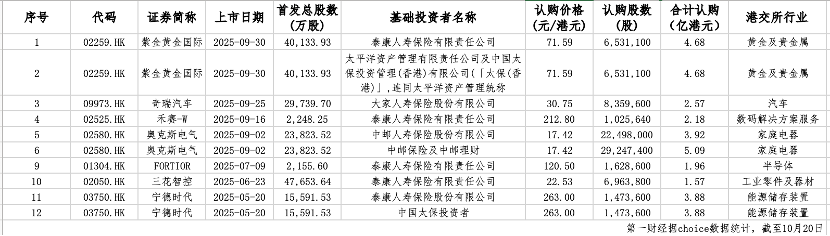
Core Viewpoint - The insurance capital's participation as cornerstone investors in Hong Kong IPOs has surged significantly this year, with subscription amounts exceeding HKD 3.44 billion, approximately three times that of the same period last year, indicating a shift in investment strategy amidst low interest rates and asset scarcity [1][2]. Group 1: Investment Trends - Insurance funds are increasingly focusing on "hard technology" and new consumption sectors, including automotive, digital solutions, home appliances, semiconductors, and energy storage devices [3][10]. - Major insurance companies like Taikang Insurance and China Pacific Insurance have actively participated in multiple IPOs, with Taikang alone investing over HKD 1.4 billion across five companies [2][3]. Group 2: Market Dynamics - The Hong Kong IPO market has seen a revival, with a total fundraising amount of HKD 182.9 billion in the first three quarters of 2025, making it the highest globally [10]. - The number of IPO applications being processed has reached a record high of 289, reflecting a robust market environment [10]. Group 3: Risks and Challenges - Despite the potential for increased returns, cornerstone investments carry risks such as market volatility, liquidity constraints due to lock-up periods, and uncertainties related to the Hong Kong dollar's exchange rate and interest rate environment [1][11]. - The rapid technological changes in the hard tech sector pose challenges for insurance companies' existing research and investment frameworks, making it difficult to adapt to fast-evolving market conditions [11].

新华视点丨新经济、新消费双轮驱动:多领域迸发新活力
Xin Hua Wang· 2025-10-20 08:15
Group 1: New Economy and Consumption - The "new economy," characterized by new technologies and models, is creating new opportunities, while "new consumption," defined by new scenarios and experiences, is generating new demand, showcasing the vibrant vitality of the Chinese economy across multiple sectors [1] - The low-altitude economy is transitioning from traditional aviation services to integrated models involving drones and low-altitude applications, significantly restructuring the industrial value chain in agriculture, logistics, tourism, and emergency services [2] Group 2: Low-altitude Economy Development - The low-altitude economy market in China is projected to reach 1.5 trillion yuan by 2025 and is expected to exceed 3.5 trillion yuan by 2035, indicating substantial growth potential [5] - Hainan's free trade port construction is facilitating the development of low-altitude tourism, with activities like helicopter skydiving and paragliding becoming popular among younger tourists, transforming low-altitude flying into a regular consumption experience [4][8] Group 3: Tax Refund Policies and Consumer Experience - Fuzhou's optimized departure tax refund policy, allowing "buy and refund" services, is enhancing the shopping experience for international tourists and promoting local brands [7] - The number of tax refund applications in Fuzhou has increased by 316% compared to the same period last year, reflecting a significant boost in consumer engagement [9] Group 4: Consumption and Economic Growth in Shandong - Shandong's Zibo is leading consumption demand through high-quality supply and various promotional policies, aiming to enhance the consumer market's quality and upgrade [11] - The local tourism industry in Zibo is thriving, with the accommodation sector becoming a new engine for economic development [13] - Zibo is implementing a "trade-in" policy for household appliances, providing subsidies to consumers, which is further stimulating the consumption market [16] Group 5: Cultural and Tourism Integration - The Refu Tea Town in Shaanxi is integrating tea culture and local customs, creating a tourism resort that offers interactive experiences like tea-making and performances, enhancing cultural tourism [17] - Historical districts are revitalizing through innovative consumption scenarios and popular IPs, blending cultural heritage with modern trends, thus becoming new landmarks in urban tourism [15]