
流动性

Search documents
流动性和机构行为跟踪:央行先收后放,资金先紧后松
GOLDEN SUN SECURITIES· 2025-07-27 06:49
Report Summary 1. Report Industry Investment Rating There is no information provided about the industry investment rating in the given content. 2. Core View of the Report The central bank first withdrew and then injected funds, leading to a situation where the funds were initially tight and then loosened. It is expected that the central bank will continue to support the market. [1] 3. Summary by Relevant Catalog I. Funds - **Fund prices and bill rates**: The R001 closed at 1.55% (previous value: 1.49%), DR001 at 1.52% (previous value: 1.46%), R007 at 1.69% (previous value: 1.51%), and DR007 at 1.65% (previous value: 1.51%). The 6M national stock bank draft transfer and discount rate closed at 0.72% (previous value: 0.81%). [1] - **Central bank's open - market operations**: The central bank had a net injection of 1095 billion yuan this week. It continuously withdrew funds in the first four days, with a cumulative net withdrawal of 6923 billion yuan, and then made a large - scale net injection of 8018 billion yuan on Friday. [1] - **Bond yields**: The 10 - year treasury bond yield increased by 7.24bp in the first four days and 6.72bp for the whole week to 1.73%; the 30 - year treasury bond yield increased by 9.05bp in the first four days and 8.40bp for the whole week to 1.97%. [1][2] II. Inter - bank Certificates of Deposit - **Maturity yields**: The 3M, 6M, and 1Y maturity yields of certificates of deposit increased by 4.69bp, 6.16bp, and 5.75bp respectively. The 1Y - 3M term spread widened. [2] - **Net financing and issuance**: The net financing of certificates of deposit was - 5598 billion yuan this week (previous value: 1444 billion yuan). The issuance interest rates of 1 - year certificates of deposit for state - owned banks, joint - stock banks, city commercial banks, and rural commercial banks increased. The weighted average issuance term shortened to 7.3M (previous value: 8.3M). [2] III. Institutional Behavior - **Government bond issuance and payment**: This week, the net issuance of government bonds was 3031 billion yuan, and the net payment was 3472 billion yuan. Next week, the expected net issuance is 4030 billion yuan, and the net payment is 2947 billion yuan. [3] - **Repurchase trading volume and leverage ratio**: The pledged repurchase trading volume first rose to 8.0 trillion and then fell to 7.1 trillion, with an average daily volume of 7.70 trillion yuan (previous value: 7.24 trillion yuan). The inter - bank market leverage ratio first rose to 109.10% and then fell to 108.39%, with an average daily ratio of 108.85% (previous value: 108.65%). [3]
资金“过山车”后,跨月压力如何?
Tianfeng Securities· 2025-07-26 11:23
1. Report Industry Investment Rating - Not provided in the document 2. Core View of the Report - This week, the liquidity demand remained high, and the central bank's net - withdrawal in the first half - week and the rise of the stock market and some commodities led to the unexpected convergence of the capital market. The capital market shifted from loose to neutral - tight, with overnight capital interest rates rising and large - bank net lending first increasing and then decreasing. Next week, as the month - end approaches, the central bank's attitude of timely support remains, and the pressure on the capital market may be marginally relieved, but the central bank's response to large - scale open - market withdrawals and the recovery of large - bank lending scale will be important determinants of the month - end capital market and interest rates [2][11][24] 3. Summary by Relevant Catalogs 3.1. Analysis of the Pressure at the Month - End after the "Roller - Coaster" of Funds - This week, due to large liquidity demand and the central bank's withdrawal of tax - period liquidity, the capital market shifted from loose to neutral - tight. Overnight capital interest rates reached a relatively high level since June, large - bank net lending first increased and then decreased, and the primary and secondary prices of certificates of deposit (CDs) rose slightly in the second half of the week. The average weekly values of DR001, R001, DR007, and R007 changed by - 2.56, - 2.77, 0.23, and 1.55BP respectively compared with the previous week. The week - average of the capital stratification between R001 and DR001 decreased by 0.21BP, and that between R007 and DR007 increased by 1.32BP [11] - The reasons for the unexpected convergence of the capital market are the central bank's net - withdrawal in the first half - week and the diversion of bond - market funds by the rising stock market and some commodities. Next week, the central bank's support attitude remains, and the pressure on the capital market may be marginally relieved as the issuance scale of government bonds and the maturity scale of CDs decline, and fiscal expenditures may accelerate at the end of the month. However, the central bank's response to open - market withdrawals and the recovery of large - bank lending will be crucial [24][25][26] 3.2. Open Market: The Maturity Scale Will Decrease Slightly Next Week - From July 21 to July 25, the open - market net injection was 1.095 billion yuan. The 7 - day reverse repurchase was issued 165.63 billion yuan and matured 172.68 billion yuan, the Medium - term Lending Facility (MLF) was issued 40 billion yuan and redeemed 20 billion yuan, and the treasury cash fixed - deposit was issued 10 billion yuan and matured 12 billion yuan. From July 28 to August 1, the open - market maturity will be 165.63 billion yuan, all of which are 7 - day reverse repurchases [3][30] 3.3. Government Bonds: The Issuance Scale Will Decrease Next Week - This week, the net payment of government bonds was 27.1 billion yuan. Next week, the planned issuance of government bonds is 51.72 billion yuan, including 18 billion yuan of treasury bonds and 33.72 billion yuan of local bonds. The net payment of treasury bonds is - 2 billion yuan, and that of local bonds is 30.76 billion yuan. This week, the net issuance of treasury bonds was 1.07 billion yuan, with a cumulative issuance of 3.8421 trillion yuan this year and an issuance progress of 62%. The issuance of new local bonds was 22.87 billion yuan, with a cumulative issuance of 3.1534 trillion yuan and an issuance progress of 61% [41][42] 3.4. Excess Reserve Tracking and Prediction - It is predicted that the excess reserve ratio in July 2025 will be about 0.97%, a month - on - month decrease of about 0.31pct and a year - on - year decrease of 0.52pct. The predicted excess reserve at the end of June is about 403.68 billion yuan. From July 21 to July 25, the open - market net injection was 1.095 billion yuan, the net payment of government bonds was 27.1 billion yuan, the predicted fiscal revenue - expenditure difference was 5.49 billion yuan, and the reserve payment was - 14 billion yuan [46][47] 3.5. Money Market: The Net Lending of Large Banks First Increased and then Decreased - Most capital interest rates increased. As of July 25, compared with July 18, DR001, DR007, R001, and R007 increased by 6.08, 14.56, 6.41, and 18.65BP respectively. The weekly average of SHIBOR overnight and 7 - day interest rates changed by - 2.72 and 0.08BP respectively to 1.47% and 1.51%. The weekly average of CNH HIBOR overnight and 7 - day interest rates changed by - 18.16 and - 7.62BP respectively to 1.56% and 1.63%. The weekly average of FR007S1Y and FR007S5Y interest rates changed by - 0.21 and 4.82BP respectively to 1.53% and 1.57%. The weekly average of six - month national - share transfer and six - month city - commercial transfer interest rates changed by - 0.1pct to 0.74% and 0.85% respectively [49][55][58] - The average daily trading volume of inter - bank pledged repurchase was 7.6986 trillion yuan, an increase of 45.4 billion yuan compared with July 14 - 18. The average daily trading volume of the Shanghai Stock Exchange's new pledged treasury bond repurchase was 2.1359 trillion yuan, an increase of 450 million yuan compared with July 14 - 18 [60] - This week, the average net lending of the banking system was 3.18 trillion yuan, a change of 175.5 billion yuan compared with last week. The average net lending of large state - owned banks was 3.87 trillion yuan, a change of 253.5 billion yuan compared with last week, with an overnight lending ratio of 97%, a change of - 0.1% compared with last week. The average net lending of other banks was - 0.69 trillion yuan, a change of - 77.9 billion yuan compared with last week [65] 3.6. Inter - bank Certificates of Deposit 3.6.1. Primary Market: The Maturity Scale Will Decrease Next Week - From July 21 to July 25, the total issuance of inter - bank CDs was 51.57 billion yuan, and the net financing was - 55.43 billion yuan, a decrease in both issuance scale and net financing compared with last week. By issuer, city - commercial banks had the highest issuance scale and net financing. By term, 1 - year CDs had the highest issuance scale and net financing [72] - Next week (July 28 - August 3), the maturity scale of inter - bank CDs will be 40.29 billion yuan, a decrease compared with this week. The maturity scale is mainly concentrated in national - share banks and city - commercial banks, and the terms are mainly concentrated in 1 - year and 3 - month CDs [82] - The weighted issuance term of inter - bank CDs this week was 7.25 months, a compression compared with last week's 8.3 months. The issuance success rate of share - holding banks was the highest, and the 3 - month issuance success rate was the highest among different terms [76][78] 3.6.2. Secondary Market: Yields Increased - Driven by the marginal convergence of the capital market this week, the secondary yields of CDs increased significantly. The yields of AAA - rated CDs of all terms increased, and the yields of 1 - year CDs of all ratings increased [96] - Compared with the previous week, the spreads between 1 - year CDs and R007, R001, 7 - day OMO, and 1 - year treasury bonds changed to - 1.87BP, 12.28BP, 27.5BP, and 29.15BP respectively [100]
华泰证券-2025年半年度私募市场策略及流动性回顾
2025-07-25 07:15
Summary of Key Points from the Conference Call Industry Overview - **Market Environment Review: Equity Market** In 2025, the equity market showed mixed performance with the Shanghai Composite Index rising by 2.76%, Shenzhen Component Index by 0.48%, and ChiNext Index by 0.53% [2][4]. Global markets also performed well, with the S&P 500 increasing by 5.50%, Nasdaq by 5.48%, and the Hang Seng Index by 20.00% [2][4]. - **Market Environment Review: Commodity Market** The Nanhua Commodity Index decreased by 2.09% in 2025, while precious metals increased by 20.74% and agricultural products by 3.20% [6][9]. - **Market Environment Review: Bond Market** The China Government Bond Index rose by 0.86%, the China Credit Bond Index by 1.18%, and the Convertible Bond Index by 7.02% [12][13]. Core Insights and Arguments - **Equity Asset Returns** The performance of various equity indices in 2025 showed significant variation, with MSCI Europe leading at 20.67% and the Shanghai Composite Index lagging at 2.76% [4]. The average return for equity assets was reported at 7.87% for the first half of 2025, with 82.74% of products achieving positive returns [19][20]. - **Private Fund Issuance** There were 4,204 new private fund products registered in 2025, with 957 new securities private funds in June alone [15][16]. - **Performance of Private Fund Strategies** The subjective long/short strategy yielded a return of 10.55% with a maximum drawdown of -15.04% [24]. The quantitative long strategy outperformed with a return of 14.00% and a maximum drawdown of -13.38% [32]. The stock long/short strategy achieved a return of 9.91% with a maximum drawdown of -9.37% [41]. Additional Important Information - **Private Fund Performance by Size** The average return for subjective long/short products varied by size, with products sized between 5 million to 10 million yielding 8.00% and those over 2 billion yielding 8.63% [28][35]. For quantitative long products, those over 2 billion had the highest average return at 20.47% [36]. - **Positive and Negative Return Distribution** The distribution of returns showed that 17.26% of products had negative returns, with an average loss of -3.62% [19][20]. The average position for subjective long/short products was reported at 86.81% [24]. - **Strategy Distribution in Private Fund Registration** The majority of new private fund strategies were categorized as "other," accounting for 82.45% of the total [17]. This summary encapsulates the key points from the conference call, highlighting the performance of various markets and private fund strategies, as well as the overall market environment in 2025.

央行预告:明日,4000亿元
新华网财经· 2025-07-24 12:56
Core Viewpoint - The People's Bank of China (PBOC) is conducting a 400 billion MLF operation to maintain liquidity in the banking system, marking the fifth consecutive month of increased operations [1][2]. Group 1: Monetary Policy Actions - On July 25, PBOC will conduct a 400 billion MLF operation with a one-year term, resulting in a net injection of 1000 billion due to 3000 billion MLF maturing this month [1][2]. - The total net liquidity injection in July reached 3000 billion, which is comparable to the previous month's 3180 billion [2][4]. - The central bank's actions are aimed at stabilizing medium-term liquidity and ensuring smooth funding conditions [2][4]. Group 2: Economic Analysis - Analysts suggest that the ongoing net liquidity injection is driven by two main factors: the rapid issuance of government bonds and an accelerated pace of credit extension, necessitating coordination between monetary and fiscal policies [2][4]. - The PBOC's continued use of quantity-based tools signals a supportive monetary policy, which is intended to stabilize market expectations and create a favorable environment for credit expansion [2][4]. Group 3: Market Outlook - In the short term, the probability of interest rate cuts is low, but the monetary policy will remain proactive under the broader goal of expanding domestic demand and stabilizing growth [3][4]. - The MLF operations are expected to continue with increased volumes, alongside timely injections of medium to long-term funds through reverse repos [4]. - The bond market is experiencing adjustments due to tight funding conditions and shifting market risk preferences, with yields on government bonds rising [5].

沸腾!A股,三大突破!意味着什么?
券商中国· 2025-07-24 07:56
Core Viewpoint - The current A-share market is experiencing a bullish trend, with significant indicators showing upward movement and optimism among institutional investors [2][12]. Market Stage Analysis - The number of stocks in a bullish arrangement is 3,061 as of July 23, which is still within a normal range compared to previous high periods [3][14]. - The ratio of financing balance to circulating market value is currently at 2.24%, lower than the levels seen in March and April [4][14]. - The current valuation level indicates that the Shanghai Composite Index is about 20% away from its high, while the ChiNext has more room for growth. Compared to the U.S. market, A-shares are relatively undervalued [5][15]. - The M1 money supply showed a significant rebound in June, and market interest rates remain low, indicating a favorable liquidity environment [6][15]. - Market expectations are not fully priced in, as evidenced by the reactions to recent events like the Yajiang Hydropower Station and Hainan developments, suggesting a cautious approach among investors [7][16]. Breakthrough Indicators - The Shanghai Composite Index broke through the 3,600-point mark, facing some resistance but showing strong support from other indices [9][10]. - The China Securities 1000 ETF and average stock prices also surpassed their March highs, indicating a broad market strength despite some pressure [10][11]. Institutional Sentiment - Major brokerages like CITIC are optimistic about the A-share market, drawing parallels to the 2014 market conditions. UBS's China equity strategy head noted potential pressures in the Hong Kong market but maintained a positive outlook for H-shares and the overall Chinese stock market [12].

流动性7月第3期:央行万亿净投放有望改善流动性预期
Yong Xing Zheng Quan· 2025-07-23 09:21
Core Insights - The central viewpoint indicates that the central bank's net injection of 1.2 trillion yuan is expected to improve liquidity expectations, with a notable increase in financing buy-ins and significant net inflows from southbound funds [1][2]. Macro Liquidity - Domestic liquidity saw a decline in both 2-year and 10-year government bond yields, with the yield spread widening. The central bank's open market net injection was 1.2011 trillion yuan, while 3,000 million yuan was withdrawn through MLF in July [2][12]. - Internationally, the 2-year U.S. Treasury yield decreased while the 10-year yield increased, leading to a rise in the dollar index. The 10-year U.S. Treasury yield rose to 4.44%, and the dollar index reached 98.46, with the China-U.S. 10-year bond yield spread widening to -2.77% [2][17]. Market Liquidity - Public funds: In July 2025, 71 new funds were established, with 39 being equity funds, totaling approximately 11.6 billion shares issued [3][22]. - ETF funds: 15 new equity ETFs were established in July 2025, with a total issuance of 6.8 billion shares [3][25]. - Southbound funds: There was a significant net inflow of southbound funds, totaling 735.9 billion yuan year-to-date, with major inflows into non-bank financials, pharmaceuticals, and consumer services [3][32][34]. - Margin financing: The average financing buy-in amount was 148.8 billion yuan, reflecting a 6.3% increase week-on-week, with significant net inflows in the computer, machinery, and electronics sectors [4][39]. Fundraising - In July, there were 4 IPOs raising approximately 22.1 billion yuan, with total equity financing around 43.4 billion yuan [4][45].
两个1.9万亿,小盘行情彻底点燃?
Sou Hu Cai Jing· 2025-07-23 04:41
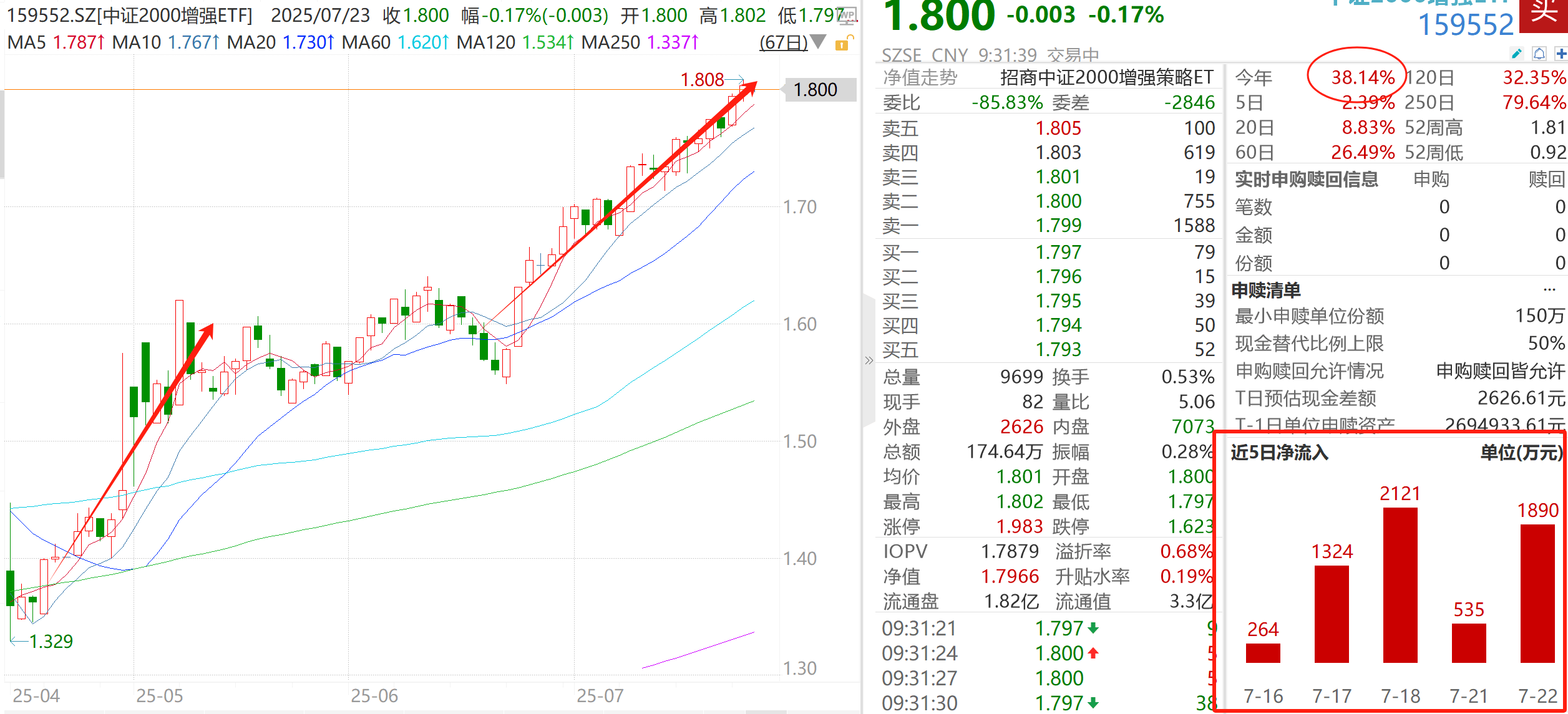
Core Viewpoint - The small-cap stocks are performing exceptionally well, with the CSI 2000 Enhanced ETF (159552) rising by 86% over the past year, significantly outperforming the CSI 2000 index, which has increased by less than 60% [1] Market Activity - The A-share market recently saw two significant indicators reaching the "1.9 trillion" mark: the total trading volume and the financing balance, both returning to this level after several months [1] - A net financing purchase of 15.4 billion yuan was recorded in a single day, marking the highest level since March of this year, indicating a strong bullish sentiment in the market [1] Investment Strategy - Despite the strong performance of the CSI 2000 Enhanced ETF, there are warnings about accumulated valuation risks and potential liquidity changes that could lead to a market pullback [3] - Investors are advised to embrace the trend but avoid reckless chasing of high prices; instead, a strategy of gradual accumulation during dips is recommended [3][4] - The CSI 2000 Enhanced ETF serves as an effective tool to manage the high volatility of small-cap stocks, providing a more controlled risk compared to betting on individual stocks [4]
国债期货日报-20250722
Nan Hua Qi Huo· 2025-07-22 12:12
国债期货日报 2025年7月22日 大宗商品大幅反弹 观点:交易盘暂时观望 南华研究院 高翔(Z0016413) 投资咨询业务资格:证监许可【2011】1290号 盘面点评: 国债期货开盘偏强窄幅震荡,盘中跳水翻绿,随着风险资产走强价格持续下跌,午后二次跳水,尾盘明显收 跌。结构上短端偏强,TS09下跌0.008。10Y活跃券250011当日上行1.2bp,接近1.69%。流动性进一步改 善,资金利率回到1.3%的关键水平,开盘前隔夜匿名1.3%超过1400亿大额,DR001同样下行回到1.3%附 近。 日内消息: 1.俄罗斯总统新闻秘书、克宫发言人佩斯科夫表示,俄罗斯总统普京将于9月访华,出席中国人民抗日战争暨 世界反法西斯战争胜利80周年纪念活动,俄方正为此次访华行程做筹备。 行情研判: 当前风险资产强势,不光是权益市场内部轮动接力,同样体现在风险资产之间的先后上涨提供支撑,风险偏 好整体强势,加上国债期货价格下跌破位,交易盘短期建议暂时止损观望,等待重要会议后反内卷政策细节 全部落地。 TS主力:净基差与基差 source: wind,南华研究 元 TS净基差:主连 TS基差:主连 10/31 12/3 ...

国债期货日报-20250721
Nan Hua Qi Huo· 2025-07-21 12:50
国债期货日报 2025年7月21日 左侧尝试 观点:交易盘试多,需要带好止损 南华研究院 高翔(Z0016413) 投资咨询业务资格:证监许可【2011】1290号 盘面点评: 国债期货跳空低开,T2509低开一毛钱,早盘偏弱震荡,午后小幅上行,跌幅收窄。资金方面,公开市场到 期2262亿,央行新做1707亿,净回笼555亿。流动性有所改善,DR001加权从上周五的1.45%回到1.35%附 近,午后隔夜匿名价格回到1.3%。非银流动性同样充裕,交易所资金价格日内震荡下行,同样回落到1.35% 附近。 日内消息: | TS2509 | 102.416 | 102.434 | -0.018 | 102.378 | TS合约持仓(手) | 122170 | 123247 | -1077 | 34519 | | --- | --- | --- | --- | --- | --- | --- | --- | --- | --- | | TF2509 | 105.935 | 106.005 | -0.07 | 105.885 | TF合约持仓(手) | 209691 | 206287 | 3404 | 208905 | ...
利率专题:如果下半年不降息?
Tianfeng Securities· 2025-07-21 11:49
1. Report Industry Investment Rating No information about the industry investment rating is provided in the report. 2. Core Viewpoints of the Report -下半年降息不确定性增加,需关注7月政治局会议增量信号 [5][36] -若降息落地或相对后置,三季度末或四季度概率高,幅度或延续上半年10BP;若无降息落地,流动性无需过多担忧,债市短端或受冲击,中长期呈震荡格局 [5][36][40] 3. Summary by Directory 3.1 Possible Scenarios and Boundaries of Interest Rate Cuts - **Monetary Expansion May Not Boost Prices**: "Promoting a reasonable recovery of prices" has become an important consideration for monetary policy. The relationship between prices and money is affected by multiple factors. Overseas, quantitative easing may not solve "low inflation." In China, the current supply - demand imbalance means that monetary expansion may suppress price recovery, so the use of aggregate monetary policy will be more cautious [2][9][12] - **Smoothing the Interest Rate Transmission Mechanism is Also Key**: Besides interest rate cuts, smoothing the interest rate transmission mechanism is crucial for reducing real - economy financing costs. Attention will be paid to financial institutions' pricing ability and enterprises' non - interest costs, especially considering the low net interest margin of commercial banks [3][21] - **Dynamic Balance of Monetary Policy**: The 5.3% GDP growth in H1 2025 reduces the urgency of interest rate cuts in the short term. In supporting expansionary fiscal policy, the central bank has various tools, and interest rate cuts may not be the top option. The central bank's support will be "moderately loose" and maintain a dynamic balance [4][27][29] 3.2 If There is No Interest Rate Cut in the Second Half of the Year - **Interest Rate Cut Scenario**: If an interest rate cut occurs, it may be postponed to the end of Q3 or Q4, with a likely 10BP reduction [5][36] - **No Interest Rate Cut Scenario**: The supportive monetary policy stance remains. Liquidity is not a major concern. In the bond market, short - term bonds may be impacted if market expectations are disappointed. In the long - term, there will be an oscillation pattern, and attention should be paid to factors causing bond market fluctuations [5][40]