估值修复

Search documents
融达期货铁合金日报-宏观情绪好转,商品系统性反弹,估值修复中
Hua Rong Rong Da Qi Huo· 2025-05-15 00:40
Group 1: Market Overview - The macro sentiment has improved, leading to a systematic rebound in commodities and valuation recovery[1] - The Wenhua Commodity Index closed at 161.76, up 1.41%, with a net capital inflow of 4.012 billion[2] Group 2: Silicon Iron Analysis - The price of 72 silicon iron is reported at 5350-5500 CNY/ton, while 75 silicon iron is at 5850-6000 CNY/ton[1] - Hebei Steel's procurement of 75B silicon iron in May increased by 20.5% to 2135 tons compared to April[1] - Silicon iron warehouse receipts remained stable at 19048, with a total of 96248 tons[1] Group 3: Manganese Silicon Analysis - Manganese ore prices are on the rise, with semi-carbonate at Tianjin Port priced at 33.5-34 CNY/ton[7] - Manganese silicon prices have slightly increased, with northern reports at 5600-5700 CNY/ton and southern reports at 5650-5750 CNY/ton[7] - Manganese silicon warehouse receipts decreased by 587 to 118693, with a total of 602935 tons[7] Group 4: Technical Analysis - The 2509 manganese silicon contract closed at 5864, up 0.62%, with a net capital inflow of 12.27 million[8] - The daily K-line for manganese silicon shows a small upward trend, indicating potential upward momentum[8] Group 5: Strategic Insights - The industry is experiencing significant losses, leading to substantial production cuts[4] - The supply-demand mismatch is narrowing, accelerating inventory reduction[4]
银行保险券商,集体爆发!金融板块迎基金增配机遇
券商中国· 2025-05-14 15:47
Core Viewpoint - The financial sector has recently gained significant attention in the capital market, driven by policies such as interest rate cuts and encouragement for insurance companies to increase equity investments, which are expected to boost market confidence and present allocation opportunities for the low-valued financial sector [1][4][8]. Group 1: Market Performance - On May 14, the Shanghai Composite Index surpassed 3400 points, with the financial sector, including banks, insurance, and securities, playing a crucial role in this rise [2]. - The Wande Insurance Index surged by 5.15%, while the Wande Securities and Banking Indices rose by 3.29% and 0.80%, respectively [2]. - Several financial stocks, including China Pacific Insurance and Hongta Securities, hit the daily limit, and multiple bank stocks reached historical highs, with the total market value of the banking sector exceeding 10 trillion yuan [2]. Group 2: Fund Allocation Opportunities - Financial sector's recent performance is attributed to both easing overseas risks and supportive domestic policies, indicating potential for increased fund allocation [4]. - As of May 14, the largest bank ETF, Huabao Bank ETF, reached a price of 1.626 yuan, marking a new high since its listing in 2017, with significant inflows exceeding 260 million yuan in the last five trading days [3][5]. - A report indicates that 46% of actively managed equity funds have their primary performance benchmark as the CSI 300 Index, with banks and non-banks being the top two weight sectors [4]. Group 3: Long-term Investment Value - The banking sector is characterized by a stable fundamental outlook, high dividend yield of approximately 6.1%, and low valuation metrics, with a PE ratio of 6.1 and PB ratio of around 0.54 [7][8]. - Recent capital increases by major state-owned banks signal confidence from state-owned entities in the banking sector's future performance, which may alleviate investor concerns about potential risks [7]. - The insurance sector is expected to see profit growth driven by investment returns, with ongoing reforms enhancing the investment environment for insurance stocks [9].


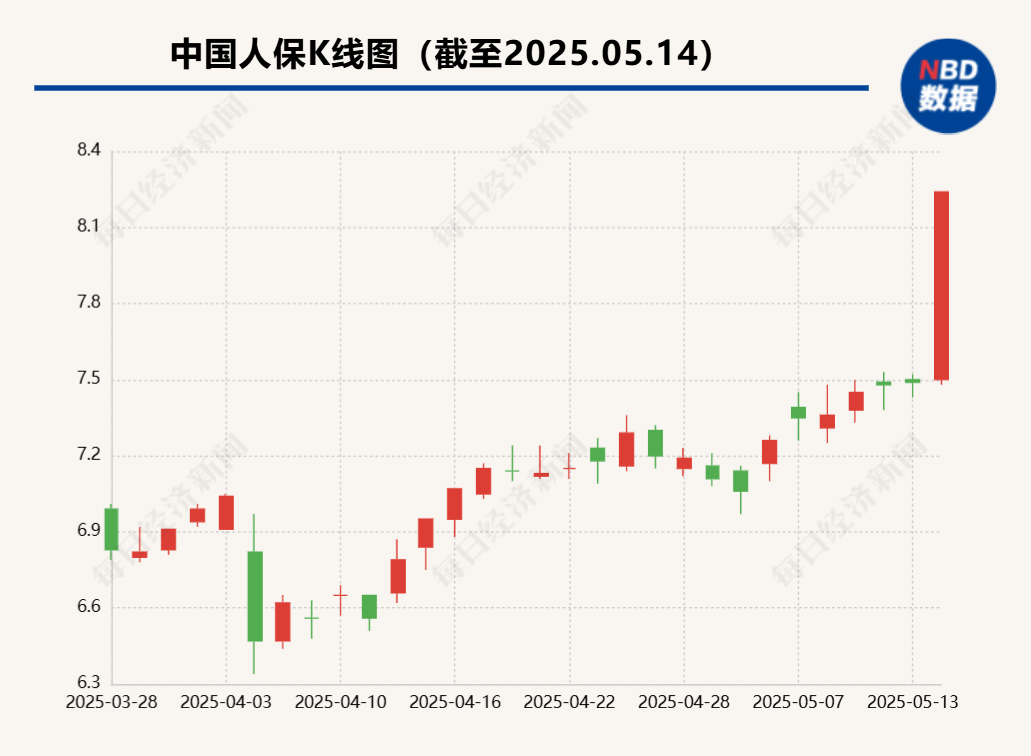
保险板块飙升近7%、中国人保涨停!业内:估值较低、明显欠配的保险股受到资金关注
Mei Ri Jing Ji Xin Wen· 2025-05-14 12:37
Core Viewpoint - The A-share market saw a significant rise in the financial sector, particularly in the insurance segment, driven by favorable macroeconomic factors and improved company performance in Q1 [1][3][4]. Group 1: Market Performance - The insurance sector overall increased by 6.92%, leading the market gains [1]. - Key companies such as China Life, China Pacific, and New China Life reported substantial stock price increases, with China Life reaching a market cap of 1.13 trillion yuan [1][4]. Group 2: Factors Driving Growth - The rise in insurance stocks is attributed to the easing of the US-China trade dispute and the release of Q1 earnings reports that exceeded expectations, alleviating concerns about negative annual performance [3][4]. - Analysts noted that the low valuation and strong beta characteristics of insurance stocks attracted more market attention [4]. Group 3: Earnings Reports - The five listed insurance companies reported a total net profit of 841.76 billion yuan in Q1, marking a 1.4% year-on-year increase [6]. - Notable performances included China Life with a net profit increase of 39.5% and China Pacific with a decrease of 18.1% [8]. Group 4: Valuation Metrics - Valuation metrics showed varying performance among companies, with New China Life having the lowest PE ratio at 7.08 and China Life the highest at 9.81 [4][5]. - In terms of PB ratio, China Ping An had the lowest at 1.06, while China Life had the highest at 2.12 [5]. Group 5: Future Outlook - Regulatory measures aimed at expanding long-term investment by insurance funds and reducing risk factors for stock investments are expected to support the capital market [9]. - Analysts predict that increased equity investments by insurance companies could enhance investment flexibility and mitigate potential "interest spread loss" pressures [9].





A股,再迎重磅利好!
Sou Hu Cai Jing· 2025-05-12 15:01
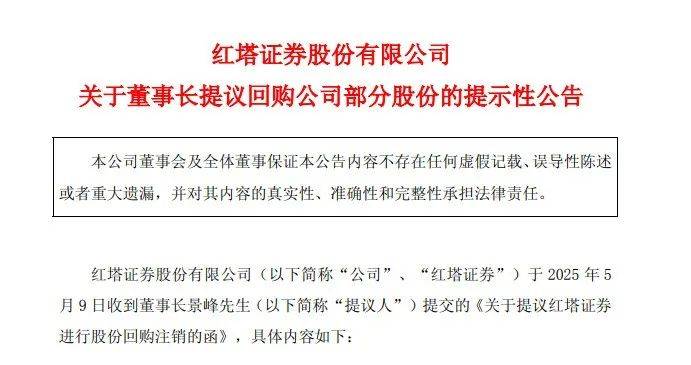
Group 1 - Hongta Securities announced a proposal for share buyback to optimize capital structure and enhance shareholder value [1] - As of May 11, 2023, 359 listed companies in A-share market have initiated buyback plans, with 265 companies specifically for stock repurchase, totaling a maximum buyback amount of 46.9 billion [1] - The State-owned Assets Supervision and Administration Commission supports central enterprises in increasing buyback efforts, leading to several securities firms, including Guotai Junan and Dongfang Securities, to propose buyback plans [4] Group 2 - The combined buyback amount from six major securities firms is estimated to reach 3.8 billion, with potential total buyback including Hongta Securities reaching up to 4 billion [4] - The People's Bank of China announced a combined usage of stock repurchase and loan increase tools with a total limit of 800 billion, enhancing the convenience and flexibility of these tools [4] - Analysts suggest that the buyback actions by securities firms signal strong confidence in their development, which can instill investor confidence in a volatile market [4] Group 3 - The current wave of buybacks is seen as a combination of policy guidance and market-driven behavior, which is expected to stabilize market confidence in the short term [5] - A series of financial policies, including interest rate cuts and increased liquidity, are contributing to the buyback trend, reinforcing the dual drive of policy and capital [5] - There are concerns regarding the sustainability of buyback funding, especially if economic pressures increase, which could lead to cash flow challenges for some firms [5] Group 4 - The A-share market is expected to experience a rotation of investment themes, with a focus on technology, consumption, and healthcare sectors in the short term [6][7] - Analysts highlight three main investment lines: TMT sector, low-cycle stocks under growth policies, and stable sectors like public utilities and transportation [6] - The overall performance of A-share companies is stabilizing, with improvements noted in both large and small-cap stocks [6]





PTA:短期偏多
Ning Zheng Qi Huo· 2025-05-12 12:08
Report Industry Investment Rating - The investment rating for the PTA industry is short - term bullish [2] Core Viewpoints - The PXN spread repair has driven the recovery of the load rate of Asian PX plants. The current phased low point of PX plant load has emerged, and it is less likely to return to the previous low - load operation state this year. The short - term rebound is due to the concentrated maintenance of PX and PTA, which is a valuation repair. In the long term, attention should be paid to terminal orders and Sino - US trade negotiations, and whether the demand can achieve substantial repair remains to be verified. Short - term participation is recommended [2][15] Summary by Directory Chapter 1: Market Review - The PTA09 contract was recommended for low - position long positions. The weekly opening price of the 09 contract was 4390, the highest was 4590, the lowest was 4328, and the closing price was 4582, with a weekly increase of 148 or 3.34% [3] Chapter 2: Analysis of Price Influencing Factors 2.1 Maintenance Supports a Small Rebound in PXN - In terms of PX capacity, the commissioning of new domestic PX capacity in 2024 is gradually coming to an end. Only Yulongdao has a plan to put into operation a new 3 million - ton capacity in 2024, and there is no expectation of new project launch in 2025. From January to April 2025, the domestic PX output was 12.28 million tons, a year - on - year decrease of 0.1%; from January to March 2025, the domestic PX imports were 2.248 million tons, a year - on - year decrease of 4.8%. The current PXCFR is reported at $777/ton, and PX - N is $223/ton; the PTA in East China is reported at 4720 yuan/ton, and the PTA cash - flow cost is 4354 yuan/ton. The load of the Chinese PX industry increased by 5.6% to 78.6%, and some plants increased their loads due to improved production efficiency. Overseas, South Korea's Daesan Hanwha Total slightly reduced its load in May, and Japan's Idemitsu's 210,000 - ton line of an 880,000 - ton plant unexpectedly shut down for about a month at the end of April [4][6] 2.2 Maintenance Promotes PTA De - stocking - From January to April 2025, the domestic PTA output was 23.69 million tons, a year - on - year increase of 2.5%. In April, the average monthly load of PTA was around 77.5%, a slight decrease of 0.1% compared with January. The PTA load increased to 79.3%, which is at a neutral level in the same period over the years. In May, due to the still - poor PTA profitability, the maintenance efforts of suppliers were still large. It is estimated that the average monthly load of PTA in May is expected to decline month - on - month. Affected by the planned maintenance of some plants, the PTA industry load decreased by 7.4% to 70.3%, reaching a low level in the same period over the years. The domestic PTA weekly output this cycle was 1.2925 million tons, a decrease of 43,800 tons from last week. The current PTA social inventory is about 4.1226 million tons, a decrease of 183,700 tons month - on - month. Whether the terminal demand can achieve a trend - based repair remains to be verified by post - holiday orders, and there is medium - term pressure on the demand side [9][10] 2.3 Polyester Load May Decline - From January to March 2025, the domestic polyester output was 25.32 million tons, a year - on - year increase of 6.8%. After the holiday, the polyester load continued to rise to 94.2% (+0.8%). Next week, the weekly output of the Chinese polyester industry is expected to be over 1.57 million tons, a slight increase from this period. As of May 9, the weekly average operating rate of Jiangsu and Zhejiang looms was 60.1%, unchanged week - on - week. As of May 9, the grey fabric inventory of East China weaving enterprises was 34.0 days, unchanged week - on - week. Terminal orders are differentiated, the polyester load has increased beyond expectations and may remain high in May. The filament trading volume has declined, and the weighted inventory has started to accumulate. The supply contraction effect caused by the concentrated maintenance of plants continues, and there is a support basis for the short - term polyester industry chain prices, but whether the demand can achieve substantial repair remains to be verified [12][13] Chapter 3: Market Outlook and Investment Strategy - The PXN spread repair has driven the recovery of the load rate of Asian PX plants. The current phased low point of PX plant load has emerged, and it is less likely to return to the previous low - load operation state this year. The short - term rebound is due to the concentrated maintenance of PX and PTA, which is a valuation repair. In the long term, attention should be paid to terminal orders and Sino - US trade negotiations, and whether the demand can achieve substantial repair remains to be verified. Short - term participation is recommended [15]
搜狐酒馆第20期开播,欧阳千里解读2024白酒年报中的“隐秘信号”
Sou Hu Cai Jing· 2025-05-12 07:49
Core Insights - The current Chinese liquor industry is characterized by a "volume decrease and price increase" trend, with leading brands like Kweichow Moutai and Wuliangye seeing revenue and net profit growth despite a decline in overall industry production [3] - The competition in the liquor market is shifting towards brand value, with a notable "volume-price divergence" becoming the new norm, as consumer demand for premium and aged liquors rises while smaller brands struggle [3] - Regional liquor companies such as Gujinggongjiu and Jinshiyuan have successfully navigated the market by focusing on local markets and transforming into business consumption models, achieving growth and entering the billion-yuan club [3] Industry Trends - The trend of "light drinking" among younger consumers poses challenges for traditional liquor companies, which need to adapt by enhancing offline channels and addressing issues related to product shelf life and profit margins [4] - The phenomenon of "liquor financialization" is viewed as a superficial trend rather than a fundamental industry shift, with larger companies leveraging cultural elements to enhance brand value while smaller companies may face risks if they pursue this direction [4] - The liquor sector is currently experiencing a valuation correction, with stock prices near historical lows, making leading companies like Moutai and Wuliangye suitable for long-term investment due to their strong cash flow and dividends [4] Recommendations for Small and Medium Enterprises - Small and medium-sized liquor companies are advised to focus on regional markets to establish dominance, transform into specialty wineries, and shorten the distance to consumers through direct engagement strategies like live streaming and private domain operations [3] - The example of Shui Jing Fang is highlighted as a promising player in the next-tier premium segment, leveraging cultural experiences and scarcity to strengthen brand recognition [4]



搜狐酒馆第20期丨欧阳千里:存量市场,白酒竞争终局仍是品牌之争
Sou Hu Cai Jing· 2025-05-09 02:41
Core Insights - The Chinese liquor industry is experiencing a trend of decreasing volume but increasing prices, with leading brands like Moutai and Wuliangye seeing revenue and net profit growth despite a decline in overall industry production [2][5][13] - Brand building has become crucial for all liquor companies, especially for small and medium enterprises, which can seek growth through regional market focus, transforming into specialty wineries, and enhancing consumer interaction [2][5][16] - The rise of low-alcohol and fruit wines poses challenges for traditional liquor companies, which must prioritize product quality and innovation to adapt to changing consumer preferences [2][22][25] Industry Trends - The overall production capacity of the liquor industry has been declining, with current capacity at about 30% of its peak in 2016, reflecting a shift in consumer preference towards premium and aged liquors [5][6][8] - The competition is increasingly characterized by a "survival of the fittest" dynamic, where leading brands grow at the expense of smaller players, leading to a phenomenon described as "this consumes that" [5][13] - The market is witnessing a bifurcation where high-end brands are facing price adjustments, with Moutai's actual transaction price dropping nearly 30% from its peak [14][29] Company Strategies - Companies like Gujinggong and Jinshiyuan have benefited from the industry's increasing concentration and have successfully leveraged regional economic growth to enhance their market positions [16][17] - Watering brands like Shui Jing Fang are focusing on brand building and product quality, positioning themselves well in the competitive landscape [19] - Small liquor companies are encouraged to either dominate a specific regional market or transform into local wineries that resonate with community sentiments, potentially leading to profitable operations [20][21] Consumer Behavior - Consumers increasingly demand specific brands when purchasing liquor, indicating a strong brand loyalty that drives market dynamics [12][19] - The perception of liquor as a premium product has led to a decline in the acceptance of non-branded or lower-quality offerings, emphasizing the importance of brand reputation [6][8][12] - The younger generation's shift towards lighter alcoholic beverages and fruit wines presents both a challenge and an opportunity for traditional liquor companies to innovate and adapt [22][23][25] Investment Outlook - The liquor sector is currently undergoing a valuation correction after a period of rapid growth, with investors advised to approach the market with a rational mindset based on their investment goals [27][29] - The potential for mergers and acquisitions in the liquor industry remains high, with significant interest in brands that can demonstrate strong growth potential [28][29] - The evolving economic landscape and changing consumer preferences necessitate a careful evaluation of investment strategies within the liquor sector [28][29]

2025年一季报业绩变化有何投资指引?
ZHONGTAI SECURITIES· 2025-05-08 12:46
Group 1 - The overall performance of A-shares stabilized in Q1 2025, with a notable improvement in non-financial sectors, where the net profit growth rate reached 5.13%, significantly higher than the previous year's growth rate [11][15][19] - Among 30 industries, 17 showed a year-on-year increase in net profit growth, particularly in the TMT (Technology, Media, and Telecommunications) sector, which saw substantial revenue and profit growth [3][29] - The financial sector exhibited a mixed performance, with state-owned banks under pressure while non-bank financial institutions showed a significant recovery, with a net profit increase of 21.30% [38][40] Group 2 - Price pressures persist across various industries, with 23 out of 30 industries having a sales net profit margin below 10%, indicating ongoing challenges despite some sectors experiencing a "turnaround" [4][41] - The steel, non-ferrous metals, and basic chemicals sectors have shown significant profit improvements, indicating a recovery from previous downturns [4][44] - The consumer electronics sector benefited from government policies, with household appliances seeing a net profit increase of 25.12% in Q1 2025, exceeding expectations [4][44] Group 3 - From a PB-ROE perspective, 14 out of 30 industries showed improved ROE compared to the previous year, particularly in the TMT sector, where electronic and media industries saw significant gains [5][45] - The communication sector within the technology industry has substantial valuation recovery potential, while the non-ferrous metals and basic chemicals sectors also show signs of potential recovery [5][48] - Public utility sectors maintain stable performance and low valuations, indicating strong long-term investment value [5][49] Group 4 - Future industry allocation should focus on three main lines: the sustained growth of the TMT sector, the recovery of low-position cyclical stocks, and the stability of defensive sectors [6][54] - The TMT sector is expected to benefit from ongoing policy support, particularly for private technology enterprises, while low-position cyclical stocks like oil and non-ferrous metals are showing signs of recovery [6][54] - Defensive sectors such as public utilities and transportation are projected to remain stable amid ongoing economic pressures, providing a strong safety margin for investors [6][55]
未知机构:长江电新20250507宁德时代更新港股上市临近重视估值修复窗口-20250508
未知机构· 2025-05-08 02:20
Summary of Conference Call Records Company: CATL (宁德时代) Key Points 1. **Upcoming H-Share Listing** CATL announced its upcoming H-share listing on the Hong Kong Stock Exchange, which is expected to enhance its global influence and potentially lead to a valuation recovery in the A-share market. The company is currently valued at around 15X, primarily due to liquidity issues in the A-share market. [1] 2. **Significant Fund Holdings** As of Q1 2025, CATL's fund holdings reached 146.8 billion yuan, making it the largest holding in A-share public funds for four consecutive quarters. This indicates that A-share market liquidity significantly impacts the company's stock price. [1] 3. **H-Share Issuance Details** The H-share issuance is projected to be around 5 billion USD, corresponding to approximately 3% of the share capital. The expected market capitalization for circulation is around 10 billion yuan. The current liquidity in the Hong Kong market is robust, with strong demand for quality leading companies, which may result in a liquidity premium. [2] 4. **Comparative Valuation** Compared to LGES, a comparable lithium battery company, CATL's market capitalization is significantly undervalued. LGES has a market cap of 391.2 billion yuan, which is only 37% of CATL's A-share market cap, despite LGES's shipments being only 25% of CATL's. This highlights CATL's competitive edge and profitability. [2] 5. **Catalysts for Valuation Improvement** The potential catalysts for CATL's valuation improvement include the recognition of its long-term value by cornerstone investors and the relatively low discount for placements compared to A-shares, which may boost market confidence. [2] 6. **Short-term Market Concerns** Short-term market concerns include exposure to the U.S. market and industry beta risks. However, CATL has reduced its U.S. exposure to a negligible level and is expected to manage this through inventory and overseas capacity in the coming years. [3] 7. **Long-term Business Value** CATL's new business ventures are not yet reflected in its current market value. Key areas of growth include: - **Battery Swapping**: Successful implementation could significantly increase CATL's market share in passenger vehicles. - **Data Centers & Zero-Carbon Grid Storage**: High barriers to entry may lead to unexpected market share and profitability. - **Low-altitude & Robotics Batteries**: Innovations in chemical systems could yield additional market share. - **Sodium Batteries & Dual-Core Batteries**: Innovations in chemical systems may further enhance market share. [3] Additional Important Insights - The H-share listing is seen as a critical opportunity for CATL to leverage its global market presence and improve its valuation metrics in the A-share market. [1][2] - The company's strategic focus on emerging markets and new technologies positions it favorably for future growth, despite current market volatility. [3]

5月7日A股收评:军工起飞科技熄火,中长线选手如何守株待兔?
Sou Hu Cai Jing· 2025-05-08 01:17
各位老铁,这里是帮主郑重的收评时间。今儿收盘这行情,像极了老茶馆里的说书场——有人拍案叫绝,有人摇头叹气。咱不凑热闹,就着这杯浓茶,给您 唠唠门道。 收盘三大指数集体收涨,3200只股票飘红,看着喜庆,但咱得透过红绿看门道。中长线投资就像种树,不能天天盯着枝头数叶子,得看根系扎得深不深。帮 主二十年练就的本事,就是能在喧嚣的市场里,听清产业变革的脚步声。记住郑重这句话:涨出来的风险,跌出来的机会,耐得住寂寞,才守得住繁华。明 儿咱们接着盘道,点个关注,干货不迷路! 先说这军工板块的旱地拔葱,晨曦航空、航天长峰这些票涨停跟放烟花似的。要搁往常,咱肯定觉得是地缘局势搅动的短线行情,但这次真不一样。您细看 十四五规划里军工装备的投入增速,再瞅瞅今年中报预增的航发产业链,这分明是行业周期拐点撞上估值修复,跟五年前的新能源车启动前夜倒有几分神 似。不过帮主得提醒您,军工这行当就像老火炖汤,得耐着性子等订单落地的真材实料。 化工板块的异动更有嚼头。江天化学、中毅达这些标的涨停,表面看是跟着原油价格起舞,实则藏着产业升级的大棋。您可能没注意,特种化学品进口替代 正在悄悄提速,这就好比当年光伏产业从"两头在外"到全产业链自主 ...