
出口退税政策调整

Search documents
建信期货工业硅日报-20260113
Jian Xin Qi Huo· 2026-01-13 02:04
1. Report Industry Investment Rating - No relevant information found 2. Core Viewpoints of the Report - The fundamentals of the industrial silicon market are neutral, with both supply and demand in a weak - reality stage. The futures price of industrial silicon will likely remain in a range - bound oscillation [4]. 3. Summary by Relevant Catalogs 3.1 Market Performance - The futures price of industrial silicon oscillated. The SI2605 contract price was 8,755 yuan/ton, with a 0.75% increase. The trading volume was 269,300 lots, the open interest was 238,877 lots, a net decrease of 827 lots. The top 20 long positions had a net reduction of 1,799 lots, and short positions had a net increase of 5,299 lots [4]. 3.2 Spot Prices - Spot prices remained stable. The price of 553 - grade in Sichuan was 9,300 yuan/ton, and in Yunnan was 8,900 yuan/ton. The price of 421 - grade in Sichuan was 9,900 yuan/ton, in Xinjiang and Inner Mongolia was 9,550 yuan/ton [4]. 3.3 Market Outlook - In the first quarter, the monthly average output is expected to be around 350,000 tons. Demand is weak. The organic silicon operating rate is stable without fulfilling the expected centralized production cuts. Polysilicon is in a policy - dominated stage from anti - involution to anti - monopoly policy correction, with monthly output decreasing month - on - month. Industrial silicon inventories are high, enterprises are scattered, the market is dull, and spot prices are weakly stable, making it difficult to break through the upside. The futures price of industrial silicon is expected to remain range - bound [4]. 3.4 Market News - On January 12th, the number of industrial silicon warehouse receipts on the Guangzhou Futures Exchange was 10,888 lots, unchanged from the previous trading day. On January 9th, the Ministry of Finance announced that starting from April 1st, 2026, the VAT export tax rebate for photovoltaic products will be cancelled. The current VAT export tax rebate rate for photovoltaic products is 9%. In 2024, the export tax rebate for photovoltaic products was reduced from 13% to 9% [5].
国泰君安期货所长早读-20260113
Guo Tai Jun An Qi Huo· 2026-01-13 01:32
1. Report Industry Investment Ratings - Not provided in the content 2. Core Views of the Report - The report analyzes various commodities in the futures market, providing insights into their market trends, supply - demand situations, and investment strategies. For instance, it mentions that the export tax - rebate policy adjustment will lead to a "rush - to - export" phenomenon in the lithium carbonate and shipping industries, while the US Department of Justice's investigation into Federal Reserve Chairman Powell may cause market fluctuations [7][8][150]. 3. Summary by Related Catalogs Metals Gold and Silver - Gold: Safe - haven sentiment is rising, with the Shanghai gold 2602 contract closing at 1,026.28 yuan, up 1.97% [18]. - Silver: Prices are rising rapidly, with the Shanghai silver 2602 contract closing at 20,957 yuan, up 11.92% [18]. Copper - Spot prices are strengthening, supporting the price. The Shanghai copper main contract closed at 103,800 yuan, up 2.36% [21]. Zinc - The market is oscillating strongly. The Shanghai zinc main contract closed at 24,175 yuan, up 0.86% [24]. Lead - A decrease in LME inventory supports the price. The Shanghai lead main contract closed at 17,475 yuan, up 0.46% [27]. Tin - The market is oscillating upwards. The Shanghai tin main contract closed at 376,920 yuan, up 6.92% [30]. Aluminum - The market is running strongly. The Shanghai aluminum main contract closed at 24,650 yuan, up 1.31% [36]. Platinum and Palladium - Platinum: Narrow - range oscillation. The platinum futures 2606 contract closed at 622.80 yuan, up 3.83% [38]. - Palladium: Range - bound oscillation. The palladium futures 2606 contract closed at 505.10 yuan, up 1.21% [38]. Nickel and Stainless Steel - Nickel: There is a game between industrial and secondary funds, with wide - range fluctuations. The Shanghai nickel main contract closed at 144,200 yuan, up 3.6% [43]. - Stainless steel: The price of nickel - iron raises the oscillation center, and the market is speculating on Indonesian policies. The stainless - steel main contract closed at 13,855 yuan [43]. Lithium Carbonate - Driven by the expectation of a "rush - to - export", attention should be paid to changes in terminal demand after a significant price increase. The 2601 contract closed at 146,000 yuan, up 5.0% [48]. Energy and Chemicals Crude Oil - Affected by geopolitical factors, prices are at a one - month high. The front - month ICE Brent contract closed at 63.34 dollars/barrel, up 2.18% [79]. PX, PTA, and MEG - PX: Unilateral high - level oscillation. The PX main contract closed at 7,308 yuan, up 0.97% [76]. - PTA: Go long on PX and short on PTA. The PTA main contract closed at 5,142 yuan, up 0.67% [76]. - MEG: Low - level rebound, with limited downward valuation space. The MEG main contract closed at 3,880 yuan, up 0.36% [76]. Rubber - Wide - range oscillation. The rubber main contract closed at a price not specified in the report [84]. Synthetic Rubber - Upward pressure is gradually increasing. The butadiene rubber main contract (03 contract) closed at 12,070 yuan, up 55 yuan [88]. LLDPE - Some production of standard products is being redirected, and regional spot shortages are being replenished. The L2605 contract closed at 6,737 yuan, up 0.94% [91]. PP - Downstream "rush - to - export" supports propylene, and PP has strong cost support. The PP2605 contract closed at 6,560 yuan, up 0.71% [94]. Caustic Soda - Weak oscillation. The 03 - contract futures price was 2,180 yuan, and the Shandong spot 32 - alkali price was 685 yuan [96]. Pulp - Wide - range oscillation. The pulp main contract (05 contract) closed at 5,490 yuan, down 60 yuan [103]. Glass - The price of the original sheet is stable. The FG605 contract closed at 1,143 yuan, down 0.09% [107]. Methanol - High - level oscillation. The methanol main contract (05 contract) closed at 2,263 yuan, down 10 yuan [111]. Urea - Short - term correction, medium - term strength. The urea main contract (05 contract) closed at 1,783 yuan, up 6 yuan [115]. Styrene - Short - term oscillation. The styrene 2601 contract closed at 6,775 yuan, down 3 yuan [118]. Soda Ash - The spot market has little change. The SA2605 contract closed at 1,239 yuan, up 1.31% [123]. LPG - Short - term supply is tight, and geopolitical disturbances are strong. The PG2602 contract closed at 4,239 yuan, up 0.43% [127]. Propylene - Spot supply and demand are tightening, with a strong upward trend. The PL2602 contract closed at 5,978 yuan, up 1.10% [127]. PVC - Weak oscillation. The 05 - contract futures price was 4,940 yuan, and the East China spot price was 4,620 yuan [135]. Fuel Oil - The weak trend continues, with support at the bottom. The FU2602 contract closed at 2,501 yuan, down 1.42% [139]. Low - Sulfur Fuel Oil - Entered into an oscillatory phase, and the spot high - low sulfur spread in the overseas market is continuously rebounding. The LU2602 contract closed at 3,040 yuan, down 0.52% [139]. Agricultural Products Soybean Oil - The upward momentum of US soybeans is limited, and the price is mainly within a range. The soybean oil main contract closed at 7,994 yuan, unchanged [172]. Palm Oil - After a negative report was released, the rebound in crude oil prices boosted the price of palm oil. The palm oil main contract closed at 8,724 yuan, up 0.48% [172]. Bean Meal - The USDA report is bearish, and the price may follow the decline of US soybeans. The DCE bean - meal 2605 contract closed at 2,790 yuan, up 0.14% [180]. Bean One - Affected by the USDA report, the price may adjust and oscillate. The DCE bean - one 2605 contract closed at 4,356 yuan, down 0.55% [180]. Corn - Attention should be paid to the spot price. The C2603 contract closed at 2,290 yuan, up 1.19% [184]. Sugar - Range consolidation. The futures main - contract price was 5,285 yuan, down 3 yuan [187]. Cotton - Continued adjustment. The CF2605 contract closed at 14,625 yuan, down 0.34% [192]. Eggs - Spot trading is profitable, but the sentiment for far - month contracts is weakening. The egg 2602 contract closed at 2,996 yuan, up 0.23% [198]. Hogs - There is negative feedback in demand, and supply is expected to increase. The hog 2603 contract closed at 11,770 yuan, up 50 yuan [201]. Peanuts - Oscillatory operation. The PK603 contract closed at 7,868 yuan, down 1.67% [204]. Shipping Container Freight Index (European Line) - Pay attention to the cabin - opening guidance; lightly short the 04 contract. The EC2602 contract closed at 1,748.0 points, up 1.03%, and the EC2604 contract closed at 1,280.8 points, up 11.3% [141][150].
碳酸锂价格突破15万元/吨 锂电池“抢货潮”预期高涨产业景气度持续攀升
Shang Hai Zheng Quan Bao· 2026-01-13 00:18
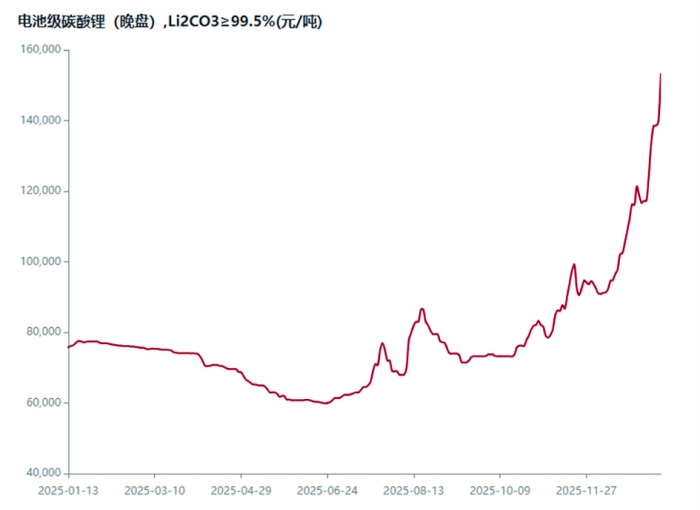
锂价狂飙势头仍在持续。 1月12日,碳酸锂主力合约继续飙升,当日一字涨停(涨幅为9%),报收156060元/吨。碳酸锂现货与期 货价格保持联动,"我的钢铁网"数据显示,1月12日,电池级碳酸锂(晚盘)均价报153400元/吨,吨价 较前一个交易日上涨13800元,再次创下近一年来新高。 "碳酸锂价格的强势拉升,或与锂电池出口退税政策调整有关。"相关人士告诉上海证券报记者,电池产 品增值税出口退税率下调或大幅提升锂电下游企业备货热情,也进一步影响到本就"紧平衡"的碳酸锂市 场。 出口退税政策调整 电池企业备货热情提升 进入2026年,碳酸锂主力合约在5个交易日内累计涨幅达20.06%。从记者了解的情况来看,碳酸锂"开 年就大涨"的情况已超出业内预期。 "从下游需求和市场热度来看,行业肯定是回暖了不少,但锂价能涨这么快,的确也没想到。"青海某年 产万吨级碳酸锂企业人士告诉记者,从实际销售价格来看,目前还没有15万元/吨那么高,但按照期货 及现货价格走势来看,售价超过15万元应该用不了多长时间。 2025年下半年以来,在储能市场需求高速增长的拉动下,碳酸锂价格持续上涨,行业供需进入"紧平 衡"。有业内人士表示,在" ...
华泰证券:电池出口退税下调,看好海外产能布局企业
Zheng Quan Shi Bao Wang· 2026-01-13 00:06
人民财讯1月13日电,华泰证券指出,2026年1月9日,中国财政部、税务总局发布《关于调整光伏等产 品出口退税政策的公告》,宣布自2026年4月1日起至2026年12月31日,将电池产品的增值税出口退税率 由9%下调至6%,2027年1月1日起,取消电池产品增值税出口退税。华泰证券认为出口退税率的下调短 期将推动电池2026年抢出口,加剧锂矿、六氟磷酸锂等环节的供需紧张,长期将推动国内落后产能出 清,优化电池行业格局,利好海外产能布局企业。 ...

碳酸锂期货创阶段新高 机构提示风险
Zheng Quan Shi Bao· 2026-01-12 23:53
Core Viewpoint - The price of lithium carbonate futures has significantly increased due to changes in export policy expectations and improvements in supply-demand dynamics, with the main contract reaching a new high of over 150,000 yuan per ton on January 12 [1] Group 1: Price Movement - On January 12, the main contract for lithium carbonate futures opened at a limit-up price, surpassing the 150,000 yuan per ton mark, marking a new phase high [1] - The recent surge in prices is primarily driven by expectations of "export rush" triggered by adjustments in export tax rebate policies [1] Group 2: Market Dynamics - The current low inventory levels in the industry chain are providing significant short-term support for prices [1] - Despite the rapid increase in prices, there are concerns regarding potential volatility risks in the future [1]
碳酸锂期货涨停!分析人士:警惕预期差
Qi Huo Ri Bao· 2026-01-12 23:50
Core Viewpoint - The recent surge in lithium carbonate futures prices is attributed to strong fundamental expectations and multiple positive market news, particularly the adjustment of export tax policies for battery products in China [2][3]. Group 1: Price Movement - On January 12, lithium carbonate futures opened with a limit increase, with the main contract LC2605 rising by 9% to 156,300 yuan/ton [1]. - The price increase reflects a strong performance compared to the non-ferrous sector, influenced by seasonal demand expectations and supply-side news [3]. Group 2: Export Tax Policy Impact - The Ministry of Finance and the State Taxation Administration announced a reduction in the VAT export rebate rate for battery products from 9% to 6% starting April 1, 2026, and the complete cancellation of the rebate from January 1, 2027 [2]. - Analysts suggest that this policy may lead to a short-term "export rush," supporting demand and mitigating concerns about seasonal demand weakness [2][4]. - The adjustment aims to guide the battery industry away from a purely scale expansion model and alleviate homogenization competition pressures [4]. Group 3: Supply and Demand Dynamics - Data from the China Automotive Power Battery Industry Innovation Alliance indicates that from January to November 2025, the cumulative export volume of power and other batteries reached 260.3 GWh, a year-on-year increase of 44.2% [2]. - Despite the potential for increased export demand, the overall impact on lithium carbonate supply and demand is expected to be limited, with a gradual accumulation of inventory observed [4][5]. - The market is currently in a phase of strong supply and demand dynamics, with ongoing competition between upstream and downstream players [4]. Group 4: Future Outlook - Analysts predict that the demand for lithium carbonate will remain strong until the cancellation of the export rebate in 2027, with potential for concentrated release of export demand [4]. - However, there are warnings about a significant decline in new energy battery demand at the beginning of 2026, which may lead to production adjustments by battery manufacturers [5]. - The market should closely monitor the actual progress of battery exports in the first quarter and the potential discrepancies between expectations and reality [5].


光伏产品出口退税将全面取消 抢运潮将至
Mei Ri Jing Ji Xin Wen· 2026-01-12 23:41
1月9日,一则调整出口退税政策的公告在光伏圈刷屏。自2026年4月1日起,财政部、税务总局将取消光 伏等产品增值税出口退税。 从退税9%到全面取消,该举措将使光伏企业的出口成本有所上升。"很多光伏工厂都取消工人休假,叫 回来加班。"运去哪一线销售人员向《每日经济新闻》记者表示,国内厂商肯定要赶在4月之前发货,但 上游抢运潮尚未传导至物流端。 预计将会有一波抢运潮 中国光伏行业协会发文称,自2024年以来,我国光伏产品出口价格持续走低,呈现"量增价减"态势。部 分光伏企业会将出口退税额让渡给境外采购方,造成利润流失。尽管调整出口退税并非从根本上解 决"内卷外化"问题的唯一手段,但从长期看,该举措有利于抑制出口价格的过快下滑,降低贸易摩擦发 生的概率。 卢勇告诉记者,光伏组件相关大型企业通常与船司签订长协,以OA联盟(全球集装箱航运领域的重要 合作组织)为主。目前来询价订舱的光伏产品多运往欧洲,还有印度,一旦光伏产品出现抢运提振货 量,其他联盟仍有运力接住外溢需求,因此影响也不会太大。 青岛泰泽国际物流有限公司总经理卢勇告诉记者,目前光伏产品的订舱量未见增长,企业尚需时间反 应,但预计会有一波抢运潮,或将对淡季航 ...
碳酸锂价格突破15万元/吨 锂电池"抢货潮"预期高涨 产业景气度持续攀升
Shang Hai Zheng Quan Bao· 2026-01-12 22:09
Core Viewpoint - The price of lithium carbonate continues to surge, driven by changes in export tax policies and strong demand from the battery sector, leading to a "tight balance" in the market [1] Group 1: Price Trends - On January 12, the main contract for lithium carbonate surged by 9%, closing at 156,060 yuan/ton, with the average price for battery-grade lithium carbonate reported at 153,400 yuan/ton, an increase of 13,800 yuan from the previous trading day [1] - The cumulative increase in the main contract for lithium carbonate over five trading days reached 20.06% [1] - The price of lithium carbonate has risen from 80,000 yuan to over 150,000 yuan within two months, indicating a strong demand-supply relationship [1] Group 2: Export Tax Policy Impact - The Ministry of Finance and the State Administration of Taxation announced a reduction in the export tax rebate rate for battery products from 9% to 6% starting April 1, 2026, and the complete cancellation of the rebate by January 1, 2027 [1] - Battery manufacturers are expected to accelerate procurement plans to avoid rising costs, leading to increased demand for lithium carbonate [1] Group 3: Technological Advancements - A research team from the Chinese Academy of Sciences has achieved breakthroughs in lithium extraction technology, enhancing the efficiency of lithium recovery from brine [1] - The new extraction technology has been successfully applied in a demonstration line capable of producing battery-grade lithium carbonate with a recovery rate exceeding 98% [1] Group 4: Market Dynamics - The demand for lithium carbonate is projected to reach 202,000 tons in 2026, with a year-on-year increase of 32%, as the demand from the energy storage sector is expected to surpass that from the power battery sector for the first time [1] - The supply side is constrained due to previous low lithium prices, which slowed the progress of some lithium mining projects, while domestic production is expected to increase from salt lakes and the resumption of lithium mica mining in Jiangxi [1] Group 5: Industry Sentiment - The rising prices and strong demand have led to increased confidence in the lithium industry, with many companies expecting significant profit growth [1] - Nearly 50% of surveyed companies believe that the price of lithium carbonate could reach 200,000 yuan per ton, with 30% anticipating prices could rise to 250,000 yuan or more [1]
碳酸锂价格突破15万元/吨 锂电池“抢货潮”预期高涨 产业景气度持续攀升
Shang Hai Zheng Quan Bao· 2026-01-12 18:58
Core Viewpoint - The price of battery-grade lithium carbonate continues to surge, driven by supply-demand dynamics and changes in export tax policies, leading to increased enthusiasm for inventory procurement among downstream battery manufacturers [3][5][9]. Group 1: Price Trends - On January 12, the main contract for lithium carbonate reached a record high of 156,060 yuan per ton, with a daily increase of 9% [3]. - The average price of battery-grade lithium carbonate was reported at 153,400 yuan per ton, up by 13,800 yuan from the previous trading day [3]. - In the first five trading days of 2026, the cumulative increase in lithium carbonate prices reached 20.06% [4]. Group 2: Export Tax Policy Impact - The adjustment of export tax rates for battery products, effective from April 1, 2026, is expected to drive battery manufacturers to stock up in advance, thereby increasing demand for lithium carbonate [5][10]. - The export tax rate for battery products will be reduced from 9% to 6%, and will be completely eliminated by January 1, 2027 [5]. Group 3: Supply and Demand Dynamics - The lithium carbonate market is currently in a "tight balance" due to high demand from the energy storage sector, with global demand projected to reach 202,000 tons in 2026, a year-on-year increase of 32% [9]. - The supply side is constrained as previous low lithium prices have slowed the progress of some lithium mining projects, limiting the growth of lithium salt production capacity [10]. Group 4: Industry Confidence and Innovations - Recent breakthroughs in lithium extraction technology have bolstered confidence in the lithium industry, with a new method achieving over 98% lithium recovery from brine [6]. - The enthusiasm for mergers and acquisitions in the lithium sector is rising, reflecting optimism about the future growth potential of the renewable energy industry [7]. Group 5: Inventory and Production Outlook - As of January 8, domestic lithium carbonate inventory was approximately 110,000 tons, with a slight increase from the previous week, primarily concentrated in trading and smelting sectors [11]. - Companies are optimistic about their performance in the first quarter, with many expecting lithium carbonate prices to exceed 200,000 yuan per ton in the near future [11].
碳酸锂期货突破15万元大关 机构提示追高风险
Zheng Quan Shi Bao· 2026-01-12 18:09
Core Viewpoint - The price of lithium carbonate futures has surged significantly due to changes in export policy expectations and improvements in supply-demand dynamics, with the main contract reaching a new high of 156,060 yuan/ton on January 12, marking a 9% increase for the day [1][2]. Group 1: Price Movement and Market Dynamics - On January 12, the lithium carbonate futures main contract hit the daily limit, breaking through the 150,000 yuan/ton mark, with a cumulative increase of over 160% since the low point in June 2025 [2][3]. - The surge in prices is primarily driven by market reactions to adjustments in export tax rebate policies for lithium battery products, which are expected to lead to a concentrated "export rush" [2][3]. - The current low inventory levels across the supply chain are providing significant support for prices, as downstream companies are adjusting their production and procurement strategies in anticipation of policy changes [2][3]. Group 2: Supply and Demand Outlook - The demand for lithium carbonate is expected to remain strong, driven by steady growth in electric vehicle sales and expanding demand in the energy storage sector, which is seen as a potential variable for exceeding expectations [3][4]. - The supply side is facing constraints, with new supply primarily relying on leading companies' lithium mining capacity, which is hindered by long construction cycles and stricter environmental regulations [4]. - Institutions believe that the lithium industry is transitioning from a phase of oversupply to a "tight balance" state, with 2026 potentially being a pivotal year for supply-demand relationships [4]. Group 3: Regulatory and Market Sentiment - Despite the overall positive market sentiment, there are warnings about potential supply-side elasticity and the risks of price volatility due to excessive speculative behavior [5][6]. - Regulatory measures have been implemented to curb excessive speculation, with the Guangzhou Futures Exchange taking action against clients exceeding trading limits on lithium carbonate contracts [5][6].