
存储芯片超级周期

Search documents
汇丰:SK海力士四季度业绩料创纪录
Jin Rong Jie· 2026-01-13 04:48
Core Viewpoint - SK Hynix is expected to see a significant increase in operating profit for Q4, projected to rise by 57% quarter-on-quarter, reaching a record 18 trillion KRW [1] Group 1: Financial Performance - The operating profit for SK Hynix in Q4 is anticipated to hit a record 18 trillion KRW, driven by strong demand for DRAM and NAND chips [1] - Prices for DRAM and NAND chips are expected to increase by 25% and 20% respectively [1] Group 2: Market Influences - The weakening of the Korean won against the US dollar may positively impact SK Hynix's Q4 earnings [1] - Continued robust shipments as a supplier of HBM products to Nvidia are expected to benefit SK Hynix [1] Group 3: Industry Trends - Ongoing investment in artificial intelligence is contributing to strong demand for general DRAM, providing dual support for SK Hynix during the storage chip supercycle [1]
美股又新高,存储芯片再大涨,A股下周怎么走?
Sou Hu Cai Jing· 2026-01-10 03:55
Group 1: Employment Data and Federal Reserve Outlook - The U.S. Labor Department reported a non-farm employment increase of 50,000 in December, which is below market expectations [1] - The unemployment rate for December was 4.4%, lower than the anticipated 4.5%, indicating that the unemployment rate has not reached a level that necessitates a rate cut by the Federal Reserve [1] - The probability of a rate cut in January has dropped to 5%, with market expectations remaining high for future months despite the lack of immediate cuts [1] Group 2: Stock Market Reaction - Despite the short-term outlook of no rate cuts being negative, U.S. stock markets reacted positively, with major indices rising: Nasdaq up 0.81% and S&P 500 up 0.65%, both reaching historical highs [3] - The surge in technology stocks, particularly in the storage chip sector, has driven the market upward, with companies like SanDisk seeing price increases of over 10% [3] Group 3: Semiconductor and Solar Industry Insights - A report from Nomura Securities suggested that prices for enterprise-level 3D NAND flash memory could double this quarter, indicating a significant positive outlook for the storage chip sector [4] - The anticipated price increases in storage chips are expected to lead to a bullish trend in both U.S. and A-share markets, particularly in semiconductor materials and equipment [4] - In the solar industry, the cancellation of export tax rebates for photovoltaic products starting April 1, 2026, is expected to negatively impact earnings for exporting companies, potentially reducing rebates by 1 to 2 billion [4][5] - However, the removal of export tax rebates may lead to market consolidation, benefiting larger firms that can enhance their pricing power in overseas markets [5]


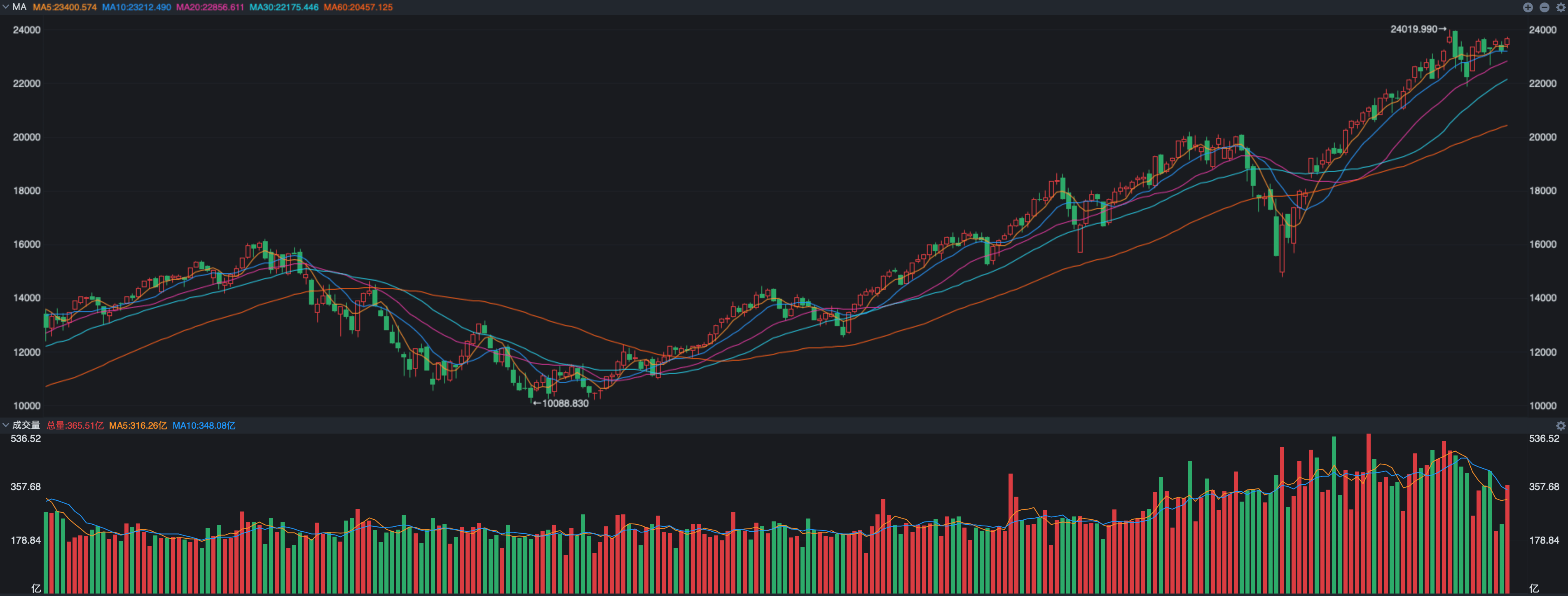
今晚,涨疯了!
Zhong Guo Ji Jin Bao· 2026-01-06 16:24
Core Viewpoint - The storage chip market is experiencing significant price increases driven by surging demand for AI infrastructure, with major companies like SanDisk and Micron seeing substantial stock price gains [3][5][6]. Group 1: Market Performance - U.S. stock indices continued to rise, with the Dow Jones up by 0.27%, Nasdaq by 0.19%, and S&P 500 by 0.22% [2]. - The market remains largely unaffected by geopolitical tensions in Venezuela, with a three-year bull market continuing, primarily fueled by demand for AI-related stocks [2][3]. - Major storage chip stocks saw significant gains, with SanDisk rising over 20%, Micron up over 6%, Western Digital up over 12%, and Seagate Technology up over 10% [3][4]. Group 2: Supply and Demand Dynamics - Analysts indicate that the surge in AI infrastructure demand is leading to a global supply crunch, which may persist for months or even years [5]. - Samsung's co-CEO described the current shortage as "unprecedented," aligning with warnings from industry peers about ongoing supply constraints [5]. - Market research firm TrendForce reported that prices in certain segments have more than doubled since February of last year, attracting traders to bet on the continuation of this upward trend [5]. Group 3: Future Outlook - Micron's CEO anticipates that the tight storage market conditions will extend beyond 2026, with the company's stock having surged 240% in 2025, significantly outperforming the Philadelphia Semiconductor Index's 42% increase [6]. - Analysts from Morningstar and JPMorgan estimate that the current "super cycle" in the market could last until 2027 or even longer [8]. Group 4: Sector Reactions - While storage chip companies are thriving, cooling system manufacturers are facing significant stock declines due to concerns about reduced demand for their products following comments from Nvidia's CEO [10]. - Companies like Johnson Controls and Modine Manufacturing saw their stock prices drop significantly, with Johnson Controls experiencing an intraday decline of up to 11% [10][13].



295亿!巨无霸IPO来了!已预审两轮,阿里腾讯小米入股
IPO日报· 2025-12-31 08:18
Core Viewpoint - Changxin Technology, a leading DRAM manufacturer in China, has officially received acceptance for its IPO on the Sci-Tech Innovation Board, aiming to raise 29.5 billion yuan for various technology upgrade projects [1][5][20]. Company Overview - Changxin Technology is the largest and most advanced DRAM manufacturer in China, established in 2016, and operates under an IDM (Integrated Device Manufacturer) model [9]. - The company offers a diverse range of products including DRAM wafers, chips, and modules, covering DDR and LPDDR series, with applications in servers, mobile devices, personal computers, and smart vehicles [9]. Market Position - According to Omdia, Changxin Technology ranks first in China and fourth globally in DRAM production capacity and shipment volume [6]. - Despite its growth, the company still lags behind the top three global players: Samsung, SK Hynix, and Micron, which collectively hold a market share of 94.27% [7]. Financial Performance - From 2022 to 2025, Changxin Technology's revenue is projected to grow significantly, with a compound annual growth rate of 72.04% in its main business revenue [11]. - However, the company has reported substantial losses, totaling over 408.57 billion yuan by mid-2023, despite a revenue increase of 97.79% year-on-year in the first nine months of 2023 [10][13]. Future Outlook - The company anticipates a turnaround in profitability in 2025, projecting a net profit of 2 billion to 3.5 billion yuan, with a significant improvement in gross margins [14][15]. - The ongoing global DRAM supply shortage, expected to last until at least 2027, presents a favorable market environment for Changxin Technology's growth [7][8]. IPO Details - The IPO is notable as it is the first pre-review project accepted on the Sci-Tech Innovation Board, reflecting the high level of attention from various stakeholders [1][20][23]. - The company has a diverse shareholder structure, with significant stakes held by various investment entities, including state-owned funds and private investors [24][25].

AI算力投资新主轴! 2025年市场真金白银选出AI交易大赢家:存储、光互连与TPU
Zhi Tong Cai Jing· 2025-12-25 09:13
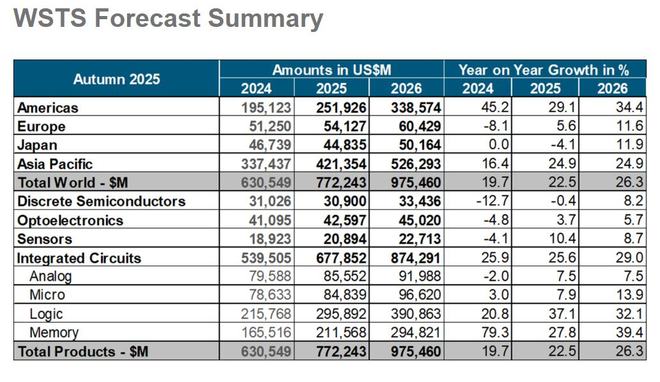
Core Insights - Nvidia has been a major player in the AI computing infrastructure sector, but five other tech stocks focused on AI data centers have shown even more remarkable growth in 2025 [1][2] - The AI infrastructure spending by major tech companies like Amazon, Microsoft, Google, and Meta is projected to reach approximately $380 billion in 2025, with a potential 50% increase in 2026 [3] - The semiconductor market is expected to see significant growth, with a projected total value of $772.2 billion in 2025 and $975.5 billion in 2026, driven by AI infrastructure demands [7][6] Group 1: AI Computing Stocks - Lumentum is highlighted as a key winner in the AI computing supply chain, with its stock price increasing nearly 400% in 2025, driven by demand for optical components in AI data centers [1][11] - Western Digital's stock has surged nearly 300% in 2025, as AI data centers require massive storage solutions for large datasets [14][15] - Micron Technology, as a major U.S. memory chip manufacturer, is benefiting from the AI infrastructure boom, with its stock price rising approximately 240% in 2025 [17][20] Group 2: Market Trends and Projections - Analysts predict that the semiconductor industry will experience a "super cycle," with significant growth in AI chip, storage, and optical interconnect sectors [4][5] - The global AI infrastructure investment wave is expected to reach $3 trillion to $4 trillion by 2030, indicating a long-term growth trajectory for AI-related investments [5][19] - The demand for high-performance storage solutions, particularly HBM and SSDs, is expected to continue to rise, with Micron and other storage companies positioned to benefit significantly [18][21] Group 3: Company-Specific Developments - Celestica, a key player in manufacturing high-performance network switches for AI data centers, has seen its stock rise over 230% in 2025 [27][28] - Seagate's stock has increased by 231% in 2025, driven by the growing demand for HDDs and SSDs in AI data centers [23][25] - The competitive landscape between Google and OpenAI in the AI computing space is expected to benefit companies like Lumentum and Western Digital, as both companies require advanced storage and optical interconnect solutions [10][12]


回望2025|内存一天一个价,华强北商家的滚烫“芯事”
Bei Ke Cai Jing· 2025-12-25 07:49
Core Narrative - 2025 is a pivotal year for the global economy and China's industries, marked by deep differentiation and value reshaping, moving beyond merely chasing trends to a more analytical approach towards underlying changes [3] Group 1: Storage Chip Market Dynamics - The storage chip market is experiencing a "super cycle," driven by AI demand and international manufacturers adjusting their production capacities, leading to significant price increases for DRAM and NAND Flash [6][7] - Prices for general DRAM are projected to rise by 18%-23% by Q4 2025, with DDR4 prices skyrocketing from approximately $3 to $70 [8][14] - The market is witnessing a shift as domestic storage chips gain traction due to their mature performance, stable supply, and competitive pricing, indicating a transition from passive replacement to active quality enhancement in Chinese manufacturing [7][30] Group 2: Impact on Trade and Supply Chain - Trade merchants in Shenzhen's Huaqiangbei are adapting to the volatile market by balancing inventory and sales, with many opting for a "buy and sell" strategy to manage rising costs [19][20] - Smaller manufacturers face significant pressure as they struggle to pass on increased costs to consumers and lack the financial capacity to stockpile inventory, often resorting to purchasing old stock or components from dismantled devices [20][21] - The rapid price increases are forcing some manufacturers to alter their procurement strategies, with many now requiring clients to secure storage components before proceeding with projects [21][22] Group 3: Consumer Price Increases - The rising costs of memory and storage chips are being rapidly transmitted to consumer electronics, with companies like Dell and Xiaomi announcing price hikes of 10% to 30% across various product lines [23][24][25] - The price increases are attributed to heightened demand for high-performance computing and data center needs, exacerbated by supply chain constraints [25][27] Group 4: Future Outlook and Market Trends - The current cycle of price increases driven by AI demand is expected to last longer than previous cycles, with predictions suggesting potential shortages extending into 2027 [26][27] - Domestic storage manufacturers are poised to capture market share in niche DRAM segments as international suppliers withdraw, presenting a significant opportunity for growth [32]

市场狂飙 存储芯片巨头上调报价
Bei Jing Shang Bao· 2025-12-24 15:56
Core Viewpoint - The storage chip market is entering a new price increase cycle, driven by both supply and demand factors, with major players like Samsung and SK Hynix raising HBM3E prices by nearly 20% for the upcoming year [1] Group 1: Market Dynamics - The global storage chip market is officially entering a new growth cycle, with rising spot prices across the board [1] - Demand for the sixth generation of HBM (HBM4) is expected to increase significantly, leading to a backlog in HBM3E production capacity [1] - Companies like Nvidia, Google, and Amazon are significantly increasing their order volumes, contributing to the demand surge [1] Group 2: Future Projections - KB Securities predicts that Samsung's HBM total shipments will triple by 2026, reaching 11.1 billion Gb, driven by the surge in ASIC demand [1] - Micron Technology has sold out its entire HBM supply for 2026, with a projected total addressable market (TAM) of $100 billion by 2028, growing from $35 billion in 2025 [2] - Morgan Stanley forecasts a "super cycle" in the storage industry driven by AI, with the global storage market potentially reaching $300 billion by 2027 [2] Group 3: Price Trends - In the first half of 2025, the DRAM composite price index rose by 47.7%, while the NAND Flash composite price index increased by 9.2% [2] - The price of 512Gb Flash Wafers has seen a cumulative increase of over 20% since October [2] Group 4: Demand Drivers - The current price increase cycle is driven by dual demand from smartphones and servers, differing from previous cycles that were consumer electronics-driven [3] - Companies like Nvidia, Amazon, Google, and AMD account for 95% of HBM demand, with significant investments in AI further boosting demand [3] Group 5: Supplier Dynamics - Apple is increasing its procurement of storage chips from Samsung, expecting Samsung to supply 60% to 70% of the DRAM for the iPhone 17 [4] - SK Hynix and Micron are shifting their production focus towards HBM, limiting their capacity for LPDDR chips, while Samsung maintains large-scale production capabilities [4][5] - Concentrating orders with Samsung may provide Apple with more predictable chip delivery and potential cost savings [6]
AI基建狂潮之下存储需求狂飙 ?美光(MU.US)业绩碾压预期! 暗示“超级周期”延伸至2027年
Zhi Tong Cai Jing· 2025-12-18 00:37
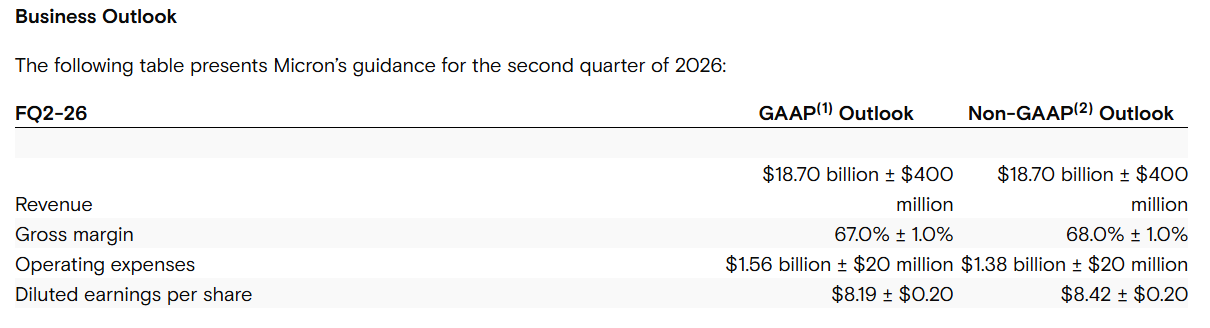
Core Viewpoint - Micron Technology (MU.US) has provided an extremely optimistic earnings outlook that significantly exceeds Wall Street analysts' expectations, indicating that the current "super cycle" in storage chips may extend until 2027 due to unprecedented demand driven by AI infrastructure [1][2] Earnings Outlook - For Q2 of fiscal year 2026, Micron expects revenue between $18.3 billion and $19.1 billion, surpassing the average analyst expectation of $14.4 billion [3][4] - Adjusted earnings per share are projected to be between $8.22 and $8.62, compared to the analyst average of $4.71 [3] - Micron's overall gross margin is expected to be 67.0% under GAAP, significantly higher than the analyst expectation of 55.7% [4] Capital Expenditure - Micron has raised its capital expenditure forecast for fiscal year 2026 from $18 billion to $20 billion, reflecting the need to expand production capacity in response to surging demand [5][9] Market Dynamics - The demand for storage chips, particularly DRAM and NAND products, is experiencing explosive growth due to the construction of large AI data centers, leading to a shift in production focus away from consumer markets [2][6] - Major players like SK Hynix and Samsung are also concentrating their production on high-bandwidth memory (HBM) systems, contributing to a supply shortage in traditional storage products [6][8] Industry Trends - TrendForce has revised its revenue forecasts for the DRAM industry, predicting a year-over-year growth of over 100% in 2026, with Micron positioned as a key beneficiary [2][11] - The semiconductor market is expected to grow significantly, with projections indicating a total value of $975.5 billion by 2026, driven by AI and cloud computing demands [13]
AI基建狂潮之下存储需求狂飙 美光(MU.US)业绩碾压预期! 暗示“超级周期”延伸至2027年
Zhi Tong Cai Jing· 2025-12-18 00:12
Core Viewpoint - Micron Technology (MU.US) has provided an extremely optimistic earnings outlook for the current quarter, significantly exceeding Wall Street analysts' expectations, and has unexpectedly raised its capital expenditure for fiscal year 2026, indicating a strong demand for storage chips driven by the unprecedented global AI boom [1][2][3] Group 1: Earnings Outlook - Micron's revenue forecast for Q2 FY2026 is projected to be between $18.3 billion and $19.1 billion, compared to Wall Street's average expectation of $14.4 billion [3][4] - The company expects a gross margin of 67.0% under GAAP, significantly higher than the analysts' average expectation of 55.7% [4][10] - Micron's adjusted earnings per share for Q2 FY2026 is estimated to be between $8.22 and $8.62, while analysts had anticipated around $4.71 [3][4] Group 2: Market Dynamics - The demand for storage chips, particularly DRAM and NAND products, is surging due to the rapid expansion of AI data centers, leading Micron to halt sales to the PC/DIY market to focus on enterprise-level products [2][7] - Wall Street analysts predict that the overall sales of the DRAM industry will see over 100% year-on-year growth in 2026, with Micron being one of the biggest beneficiaries [2][3] - TrendForce has revised its revenue forecasts for the DRAM industry, expecting approximately $165.7 billion in 2025 (up 73% YoY) and $333.5 billion in 2026 (up 101% YoY) [2][3] Group 3: Competitive Position - Micron is strategically positioned as a key supplier for AI infrastructure, focusing on high-performance storage components essential for AI training and inference systems [9][11] - The company is expected to capture significant market share in the HBM storage systems and enterprise-level SSDs, which are critical for AI applications [14][15] - Micron's capital expenditure for fiscal year 2026 has been raised from $18 billion to $20 billion, reflecting its commitment to expanding production capacity in response to soaring demand [4][10]
华尔街顶级分析师最新评级:新思科技获上调、华纳兄弟遭下调
Xin Lang Cai Jing· 2025-12-09 15:10
Core Viewpoint - The report summarizes significant rating changes from Wall Street that are expected to impact the market, highlighting both upgrades and downgrades across various companies and sectors [1][6]. Upgrades - Synopsys (SNPS): Rosenblatt Securities upgraded the rating from "Neutral" to "Buy," lowering the target price from $605 to $560, anticipating that Q4 results will meet market expectations after a disappointing Q3 [5]. - Eaton Corporation (ETN): Wolfe Research upgraded the rating from "In-Line" to "Outperform," setting a target price of $413, expecting benefits from electrical business orders and easing cyclical factors in 2026 [5]. - Colgate-Palmolive (CL): Royal Bank of Canada upgraded the rating from "Sector Perform" to "Outperform," maintaining a target price of $88, noting that earnings expectations are at a reasonable low despite challenges in 2026 [5]. - RPM International (RPM): Royal Bank of Canada upgraded the rating from "Sector Perform" to "Outperform," raising the target price from $121 to $132, indicating that the stock price has "bottomed out" [5]. - Viking Holdings (VIK): Goldman Sachs upgraded the rating from "Neutral" to "Buy," increasing the target price from $66 to $78, citing the company's unique geographic business layout and high-income customer focus [5]. Downgrades - Warner Bros. Discovery (WBD): Harbor Research downgraded the rating from "Buy" to "Neutral" without providing a target price, following a hostile takeover bid from Paramount [5]. - Norwegian Cruise Line (NCLH): Goldman Sachs downgraded the rating from "Buy" to "Neutral," lowering the target price from $23 to $21, citing an unfavorable risk-reward ratio due to market conditions in the Caribbean [5]. - Confluent (CFLT): Royal Bank of Canada downgraded the rating from "Outperform" to "Sector Perform," raising the target price from $30 to $31, following an acquisition agreement with IBM at $31 per share [5]. - SLM Corporation (SLM): Compass Point downgraded the rating from "Buy" to "Sell," reducing the target price from $35 to $23, after revealing updated mid-term outlooks at an investor forum [5]. - Viavi Solutions (VRT): Wolfe Research downgraded the rating from "Outperform" to "In-Line," citing valuation issues as the stock price has increased 14 times since the last upgrade [5]. Initiations - Micron Technology (MU): HSBC initiated coverage with a "Buy" rating and a target price of $330, identifying the company as a core beneficiary of the storage chip supercycle [9]. - United Airlines (UAL): Montreal Bank Capital Markets initiated coverage with an "Outperform" rating and a target price of $125, noting improvements in the industry environment and recovery in business travel [12]. - Thermo Fisher Scientific (TMO): Goldman Sachs initiated coverage with a "Buy" rating and a target price of $685, expecting the market for life science tools to return to historical growth rates [12]. - Affirm (AFRM): Wolfe Research initiated coverage with a "Sector Perform" rating, setting a fair value range of $72-$82 for the end of 2026 [10]. - Urban Outfitters (URBN): Goldman Sachs initiated coverage with a "Neutral" rating and a target price of $83, acknowledging market positioning but cautioning against high valuation risks [10].


