消费增长

Search documents
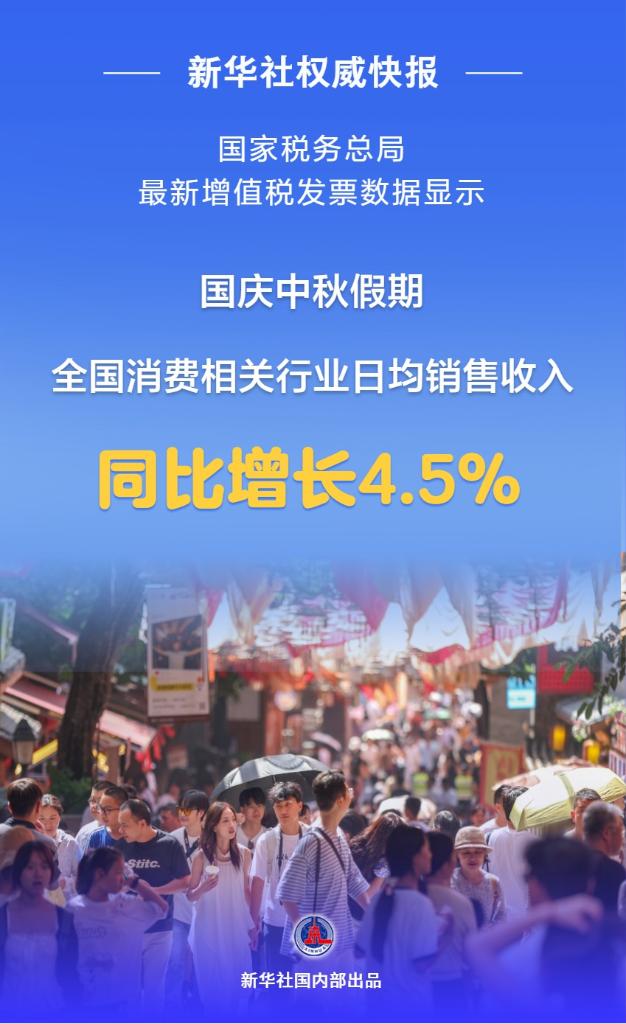
新华社权威快报丨国庆中秋假期全国消费相关行业日均销售收入同比增长4.5%
Xin Hua Wang· 2025-10-09 03:05
Core Insights - The latest data from the State Taxation Administration indicates that the average daily sales revenue in consumption-related industries during the National Day and Mid-Autumn Festival holiday increased by 4.5% year-on-year [2][4] Consumption Trends - Among the consumption categories, goods consumption and service consumption grew by 3.9% and 7.6% year-on-year, respectively [4] - Digital products and automotive sales experienced rapid growth during the holiday period [4] - There was strong demand for tourism, cultural, artistic, and sports services [4] - Food and health product consumption showed stable growth [4]

国庆假期上海线上线下消费支付金额796亿元,离境退税开单数同比增6倍
Xin Lang Cai Jing· 2025-10-08 23:44
Core Insights - During the holiday period from October 1 to October 8, Shanghai's total online and offline consumption payment amounted to 79.6 billion yuan, representing a year-on-year growth of 3.0% [1] - The consumption by foreign visitors in Shanghai was notably active, with the number of tax refund claims increasing sixfold compared to the previous year, and the sales amount growing by 7.2% year-on-year [1]

微信发布国庆中秋假期数据报告:新一线、县域市场消费“领涨”全国
Yang Guang Wang· 2025-10-08 09:49
Core Insights - The 2025 National Day and Mid-Autumn Festival holiday has significantly boosted travel and consumption, with new first-tier cities and county markets leading the growth, showing a 10% increase in total consumption compared to the May Day holiday [1][34] - Chongqing emerged as the top city in terms of WeChat payment consumption and transaction volume, surpassing major cities like Beijing, Shanghai, Guangzhou, and Shenzhen [1][5][6] - Cross-border tourism has surged, with WeChat payment transactions in destinations like New Zealand and Italy seeing substantial year-on-year increases of 131% and 100%, respectively [1][36] Consumption Trends - New first-tier cities and county markets are showing significant potential, with consumption growth rates surpassing those of traditional first-tier cities during the holiday [34] - Popular consumption categories include sports and fitness, beauty and hairdressing, and travel, with sports fitness transaction volume increasing by 16% and beauty spending rising by 11% [10][11][34] - The use of WeChat for purchasing railway and passenger transport tickets has increased by 21%, while spending on electric vehicle charging stations has surged by 43% [13][34] Cross-Border Payment Growth - Cross-border payment transactions increased by 21% during the holiday, with notable growth in countries benefiting from visa-free policies, such as South Korea (46% increase) and Singapore (32% increase) [36][21] - The integration of WeChat with local payment systems in Japan and other countries has enhanced the travel experience for Chinese tourists, leading to a 25% increase in transactions in Japan [36][37] - The overall transaction volume for cross-border small programs in the transportation sector grew by over 2.5 times year-on-year [1][26] Regional Highlights - The Greater Bay Area saw a significant increase in cross-border transactions, with Hong Kong residents traveling to mainland China for holiday celebrations, resulting in a 120% increase in transaction volume [35][34] - The report highlights the vibrant consumption patterns in various cities, with users in Chongqing and Chengdu favoring leisurely activities, while users in Beijing and Shanghai are more inclined towards entertainment events [34][36]

美联储最青睐通胀数据缓解忧虑,三大指数终结三连阴
2 1 Shi Ji Jing Ji Bao Dao· 2025-09-27 03:33
Core Insights - The U.S. Personal Consumption Expenditures (PCE) price index rose by 0.3% month-on-month and 2.7% year-on-year in August, while the core PCE index increased by 0.2% month-on-month and 2.9% year-on-year, indicating stable inflation data [2] - Following the release of the PCE data, U.S. stock markets rebounded after three consecutive days of decline, with the Dow Jones up 0.65%, S&P 500 up 0.59%, and Nasdaq up 0.44% [2] - The consumer confidence index for September fell to 55.1, marking one of the lowest levels since 1952, reflecting growing pessimism among consumers regarding the economy [4] Economic Indicators - Initial jobless claims decreased by 14,000 to 218,000, the lowest since mid-July, which was significantly below market expectations [3] - The final GDP growth rate for Q2 was revised up to an annualized 3.8%, driven by unexpectedly strong consumer spending and a decline in imports [3] - Consumer spending, which accounts for over two-thirds of U.S. economic activity, grew by 0.6% month-on-month in August, surpassing expectations of 0.5% [5] Consumer Sentiment - A significant 44% of survey respondents reported that high prices are eroding their financial situation, the highest proportion in the past year [4] - The consumer sentiment index indicates that concerns over inflation and a weakening job market are prevalent among consumers [4] - High-income households are currently the main drivers of consumer spending, supported by a strong stock market and high housing prices [5] Market Outlook - There is a divergence in views within the Federal Reserve regarding the pace and extent of future interest rate cuts, with some officials advocating for caution while others call for more aggressive action [4] - The wealth effect from rising stock and housing prices is increasingly influencing consumer spending, posing risks if these asset prices decline [5]
前八个月我省经济运行总体平稳
Liao Ning Ri Bao· 2025-09-19 01:33
Economic Overview - The overall economic operation of the province remains stable in the first eight months of the year, with a year-on-year industrial added value growth of 3.5% [1] - High-tech manufacturing industry added value increased by 6.4% [1] Industrial Performance - Mining industry added value grew by 10.1%, manufacturing by 2.9%, and electricity, heat, gas, and water production and supply by 0.1% [1] - Among 40 major industrial categories, 23 experienced year-on-year growth, resulting in a growth coverage of 57.5% [1] - Notable product performance includes transformer production up by 63%, chemical reagents by 35.9%, civil steel ships by 32.1%, and new energy vehicles by 19.7% [1] Investment Trends - Fixed asset investment in the manufacturing sector grew rapidly, with a year-on-year increase of 14.3%, and high-tech manufacturing investment up by 16.7% [1] - Investment in the primary industry increased by 20.4%, while the secondary industry saw a growth of 4.1% [1] - Investment in construction projects exceeding one billion yuan grew by 2.8% [1] Consumer Market - The total retail sales of social consumer goods reached 687.48 billion yuan, with a year-on-year growth of 4.6% [2] - Basic living goods sales showed stable growth, with food and oil retail sales up by 16% and daily necessities by 11.4% [2] - Upgraded consumer goods saw significant sales growth, including smartphones up by 120%, wearable smart devices by 77.8%, and energy-efficient home appliances by 44.7% [2] Trade Performance - The total import and export value reached 501.94 billion yuan, with a slight year-on-year increase of 0.1% [2] - Exports totaled 267.67 billion yuan, growing by 11.6%, with notable increases in agricultural products by 9.6% and steel by 5.7% [2] - Electrical equipment exports increased by 14.6%, while ship exports rose by 23.1% [2] Price Trends - Consumer prices decreased by 0.2% year-on-year, while industrial producer prices fell by 4.8% [2] - The purchase prices for industrial producers declined by 5.2% [2]
NBER's John Lipsky on the Fed's path ahead and what it means for the economy
Youtube· 2025-09-12 16:16
Group 1 - The Senate is expected to confirm Steven Myin as a Fed Governor soon, which could influence Fed meetings and decisions [1] - Market sentiment is optimistic about a rate cut next week and potentially two more cuts by the end of the year [2][3] - There is uncertainty regarding inflation and the strength of the economy, with the next rate cut being highly likely [3][4] Group 2 - Recent employment data shows limited job growth, but does not indicate outright job losses, suggesting stability in the job market [5][7] - There is a noted slowdown in disposable income growth, which may lead to moderated consumption growth in the coming months [6][10] - Concerns about inflation and its impact on real disposable income growth could complicate the Fed's actions and credibility regarding their inflation targets [11][12]
从5432份中报看中国经济:3万亿净利背后的产业升级N个逻辑
2 1 Shi Ji Jing Ji Bao Dao· 2025-09-02 15:01
Group 1 - The overall revenue growth of A-shares has turned positive, with net profit maintaining positive growth, indicating a solid foundation for economic recovery [3] - Nearly 60% of companies reported positive revenue growth, and over three-quarters achieved profitability, with 1,943 companies experiencing both revenue and net profit growth [3] - Private-controlled listed companies saw significant recovery in profitability, with revenue and net profit growth rates of 4.8% and 10% respectively [3] Group 2 - Industries such as steel, software services, building materials, media, semiconductors, and non-ferrous metals performed well, with net profit growth rates exceeding 30% [3] - The consumer market is experiencing multi-polar growth, driven by policies like "trade-in" for consumer goods, resulting in over 10% year-on-year net profit growth in related industries [3] - Emerging sectors like the pet economy and millet economy have shown remarkable growth, with net profit increases of 39.67% and 54.21% respectively [3] - The introduction of optimized visa policies has led to a surge in tourism-related industries, with net profit growth exceeding 50% [3] Group 3 - The R&D investment in the A-share market reached 745.69 billion yuan, a year-on-year increase of 2.68%, with the overall R&D intensity rising to 2.13% [3] - The government work report emphasizes the cultivation and expansion of emerging and future industries, promoting the integrated development of strategic emerging industries [4]
高盛:升古茗目标价至32港元 维持“买入”评级
Zhi Tong Cai Jing· 2025-08-28 08:04
Core Viewpoint - Goldman Sachs reports that Gu Ming (01364) has been opening stores at a pace exceeding expectations, driven by delivery subsidies and new product offerings, with a strong growth in gross merchandise value (GMV) of over 20% in July and August [1] Financial Performance - The company’s revenue growth is expected to be supported by strong store openings and category expansion, despite an increased base for food delivery subsidies by 2025 [1] - Goldman Sachs has raised its profit forecasts for Gu Ming for 2025 to 2027 by 9% to 14%, and adjusted the core net profit forecast for this year from 2.2 billion RMB to 2.4 billion RMB [1] Target Price and Rating - The target price for Gu Ming has been increased from 30 HKD to 32 HKD, maintaining a "Buy" rating [1]
我国7月社会消费品零售总额3.88万亿元 同比增长3.7%
Yang Shi Xin Wen Ke Hu Duan· 2025-08-22 08:27
Group 1: Overall Consumption Market Performance - In July, China's retail sales of consumer goods reached 3.88 trillion yuan, with a year-on-year growth of 3.7%, which is 1 percentage point higher than the same period last year [1] - From January to July, the total retail sales of consumer goods amounted to 28.42 trillion yuan, showing a year-on-year increase of 4.8% [1] Group 2: Product Consumption Trends - In July, the retail sales of goods grew by 4.0% year-on-year, with retail sales from above-designated size units increasing by 3.1% [2] - The "old-for-new" consumption policy has positively impacted sales, with retail sales of home appliances, furniture, communication equipment, and cultural office supplies increasing by 28.7%, 20.6%, 14.9%, and 13.8% respectively [2] - Passenger car retail sales increased by 6.3% year-on-year in July, with new energy vehicle sales growing by 12.0%, achieving a penetration rate of 54% [2] - Retail sales of upgraded products such as sports and entertainment goods and gold and silver jewelry rose by 13.7% and 8.2% year-on-year respectively [2] Group 3: Service Consumption Highlights - From January to July, service retail sales in categories such as cultural and recreational services, tourism consulting and leasing services, and transportation services maintained double-digit growth [3] - There was a significant increase in interest for summer vacation destinations, with search popularity for "summer cooling spots" rising sharply [3] - Museum bookings saw a year-on-year growth of over 200% [3] Group 4: Film and Entertainment Sector - The film market showed strong performance, with the summer box office surpassing 10 billion yuan, and several domestic films achieving both critical and commercial success [4] Group 5: Inbound Consumption Growth - The term "China Shopping" gained popularity due to optimized tax refund policies for outbound tourists and the expansion of visa-free countries, leading to a significant increase in inbound consumption [5] Group 6: Online and Offline Retail Dynamics - From January to July, online retail sales grew by 9.2% year-on-year, with physical goods online retail sales increasing by 6.3%, outpacing the overall retail sales growth by 1.5 percentage points [6] - Physical retail enterprises are adapting to new consumption trends by optimizing product and service offerings and innovating diverse consumption scenarios [6] - Retail sales from above-designated size physical stores increased by 4.2% year-on-year, with warehouse membership stores seeing growth rates exceeding 30% and shopping centers growing by 6.4% [6]
7月同比增长 3.7%,消费增势良好|快讯
Hua Xia Shi Bao· 2025-08-15 03:16
Group 1 - In July, the total retail sales of consumer goods reached 38,780 billion yuan, with a year-on-year growth of 3.7% and a month-on-month decrease of 0.14% [2] - Urban retail sales amounted to 33,620 billion yuan in July, growing by 3.6% year-on-year, while rural retail sales were 5,160 billion yuan, increasing by 3.9% [2] - From January to July, urban retail sales totaled 246,669 billion yuan, up by 4.8%, and rural retail sales reached 37,569 billion yuan, growing by 4.7% [2] Group 2 - In July, the retail sales of goods were 34,276 billion yuan, with a year-on-year increase of 4.0%, while catering revenue was 4,504 billion yuan, growing by 1.1% [2] - From January to July, the retail sales of goods totaled 252,254 billion yuan, increasing by 4.9%, and catering revenue was 31,984 billion yuan, up by 3.8% [2] - Sales of basic living goods and some upgraded products showed strong growth, with retail sales of grain, oil, and food increasing by 8.6%, daily necessities by 8.2%, sports and entertainment products by 13.7%, and gold and silver jewelry by 8.2% [2] Group 3 - The policy of replacing old consumer goods with new ones has continued to show effectiveness, with retail sales of household appliances and audio-visual equipment increasing by 28.7%, furniture by 20.6%, communication equipment by 14.9%, and cultural office supplies by 13.8% [2] - From January to July, the total retail sales of consumer goods reached 284,238 billion yuan, with a year-on-year growth of 4.8% [3] - The national online retail sales amounted to 86,835 billion yuan, growing by 9.2%, with physical goods online retail sales at 70,790 billion yuan, increasing by 6.3%, accounting for 24.9% of total retail sales [3]