
牛市

Search documents
光大证券晨会速递-20260126
EBSCN· 2026-01-26 01:29
2026 年 1 月 26 日 晨会速递 分析师点评 市场数据 总量研究 【策略】A 股牛市当前阶段形态特征六问六答——解密牛市系列之六 本轮牛市或已突破第二震荡段,进入上涨段 3。参考历史结构性牛市规律,本轮牛市 上涨段 3 初期或在 4200-4300 点形成阶段性高点,随后回调企稳于震荡段 2 上沿, 并重新开启新一轮上涨。后续需重点跟踪两点:一是 4200-4300 点区间压力释放与 资金承接情况;二是震荡段 2 上沿的支撑有效性及核心板块企稳信号。 【策略】保持稳健,持股过节——策略周专题(2026 年 1 月第 3 期) 保持稳健,持股过节。参考之前的市场行情,我们认为春节前市场将会保持震荡,难 以保持稳定的趋势,这主要与春节之前投资者交易热度有所下行,以及微观流动性短 期趋紧有关。从历史情况来看,春节前 20 个交易日,主要指数上涨概率不足 50%。 预计春节之后市场将会迎来新一轮上行动力,春节后 20 个交易日主要指数上行概率 与平均涨幅均较高。因此建议投资者近期以稳为主,但仍应持股过节。 【债券】如何看待近期 DR001 的上行?——2026 年 1 月 23 日利率债观察 如果一段时间内 ...
未来A股还会有熊市吗?|投资小知识
银行螺丝钉· 2026-01-24 13:53
Group 1 - The core viewpoint of the article is that the market is inherently cyclical, oscillating between bull and bear markets, similar to a pendulum, and will not remain in either state indefinitely [3][4]. - There are three significant cycles that impact the market: the liquidity cycle, the fundamental cycle, and the sentiment cycle [4]. - The liquidity cycle refers to the availability of money in the market, influenced by fluctuations in interest and exchange rates, typically operating on a small cycle of 3-5 years [5]. - The fundamental cycle pertains to the growth rate of corporate earnings, where faster year-on-year growth in earnings is conducive to the emergence of a bull market [6][8]. - The sentiment cycle reflects investor emotions, where optimism peaks during market upswings and pessimism during downturns, indicating that market sentiment is cyclical [9]. - When one or two of these cycles are at their peaks or troughs simultaneously, it can lead to the occurrence of bull or bear markets, emphasizing the perpetual nature of these cycles [9]. Group 2 - Savvy investors can capitalize on these cycles by buying during downturns and selling during upswings, effectively leveraging market opportunities [10].


Trump's Greenland 'Framework' Defuses Crisis, Averting EU Tariffs: 'Don't Blink' As Buy-The-Dip Strategy Pays Off - SPDR S&P 500 (ARCA:SPY)
Benzinga· 2026-01-22 08:26
Core Insights - The announcement by President Trump to retreat from planned EU tariffs has led to a rapid de-escalation of trade tensions, validating bullish investment strategies and reversing market jitters [1][2] Group 1: Market Reactions - Following a productive meeting at the World Economic Forum, Trump scrapped the threatened 10% levies on the EU, easing transatlantic trade tensions [2] - The defusing of the "Greenland crisis" has sparked a relief rally, driven by the removal of global policy uncertainty, according to Eric Teal, Chief Investment Officer for Comerica Wealth Management [3] Group 2: Investment Strategies - Experts suggest that the turnaround reinforces the resilience of the current bull market, with Gina Bolvin stating that "buy-the-dip" remains a solid investment strategy [4] - The market rally is broadening beyond the leading AI companies into a healthier, sector-wide advance, indicating a positive shift in investor sentiment [5] Group 3: Sector Performance - Gains have been most pronounced in traditional value sectors, particularly financials, which are better insulated from policy shocks, and energy companies, supported by rising crude prices due to unrest in Iran and colder weather forecasts [6] - Benchmark indices have shown positive year-to-date performance, with the Nasdaq 100 index gaining 0.48%, the S&P 500 index up 0.25%, and the Dow Jones index returning 1.44% [7]

全民参与有点让人害怕
集思录· 2026-01-21 14:12
Core Viewpoint - The current market sentiment is not as enthusiastic as previous bull markets, with a noticeable lack of widespread participation and excitement among retail investors [2][3][8]. Group 1: Market Sentiment - The current atmosphere in the stock market is compared unfavorably to previous bull markets, indicating a lower level of enthusiasm among investors [2][3]. - There is a mention of a significant difference in the level of retail participation compared to past bull markets, such as 2015 and 2007, where retail investors were more actively engaged [4][8]. - The sentiment is described as being at a lukewarm level, with only a slight increase in discussions about stocks, rather than the fervent trading seen in previous bull markets [3][7]. Group 2: Investor Behavior - New investors entering the market are experiencing rapid gains, reminiscent of past bull markets, but seasoned investors are more cautious and tend to take profits quickly [5][6]. - The article highlights a cyclical nature of investor behavior, where new investors become seasoned over time and may adopt more conservative strategies as they gain experience [5]. - There is a suggestion that the market may become more active when a broader range of participants, including those less traditionally involved in investing, start recommending stocks [7]. Group 3: Market Indicators - The article references the Buffett Indicator, suggesting that a ratio of 1.13 times GDP is a threshold to watch for potential market risks, with a current calculation indicating a ratio of approximately 0.914 [10]. - This ratio reflects a cautious approach to market valuation, indicating that as GDP increases, the market's valuation should also be monitored closely for signs of overheating [10].

张尧浠:地缘局势加剧 金价创新高突破阻力多头动力加大
Xin Lang Cai Jing· 2026-01-21 10:54
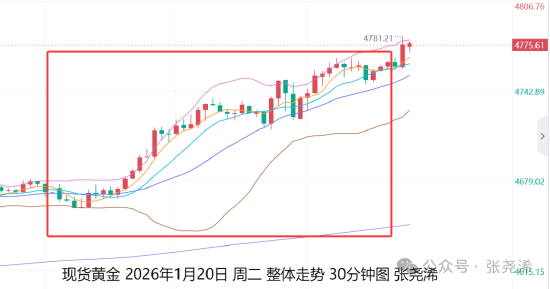
1月21日:上交易日周二(1月20日):国际黄金继续反弹,强势拉升收涨,白宫就格陵兰岛的未来向欧 洲发出威胁,再度引发抛售美国交易,引发对避险资产的抢购,导致美元指数大幅回落收跌,推动金价 继续走强突破新高,并收至日图上升趋势线通道之上,这暗示多头进一步向上突破,再度打开牛市空 间,那么后市将继续上行,等待触及5000美元目标或更高位置。 具体走势上,金价自亚市开于4668.63美元/盎司,先行偏弱走低录得日内低点4659.45美元,之后反弹回 升突破4700美元关口,欧盘时段横盘于4710美元上方,美盘开盘震荡上行,一直延续到盘尾录得日内高 点4766.01美元,最终收于4763.23美元,日振幅106.56美元,收涨94.6美元,涨幅2.03%。 展望今日周三(1月21日):国际黄金开盘延续昨日多头动力继续表现走强,美元指数虽早盘止跌表 现,但昨日的回落已使其处于阻力下方,空头占据优势,另外,月图走势仍处于布林带下行通道,且短 期走势前景仍偏弱,故此日内止跌对于金价限制有限,金价仍维持看涨不变。 日内可留意美国12月成屋签约销售指数月率和美国10月营建支出月率等数据,市场预期整体偏向利好金 价,故此,日内 ...
牛市归来,但我劝客户别乱买!
Xin Lang Cai Jing· 2026-01-21 08:13
Core Viewpoint - The A-share market is experiencing a significant rise, with the Shanghai Composite Index reaching 4100 points, indicating a recovery in investor confidence. However, wealth management practices are being reshaped by new regulations, necessitating a shift from traditional sales models to a more client-focused advisory approach [1]. Group 1: Buy-side Advisory - In a bullish market, the role of buy-side advisors is crucial for establishing long-term trust with clients. Advisors should focus on comprehensive services that include financial planning and asset allocation rather than merely pushing products [2]. - The current market conditions present an opportunity for advisors to build new trust relationships by guiding clients back to their financial goals and away from impulsive trading behaviors [2]. Group 2: Implementation Strategy - Transitioning from traditional sales to a buy-side advisory model requires a practical and replicable methodology. This involves a clear "battle map" consisting of eight core modules [3][4]. - The first module focuses on understanding the essence of buy-side advisory and differentiating between genuine and superficial transformations in advisory practices [4]. - The second module addresses client acquisition strategies, offering six actionable methods for activating existing clients and building private traffic [5]. - The third module emphasizes the importance of client selection, providing tools for creating client profiles and gracefully declining unsuitable clients [6]. - The fourth module involves diagnosing client needs through a structured assessment framework to create tailored financial plans [7]. - The fifth module outlines the implementation of a dual-layer asset allocation framework that moves beyond traditional risk assessment and product recommendations [8]. - The sixth module provides a comprehensive post-investment management process, including regular reviews and adjustment strategies during market fluctuations [8]. - The seventh module focuses on managing client emotions, offering differentiated support strategies based on client risk profiles [8]. - The eighth module aims to align clients' investment beliefs with educational resources to strengthen long-term trust [9]. Group 3: Professional Development - The current market recovery serves as a test for the industry and an accelerator for personal career transformation. Professionals with genuine skills will navigate the market effectively [10]. - This guide is intended for those transitioning to buy-side advisory roles and for financial advisors seeking to explore new models within traditional platforms [10].
中证1000ETF(159845.SZ)盘中成交额超80亿,机构表示本轮“牛市”根基依旧牢固
Sou Hu Cai Jing· 2026-01-21 06:36
Group 1 - A-shares indices collectively rose, with the Shanghai Composite Index increasing by 0.29% [1] - The CSI 1000 ETF saw a rise of 0.89%, while other major indices like the SSE 50 and CSI 300 also experienced gains [1] - Among the top 50 weighted stocks in the CSI 1000 ETF, notable gainers included Zhongtung High-tech (+10.00%), Yuntian Lifeng (+8.55%), and Jucheng Co. (+8.10%) [1] Group 2 - The electronic sector rose by 2.71%, while other sectors such as power equipment and pharmaceuticals also showed positive performance [1] - Recent government policies aim to reduce financing costs and lower barriers for private enterprises, addressing the challenges of high financing costs and difficulties in obtaining financing [2] - Analysts suggest that the A-share market retains strong upward momentum due to factors like increased household savings entering the market and a new wave of technological industrial revolution [2]
任泽平写给股民们的九条建议:理性看待市场波动,不盲目加杠杆,忌追涨杀跌、频繁操作、反复折腾……
Sou Hu Cai Jing· 2026-01-21 03:25
Group 1 - The article discusses the current bullish sentiment in the market, emphasizing the need for rationality and caution as regulatory measures aim to cool down excessive speculation [1] - It highlights the importance of understanding market trends and maintaining a long-term perspective, suggesting that the logic behind the bull market remains intact as long as confidence, policy support, and technological advancements continue [1] - The article warns that market fluctuations are normal and that investors should not be swayed by emotions, advocating for a disciplined approach to investing [4][5] Group 2 - It stresses the significance of investing only with spare money and avoiding a gambler's mentality, recommending that investors maintain a financial buffer for living expenses [6] - The article points out that bull markets do not guarantee profits and cautions against chasing trends and frequent trading, which can lead to losses [7][8] - It emphasizes the necessity of enhancing one's understanding of the market and avoiding impulsive decisions based on rumors or short-term fluctuations [9] Group 3 - The article advises investors to operate within their capability circles and choose investment strategies that suit their expertise, whether through direct stock purchases or utilizing professional funds [10] - It recommends diversification to mitigate risks, suggesting that investors should not concentrate their assets in one area [11] - The importance of maintaining a long-term vision is highlighted, with a warning against being influenced by short-term market movements [12][13] Group 4 - The article discusses the "disposition effect," where investors tend to sell winning stocks too early while holding onto losing ones, urging a focus on fundamental analysis instead [14] - It warns against "selective attention," where investors only acknowledge information that supports their views, advocating for a comprehensive evaluation of market conditions [15]
写给股民们的九条建议
泽平宏观· 2026-01-20 16:06
Core Viewpoint - The article discusses the current bullish market sentiment and the potential for a "slow bull" rather than a "crazy bull," emphasizing the importance of rationality and understanding market dynamics to avoid pitfalls in investing [1]. Market Volatility - Market fluctuations are normal, and investors should respect market rules and avoid being swayed by emotions. The concept of "Mr. Market" illustrates that stock prices can deviate from intrinsic values in the short term, but will eventually revert to their true value [5]. - Investors should remain calm and rational, avoiding emotional reactions to market movements. The article highlights the dangers of impulsive trading based on fear or greed, advocating for a focus on identifying strong companies and waiting for the right opportunities [6]. Investment Principles - Investing should be done with spare money that does not affect one's quality of life. The article warns against a gambler's mentality, where investors risk all their assets in hopes of quick wealth, which can lead to stress and poor decision-making [7]. - The article categorizes household assets into four types: money for expenses, money for safety, money for growth, and money for preservation. It emphasizes the importance of maintaining sufficient cash for living expenses [8]. Market Behavior - The article cautions that a bull market does not guarantee profits and warns against chasing trends and frequent trading. It cites Graham's observation that bull markets can lead to losses for ordinary investors due to overconfidence and impulsive actions [10]. - A-shares are characterized by a predominance of retail investors, which amplifies market volatility and can lead to herd behavior. The number of retail investors has surpassed 240 million, with retail holdings accounting for about 28% of the market capitalization [11]. Cognitive Awareness - Investors must change their mindset and avoid making decisions based on rumors or superficial information. Understanding the fundamentals of the market, including economic indicators and company performance, is crucial for successful investing [12]. - The article emphasizes the importance of investing within one's capability and knowledge. It suggests that investors should either engage directly in stock trading if experienced or rely on professional fund managers if they lack the time or expertise [13]. Risk Management - Diversification is essential to mitigate non-systematic risks. The article advises against concentrating investments in a single asset or sector, promoting a balanced portfolio across various asset classes [14]. - Investors should maintain a long-term perspective and not let short-term market fluctuations alter their investment beliefs. Focusing on companies with long-term growth potential is key to achieving better returns [16]. Emotional Discipline - The article discusses the "disposition effect," where investors tend to sell winning stocks too early and hold onto losing ones. It encourages focusing on fundamental analysis rather than succumbing to short-term market pressures [17]. - Investors should avoid "selective attention," which leads to a biased view of the market. A comprehensive evaluation of market conditions and company performance is necessary for informed decision-making [18].

黑天鹅又来
Sou Hu Cai Jing· 2026-01-20 14:27
Group 1 - The A-share market is experiencing a significant decline, particularly in the previously overheated sectors, with the ChiNext index showing substantial losses [1] - Since January 15, the selling amount by institutional investors in major ETFs has reached approximately 390 billion yuan, indicating a strong sell-off trend [1] - Despite the sell-off, market sentiment remains stable with a trading volume of 2.8 trillion yuan, suggesting that investor interest is still present [1] Group 2 - Recent regulatory actions have targeted market manipulation, with the China Securities Regulatory Commission (CSRC) penalizing prominent financial influencers and tightening control over financial content [2] - The introduction of the "Dragon and Tiger List" has led to increased transparency but has also resulted in unintended consequences, such as encouraging retail investors to follow large traders, which can distort market pricing [2] - The CSRC's ongoing crackdown on irregular trading practices indicates a shift towards stricter market oversight [2] Group 3 - Global markets are reacting to unexpected events, including a sharp decline in Japanese government bonds and trade tensions initiated by former President Trump, leading to increased risk aversion [3] - The gold futures market has surged by 3%, reaching 4,735 USD, while the US dollar index has seen a consecutive decline, reflecting a shift in investor sentiment [3] - The People's Bank of China has maintained the Loan Prime Rate (LPR), while the National Development and Reform Commission emphasizes the need for proactive fiscal policies, which could benefit cyclical sectors as consumer expectations rise ahead of the Spring Festival [3]