
股债性价比

Search documents
A股市场快照:宽基指数每日投资动态-20251023
Jianghai Securities· 2025-10-23 08:57
- The report provides a snapshot of the performance of broad-based indices in the A-share market, highlighting daily, weekly, monthly, and yearly changes in index returns, with the highest annual return observed for the ChiNext Index at 42.85%[10][11][13] - It compares indices against their moving averages (MA5, MA10, MA20, MA60, MA120, MA250) and their 250-day high and low levels, showing that all indices remain above their 5-day moving averages, except the CSI 2000, which fell below its 10-day moving average[13][14] - The turnover rate and trading volume share are analyzed, with CSI 2000 having the highest turnover rate at 3.56, while the CSI 300 accounts for the largest trading volume share at 26.89%[16][17] - Daily return distributions are examined, revealing that the ChiNext Index has the largest negative skewness and kurtosis deviation, while the CSI 300 has the smallest[23][24] - Risk premium analysis is conducted using the 10-year government bond yield as the risk-free rate, showing that the CSI 1000 and CSI 2000 have higher volatility in risk premiums compared to other indices[26][27][30] - PE-TTM ratios are evaluated as valuation metrics, with CSI 500 and CSI All Index showing the highest 5-year percentile values at 98.18% and 97.44%, respectively, while the ChiNext Index has the lowest at 58.51%[38][41][42] - Dividend yield analysis indicates that the ChiNext Index and CSI 1000 have the highest 5-year historical percentile values at 69.42% and 46.2%, respectively, while CSI 2000 and CSI 500 have the lowest at 20.25% and 16.28%[46][51][52] - The report also tracks the percentage of stocks trading below their net asset value (break-net ratio), with the highest ratio observed for the SSE 50 at 18.0% and the lowest for the ChiNext Index at 1.0%[53]
A股市场快照:宽基指数每日投资动态-20251021
Jianghai Securities· 2025-10-21 08:30
- The report provides a snapshot of the performance of broad-based indices in the A-share market, highlighting that all indices experienced an increase on October 20, 2025, with the ChiNext Index (1.98%) and CSI 2000 (1.43%) showing the largest daily gains[1][2][10] - The ChiNext Index achieved the highest annual growth rate of 39.78%, followed by CSI 2000 (28.01%) and CSI 500 (23.47%), while the SSE 50 recorded the smallest annual growth rate of 10.81%[10][11] - The ChiNext Index broke above its 5-day moving average, while other indices remained below their 5-day and 10-day moving averages, with all indices being more than 1.5% away from their 250-day highs[13][14] - The turnover rate of indices on October 20, 2025, was led by CSI 2000 (3.21), followed by CSI 1000 (2.25) and ChiNext Index (2.07), while SSE 50 had the lowest turnover rate at 0.31[16][17] - The distribution of daily returns showed that the ChiNext Index had the largest negative skewness and kurtosis deviation, while CSI 1000 had the smallest negative skewness and kurtosis deviation[23][24] - Risk premium analysis revealed that the ChiNext Index (88.81%) and CSI 2000 (85.08%) had relatively high 5-year percentile values, while CSI 1000 (72.7%) and SSE 50 (62.22%) had lower values[28][30] - PE-TTM analysis indicated that CSI 500 (98.26%) and CSI All Index (95.62%) had high 5-year percentile values, while CSI 2000 (82.89%) and ChiNext Index (58.02%) had lower values[39][41] - Dividend yield analysis showed that the ChiNext Index (71.07%) and CSI 1000 (50.66%) were at relatively high 5-year historical percentile values, while CSI 2000 (24.13%) and CSI 500 (16.61%) were at lower values[50][51] - Current net break rates for indices were reported as follows: SSE 50 (20.0%), CSI 300 (15.67%), CSI 500 (11.6%), CSI 1000 (7.4%), CSI 2000 (3.3%), ChiNext Index (1.0%), and CSI All Index (5.99%)[52][54]
固定收益周报:期限利差如期收窄-20251019
Huaxin Securities· 2025-10-19 11:02
1. Report Industry Investment Rating No relevant content provided. 2. Core Views of the Report - The overall outlook for China in 2025 is that the real GDP growth rate of the asset side will run smoothly, fluctuating narrowly between 4 - 5%. The liability side will see the debt growth rate of the real - sector decline and approach the nominal economic growth rate. The monetary policy will coordinate with the fiscal policy, maintaining an overall neutral and oscillating stance [21]. - The stock - bond performance shows that the risk preference has declined, funds tend to flow into long - term bonds and value - style equities. The equity style is dominated by value, and the stock - bond ratio favors bonds. The long - term bond yield has decreased, and the short - term bond yield has increased [6][22]. - In the contraction cycle, the stock - bond ratio favors equities to a limited extent, and the value style is more likely to be dominant. A + H dividend portfolios and A - share portfolios are recommended, mainly concentrated in industries such as banking, telecommunications, petroleum and petrochemicals, and transportation [10][25]. 3. Summary According to the Directory 3.1 National Balance Sheet Analysis - **Liability Side**: In September 2025, the debt growth rate of the real sector was 8.9%, in line with expectations. It is expected to drop to around 8.7% in October, and further to around 8.5% by the end of the year. The financial sector's capital is still tight, and risk preference has declined, with funds flowing into long - term bonds and value - style equities [1][17]. - **Fiscal Policy**: Last week, the net reduction of government bonds was 238 billion yuan, higher than the planned 69.1 billion yuan. Next week, the net increase of government bonds is planned to be 133.3 billion yuan. The government debt growth rate in September 2025 was 14.5%, expected to drop to around 13.6% in October and around 13.0% by the end of the year [2][18]. - **Monetary Policy**: Last week, the average weekly trading volume of funds increased, the price decreased, and the term spread narrowed significantly. The one - year Treasury yield rose to 1.44% at the weekend, and its lower limit is estimated to be around 1.3%. The term spread between the ten - year and one - year Treasury bonds narrowed to 38 basis points. The future yield fluctuation ranges of the ten - year and thirty - year Treasury bonds are estimated to be around 1.6% - 1.9% and 1.8% - 2.3% respectively [3][19]. - **Asset Side**: The physical volume data in August continued to weaken compared to July. The annual real economic growth target for 2025 is around 5%, and the nominal economic growth target is around 4.9%. It remains to be seen whether 5% will become the central target for China's nominal economic growth in the next 1 - 2 years [5][20]. 3.2 Stock - Bond Ratio and Stock - Bond Style - **Overall Outlook**: In 2025, China's asset side real GDP growth will be stable, and the liability side's real - sector debt growth rate will decline. The stock - bond ratio favors bonds, and the equity style is dominated by value. The recommended allocation is 60% for the Shanghai Composite 50 Index, 20% for the CSI 1000 Index, and 20% for the 30 - year Treasury Bond ETF [21][25]. - **Market Performance**: Last week, the risk preference declined, funds flowed into long - term bonds and value - style equities. The ten - year Treasury yield decreased by 2 basis points to 1.82%, the one - year Treasury yield increased by 7 basis points to 1.44%, and the 30 - year Treasury yield decreased by 8 basis points to 2.20%. The broad - based rotation strategy outperformed the CSI 300 Index by 1.51 percentage points last week [6][22]. 3.3 Industry Recommendation - **Industry Performance Review**: This week, the A - share market declined with shrinking trading volume. Among the Shenwan primary industries, banking, coal, food and beverage, transportation, and textile and apparel had the largest increases, while electronics, media, automobiles, communications, and machinery had the largest declines [30]. - **Industry Crowding and Trading Volume**: As of October 17, the top five crowded industries were electronics, power equipment, non - ferrous metals, computers, and machinery. The industries with the largest increase in crowding this week were pharmaceutical biology, transportation, coal, banking, and commercial retail. The overall average daily trading volume of A - shares decreased this week. Industries such as steel, coal, transportation, banking, and beauty care had the highest year - on - year trading volume growth [33][34]. - **Industry Valuation and Earnings**: Among the Shenwan primary industries this week, banking, coal, food and beverage, transportation, and textile and apparel had the largest increases in PE (TTM), while electronics, media, communications, basic chemicals, and machinery had the smallest increases. Industries with high 2024 full - year earnings forecasts and relatively low current valuations compared to history include banking, insurance, petroleum and petrochemicals, transportation, traditional Chinese medicine, pharmaceutical biology, beauty care, and consumer electronics [38][39]. - **Industry Prosperity**: Externally, the global manufacturing PMI declined in September, the CCFI index decreased, and the port cargo throughput declined. South Korea's export growth rate decreased in early October. Domestically, the second - hand housing price decreased last week, and the quantity indicators showed mixed trends. The highway truck traffic volume increased, the ten - industry fitted capacity utilization rate declined from September to October, the automobile trading volume was at a relatively high level in the same period of history, the new - housing trading volume was at a historical low, and the second - hand housing trading volume declined seasonally [43]. - **Public Offering Market Review**: In the second week of October (October 13 - 17), most active public - offering equity funds underperformed the CSI 300. As of October 17, the net asset value of active public - offering equity funds was 4.04 trillion yuan, slightly higher than 3.66 trillion yuan in Q4 2024 [59]. - **Industry Recommendation**: In the contraction cycle, the stock - bond ratio favors equities to a limited extent, and the value style is more likely to be dominant. Recommended A + H dividend portfolios and A - share portfolios mainly include 20 stocks each, concentrated in industries such as banking, telecommunications, petroleum and petrochemicals, and transportation [10][63].
部分基金管理人调高旗下债基净值精度应对大额赎回
Zheng Quan Ri Bao· 2025-10-14 15:43
Core Viewpoint - The bond funds have experienced significant net outflows, totaling 10.04 billion yuan in the first three trading days of October, while stock funds attracted nearly 60 billion yuan, indicating a shift in market risk appetite and testing fund managers' liquidity management capabilities [1][4]. Group 1: Bond Fund Redemption - Multiple bond funds faced large redemptions post the National Day holiday, prompting fund managers like Ping An Fund to announce adjustments to net asset value precision to mitigate the impact of these redemptions [2][3]. - As of October 14, 12 fund managers, including Hengyue Fund and ICBC Credit Suisse Fund, have reported significant redemptions in their bond funds and have raised net asset value precision [2][3]. Group 2: Impact of Large Redemptions - Large redemptions can lead to a rapid decrease in the asset scale of bond funds, forcing managers to sell liquid assets, which may cause bond prices to drop and create a negative feedback loop of further redemptions and net value declines [3]. - Adjusting net asset value precision to eight decimal places allows for a more accurate reflection of the fund's actual value post-redemption, reducing discrepancies in returns for investors and minimizing compliance risks for fund companies [3]. Group 3: Stock Fund Inflows - In stark contrast to bond funds, stock funds saw a net inflow of 59.846 billion yuan in the same period, with several funds, including the GF National Index New Energy Vehicle Battery ETF, attracting over 1 billion yuan each [4]. - Investor confidence in the equity market has increased, leading to a preference for stock funds over bond funds, particularly in sectors like AI and robotics, which have shown strong performance [4]. Group 4: Market Outlook - Despite the short-term pressures on the bond market, industry experts remain optimistic about opportunities in the fourth quarter, citing the central bank's supportive stance on interbank liquidity as a positive factor for short-term bonds [4]. - The yield on 30-year government bonds is generally above 2.2%, suggesting that long-term bonds may present further investment value as equity market returns decline [5].
这只“量化”基金,连亏5年...
Sou Hu Cai Jing· 2025-10-14 10:25
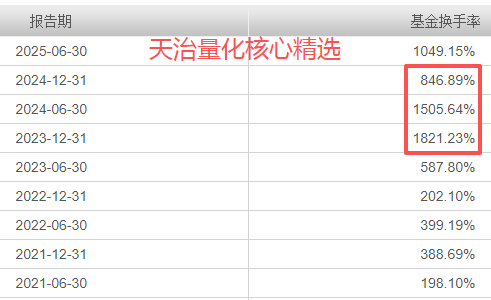
Core Viewpoint - The "Tian Zhi Quantitative Core Selection" fund has experienced significant losses, with a reported decline of 13.39% this year, marking a trend of consecutive annual losses over the past four years, each exceeding double digits [5][27]. Fund Performance - The fund's turnover rate has been exceptionally high, reaching over 1000% since August 2023, indicating frequent trading of its top holdings [14]. - The fund's net asset value has fluctuated significantly, with a reported net asset change rate of 374.38% as of June 30, 2025, despite the overall decline in performance [8]. Fund Management - The fund has undergone management changes, with five different fund managers, each contributing to poor performance rankings [19]. - The previous manager, Xu Jiahan, is noted for making high-risk investments, leading to substantial losses during his tenure [11][23]. Investment Strategy - The fund's investment strategy has been criticized for chasing high-performing stocks, particularly during periods of market volatility, which has exacerbated losses [16][27]. - The current manager, Li Shen, has shifted the fund's focus towards value stocks, particularly in the financial and public utility sectors, but has struggled to capitalize on market rebounds [25][27]. Market Context - The fund's performance is set against a backdrop of broader market trends, with significant fluctuations in growth and value sectors, impacting overall investment strategies [30][34]. - Despite the fund's poor performance, there has been an influx of retail investor interest, leading to an increase in the fund's C share scale from 2 million to 7 million [28].


财通资管宫志芳:回撤有底线,以大类资产配置思维做投资
Zhong Guo Ji Jin Bao· 2025-10-13 03:33
Core Viewpoint - The current market environment presents a favorable opportunity for investing in multi-strategy fixed income products, emphasizing risk control and sustainable returns over maximizing short-term gains [1][2]. Group 1: Investment Strategy - The investment philosophy prioritizes risk management, with a focus on controlling drawdowns and ensuring accumulative returns [2][4]. - The approach involves setting predetermined stop-loss and take-profit points for each trade, balancing between profit-taking and risk management [3]. - The company emphasizes a top-down asset allocation strategy, making macro-level judgments to guide investment decisions [4][5]. Group 2: Market Outlook - The bond market is expected to have limited further adjustments, with potential opportunities for allocation in the fourth quarter [7]. - The equity market is anticipated to continue its structural rally, with a focus on selecting next-tier leaders or broad-based ETFs to reduce portfolio volatility [7]. - Convertible bonds are viewed as a significant source of yield enhancement, with a focus on stocks with strong growth potential and themes like "anti-involution" and AI-related sectors [7][8]. Group 3: Team and Product Development - The fixed income team at the company consists of nearly 70 professionals with an average of 7 years of experience, covering a wide range of asset classes and investment strategies [5][6]. - Since 2016, the company has developed a mature management system for multi-strategy fixed income products, currently offering 14 different products [6]. - The company aims to balance volatility and return sources while allowing fund managers to leverage their strengths and meet investors' risk preferences [6].
策略周报:波动再度放大,如何应对?-20251012
HWABAO SECURITIES· 2025-10-12 06:06
Group 1 - The report highlights that the bond market is experiencing a mild recovery due to the central bank's continued support for liquidity, with expectations of a gradual decline in supply in the fourth quarter [2][10][12] - In the stock market, increased volatility is noted, particularly in the financial and low-volatility sectors, as profit-taking in growth sectors leads to significant market fluctuations [3][10][12] - The report suggests a balanced investment approach, focusing on mid to large-cap indices, and indicates that stable funds may enter the market to maintain stability during periods of heightened volatility [3][12][13] Group 2 - Key events include a significant increase in domestic travel during the National Day holiday, with 888 million trips taken, generating a total expenditure of 809 billion yuan, reflecting a year-on-year increase [9] - The report mentions new export control measures on certain materials, which will take effect on November 8, indicating potential impacts on related industries [9] - The report tracks important market indicators, noting that the average daily trading volume in the A-share market has rebounded to 2.603 trillion yuan, indicating increased market activity post-holiday [21][22]
螺丝钉股市牛熊信号板来啦:当前市场估值如何|2025年10月份
银行螺丝钉· 2025-10-10 05:30
Core Viewpoint - The article discusses the current state of the stock market as of October 2025, highlighting various quantitative and qualitative signals that indicate market conditions, including valuation metrics and investor sentiment [1][55]. Quantitative Signals - The Buffett Indicator shows a market valuation of 80% below GDP, indicating a relatively low market valuation [25]. - The price-to-book ratio percentile indicates that the market is at 71.51% for large-cap value stocks and 83.49% for small-cap value stocks, suggesting that large-cap stocks are relatively undervalued [3][5]. - The stock-bond yield ratio is at 2.46, which is above the threshold of 2, indicating that stocks are undervalued compared to bonds [29]. - The financing balance in the A-share market is at 23,784 billion, reflecting a cooling market sentiment [9][10]. - The current trading volume percentile is at 99.60%, indicating a high level of trading activity compared to historical data [11]. Qualitative Signals - The number of new stock issuances has decreased significantly, and the high rate of new stock failures suggests a bearish market sentiment [36]. - The M2 money supply is used as a liquidity indicator, with the market's performance closely tracking its movements [38]. - The scale of old funds has decreased significantly, with many funds down by 50%-60% compared to their peak in 2021, indicating a lack of investor confidence [41]. - The issuance of new funds remains low, with recent data showing a historical low in new fund sizes, reflecting a bearish market environment [45]. - The proportion of limited purchase funds is at 17.39%, indicating a cautious approach from fund managers in a potentially overvalued market [50]. Market Trends - The article notes two significant market lows in early 2024, both at a star rating of 5.9, indicating extreme undervaluation [56]. - Following these lows, the market has shown signs of recovery, with the star rating improving to around 4.1 by October 2025, suggesting a gradual return to normal valuation levels [57]. - The small-cap growth style has seen significant gains, reaching overvalued levels, while other styles remain closer to normal or undervalued [57].

A股市场快照:宽基指数每日投资动态-20250929
Jianghai Securities· 2025-09-29 13:12
- The report provides a snapshot of the A-share market performance, highlighting that all broad-based indices experienced a decline on September 26, 2025, with the largest drops seen in the ChiNext Index (-2.6%) and CSI 2000 (-1.55%) [1][2][10] - The report notes that most indices, except SSE 50, fell below their 5-day moving averages, with CSI 1000 and CSI All Share Index also falling below their 10-day moving averages, and SSE 50 and CSI 2000 dropping below their 20-day moving averages [2][13][15] - The turnover rate of the indices on September 26, 2025, is highlighted, with CSI 2000 having the highest turnover rate (3.69), followed by ChiNext Index (3.02) and CSI 1000 (2.67) [2][18] - The daily return distribution of the indices is analyzed, showing that CSI All Share Index has the largest negative kurtosis deviation, while CSI 1000 has the smallest negative kurtosis deviation. CSI All Share Index also has the largest negative skewness, whereas SSE 50 and CSI 300 have the smallest negative skewness [2][23][25] - The risk premium of the indices relative to the 10-year government bond yield is discussed, with SSE 50 (33.65%) and CSI 300 (14.92%) having relatively high 5-year percentile values, while CSI 500 (10.63%) and ChiNext Index (4.68%) have lower values [2][30][32] - The PE-TTM values and percentiles of the indices are analyzed, showing that CSI 500 (99.75%) and CSI All Share Index (96.45%) have high 5-year percentile values, while SSE 50 (82.48%) and ChiNext Index (60.5%) have lower values [3][40][42] - The stock-bond valuation ratio is calculated using the reciprocal of PE-TTM and the difference with the 10-year government bond yield. None of the indices exceed their 80% percentile, and CSI 500 is below its 20% percentile [45][46] - Dividend yield trends are analyzed, showing that ChiNext Index (63.39%) and CSI 1000 (47.19%) are at relatively high 5-year historical percentiles, while CSI 2000 (18.6%) and CSI 500 (15.12%) are at lower percentiles [3][50][53] - The report highlights the current net asset value discount rates of the indices, with SSE 50 having the highest rate (26.0%), followed by CSI 300 (17.33%) and CSI 500 (12.0%), while ChiNext Index has the lowest rate (1.0%) [3][54]
资产配置周报:推荐长债加价值的配置组合-20250928
Huaxin Securities· 2025-09-28 11:02
1. Report Industry Investment Rating No relevant content provided. 2. Core Viewpoints of the Report - China is in a marginal de - leveraging process, with the growth rate of the real - sector's liabilities expected to decline to around 8% by the end of the year, and the government - sector's liabilities to around 12.5%. The bond market will not enter a trending bear market, and yields are expected to oscillate at low levels. Risk preference repair is basically in place, and future risk preference will oscillate within a range with earnings. The recommended asset - allocation combination is long - term bonds plus value stocks. In the de - leveraging cycle, the dividend - type stocks in the A + H market are recommended, mainly concentrated in industries such as banking, telecommunications, petroleum and petrochemicals, and transportation [3][4][11]. 3. Summary by Relevant Catalogs 3.1 National Balance Sheet Analysis - **Liability Side**: In August 2025, the real - sector's liability growth rate was 8.9%, down from 9.1% previously, and is expected to drop to around 8.7% in September. The government's liability growth rate was 15.0% at the end of August, and is expected to decline to around 14.5% in September. The central bank aims to stabilize the macro - leverage ratio, and large - scale debt resolution reduces local government financing costs. The money market tightened marginally last week, and there is a higher probability of a temporary relaxation in October [3][4]. - **Asset Side**: The physical volume data in August was weaker than in July. The annual nominal economic growth target for 2025 is around 4.9%, and it needs to be further observed whether this will become the central target for China's nominal economic growth in the next 1 - 2 years [5]. 3.2 Stock - Bond Cost - Effectiveness and Stock - Bond Style - **Overall Performance**: Last week, the money market tightened marginally, and the stock - bond market was generally stable, with value stocks slightly outperforming. The ten - year bond yield rose 1 basis point to 1.88%, and the one - year bond yield remained stable at 1.39%. The wide - based rotation strategy underperformed the CSI 300 index by - 0.66pct last week and - 8.04pct since July [7]. - **Risk Preference and Asset Allocation**: Risk preference repair is basically in place, and future risk preference will oscillate within a range with earnings. The recommended asset - allocation combination is long - term bonds plus value stocks. In the next two weeks, the recommended allocation is the SSE 50 index (60% position), the CSI 1000 index (20% position), and the 30 - year Treasury bond ETF (20% position) [9][10]. 3.3 Industry Recommendation - **Industry Performance Review**: This week, the A - share market rose with shrinking volume. The sectors with the largest increases were power equipment, non - ferrous metals, electronics, environmental protection, and media, while the sectors with the largest declines were social services, comprehensive, commercial retail, light manufacturing, and textile and apparel [33]. - **Industry Crowding and Trading Volume**: As of September 26, the top five crowded industries were electronics, power equipment, computers, machinery, and automobiles, while the bottom five were comprehensive, beauty care, coal, petroleum and petrochemicals, and steel. The industries with the largest increase in crowding were power equipment, electronics, non - ferrous metals, computers, and media [34]. - **Industry Valuation and Earnings**: This week, the PE (TTM) of power equipment, non - ferrous metals, electronics, environmental protection, and media increased the most, while that of social services, comprehensive, commercial retail, light manufacturing, and textile and apparel increased the least. Industries with high 2024 full - year earnings forecasts and relatively low current valuations include banking, insurance, coal, petroleum and petrochemicals, transportation, traditional Chinese medicine, pharmaceutical biology, beauty care, and consumer electronics [39][40]. - **Industry Prosperity**: External demand generally rebounded, with the global manufacturing PMI rising from 49.7 to 50.9 in August. Domestic demand showed mixed signals, with second - hand housing prices falling and some quantity indicators rising and falling. The capacity utilization rate of ten industries increased from May to August and declined slightly in September [44]. - **Public Fund Market Review**: In the fourth week of September, most active public equity funds outperformed the CSI 300. As of September 26, the net asset value of active public equity funds was 4.21 trillion yuan, slightly up from 3.66 trillion yuan in Q4 2024 [60]. - **Industry Recommendation**: In the de - leveraging cycle, the recommended A + H dividend portfolio includes 20 A + H stocks, and the A - share portfolio includes 20 A - share stocks, mainly concentrated in industries such as banking, telecommunications, petroleum and petrochemicals, and transportation [11].