
降息降准

Search documents
9月LPR按兵不动,专家预测:年底前将有下降空间
Sou Hu Cai Jing· 2025-09-22 11:26
Group 1 - The People's Bank of China (PBOC) has been deepening interest rate marketization reforms, enhancing the framework for market-based interest rate regulation, and promoting a decline in overall financing costs in society [1][2] - The 1-year Loan Prime Rate (LPR) has remained stable at 3% and the 5-year LPR at 3.50% since May 2025, following a 10 basis point reduction [1][2] - The average weighted interest rate for new corporate loans in August was approximately 3.1%, down about 40 basis points year-on-year, while the average for new personal housing loans was also around 3.1%, down about 25 basis points year-on-year [2] Group 2 - The bond market has experienced significant fluctuations, with the 10-year government bond yield recently exceeding 1.8%, indicating market expectations for the PBOC to resume government bond trading operations [2] - As of the end of Q2 2025, the net interest margin for commercial banks was 1.42%, a slight decrease from the previous quarter, with large commercial banks, joint-stock commercial banks, and private banks reporting net interest margins of 1.31%, 1.55%, and 3.91% respectively [2] - There is an expectation that the PBOC may implement another round of interest rate cuts in Q4, which could lead to further declines in LPR quotes and lower loan rates for businesses and residents [3][4] Group 3 - The current low inflation levels provide ample space for the PBOC to adopt a moderately loose monetary policy, including potential interest rate cuts, without immediate concerns about high inflation [4] - The anticipated downward adjustment of the 5-year LPR could significantly reduce residential mortgage rates, stimulating housing demand and reversing market expectations [4]

9月LPR保持“按兵不动”,四季度5年期以上LPR有望单独下行
Bei Jing Shang Bao· 2025-09-22 07:47
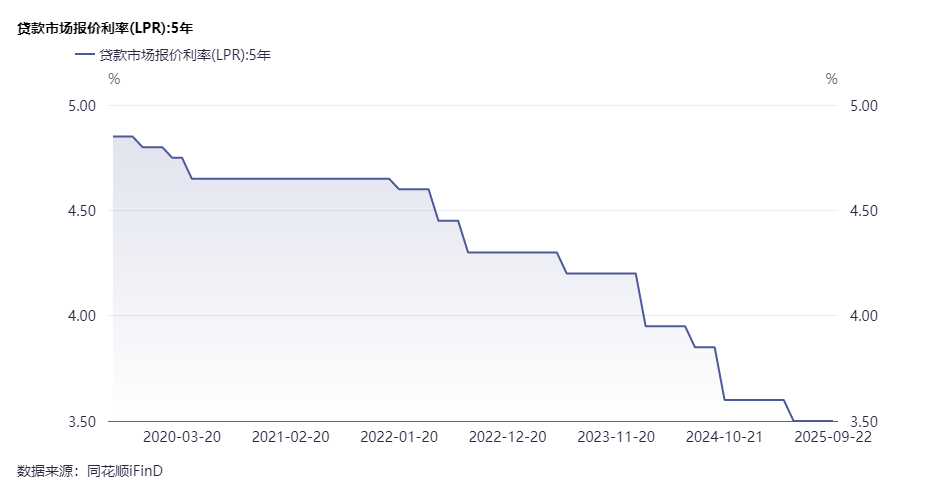
Core Viewpoint - The latest Loan Prime Rate (LPR) remains unchanged, with the 1-year LPR at 3.0% and the 5-year LPR at 3.5%, reflecting stability in monetary policy and market conditions [1][4]. Interest Rate Trends - The LPR has not changed for four consecutive months since a reduction in May 2025, where the 1-year LPR decreased from 3.10% to 3.0% and the 5-year LPR from 3.60% to 3.5% [4]. - The stability in LPR is attributed to the unchanged 7-day reverse repurchase rate and market expectations influenced by various factors, including the recent rise in medium to long-term market interest rates [4]. Financial Market Performance - Recent fluctuations in the bond market have led to increased attention on the 10-year government bond yield, which briefly surpassed 1.8%, with the latest yield reported at 1.7890% [4]. - The net interest margin for commercial banks was reported at 1.42% as of Q2 2025, showing a slight decline from the previous quarter [5]. Monetary Policy Outlook - Analysts anticipate potential interest rate cuts in Q4 2025, which could lead to further reductions in LPR, thereby encouraging lower loan rates for businesses and consumers [6]. - The current low inflation environment provides sufficient room for monetary policy adjustments, including interest rate cuts, without immediate concerns over high inflation [6]. - There is a focus on reducing housing loan rates to stimulate demand and stabilize the real estate market, with expectations for targeted reductions in the 5-year LPR [6].
9月LPR维持不变:1年期3%,5年期以上3.5%|快讯
Hua Xia Shi Bao· 2025-09-22 06:57
Core Viewpoint - The People's Bank of China has maintained the LPR rates for both 1-year and 5-year terms at 3.0% and 3.5% respectively for four consecutive months, aligning with market expectations [2] Group 1: LPR Rates - The 1-year LPR remains at 3.0% and the 5-year LPR at 3.5%, unchanged for four months [2] - The stability in policy rates, particularly the central bank's 7-day reverse repurchase rate, indicates no changes in the pricing basis for LPR this month [2] Group 2: Future Expectations - Industry experts anticipate a potential new round of interest rate cuts and reserve requirement ratio reductions in the fourth quarter, which may lead to a decrease in LPR rates [2] - A significant reduction in loan rates for enterprises and residents is expected, aimed at stimulating internal financing demand and promoting consumption and investment [2] - There is an expectation for stronger policies to stabilize the real estate market, potentially leading to a more substantial decrease in residential mortgage rates through targeted adjustments to the 5-year LPR [2]

中国LPR连续四个月未变 专家称年内仍有降息空间
Zhong Guo Xin Wen Wang· 2025-09-22 06:25
Core Viewpoint - The Loan Prime Rate (LPR) in China has remained unchanged for four consecutive months, with the one-year LPR at 3.0% and the five-year LPR at 3.5%, aligning with market expectations [1][2] Group 1 - The stability of the LPR is attributed to the unchanged policy interest rates, specifically the central bank's seven-day reverse repurchase rate, which has not changed in September [1] - Recent increases in medium to long-term market interest rates, such as the AAA-rated one-year interbank certificates of deposit and the ten-year government bond yields, have reduced the motivation for banks to lower LPR quotes [1] - The current net interest margin for commercial banks is at a historical low, further contributing to the lack of incentive to adjust LPR downwards [1] Group 2 - There is potential for a reduction in policy interest rates and LPR quotes before the end of the year, particularly as measures to boost domestic demand and stabilize the real estate market are implemented [2] - The expectation of a new round of interest rate cuts and reserve requirement ratio reductions by the central bank in the fourth quarter could lead to a significant decrease in loan rates for businesses and residents [2] - This monetary easing is seen as a crucial strategy to stimulate consumption and investment, effectively countering the slowdown in external demand [2]
9月LPR报价保持不变,未来走势如何?解读来了
Sou Hu Cai Jing· 2025-09-22 04:50
Group 1 - The People's Bank of China (PBOC) has maintained the Loan Prime Rate (LPR) for both 1-year and 5-year terms at 3.0% and 3.5% respectively, aligning with market expectations [1] - The stability in LPR quotes is attributed to unchanged policy rates and a lack of incentive for banks to lower LPR amid historically low net interest margins [1] - Macro data such as consumption, investment, and industrial production have shown a decline due to multiple factors including extreme weather and real estate market adjustments, but fiscal policies have been strengthened [1] Group 2 - The high tariff policies from the U.S. are expected to further impact global trade and China's exports in Q4, increasing the necessity for policies aimed at stabilizing growth and employment [3] - There is potential for a new round of interest rate cuts and reserve requirement ratio reductions by the central bank in Q4, which could lead to lower LPR quotes and stimulate internal financing demand [3] - The need for stronger policies to stabilize the real estate market is anticipated, with expectations for regulatory measures to guide down the 5-year LPR, thereby reducing mortgage rates and boosting housing demand [3]
LPR5年期维持3.5%不变 业内:报价仍有下调空间
Mei Ri Jing Ji Xin Wen· 2025-09-22 04:37
Core Viewpoint - The People's Bank of China (PBOC) has maintained the Loan Prime Rate (LPR) at 3.0% for 1-year and 3.5% for 5-year and above, indicating stability in monetary policy and potential for future adjustments to stimulate domestic demand and stabilize the real estate market [1][6]. Group 1: LPR and Monetary Policy - The LPR for both 1-year and 5-year terms remained unchanged in September, aligning with market expectations due to stable policy rates [4]. - The PBOC's 7-day reverse repurchase rate has not changed, suggesting that the pricing basis for the LPR has not shifted significantly [1][4]. - Analysts believe there is still room for downward adjustments in policy rates and LPR before the end of the year to support economic growth and stabilize the real estate market [6][7]. Group 2: Economic Conditions and Future Outlook - Recent macroeconomic data has shown volatility due to various factors, including extreme weather and external market fluctuations, but fiscal policies have been supportive since the beginning of the year [4]. - The PBOC is expected to implement a new round of interest rate cuts and reserve requirement ratio reductions in the fourth quarter, which could lead to lower loan rates for businesses and consumers [7]. - The current low inflation levels provide sufficient space for a moderately loose monetary policy, reducing concerns about high inflation [7]. Group 3: Market Reactions and Implications - The shift to a fixed quantity and interest rate bidding for the 14-day reverse repurchase operations indicates a move towards market-driven interest rates [5]. - Analysts suggest that the recent Federal Reserve rate cut may improve the environment for China's monetary easing, allowing for more aggressive domestic policy adjustments [6][8]. - The need for further support in the real estate market is emphasized, with expectations for targeted reductions in the LPR for longer-term loans to stimulate housing demand [7].
9月LPR继续按兵不动 分析师:四季度可能实施新一轮降息降准
Xin Lang Cai Jing· 2025-09-22 03:11
Core Viewpoint - The Loan Prime Rate (LPR) for both 1-year and 5-year terms remains unchanged at 3.00% and 3.50% respectively, reflecting market expectations and stable policy rates [1][2]. Group 1: LPR Stability - The LPR has not changed for four months since its reduction in May, indicating a stable pricing basis due to unchanged policy rates [1]. - The stability in LPR is attributed to various factors including extreme weather, growth stabilization policies, external fluctuations, and adjustments in the real estate market, which have led to a decline in macroeconomic data such as consumption and investment [1]. Group 2: Future Expectations - Analysts expect that the high tariff policies from the U.S. may further impact global trade and China's exports in the fourth quarter, increasing the necessity for policies aimed at stabilizing growth and employment [2]. - There is potential for a downward adjustment in policy rates and LPR quotes by the end of the year, particularly as measures to boost domestic demand and stabilize the real estate market are implemented [2]. - The recent decision by the Federal Reserve to lower the federal funds rate may reduce external constraints on China's monetary policy, suggesting that a new round of rate cuts could occur in the fourth quarter, which would lower loan rates and stimulate financing demand [2].
一周流动性观察 | 央行重启14天逆回购护航跨季跨节资金 流动性压力预计边际缓解
Zhong Guo Jin Rong Xin Xi Wang· 2025-09-22 02:55
Core Viewpoint - The People's Bank of China (PBOC) is actively managing liquidity through various monetary policy tools, including reverse repos, to maintain stability in the financial system amid seasonal pressures and external factors [1][2][3]. Group 1: Monetary Policy Operations - On September 22, the PBOC conducted a 240.5 billion yuan 7-day reverse repo operation at an interest rate of 1.40% and a 300 billion yuan 14-day reverse repo operation using a fixed quantity, interest rate bidding, and multiple price bidding method [1]. - The net injection of liquidity in the open market for the week of September 15-19 was 562.3 billion yuan, with a total net injection of 300 billion yuan for the month [1][2]. - The PBOC's adjustment of the 14-day reverse repo operation to a fixed quantity and multiple price bidding is aimed at better reflecting the differentiated funding needs of institutions and may effectively lower interest rates [3][4]. Group 2: Market Reactions and Expectations - The liquidity pressure in the market increased during the tax payment period, with R001 and R007 rates rising to 1.55% and 1.56%, respectively, before the PBOC increased its liquidity injection to alleviate the pressure [2]. - Analysts expect that the PBOC will continue to maintain a supportive stance through reasonable open market operations, with the month-end 7-day funding rate likely to be around 10-20 basis points above the reverse repo rate [3][4]. - The recent stability in the Loan Prime Rate (LPR) reflects the current macroeconomic conditions, with expectations for potential interest rate cuts in the fourth quarter to stimulate domestic demand [5].
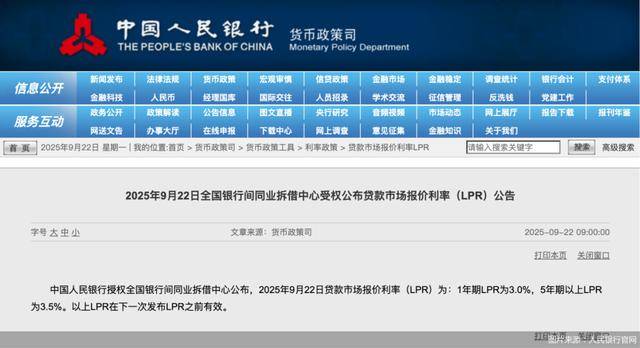
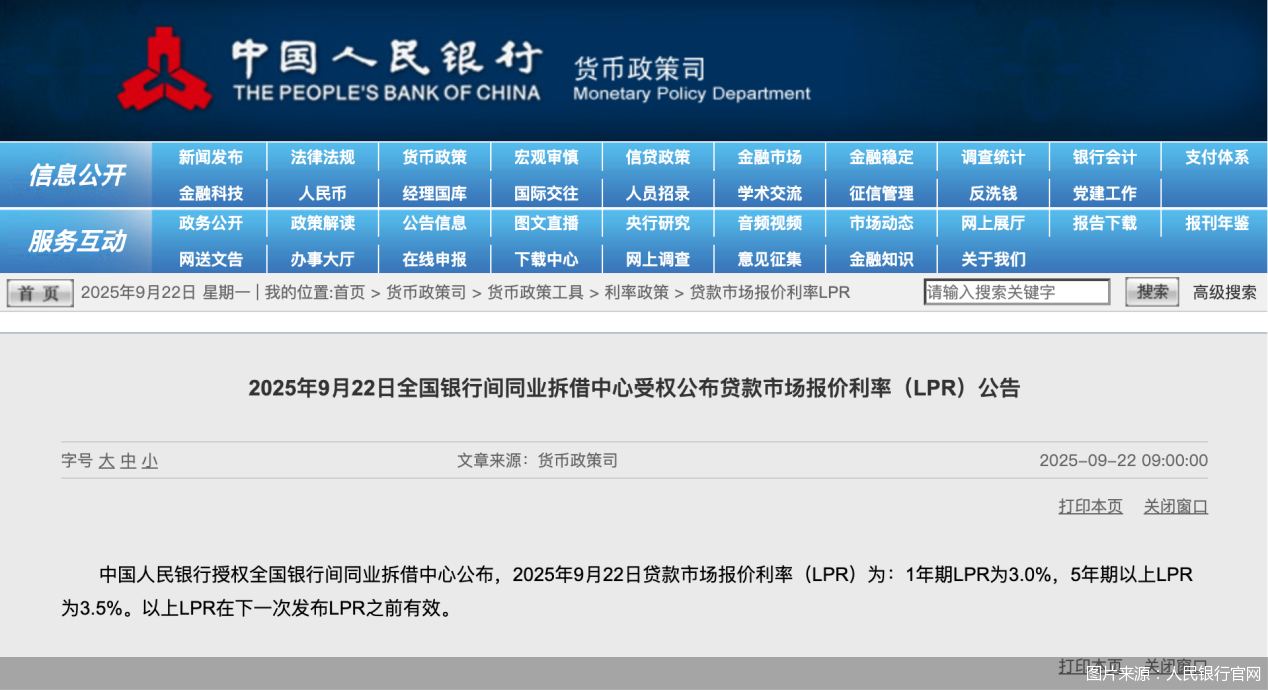
9月LPR继续按兵不动,分析师:四季度可能实施新一轮降息降准
Sou Hu Cai Jing· 2025-09-22 01:50
记者 辛圆 中国人民银行授权全国银行间同业拆借中心公布,2025年9月20日,贷款市场报价利率(LPR)为:1年期LPR为3.00%,5年期以上LPR为3.50%,均较上月 保持不变。 LPR自今年5月下调之后,已有4个月按兵不动。 东方金诚首席宏观分析师王青接受智通财经采访时表示,9月两个期限品种的LPR报价保持不变,符合市场预期。9月以来政策利率(央行7天期逆回购利 率)保持稳定,意味着当月LPR报价的定价基础没有发生变化,已在很大程度上预示9月LPR报价会保持不动。 另外,王青提到,受"反内卷"牵动市场预期等影响,近期包括1年期银行同业存单到期收益率(AAA级)、10年期国债收益率等主要中长端市场利率有所上 行,在商业银行净息差处于历史最低点的背景下,报价行也缺乏主动下调LPR报价加点的动力。由此,9月两个期限品种的LPR报价不动符合市场普遍预 期。 三季度以来,受极端天气、稳增长政策节奏、外部波动、房地产市场调整等多重因素影响,消费、投资、工业生产等宏观数据有所下行。 王青在采访中分析称,9月美联储恢复降息,意味着外部因素对国内实施适度宽松货币政策的掣肘进一步弱化。四季度央行有可能实施新一轮降息降准, ...

9月LPR报价保持不变符合市场预期,四季度有可能下调
Dong Fang Jin Cheng· 2025-09-22 01:40
Group 1: LPR Pricing and Market Expectations - The LPR rates for September remain unchanged at 3.0% for the 1-year term and 3.5% for the 5-year term, consistent with market expectations[1] - The stability in LPR pricing is attributed to unchanged policy rates and a lack of incentive for banks to lower LPR amid historically low net interest margins[2] - Recent macroeconomic data has shown a decline in consumption, investment, and industrial production due to multiple factors, including extreme weather and real estate market adjustments[2] Group 2: Future Policy Outlook - There is potential for a reduction in policy rates and LPR in the fourth quarter to stimulate domestic demand and stabilize the real estate market[3] - The U.S. Federal Reserve's recent interest rate cuts may reduce external constraints on China's monetary policy, allowing for more flexibility in rate adjustments[3] - The current low inflation levels provide ample room for monetary policy easing, including potential interest rate cuts[3] Group 3: Real Estate Market Support - Additional measures are expected to support the real estate market, including potential targeted reductions in the 5-year LPR to lower mortgage rates[4] - Lowering mortgage rates is seen as crucial for stimulating housing demand and reversing negative market expectations[4]