
风险资产

Search documents
资金撤出最冒险的角落
Xin Lang Cai Jing· 2025-11-18 06:56
Market Overview - Asian stock markets continue to decline, with losses greater than those in the US markets, as A-shares drop by 1%, Hong Kong stocks by 2%, and Japanese stocks by 3% [2] - The Asian stock market has broken below the 50-day moving average, signaling an accelerated bearish trend, with the S&P 500 index also falling below this average for the first time in 139 days [2] - Bitcoin has plummeted by 5%, falling below $90,000, indicating a withdrawal of funds from high-risk assets [2] Market Sentiment - The current market downturn is characterized by a collective contraction rather than a reaction to bad news, akin to a driver instinctively braking before entering a tunnel [3] - The market is experiencing a threefold pressure of fear, fatigue, and anticipation, with concerns about Nvidia's earnings, strong non-farm payrolls leading to potential interest rate hikes, and the sustainability of AI valuations [2] - Investors are waiting for key events such as Nvidia's earnings report, non-farm payroll data, and the Federal Reserve's meeting minutes, as well as clear signals regarding interest rate cuts in December [2] Investment Strategy - The company suggests that this week is a "turning point week" rather than an observation week, with a low probability of sideways movement in various assets including the US dollar, A-shares, Chinese government bonds, US stocks, gold, silver, oil, and Bitcoin [4] - Insights into the 2026 outlook for China indicate that the secret to profitability will be revealed, alongside an analysis of a key action by the People's Bank of China that may signal the onset of a bull market [4]

美股三大指数收跌,多数中概股下跌,逸仙电商跌近21%,小鹏跌10%
2 1 Shi Ji Jing Ji Bao Dao· 2025-11-17 23:49
Core Points - The U.S. stock market experienced a significant decline, with the Dow Jones dropping over 500 points, marking a decrease of approximately 1.2% [1] - The S&P 500 index has fallen over 2% in November, ending a six-month streak of gains, and is down more than 3% from its historical peak [1] - The Nasdaq index has also retreated over 5% from its record high [1] Group 1: Major Tech Stocks - Most large tech stocks saw declines, with Micron Technology down nearly 2%, Nvidia and Apple dropping over 1.8%, and Meta down 1.2% [2] - Tesla was an exception, rising by 1.1%, while Google saw a notable increase, initially rising 6% to reach a historical high before closing with a gain of just over 3% [2] - Berkshire Hathaway, led by Warren Buffett, established a position in Google during the third quarter [2] Group 2: Chinese Concept Stocks - The Nasdaq Golden Dragon China Index fell by 1.21%, with notable declines in several Chinese concept stocks: Yatsen E-commerce down nearly 21%, Manbang down over 11%, and XPeng down over 10% [2] - Other Chinese stocks like Li Auto and NIO also experienced declines, while Alibaba saw a gain of 2.5% [2] Group 3: Commodities and Cryptocurrencies - The FTSE China A50 index futures fell by 0.52%, and precious metals, including gold and silver, saw significant declines, with gold dropping nearly 2% to a low of $4006.80 per ounce [3] - Bitcoin experienced a sharp decline, falling below $92,000, while Ethereum also dropped below $3,000, leading to over 160,000 liquidations worth $851 million in the past 24 hours [3] - The tightening liquidity of the U.S. dollar and changing Federal Reserve policy expectations are cited as key factors impacting high-volatility assets like cryptocurrencies [3][4]



道指大跌超500点,多数中概股下跌,逸仙电商跌近21%,小鹏跌10%,比特币跌破92000美元
2 1 Shi Ji Jing Ji Bao Dao· 2025-11-17 23:17
Market Overview - On November 18, US stock indices collectively declined, with the Dow Jones falling over 500 points, a decrease of approximately 1.2% [1] - The S&P 500 index has dropped over 2% since November, ending a six-month streak of gains, and is down more than 3% from its historical peak [1] - The tech-heavy Nasdaq has fallen over 5% from its record high [1] Stock Performance - Major tech stocks mostly declined, with Micron Technology down nearly 2%, Nvidia and Apple down over 1.8%, and Meta down 1.2%. Tesla, however, rose by 1.1% [2] - Google was a notable exception, initially rising 6% to reach a new all-time high before closing with a gain of just over 3%. Berkshire Hathaway reportedly built a position in Google during Q3 [2] - The Nasdaq China Golden Dragon Index fell by 1.21%, with significant declines in several Chinese stocks, including Yatsen Global down nearly 21% and XPeng down over 10% [2] Commodity Market - Precious metals and base metals experienced widespread declines, with spot gold dropping nearly 2% to a low of $4006.80 per ounce before closing around $4045 [4] - LME aluminum, nickel, and lead all fell over 1% [4] - The CME FedWatch Tool indicates a reduced probability of a 25 basis point rate cut by the Federal Reserve in December, now at 42.9% [4] Cryptocurrency Market - Cryptocurrencies faced significant declines, with Bitcoin dropping below $92,000 and Ethereum also falling below $3,000 [4][5] - Over the past 24 hours, more than 160,000 traders were liquidated, with a total liquidation amount of $851 million [5] - The recent drop in Bitcoin prices is attributed to tightening dollar liquidity and changing Federal Reserve policy expectations, leading to increased selling pressure on high-volatility assets [5][6] Risk Assets - An unusual phenomenon observed is the simultaneous decline of risk assets like Bitcoin and traditional safe-haven assets like gold, which raises concerns [6]

风险资产与避险资产齐跌,比特币与黄金共同拉响流动性警报
2 1 Shi Ji Jing Ji Bao Dao· 2025-11-17 13:17
Core Viewpoint - Bitcoin has experienced significant volatility, reaching a peak of $126,251 on October 6, only to drop below $94,000 by November 17, erasing all gains for the year due to tightening dollar liquidity and changing market conditions [1][2][3] Market Dynamics - The recent decline in Bitcoin's price is attributed to a combination of macro liquidity tightening, decreased market risk appetite, and cyclical factors within the cryptocurrency industry [2][3] - The uncertainty surrounding U.S. fiscal and monetary policy has led to a cautious trading environment, affecting both risk and safe-haven assets [3][4] Institutional Involvement - Institutional investors have been a key support for Bitcoin's price, but recent outflows indicate a potential shift as macro liquidity tightens and political uncertainties rise [5][6] - The reliance on institutional capital highlights the fragility of Bitcoin's narrative as a hedge against inflation, especially given its high volatility compared to traditional assets like gold [6][7] Regulatory Environment - The evolving regulatory landscape and the diminishing expectations of supportive policies from the Trump administration have contributed to market participants' cautious outlook [3][4] - The need for a robust regulatory framework and the maturation of ETF channels are seen as essential for Bitcoin's long-term viability [6][7] Correlation with Other Assets - The simultaneous decline of Bitcoin and gold suggests a breakdown of traditional safe-haven logic, driven by liquidity constraints and a strong dollar [8][9] - The current market environment indicates a deeper liquidity pressure test, where all asset classes are experiencing increased correlation and simultaneous declines [10]
接盘侠越来越少 比特币坠入熊市! ETF撤资近9亿美元 创有史以来第二大流出规模
Zhi Tong Cai Jing· 2025-11-14 13:45
Core Insights - The recent wave of risk aversion in global financial markets has led to a significant decline in high-valued U.S. tech stocks and risk assets like Bitcoin, with nearly $900 million withdrawn from Bitcoin ETFs [1] - The absence of "blind speculators" in the Bitcoin market has contributed to the ongoing downward trend, as there are fewer short-term traders willing to buy Bitcoin, leading to a collapse in demand [1] - Bitcoin has dropped below the $100,000 mark, with a decline of over 20% from its all-time high earlier in October, entering what is referred to as a "bear market" [1] Market Dynamics - CoinGecko reported a forced liquidation of $19 billion in the cryptocurrency market on October 10, erasing over $1 trillion from the total market capitalization [2] - Bitcoin ETFs experienced a net outflow of approximately $870 million, marking the second-largest single-day redemption since their inception in January 2024 [2][5] - The tightening liquidity in the cryptocurrency market is evident, with market depth decreasing by about 30% from its peak earlier this year [5] Investor Sentiment - The recent sell-off in Bitcoin and other cryptocurrencies is synchronized with other risk assets, but the inherent volatility of cryptocurrencies results in larger declines [5] - There is growing concern among traders regarding upcoming economic data releases, which could further exacerbate the sell-off in risk assets, including cryptocurrencies [5] - The demand for neutral hedging options strategies, such as strangles and straddles, is increasing among cryptocurrency traders, indicating a shift towards managing volatility [8]
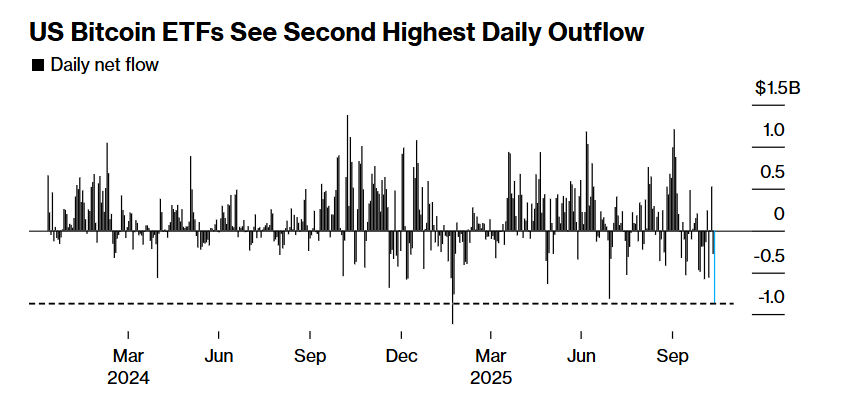
接盘侠越来越少 比特币坠入熊市! ETF撤资近9亿美元 创有史以来第二大流出规模
智通财经网· 2025-11-14 11:24
Core Viewpoint - The recent wave of risk aversion in global financial markets has led to significant declines in high-valuation U.S. tech stocks and risk assets like Bitcoin, with nearly $900 million withdrawn from Bitcoin ETFs, causing Bitcoin to drop below $100,000 and enter a bear market [1][2]. Group 1: Bitcoin Market Dynamics - Bitcoin ETFs have seen substantial outflows, with approximately $870 million in net withdrawals, marking the second-largest single-day redemption since their inception in January 2024 [2][5]. - The decline in Bitcoin's price is attributed to a lack of "blind speculative investors," leading to a collapse in demand as the market struggles to find buyers [1]. - Bitcoin's price fell by as much as 2.8%, settling around $97,070, which is over 20% lower than its historical peak earlier in October [1]. Group 2: Market Conditions and Economic Data - The cryptocurrency market is under pressure following a significant liquidation event of $19 billion on October 10, erasing over $1 trillion from the total market cap [2]. - The U.S. stock market briefly rebounded due to the end of a prolonged government shutdown but quickly fell back, with Bitcoin and tech stocks showing similar downward trends during risk-off periods [5]. - Concerns are rising regarding the upcoming economic data releases, which could further exacerbate the sell-off in risk assets, including cryptocurrencies [5]. Group 3: Market Liquidity and Volatility - Liquidity in the cryptocurrency market has tightened significantly, with market depth decreasing by approximately 30% from its peak earlier this year [5]. - The demand for neutral hedging options strategies, such as strangles and straddles, is increasing among traders focused on cryptocurrencies, indicating expectations of heightened volatility [8].
中信期货晨报:国内商品期货涨多跌少,沪银领涨期市-20251113
Zhong Xin Qi Huo· 2025-11-13 07:59
1. Report Industry Investment Rating No relevant content provided. 2. Core Viewpoints of the Report - The global macro situation this week focuses on changes in US dollar liquidity. Although there is short - term tightness, it won't have a significant impact on major asset prices. There are two factors for improvement: marginal easing of monetary policy and normal release of funds in the TGA account when the US government resumes work [7]. - In October, China's export growth was weaker than expected, but there were more positive signs in inflation data, and consumer data may slightly exceed expectations [7]. - In November, the macro environment enters a vacuum period, and major assets may enter a short - term shock period. However, the overall allocation idea in the fourth quarter remains unchanged, and the macro environment is still favorable for risk assets. It is recommended to allocate major assets evenly in the fourth quarter, hold long positions in stock indices, non - ferrous metals (copper, lithium carbonate, aluminum, tin), and precious metals, and increase positions appropriately if there is a correction [7]. 3. Summary by Directory 3.1 Macro Highlights - **Overseas Macro**: The short - term tightness of US dollar liquidity won't have a large impact on major asset prices. Monetary policy is marginally easing, and the release of TGA account funds after the US government resumes work can relieve the short - term pressure [7]. - **Domestic Macro**: October's export growth was weaker than expected, but there were positive signs in inflation data, and consumer data may slightly exceed expectations [7]. - **Asset Views**: In November, major assets may enter a shock period. The overall allocation idea in the fourth quarter remains unchanged, and it is recommended to evenly allocate major assets, hold long positions in stock indices, non - ferrous metals, and precious metals, and increase positions if there is a correction [7]. 3.2 Viewpoint Highlights 3.2.1 Financial Sector - **Stock Index Futures**: Catalyzed by technology events, the growth style is active. There is a risk of overcrowding in small - cap funds, and the short - term trend is expected to be a volatile upward [8]. - **Stock Index Options**: The overall trading volume has slightly declined, and the short - term trend is expected to be volatile [8]. - **Treasury Bond Futures**: The bond market continues to be weak. The short - term trend is expected to be volatile, affected by policy, fundamental repair, and tariff factors [8]. 3.2.2 Precious Metals - **Gold/Silver**: Due to the easing of geopolitical and economic and trade situations, precious metals are in a phased adjustment. The short - term trend is expected to be volatile, affected by the US fundamentals, Fed's monetary policy, and global equity market trends [8]. 3.2.3 Shipping - **Container Shipping to Europe**: The peak season in the third quarter has passed, and there is a lack of upward momentum. The short - term trend is expected to be volatile, and attention should be paid to the rate of freight decline in September [8]. 3.2.4 Steel and Iron Ore - **Steel**: In the off - season, the fundamentals are under pressure, and the short - term trend is expected to be volatile, affected by the issuance of special bonds, steel exports, and iron - water production [8]. - **Iron Ore**: The short - term fundamentals are stable, and the short - term trend is expected to be volatile, affected by overseas mine production and shipment, domestic iron - water production, weather, port inventory, and policy [8]. 3.2.5 Black Building Materials - **Coke**: The game between coking and steel enterprises continues, and the short - term trend is expected to be volatile, affected by steel mill production, coking costs, and macro sentiment [8]. - **Coking Coal**: The market sentiment is weak, but the spot price is rising. The short - term trend is expected to be volatile, affected by steel mill production, coal mine safety inspections, and macro sentiment [8]. - **Silicon Iron**: The supply - demand driving force is limited, and it follows the valuation fluctuations of coal. The short - term trend is expected to be volatile, affected by raw material costs and steel procurement [8]. - **Manganese Silicon**: After the first - round steel procurement inquiry is announced, the price follows the decline of coking coal. The short - term trend is expected to be volatile, affected by cost prices and overseas quotes [8]. - **Glass**: Prices have been lowered in various regions, and downstream purchasing sentiment is weak. The short - term trend is expected to be volatile, affected by spot sales [8]. - **Soda Ash**: Supply exceeds demand, and cost - driven upward movement is limited. The short - term trend is expected to be volatile, affected by soda ash inventory [8]. - **Aluminum Oxide**: The fundamentals are still in an oversupply situation, and the price is under pressure. The short - term trend is expected to be volatile, affected by ore复产 and electrolytic aluminum复产 [8]. - **Aluminum**: The stock - futures linkage leads to an upward - volatile price. The short - term trend is expected to be a volatile upward, affected by macro risks, supply disruptions, and demand [8]. - **Zinc**: The export window is open, and the price is fluctuating at a high level. The short - term trend is expected to be volatile, affected by macro risks and zinc ore supply [8]. - **Lead**: Social inventory is slightly increasing, and the price is fluctuating. The short - term trend is expected to be volatile, affected by supply disruptions and battery exports [8]. - **Nickel**: Market sentiment is improving, and the price is fluctuating. The short - term trend is expected to be volatile, affected by macro and geopolitical changes, and Indonesian policies [8]. - **Stainless Steel**: Warehouse receipts are decreasing, and the price is fluctuating. The short - term trend is expected to be volatile, affected by Indonesian policies and demand growth [8]. - **Tin**: The inventory of Shanghai tin continues to decrease, and the price is fluctuating. The short - term trend is expected to be volatile, affected by the resumption of production in Wa State and demand improvement [8]. - **Industrial Silicon**: The supply in the southwest is rapidly decreasing, and the price is fluctuating. The short - term trend is expected to be volatile, affected by supply - side production cuts and photovoltaic installations [8]. - **Lithium Carbonate**: The resumption of production expectation is fluctuating, and the price may fluctuate significantly. The short - term trend is expected to be volatile, affected by demand, supply disruptions, and technological breakthroughs [8]. 3.2.6 Energy and Chemicals - **Crude Oil**: There is a lack of short - term driving forces, and the price is expected to be volatile, affected by OPEC+ production policies and the Middle East geopolitical situation [10]. - **LPG**: Refinery output has decreased, and import costs are under pressure. The short - term trend is expected to be volatile, affected by cost factors such as crude oil and overseas propane [10]. - **Asphalt**: The spot price in Shandong has stabilized, and the futures price is expected to be volatile, affected by sanctions and supply disruptions [10]. - **High - Sulfur Fuel Oil**: The futures price is volatile, and attention should be paid to the Russia - Ukraine conflict. The short - term trend is expected to be volatile, affected by geopolitics and crude oil prices [10]. - **Low - Sulfur Fuel Oil**: The refined oil market is strong, and the price may be on a volatile upward trend, affected by crude oil prices [10]. - **Methanol**: High inventory suppresses the price, and overseas disturbances are not significant. The short - term trend is expected to be volatile, affected by the macro - energy situation and overseas developments [10]. - **Urea**: Export information boosts the spot market, and the futures price is expected to be volatile in the short term, affected by export quotas and coal prices [10]. - **Ethylene Glycol**: The spot market is loose, and there is little hope of reversing the downward trend in the short term. The short - term trend is expected to be a volatile downward, affected by coal and oil prices, port inventory, and Sino - US trade friction [10]. - **PX**: The market sentiment is rational, and the processing fee is strongly supported by strong supply and demand. The short - term trend is expected to be volatile, affected by crude oil fluctuations and macro changes [10]. - **PTA**: The market sentiment is flat, and the basis is under pressure. The short - term trend is expected to be volatile, affected by crude oil fluctuations and macro changes [10]. - **Short - Fiber**: Consumers tend to buy on dips, and attention should be paid to the off - peak and peak season conversion. The short - term trend is expected to be volatile, affected by downstream yarn mill purchasing and peak - season demand [10]. - **Bottle Chips**: The market performance is flat, and it follows the cost passively. The short - term trend is expected to be volatile, affected by bottle - chip enterprise production cuts and new device commissioning [10]. - **Propylene**: Inventory needs time to be digested, and the price is expected to be on a volatile downward trend, affected by oil prices and the domestic macro situation [10]. - **PP**: Maintenance support is limited, and the price is expected to be on a volatile downward trend, affected by oil prices and domestic and overseas macro situations [10]. - **Plastic**: Downstream transactions have increased, but maintenance support is limited. The price is expected to be on a volatile downward trend, affected by oil prices and domestic and overseas macro situations [10]. - **Styrene**: There are still concerns about over - inventory, and the price is expected to be on a volatile downward trend, affected by oil prices, macro policies, and device operations [10]. - **PVC**: The weak reality suppresses the price, and it is expected to be volatile, affected by expectations, costs, and supply [10]. - **Caustic Soda**: With low valuation and weak expectations, the price is expected to be volatile, affected by market sentiment, production, and demand [10]. 3.2.7 Agriculture - **Oils and Fats**: Rapeseed oil is relatively strong, and attention should be paid to the effectiveness of upper - level technical resistance. The short - term trend is expected to be a volatile upward, affected by US soybean weather and Malaysian palm oil production and demand data [10]. - **Protein Meal**: US soybeans are testing the upper - level resistance, and it is recommended to hold reverse spreads on Dalian soybean meal. The short - term trend is expected to be volatile, affected by weather, domestic demand, macro factors, and Sino - US and Sino - Canadian trade wars [10]. - **Corn/Starch**: The market is in a short - term tight situation, and the price is expected to be volatile at a high level, affected by demand, macro factors, and weather [10]. - **Pigs**: Supply and demand are loose, and the price is weak. The short - term trend is expected to be a volatile downward, affected by breeding sentiment, epidemics, and policies [10]. - **Natural Rubber**: With the approaching expiration of the November contract, there may be a pulse - like upward movement. The short - term trend is expected to be volatile, affected by production - area weather, raw material prices, and macro changes [10]. - **Synthetic Rubber**: The short - term trend is expected to be volatile, affected by crude oil fluctuations [10]. - **Cotton**: The price has slightly declined, and the short - term trend is expected to be volatile, affected by demand and inventory [10]. - **Sugar**: The price is fluctuating within a narrow range, and the short - term trend is expected to be a volatile downward, affected by imports and Brazilian production [10]. - **Pulp**: The market is dominated by funds, and the long - position advantage remains. The short - term trend is expected to be volatile, affected by macro - economic changes and US dollar - denominated quotes [10]. - **Double - Glued Paper**: In the tendering peak season, the price is expected to stabilize in November and be volatile, affected by production and sales, education policies, and paper - mill operations [10]. - **Logs**: In the de - inventory cycle, the price is expected to be volatile, affected by special port fees, shipment volume, and dispatch volume [10].
中信证券大类资产2026年策略:风险资产的性价比料仍强于避险资产
Xin Lang Cai Jing· 2025-11-11 01:27
Core Insights - The core viewpoint of the article emphasizes that the macroeconomic themes for 2026 will revolve around economic recovery, rising inflation, and the cessation of monetary easing [1] Group 1: Economic Outlook - Economic recovery will determine the direction of asset allocation [1] - Producer Price Index (PPI) and liquidity will dictate the timing of asset allocation [1] - Changes in the risk-return characteristics of assets will inform tactical responses [1] Group 2: Asset Allocation Strategy - Risk assets are expected to maintain a stronger cost-performance ratio compared to safe-haven assets for 2026 [1]

机构研究周报:市场风格有望再平衡,货币政策或加快放松
Wind万得· 2025-11-09 22:31
Core Viewpoints - The market style is expected to rebalance in November, potentially returning to a "dumbbell" structure, as liquidity remains relatively loose and external factors like the Fed's interest rate expectations may fluctuate [1][22]. Economic Data - China's October exports fell by 1.1% year-on-year, below the expected 3% growth, while imports grew by 1%. The trade surplus was $90.07 billion, slightly down from the previous month's $90.45 billion. For the first ten months of 2025, total trade value reached $520.46 billion, a 2.7% year-on-year increase [3][4]. - The decline in exports is attributed to a high base from the previous year and a slowing global economy, compounded by increased tariffs from the U.S. [3]. Equity Market Insights - Morgan Asset Management indicates that the global macro environment remains favorable for risk assets, supported by healthy consumer balance sheets, expectations of gradual monetary easing from the Fed, and ongoing fiscal stimulus [5]. - CITIC Securities suggests that resource products may become a new investment focus due to global monetary easing and supply-demand gaps, highlighting strategic resources like rare earths and lithium as having long-term investment value [6]. - China Europe Fund emphasizes the importance of cyclical stocks and technology resonance, suggesting that the market's current valuation recovery is nearly complete, with future growth driven by earnings [7]. Industry Research - CITIC Securities highlights that 2026 will be a critical year for the recovery of real estate companies' balance sheets, with a potential bottoming out of profits. The residential market shows signs of stabilization, and companies with quality investment properties are expected to perform well [11]. - Guotai Junan Securities notes that the liquor industry is undergoing a period of accelerated adjustment, with inventory clearing expected to lead to a rebound in stock prices [12]. - Penghua Fund anticipates that the domestic economy will seek balance between policy support and structural optimization over the next two to three years, favoring high-quality dividend assets [13]. Macro and Fixed Income - Huatai Securities recommends a focus on short-term credit bonds for defensive strategies, as overall credit demand is weakening [18]. - CICC predicts that monetary policy will accelerate easing due to ongoing export pressures, with expectations for rate cuts and reserve requirement ratio reductions [19]. - Bosera Fund indicates that domestic financial policies are favorable for the bond market, enhancing supply-demand dynamics [20].

瀚亚投资:亚洲多国政府推出新一轮刺激措施 短期继续普遍看好风险资产
Zhi Tong Cai Jing· 2025-11-03 08:16
Group 1 - The core viewpoint indicates that economic growth in the US and East Asia is expected to slow in the coming months until policy stimulus measures drive recovery in early 2026 [1] - The Federal Reserve announced a 25 basis point reduction in the federal funds rate target range to 3.75% to 4.00% in October, with another expected cut in December [1] - Asian central banks are anticipated to further lower interest rates in 2025 and the first half of 2026, positively impacting the Asian economy and earnings until the second half of 2026 [1] Group 2 - Japan's GDP growth is expected to stagnate in Q3 and remain weak in Q4 due to declining exports and industrial production, although leading indicators suggest a rebound later in the year [2] - China's economic outlook for 2026 will be guided by new stimulus measures focusing on consumer subsidies and industrial investment, particularly in the technology sector [2] - India's economic activity indicators are at a turning point, with government fiscal stimulus measures expected to enhance growth in early 2026 [2] Group 3 - Stock and fixed income performance has been outstanding in 2025, with double-digit returns across various markets, leading to significantly higher stock valuations compared to the beginning of the year [3] - The investment team remains generally optimistic about risk assets in the short term, particularly favoring emerging markets and Asia due to positive economic data [3] - China is a key market of interest, with upcoming political meetings expected to provide insights into future market directions [3]