AI大模型

Search documents
电车战略变动计提巨额损失,本田股价“崩了”;英伟达将投资260亿美元开发AI大模型;国际油价涨破100美元后回调|美股盘前
Mei Ri Jing Ji Xin Wen· 2026-03-12 11:19
Group 1 - Major stock indices futures declined, with Dow futures down 0.77%, S&P 500 futures down 0.63%, and Nasdaq futures down 0.63% [1] - Morgan Stanley restricted redemptions for a private credit fund to 5% of circulating units due to increased investor withdrawal concerns, resulting in a 2.11% drop in the company's stock [1] - Tesla's energy division received a power supply license from the UK energy regulator, allowing it to supply electricity to homes and businesses across the UK, with the stock down 0.15% [1] Group 2 - Three major international chip design firms, Texas Instruments, NXP, and Infineon, announced price increases effective April 1, impacting the automotive and industrial electronics sectors, with Texas Instruments stock down 0.66% [2] - International oil prices experienced fluctuations, with Brent crude reaching a peak of $101.59 per barrel before settling at $98.86, as the IEA reported a reduction in global oil supply by 8 million barrels per day [2] Group 3 - NVIDIA plans to invest $26 billion over the next five years to develop open-source AI models, with the first models expected to be available by late 2026 to early 2027, while the stock decreased by 0.7% [3] - Honda announced the cancellation of three planned electric vehicle models in North America, leading to an estimated loss of approximately $15.73 billion, causing the stock to drop by 7.88% [3] - Google is splitting its fiber internet division and merging it with Astound, retaining only a minority stake in the new company, with the stock down 0.76% [3] Group 4 - Shell announced a force majeure on LNG cargo sales from Qatar after the Qatar Energy Company halted production at its LNG facility, resulting in a 0.4% decline in Shell's stock [4]

【美股盘前】国际油价涨破100美元后回调;限制旗下一私募信贷基金赎回额度,大摩跌超2%;电车战略变动计提157亿美元损失,本田跌近8%;英伟达将投资26...
Mei Ri Jing Ji Xin Wen· 2026-03-12 10:24
Group 1 - Major U.S. stock index futures declined, with Dow futures down 0.77%, S&P 500 futures down 0.63%, and Nasdaq futures down 0.63% [1] - Morgan Stanley restricted redemptions for a private credit fund to 5% of circulating units due to increased investor withdrawal concerns, resulting in a 2.11% drop in its stock [1] - Tesla's energy division received a power supply license from the UK energy regulator, allowing it to supply electricity to homes and businesses across the UK, with Tesla's stock down 0.15% [1] Group 2 - Three major international chip design firms, Texas Instruments, NXP, and Infineon, announced price increases effective April 1, impacting the automotive and industrial electronics sectors, with Texas Instruments' stock down 0.66% [2] - International oil prices briefly surpassed $100 per barrel before retreating, with Brent crude futures reaching a high of $101.59 before settling at $98.86 per barrel, amid a forecasted reduction in global oil supply by 8 million barrels per day [2] Group 3 - NVIDIA plans to invest $26 billion over the next five years to develop open-source AI models, with the first models expected to be available by late 2026 to early 2027, while its stock fell 0.7% [3] - Honda announced the cancellation of three planned electric vehicle models in North America, leading to an estimated loss of approximately $15.73 billion, with Honda's stock down 7.88% [3] - Google is splitting its fiber internet division and merging it with Astound, retaining only a minority stake in the new company, resulting in a 0.76% decline in its stock [3] Group 4 - Shell announced a force majeure on LNG cargo sales from Qatar after the Qatar Energy Company halted production at its LNG facility, leading to a 0.4% drop in Shell's stock [4]
大模型:超人智能诞生,迈向硅基文明
泽平宏观· 2026-03-11 16:06
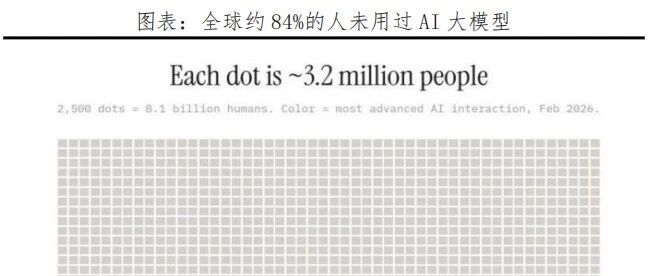
Core Insights - AI large models are revolutionizing human life and work paradigms, breaking traditional skill barriers and enabling ordinary individuals to become super individuals or one-person companies [3][5] - Approximately 84% of the global population has never interacted with AI, indicating a significant opportunity for AI infrastructure similar to the internet's early days [3][12] - The development of large models will follow five decisive trends, including exponential growth in reasoning power demand and the transition from pre-training to post-training as a core breakthrough [4][25] Group 1: Social Impact of AI Large Models - The emergence of AI assistants like ChatGPT and Gemini represents a shift towards more intelligent tools that can perform complex tasks [5] - Skills barriers are being dismantled, allowing anyone to become a creator, with tools enabling non-coders to develop software through natural language [5][6] - The education system will need to adapt, focusing on critical thinking and creativity rather than rote memorization, as traditional skills become less valuable [9][10] - AI will transform work and life paradigms, leading to a collaborative era with AI acting as a second brain for individuals [10][11] - Access to top-tier professional services in fields like healthcare and law will become more equitable, allowing broader access to expert knowledge [11] Group 2: Cognitive Divide and AI Accessibility - Despite the productivity boost from AI, a cognitive divide is emerging, with 84% of the global population lacking AI exposure, risking marginalization for those who do not adopt AI tools [12][15] - The current penetration of AI among the population is low, with only about 16% having used free AI tools, indicating that the majority remain outside the technological benefits [12][15] Group 3: Technical Foundations of AI Large Models - The essence of large models lies in predicting the next word based on vast data, utilizing algorithms similar to human brain functions [16] - The breakthrough of the Transformer architecture in 2017 marked a significant advancement, allowing for parallel processing and efficient computation [17] - The emergence of capabilities in AI models occurs when parameters exceed a critical threshold, leading to enhanced reasoning and thinking abilities [18] Group 4: Future Development Directions - The focus is shifting from sheer computational power to algorithm optimization and sensory evolution, with a move towards more efficient models [20] - The industry is transitioning from a "power race" to an "architecture revolution," emphasizing algorithmic efficiency and multi-modal processing [20][21] - The global landscape of AI large models is consolidating, with leading companies establishing dominance through superior technology and data resources [21][29] Group 5: Trends in AI Large Models - Exponential demand for reasoning power will emerge as AI applications become mainstream, with significant increases in computational resource consumption [25] - Post-training will become essential for overcoming algorithmic bottlenecks, focusing on specific tasks and vertical scenarios [26] - The concept of world models will gain traction, enabling AI to understand physical laws and interact with real environments [27] - The concentration of AI capabilities will favor leading companies, particularly in China, which are positioned to dominate the global market [29] - Ensuring alignment between human values and AI decision-making will be critical as AI capabilities surpass human intelligence [30]

迈克生物智慧化实验室接入AI大模型
仪器信息网· 2026-03-10 09:02
Core Viewpoint - The company has integrated AI models into its smart laboratory, focusing on enhancing the efficiency and accuracy of medical testing processes [2]. Group 1: AI Integration - The company has successfully embedded AI models into its smart laboratory, achieving full-process intelligent management from sample collection to test results [2]. - The company is tracking the development of general AI models like Doubao and Tongyi Qianwen to assess their applicability in natural language interaction, multimodal data analysis, and personalized report generation [2]. Group 2: Future Directions - The company aims to explore deeper integration of AI technologies to further advance the intelligence, precision, and convenience of medical testing [2].


计算机行业周报:行业大幅下跌,腾讯免费安装OpenClaw-20260309
Guoyuan Securities· 2026-03-09 08:18
Investment Rating - The report maintains a "Recommended" rating for the industry [6] Core Insights - The computer industry index (Shenwan) experienced a significant decline of 5.29% during the week of March 2 to March 6, 2026, underperforming major indices such as the Shanghai Composite Index, which fell by 0.93%, the Shenzhen Component Index by 2.22%, and the ChiNext Index by 2.45% [1][11] - The report highlights the launch of Tencent's OpenClaw, which provides a comprehensive service for installation and deployment, indicating a growing interest in AI Agent technology and its applications [4][21] - The report suggests that as AI Agent technology matures, related applications are entering a commercialization phase, with expectations for rapid growth in token consumption [4][21] Summary by Sections Market Review - The computer industry index fell by 5.29%, ranking third from the bottom in terms of performance among sectors [1][11] - Sub-sector performance included declines of 5.19% for computer equipment, 5.36% for IT services II, and 5.29% for software development [1][11][13] Major Events - The report notes significant developments in AI technology, including the release of OpenAI's GPT-5.4 series and Google's new tools, which enhance capabilities in coding and desktop control [16] - Tencent, ByteDance, Alibaba, and others have launched OpenClaw services on their cloud platforms, indicating a competitive landscape in AI service offerings [16] Key Announcements - Star Ring Technology is developing a new AI database named the cognitive database, integrating AI and machine learning into the database engine [2][19] - Zhongkong Technology forecasts a revenue of 520 million to 620 million yuan for January-February 2026, representing a year-on-year growth of 20.59% to 43.78% [2][19] - Chen'an Technology has received approval for a specific stock issuance from the State-owned Assets Supervision and Administration Commission [3][19]

蔚来、理想、特斯拉共同预警 汽车行业缺芯潮又要来了!
阿尔法工场研究院· 2026-03-09 00:05
Core Viewpoint - The ongoing chip shortage is significantly impacting the automotive industry, with predictions that the supply of storage chips may not meet demand for several years, particularly due to the rising needs from AI applications and smart vehicle technologies [3][4][10]. Group 1: Industry Insights - NIO's CEO Li Bin highlighted that rising memory prices are a major cost pressure for the industry, although currently manageable for NIO [3]. - Ideal Auto's supply chain VP Meng Qingpeng predicts that by 2026, the automotive industry's storage chip supply satisfaction rate may fall below 50% [4]. - Elon Musk stated that even considering all major storage chip suppliers, it is difficult to meet Tesla's demand, indicating a severe supply shortage exacerbated by increasing memory requirements for smart vehicles [5][6]. Group 2: Supply Chain Dynamics - Automakers are beginning to bypass Tier 1 suppliers and sign long-term supply contracts directly with memory manufacturers, as seen with Volkswagen, Hyundai, and Tesla [6][7]. - The chip shortage is not only affecting automakers but also stems from a previous misjudgment of market demand during the pandemic, leading to a shift in chip production towards consumer electronics [8][9]. Group 3: Market Competition - The AI boom has created a massive demand for chips, with companies like Google and Microsoft competing aggressively for DRAM capacity, often outbidding traditional automotive clients [11][12]. - The price of DDR4 chips surged by 172% in January, reflecting the intense competition for available memory [12]. Group 4: Future Projections - The chip shortage is expected to persist until around 2028, with significant capacity expansions planned by major suppliers like SK Hynix and Micron [13][16]. - Long-term, the automotive market is projected to grow significantly due to advancements in autonomous driving and smart cockpit technologies, which will require increasingly sophisticated memory solutions [15][16].


中国人形机器人再迎百亿独角兽
21世纪经济报道· 2026-03-06 10:21
Core Insights - The field of embodied robotics is experiencing a surge in financing, with companies like Xingdong Jiyuan completing a strategic round of financing worth 1 billion yuan, achieving a valuation exceeding 10 billion yuan [1] - As of now, there are eight companies that have entered the unicorn club with valuations over 10 billion yuan, indicating a trend of increasing investment in this sector [1][2] - The competition for achieving a 10 billion yuan valuation is driven by its symbolic significance as a marker of unicorn status, which attracts substantial funding towards leading companies [2] Financing Trends - In 2025, the total financing amount in the domestic embodied intelligence sector is projected to reach 73.543 billion yuan, with over 740 investment events [4] - The largest financing amount in recent times was secured by Yinhe Tongyong, which completed a new round of financing worth 2.5 billion yuan, bringing its post-investment valuation to 30 billion USD (over 200 billion yuan) [5] - The capital influx is driven by the anticipated scaling of humanoid robots, with predictions indicating that sales will reach 28,000 units in 2026, a 133% increase from previous estimates [6] Market Dynamics - The market is witnessing a shift towards head companies, with capital increasingly concentrating on a few leading firms as the industry matures [4][7] - Companies focusing on the "brain" aspect of robotics, such as Yinhe Tongyong and Ziyuan Robotics, are receiving higher valuations compared to those concentrating on hardware [9] - The integration of both software (brain) and hardware (body) is becoming essential, as companies recognize the need for collaboration to enhance their technological capabilities [10] Technological and Commercialization Factors - Key technological advancements include the development of proprietary models and data sets, such as Yinhe Tongyong's "Galaxy Star Brain," which is a leading integrated model in the field [11] - Commercialization efforts are accelerating, with companies like Xingdong Jiyuan implementing logistics solutions and achieving significant orders in industrial applications [12] - The expectation for the humanoid robotics market is optimistic, with industry experts suggesting that the sector will continue to grow over the next five to ten years, indicating a long-term upward trajectory [13]

剑指千亿美元,博通AI芯片营收暴涨,能否撕开英伟达算力护城河?
3 6 Ke· 2026-03-06 07:48
Core Insights - The global AI chip market is currently dominated by Nvidia, which leads the AI data center chip market due to its CUDA ecosystem. However, major tech companies are increasing their investment in self-developed chips and customized chips through Broadcom to diversify their supply and reduce reliance on Nvidia [1][3]. Group 1: Broadcom's AI Chip Revenue Growth - Broadcom's customized AI chips are significantly impacting Nvidia's market position, with AI chip revenue expected to exceed $100 billion by 2027. In Q1 of FY2026, Broadcom reported revenue of $19.311 billion, a 29% year-over-year increase, with net profit rising 34% to $7.349 billion. AI chip revenue doubled, reaching $8.4 billion, a 106% increase year-over-year [2][4]. - Broadcom's CEO noted that the strong demand for customized AI accelerators and AI network products is driving this growth, with expectations for AI semiconductor revenue to reach $10.7 billion in Q2 [2][4]. Group 2: Market Dynamics and Competition - The AI chip landscape is changing, with Broadcom positioned as a strong competitor to Nvidia. Nvidia's data center revenue reached $193.7 billion in FY2026, a 68% increase, benefiting from a surge in demand for computing power since the launch of ChatGPT [3][5]. - Major tech companies are increasing capital expenditures to secure high-performance chips from Nvidia, leading to supply shortages. Companies like Google, Meta, OpenAI, and Anthropic are exploring customized chips from Broadcom to reduce dependency on Nvidia [3][5]. Group 3: Future Projections and Market Trends - Broadcom's AI revenue is projected to reach $120 billion by 2027, with some analysts estimating it could exceed $200 billion. The ongoing expansion of AI infrastructure spending among large tech firms is expected to drive the global semiconductor market towards a trillion-dollar scale [2][4][6]. - The demand for customized AI chips is expected to grow rapidly, with Broadcom's ASIC chips being recognized for their competitive advantages in the AI market. This shift towards customized solutions is anticipated to disrupt Nvidia's dominance in the AI chip sector [5][6].

未知机构:广发计算机刘雪峰团队继续看好星环科技的长期价值公司开-20260306
未知机构· 2026-03-06 02:30
Summary of Conference Call Notes Company Overview - The company discussed is Xinghuan Technology, which focuses on the development of cognitive databases optimized for GPU hardware and the NVIDIA CUDA platform. Key Points and Arguments - The cognitive database has achieved significant performance improvements: - In tests processing 150GB of data, the cognitive database on GPU demonstrated up to a **20x performance increase** compared to running on CPU [1] - The vectorized search speed of the cognitive database on GPU is **200 times faster** than that on CPU [2] - The development of the GPU-native cognitive database is based on the growth and application prospects of AI large model technology, indicating potential for expansion as AI large models penetrate sectors such as finance, energy, manufacturing, and transportation [3] Additional Important Content - The emphasis on the optimization for GPU hardware highlights the company's strategic focus on leveraging advanced technology to enhance database performance, which may attract interest from investors looking for innovative tech solutions [1][2][3]

李东生:我想说的话
经济观察报· 2026-03-05 12:58
Core Viewpoint - The article emphasizes the need for a more efficient business system in China that minimizes unnecessary consumption and allows the market to function effectively [1] Group 1: Company Overview - TCL, founded by Li Dongsheng, has evolved from a consumer electronics brand to a global technology conglomerate with total revenue reaching 356 billion yuan, driven by its core businesses in semiconductor displays and renewable energy [2] - The semiconductor display business is projected to exceed 100 billion yuan in revenue with a net profit of over 8 billion yuan by 2025, while the renewable energy sector is currently facing supply-demand imbalances [2][4] Group 2: Challenges Faced - The first challenge is the distortion in policy execution, where local governments impose unnecessary requirements for subsidies, leading TCL to establish approximately 540 new legal entities, increasing operational costs without adding social value [3][25] - The second challenge involves excessive local capital intervention in the market, with local funds often holding a significant stake in new photovoltaic projects, even when market conditions suggest a halt in expansion [4][16] - The third challenge is the difficulty in securing financing for large-scale semiconductor manufacturing projects, where financial institutions require a minimum of 40% equity from companies, complicating the funding process [6][9] Group 3: Market Dynamics - In 2025, China's television sales are expected to decline by 8.5% to 32.895 million units, contrasting with the U.S. market, which is projected to sell 49.9 million units, highlighting a disparity in content service attractiveness [7][29] - The article suggests that enhancing content services and promoting differentiated consumption could stimulate domestic demand, which is currently lagging behind GDP growth [28][30] Group 4: Recommendations for Improvement - Li Dongsheng proposes that local funds should have clear exit mechanisms and limited liability to prevent excessive market interference [5][22] - He advocates for a more streamlined financing process for heavy asset industries, suggesting that regulatory bodies should create special channels for these sectors to facilitate easier access to capital [9][10] - The article also emphasizes the importance of mergers and acquisitions to clear excess capacity in the renewable energy sector, suggesting that a conducive environment for such activities should be established [13][14] Group 5: Globalization and Supply Chain - TCL's global revenue reached 170.1 billion yuan, with a significant portion generated from overseas operations, indicating the importance of establishing local supply chains to enhance competitiveness [36] - The company aims to shift from merely exporting products to building supply chain capabilities abroad, which is essential for sustainable growth in the global market [35][36] Group 6: Future Outlook - The article discusses the potential for TCL's joint venture with Sony, which aims to leverage both companies' strengths to enhance competitiveness in the television market [38][40] - It highlights the necessity for local governments to support industries like semiconductors while ensuring that their involvement does not distort market dynamics [22][25]