
HBM

Search documents
见证历史,A股“涨停潮”
Zhong Guo Ji Jin Bao· 2025-10-24 02:54
Market Overview - On October 24, A-shares opened higher with the Shanghai Composite Index starting at 3929.12 points, up 0.17%, while the Shenzhen Component Index rose by 0.51% and the ChiNext Index increased by 0.83% [1][2] - The Shanghai Composite Index broke through the previous high of 3946.16 points, reaching a nearly ten-year high with an intraday increase of 0.42% [1] Sector Performance - The semiconductor and computer hardware sectors led the market, with significant activity in memory, commercial aerospace, satellite internet, satellite navigation, and HBM concept stocks [2][3] - The satellite navigation sector opened strong, with several stocks hitting the daily limit, including Tongyi Aerospace and Aerospace Huanyu, which saw increases of 30% and 20% respectively [4][5] - The storage chip sector also opened high, with Shengyi Electronics hitting the daily limit and a current price of 88.94 yuan per share, with a market capitalization of 740 billion yuan [6] Notable Stocks - Tongyi Aerospace recorded a price of 19.29 yuan with a 29.99% increase, and a year-to-date increase of 67.18% [5] - Aerospace Huanyu reached 26.76 yuan, up 20%, with a market cap of 10.9 billion yuan [5] - Shengyi Electronics hit a price of 88.94 yuan, marking a significant rise in the storage chip sector [6] Declining Sectors - The coal sector experienced a notable decline, with several stocks approaching their daily limit down, including Yunmei Energy, which fell nearly 9% [11][12] - Other coal-related stocks such as Antai Group and Baotailong also saw significant drops, indicating a bearish trend in this sector [11][12]


见证历史,“涨停潮”!
中国基金报· 2025-10-24 02:46
Market Overview - A-shares opened higher on October 24, with the Shanghai Composite Index reaching a new ten-year high at 3929.12 points, up 0.17% [2][3] - The Shanghai Composite Index broke the previous high of 3946.16 points during the day, increasing by 0.42% [3] Sector Performance - The semiconductor sector, particularly storage chips, showed strong performance, with multiple stocks opening high [11] - The satellite navigation sector led the market gains, with significant increases in individual stocks [8][10] - Coal stocks experienced a noticeable pullback, with several coal-related stocks approaching their daily limit down [17][19] Notable Stocks - In the satellite navigation sector, Tongyi Aerospace saw a 30% increase, while Aerospace Hanyu and Aerospace Zhizhuang both rose by 20% [8][10] - In the semiconductor sector, Shengyi Electronics hit the daily limit up of 20%, with a market value of 740 million [11] - Coal stocks like Yunmei Energy and Antai Group saw declines of nearly 9% [19][20] Summary of Key Indices - Shanghai Composite Index: 3929.12, up 0.17% [4] - Shenzhen Component Index: up 0.51% [4] - ChiNext Index: up 0.83% [4] Conclusion - The market showed a mixed performance with strong gains in technology sectors while coal stocks faced declines, indicating sector rotation and investor sentiment shifts [17][19]

国新证券每日晨报-20251022
Guoxin Securities Co., Ltd· 2025-10-22 06:42
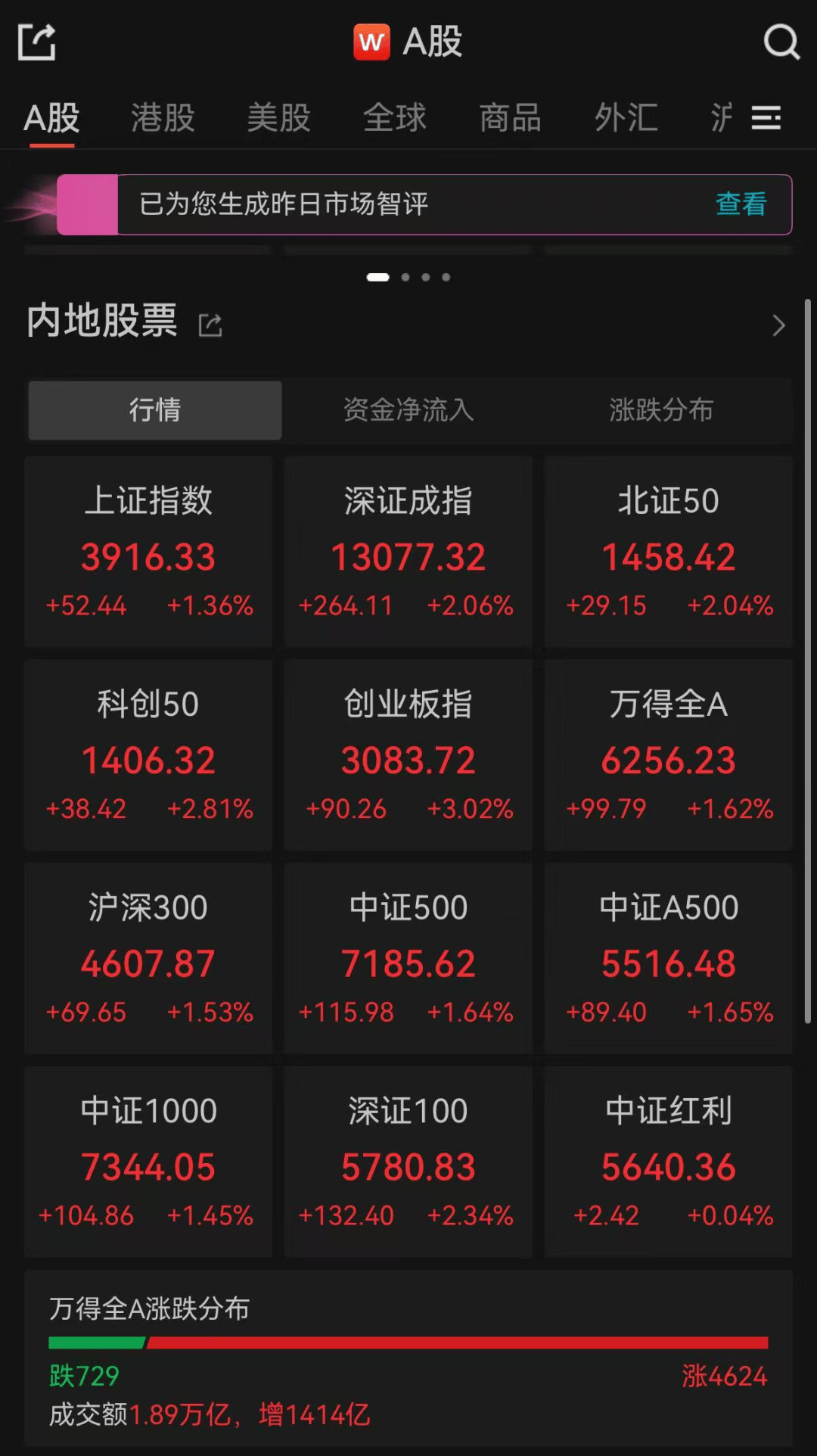
Domestic Market Overview - The domestic market experienced a strong increase with both volume and price rising, as evidenced by the Shanghai Composite Index closing at 3916.33 points, up 1.36%, and the Shenzhen Component Index closing at 13077.32 points, up 2.06% [1][9] - Among the 30 sectors tracked, 29 saw gains, with telecommunications, electronics, and real estate leading the increases, while only coal experienced a slight decline [1][9] - The total trading volume for the entire A-share market reached 1.8927 trillion yuan, showing an increase compared to the previous day [1][9] Overseas Market Overview - The U.S. stock market showed mixed results, with the Dow Jones Industrial Average rising by 0.47%, while the Nasdaq Composite fell by 0.16% [2] - Notable stock movements included General Motors surging nearly 15% and Beyond Meat experiencing a dramatic increase of over 146% [2] - Chinese concept stocks mostly declined, with the Nasdaq Golden Dragon China Index dropping by 0.97% [2] Industry Insights - The AI Infrastructure as a Service (IaaS) market in China saw a significant year-on-year growth of 122.4% in the first half of 2025, reaching a market size of 19.87 billion yuan [13][14] - The Generative AI IaaS segment grew even more rapidly, with a year-on-year increase of 219.3%, totaling 16.68 billion yuan, while the non-generative segment saw a decline of 14.1% [14] - The Guangdong government is promoting the construction of advanced intelligent factories, focusing on sectors such as consumer electronics and high-end equipment, as part of its initiative to enhance manufacturing quality through AI [12]
资讯早班车-2025-10-22-20251022
Bao Cheng Qi Huo· 2025-10-22 02:43
I. Report Industry Investment Rating No information provided in the given content. II. Core Views of the Report - The report presents a comprehensive overview of macro - economic data, commodity investment trends, financial news, and stock market performance. It indicates that the economy shows mixed trends, with some sectors improving while others face challenges. For example, the export and import values have increased, but the fixed - asset investment has declined. In the commodity market, there are significant price fluctuations, and in the financial market, various policies and events are influencing the bond, stock, and currency markets [1][2][31]. III. Summary According to Relevant Catalogs 1. Macro Data - GDP in Q3 2025 (constant price, quarterly YoY) was 4.8%, down from 5.2% in the previous quarter but up from 4.6% in the same period last year. The manufacturing PMI in September 2025 was 49.8%, slightly up from 49.4% in the previous month and the same as last year. The non - manufacturing PMI for business activities was 50.0%, down from 50.3% in the previous month and the same as last year [1]. - In September 2025, M0 (currency in circulation) YoY was 11.5%, down from 11.7% in the previous month and the same as last year; M1 (money) YoY was 7.2%, up from 6.0% in the previous month and significantly up from - 3.3% last year; M2 (money and quasi - money) YoY was 8.4%, down from 8.8% in the previous month but up from 6.8% last year [1]. - The CPI in September 2025 was - 0.3% YoY, up from - 0.4% in the previous month but down from 0.4% last year. The PPI was - 2.3% YoY, up from - 2.9% in the previous month but down from - 2.8% last year [1]. - Fixed - asset investment (excluding rural households) cumulative YoY in September 2025 was - 0.5%, down from 0.5% in the previous month and 3.4% last year. The cumulative YoY of total retail sales of consumer goods was 4.46%, down from 4.6% in the previous month but up from 3.3% last year [1]. - The export value in September 2025 was 8.3% YoY, up from 4.3% in the previous month and 2.33% last year. The import value was 7.4% YoY, up from 1.2% in the previous month and 0.13% last year [1]. 2. Commodity Investment 2.1 Comprehensive - The Ministry of Commerce held a policy - interpretation round - table meeting for foreign - invested enterprises, emphasizing responsible export control and maintaining global supply - chain stability [2]. - 92 - octane gasoline may return to the 6 - yuan era, with the next price adjustment on October 27. The expected price cut is 320 yuan/ton, and if implemented, it will be a four - year low [2]. - The Chinese government's stance on Sino - US economic and trade issues is to resolve problems through negotiation on an equal, respectful, and reciprocal basis [2]. - Trump plans to visit China early next year, and currently, there is no specific information available [3]. - High - City Sanae was elected as the 104th Prime Minister of Japan, advocating expansionary fiscal policies and increased defense spending [3]. 2.2 Metals - Precious - metal prices tumbled. CitiBank expects gold to enter a volatile phase in the next 3 weeks due to the end of the US government shutdown and eased Sino - US trade frictions. It now has a short - term bearish view on gold, with a 1 - 3 month target price of $4000/ounce [4][5]. - The LME zinc market faces a severe supply shortage, with the spot - to - three - month futures premium reaching a record high since 1997. The LME warehouse inventory is extremely low [5]. - Swiss gold exports in September increased by 37% MoM. CitiBank is bullish on copper and aluminum prices in the medium term, with a 6 - 12 month target price of $12000/ton for copper and $3500/ton for aluminum in 2027 [7]. 2.3 Coal, Coke, Steel, and Minerals - In September 2025, India's crude - oil production decreased by 1.3% YoY, natural - gas production decreased by 3.8% YoY, while steel production increased by 14.1% YoY, cement production increased by 5.3% YoY, power generation increased by 2.1% YoY, fertilizer production increased by 1.6% YoY, and the output of key industries increased by 3.0% YoY [8]. 2.4 Energy and Chemicals - The Trump administration plans to purchase 100 million barrels of crude oil for the US Strategic Petroleum Reserve. The US benchmark WTI crude has fallen by about 30% since January [9][10]. - Brazil's national oil company may delineate an oil field in two years and start production in 7 - 8 years if the potential of the Amazon estuary block is confirmed [10]. - South Korea will extend the fuel - tax cut for 2 months until the end of December [10]. - Egypt plans to buy over 1 million tons of diesel, gasoline, and butane gas in November [10]. - Kazakhstan's KARACHAGANAK oil field has reduced production by 8500 - 9000 tons, aiming to lift production restrictions in three days [10]. - The EU plans to stop importing Russian natural gas by the end of 2027 [11]. 2.5 Agricultural Products - A corn pest - control demonstration area in Hohhot achieved a high yield of 1315 kg per mu, with effective pest control and reduced pesticide use [12]. - In September, 373,800 tons of out - of - quota raw sugar arrived in China, and 119,000 tons are expected to arrive in October [12]. - US soybeans are being stored instead of exported, and some farmers may face a financial crisis [13]. - Brazil's October soybean and soybean - meal export volumes are expected to be 7.34 million tons and 2.09 million tons respectively [13]. - As of October 19, the EU's 2025/26 soft - wheat exports were 5.87 million tons, down from 7.45 million tons in the same period last year [13]. 3. Financial News 3.1 Open Market - On October 21, the central bank conducted 159.5 billion yuan of 7 - day reverse repurchase operations, with a net investment of 68.5 billion yuan after 91 billion yuan of reverse repurchases matured [14]. 3.2 Key News - The Ministry of Commerce and relevant departments held meetings to discuss economic and trade issues, emphasizing the importance of maintaining global supply - chain stability and resolving trade issues through negotiation [2][15]. - In the first three quarters, domestic tourism increased by 18% YoY in terms of person - times and 11.5% YoY in terms of spending [16]. - Guangzhou issued a plan to boost consumption, including measures to increase income, improve housing consumption, and promote rural development [17]. - As of June 2025, the trust industry's asset - management scale reached 32.43 trillion yuan, a 20.11% YoY increase [17]. - In September, the real - estate industry's bond financing was 56.1 billion yuan, a 31% YoY increase, with an average interest rate of 2.68% [18]. - Three policy banks have invested nearly 300 billion yuan in new policy - based financial instruments, expected to drive over 4 trillion yuan in project investment [18]. - Since October, over 10 small and medium - sized banks have cut deposit rates to stabilize interest margins [18]. - As of October 21, 93 panda bonds worth 151.15 billion yuan have been issued this year, and the market is expected to expand [19]. - 16 A - share listed companies plan to use convertible bonds for mergers and acquisitions [19]. - European leaders support a cease - fire in the Russia - Ukraine conflict through negotiation [19]. - The Japanese bond market is experiencing a severe sell - off, and Japanese government bonds have a negative return this year [20]. 3.3 Bond Market Summary - The Chinese bond market is oscillating, with most spot - bond yields declining, and long - term bonds performing well. The 30 - year Treasury bond yield decreased by nearly 3bp, and Treasury - bond futures rose [21]. - In the exchange - bond market, some bonds rose while others fell, and the real - estate and high - yield urban - investment bond indices had slight increases [21]. - The convertible - bond index rose by 0.99%, and the weighted convertible - bond index rose by 1.29%. Some convertible bonds had significant price changes [21]. - Money - market interest rates showed mixed trends, with some rising and some falling [22]. - The yields of European and US government bonds decreased [24]. 3.4 Foreign Exchange Market - The on - shore RMB against the US dollar closed at 7.1171, up 60 basis points. The central parity rate was 7.093, up 43 basis points [26]. - The US dollar index rose by 0.35%, and most non - US currencies fell. The offshore RMB against the US dollar fell 28 basis points [26]. 3.5 Research Report Highlights - CITIC Securities believes that the bond - market sentiment is improving, but trading should be cautious. It suggests that trading desks be more active in intraday trading and that allocation desks maintain a neutral position [27]. - Huatai Fixed - Income believes that the fourth - quarter fundamentals may weaken slightly, and the bond market will be volatile. It also has a positive long - term view on the stock market [27]. - Shenwan Fixed - Income expects local - government bond issuance to increase in the fourth quarter [27]. - Yangtze River Fixed - Income points out that the inter - bank bond - market leverage has increased slightly, and the funds will remain relatively loose before tax payments and month - end [28]. 4. Stock Market News - On Tuesday, the A - share market rose unilaterally, with technology stocks and some short - term themes performing well. The Shanghai Composite Index rose 1.36%, the Shenzhen Component Index rose 2.06%, and the ChiNext Index rose 3.02%, with a trading volume of 1.89 trillion yuan [31]. - The Hong Kong Hang Seng Index rose 0.65%, the Hang Seng Tech Index rose 1.26%, and the Hang Seng China Enterprises Index rose 0.76%. Southbound funds had a net purchase of HK$1.171 billion [32]. - As of October 21, 843 A - share companies announced 850 mid - year dividend plans worth 662.026 billion yuan, with 595 plans already implemented and 255 pending [32].
陆家嘴财经早餐2025年10月22日星期三
Wind万得· 2025-10-21 22:47
Group 1 - The US President Trump plans to visit China early next year, emphasizing the importance of high-level diplomatic communication in US-China relations [2] - The Chinese Ministry of Commerce held a video conference with EU officials to discuss key trade issues, including export controls and the EU's anti-subsidy measures against Chinese electric vehicles [2] - The Chinese government is enhancing its export control system in response to international obligations, while urging the Netherlands to resolve semiconductor-related issues to maintain global supply chain stability [2] Group 2 - The precious metals market experienced a significant decline, with spot gold dropping as much as 6.3% to approximately $4080 per ounce, marking the largest single-day drop in over 12 years [3] - Spot silver fell by 8.7% to $47.89 per ounce, the worst single-day performance since February 2021, driven by reduced safe-haven demand and a stronger dollar [3] - COMEX gold and silver futures also saw substantial declines, with gold futures down 5.07% to $4138.5 per ounce and silver futures down 6.27% to $48.16 per ounce [3] Group 3 - The Ministry of Commerce held a roundtable meeting with over 170 foreign enterprises, emphasizing China's commitment to maintaining global supply chain stability through responsible export control measures [4] - Domestic tourism in China saw significant growth, with 4.998 billion trips taken in the first three quarters, an increase of 18% year-on-year, and total spending reaching 4.85 trillion yuan, up 11.5% [4] - The People's Bank of China plans to accelerate legislation in key and emerging areas to enhance the financial legal system and support high-quality financial development [4] Group 4 - The A-share market saw a strong upward trend, with the Shanghai Composite Index rising 1.36% to 3916.33 points, driven by interest in technology stocks and consumer themes [5] - The Hong Kong Hang Seng Index closed up 0.65% at 26027.55 points, with significant gains in major financial stocks [5] - A total of 843 A-share companies announced mid-term dividend plans, with a total dividend amount of 662.03 billion yuan, indicating a trend of high amounts and frequency of dividends [6] Group 5 - A report predicts that Wuliangye's third-quarter revenue may decline by 30% year-on-year, with net profit expected to drop by 45% [7] - Changxin Storage, a leading Chinese memory chip manufacturer, plans to launch an IPO on the Shanghai Stock Exchange, targeting a valuation of 300 billion yuan [7] - Pop Mart anticipates a 245%-250% year-on-year increase in overall revenue for the third quarter, with significant growth in both domestic and overseas markets [7] Group 6 - China Telecom reported a third-quarter net profit of 7.756 billion yuan, a year-on-year increase of 3.6% [9] - Wens Foodstuff Group's third-quarter net profit fell by 65.02%, with a proposed dividend of 3 yuan per share [9] - China Giant Glass reported a 54.06% year-on-year increase in net profit for the third quarter [9] Group 7 - The National Medical Products Administration plans to enhance the legal standards for medical devices and accelerate the approval process for innovative products [10] - The total asset management scale of the trust industry in China is expected to reach 32.43 trillion yuan by June 2025, marking a 20.11% year-on-year growth [10] - Guangzhou has announced plans to develop six core future industries, including intelligent systems and quantum technology [10] Group 8 - The US stock market showed mixed results, with the Dow Jones rising 0.47% while the Nasdaq fell 0.16% [17] - Japan's Nikkei 225 index closed above 49000 points for the first time, reflecting investor optimism regarding the new prime minister's fiscal policies [17] - European stock indices experienced slight gains, supported by strong performances in the technology and luxury goods sectors [17]

重回3900点!A股三大指数集体收涨
Sou Hu Cai Jing· 2025-10-21 08:25
Market Overview - On the 21st, all three major A-share indices closed higher, with the Shanghai Composite Index rising by 1.36% to 3916.33 points, the Shenzhen Component Index increasing by 2.06%, and the ChiNext Index up by 3.02% [1] - The total trading volume for A-shares reached 1.89 trillion yuan, with over 4600 stocks rising across the market [1] Sector Performance - The CPO, HBM, and consumer electronics sectors saw significant gains, while the electrolyte, coal, and civil aviation sectors experienced declines [4] - The fruit supply chain concept had notable performance, with companies like Luxshare Precision hitting the daily limit, and others such as Wingtech Technology and Huanxu Electronics also reaching their limits [4] - AI hardware led the gains, with Yuanjie Technology hitting a historical high, and companies like Zhongji Xuchuang and Xinyisheng seeing increases of over 10% [4] Detailed Sector Tracking - Communication equipment rose by 4.81%, energy equipment by 4.39%, and heavy machinery by 3.15% [5] - Real estate stocks strengthened, with Guangming Real Estate and Shenzhen Zhenye A hitting the daily limit, and Yunnan Chengdu Investment rising over 5% [6] - Brokerage stocks also saw gains, with Ruida Futures and Tianfeng Securities hitting the daily limit, and Changjiang Securities increasing by over 5% [6] Declines - Coal stocks generally fell, with China Coal Energy and Yanzhou Coal Mining dropping over 2% [7] - Civil aviation stocks retreated, with China Southern Airlines and China National Aviation falling by 2% [7]
粤开市场日报-20251021
Yuekai Securities· 2025-10-21 07:53
Market Overview - The A-share market showed a positive trend today, with major indices mostly rising. The Shanghai Composite Index increased by 1.36% to close at 3916.33 points, while the Shenzhen Component Index rose by 2.06% to 13077.32 points. The Sci-Tech 50 index saw a gain of 2.81%, closing at 1406.32 points, and the ChiNext Index increased by 3.02% to 3083.72 points. Overall, 4624 stocks rose, 729 fell, and 80 remained unchanged, with a total trading volume of 18739 billion yuan, an increase of 1362.89 billion yuan compared to the previous trading day [1]. Industry Performance - Among the Shenwan first-level industries, all sectors except coal experienced gains today. The leading sectors in terms of growth included telecommunications, electronics, construction decoration, comprehensive, real estate, and machinery equipment [1]. Sector Highlights - The top-performing concept sectors today included optical modules (CPO), consumer electronics OEM, optical chips, HBM, primary real estate developers, cultivated diamonds, copper-clad laminates, circuit boards, optical communications, excavators, memory storage, urban village renovation, natural gas, oil and gas extraction, and GPU sectors [1].
国际油价、蛋氨酸价格下跌,六氟磷酸锂价格上涨 | 投研报告
Zhong Guo Neng Yuan Wang· 2025-10-21 01:44
Core Viewpoint - The chemical industry is experiencing mixed price movements, with 17 products increasing in price, 52 decreasing, and 31 remaining stable during the week of October 13-19. The report highlights the need to focus on quarterly earnings, undervalued industry leaders, and the impact of "anti-involution" on supply in related sub-industries [1][2][3]. Industry Dynamics - During the week of October 13-19, among 100 tracked chemical products, 17 saw price increases, 52 saw decreases, and 31 remained stable. Specifically, 29% of products had a month-on-month average price increase, while 56% experienced a decrease, and 15% remained unchanged [3]. - The products with the highest weekly price increases included sulfur (Zhejiang Juhua 98%), vinyl acetate (East China), propylene oxide (East China), hydrochloric acid (Yangtze River Delta 31%), and pure MDI (East China). Conversely, the largest price decreases were seen in WTI crude oil, acetone (East China), NYMEX natural gas, naphtha (Singapore), and vitamin E [3]. Oil Market Overview - International oil prices fell during the week, with WTI crude oil futures closing at $57.54 per barrel, a weekly decline of 2.31%, and Brent crude oil futures at $61.29 per barrel, also down 2.30%. The report notes geopolitical developments, including a ceasefire agreement in Gaza and India's commitment to halt oil purchases from Russia [4]. - U.S. crude oil production averaged 13.636 million barrels per day, an increase of 0.7 thousand barrels from the previous week and up 13.6% year-on-year. However, U.S. oil demand decreased to an average of 19.726 million barrels per day, down 226.4 thousand barrels from the previous week [4]. - EIA forecasts indicate that Brent crude prices may drop from an average of $69 per barrel in 2025 to $52 per barrel in 2026 due to oversupply [4]. Specific Chemical Products - Methionine prices decreased, with an average price of 21.15 yuan/kg on October 17, down 0.94% week-on-week and 2.76% month-on-month. Production remained stable at 14,700 tons, with a utilization rate of 71.46% [6]. - Lithium hexafluorophosphate prices increased, with an average price of 75,000 yuan/ton on October 19, up 7.14% week-on-week and 33.93% month-on-month. Production levels are high, and demand from electrolyte manufacturers is strong [7]. Investment Recommendations - As of October 17, the SW basic chemical sector's P/E ratio (TTM excluding negative values) is 24.76, at the 73.39% historical percentile, while the P/B ratio is 2.16, at the 49.29% historical percentile. The SW oil and petrochemical sector's P/E ratio is 11.53, at the 24.01% historical percentile, and the P/B ratio is 1.14, at the 19.57% historical percentile [8]. - Investment focus for October includes quarterly earnings, undervalued industry leaders, the impact of "anti-involution" on supply, and the importance of self-sufficiency in electronic materials [2][8]. - Long-term investment themes include sustained high oil prices benefiting the oil and gas extraction sector, rapid development in downstream industries, and the growth potential in new materials [9]. Recommended companies include China Petroleum, China National Offshore Oil Corporation, and various technology and chemical firms [9][10].



ETF午评 | A股三大指数集体下跌,新能源板块跌幅居前,储能电池ETF跌5%,黄金ETF涨3.22%,消电ETF跌3.69%
Sou Hu Cai Jing· 2025-10-17 04:50
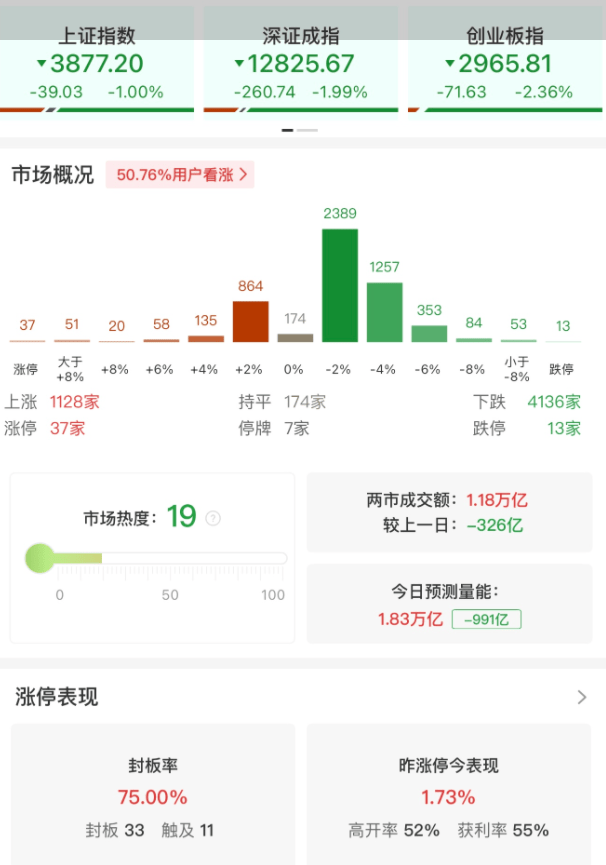
Market Overview - The three major A-share indices experienced a collective decline in the morning session, with the Shanghai Composite Index down by 1%, the Shenzhen Component Index down by 1.99%, and the ChiNext Index down by 2.37% [1] - The total trading volume in the Shanghai, Shenzhen, and Beijing markets reached 1.189 trillion yuan, a decrease of 34 billion yuan compared to the previous day [1] - Over 4,100 stocks in the market fell, indicating a broad-based decline [1] Sector Performance - The photovoltaic, energy storage, and charging pile concepts saw significant declines, with the leading energy storage battery ETF and photovoltaic ETF down by 5.07% and 4.96%, respectively [4] - The AI hardware sector also experienced a widespread pullback, with related stocks collectively retreating [1] - Conversely, the Fujian sector and gas stocks performed well, with the latter reaching historical highs [1] ETF Performance - International gold prices reached new highs for five consecutive days, leading to gains in gold ETFs, with Huaan Fund's gold ETF and Bank of China Shanghai Gold ETF rising by 3.22% and 3.21%, respectively [3] - Gold stocks also showed strong performance, with various gold stock ETFs increasing by 1.59%, 1.44%, and 1.37% [3] - Dividend strategy ETFs saw slight increases, with the China Construction Bank's CSI 300 Dividend ETF and the low-volatility dividend ETF rising by 0.62% and 0.57%, respectively [3]
ETF午评 | 新能源板块跌幅居前,储能电池ETF跌5%
Ge Long Hui· 2025-10-17 04:05
Market Overview - The three major A-share indices collectively declined in the morning session, with the Shanghai Composite Index down by 1%, the Shenzhen Component Index down by 1.99%, and the ChiNext Index down by 2.37% [1] - The total trading volume in the Shanghai, Shenzhen, and Beijing markets reached 11,890 billion yuan, a decrease of 340 billion yuan compared to the previous day [1] - Over 4,100 stocks in the market experienced declines [1] Sector Performance - The new energy sector saw a significant downturn, with photovoltaic, energy storage, and charging pile concepts leading the declines [1] - AI hardware-related stocks also faced widespread declines, including copper-clad laminates, liquid cooling, and HBM concepts [1] - The Fujian sector performed well against the trend, with banking and gas stocks also showing resilience, while Agricultural Bank reached a historical high [1] ETF and Commodity Performance - International gold prices reached new highs for five consecutive days, with Huaan Fund's Gold ETF and Bank of China Shanghai Gold ETF rising by 3.22% and 3.21% respectively [1] - Gold stocks performed strongly, with ICBC Credit Suisse Fund's Gold Stock ETF, Yongying Fund's Gold Stock ETF, and Huaxia Fund's Gold Stock ETF increasing by 1.59%, 1.44%, and 1.37% respectively [1] - Dividend strategy ETFs saw slight increases, with Jianxin Fund's CSI 300 Dividend ETF and Dividend Low Volatility ETF rising by 0.62% and 0.57% respectively [1] Specific Sector Declines - The new energy sector faced substantial declines, with the energy storage battery ETF and photovoltaic ETF leading the drops at 5.07% and 4.96% respectively [1] - The consumer electronics sector also declined, with the consumer electronics ETF falling by 3.69% [1]