拉尼娜

Search documents
国投期货农产品日报-20251126
Guo Tou Qi Huo· 2025-11-26 11:08
Report Industry Investment Ratings - Soybean (Domestic): ☆☆☆ [1] - Soybean Oil: ☆☆☆ [1] - Palm Oil: ★★★ [1] - Soybean Meal: ★★★ [1] - Rapeseed Oil: ☆☆☆ [1] - Rapeseed Meal: ★★★ [1] - Corn: ★★★ [1] - Hog: ★★★ [1] - Egg: ★★★ [1] Core Views - The agricultural product market shows complex trends with different factors influencing each product. Some products have clear trends and investment opportunities, while others lack short - term drivers and are recommended for a wait - and - see approach [2][3][6] - The market is affected by factors such as weather, supply and demand, trade policies, and international price fluctuations [3][4][6] Summary by Product Soybean - Domestic soybean futures are reducing positions and prices are回调. The new crop market features high - quality, high - price. The price difference between domestic and imported soybeans is fluctuating. Short - term focus is on the domestic spot market and policies, and medium - term on South American weather [2] - Imported soybeans are affected by US exports in the short - term and South American weather in the medium - term [2][4] Soybean & Soybean Meal - The domestic soybean supply is sufficient and the crushing volume has increased. The inventory of soybean meal has reached a high level, and the supply is loose [3] - South American new - season soybeans are affected by La Nina, with slow planting progress. Wait for the new Sino - US trade agreement and look for buying opportunities after the回调 [3] Soybean Oil & Palm Oil - The marginal negative factors in the palm oil market have eased. The domestic palm oil basis has strengthened slightly, and the price difference between soybean oil and palm oil has turned positive. Palm oil may see short - covering [4] - Soybean oil is affected by US soybean prices, with short - term focus on US exports and medium - term on South American weather [4] Rapeseed Meal & Rapeseed Oil - Domestic rapeseed futures prices have risen slightly, mainly following the external market. Canadian rapeseed has high crushing demand but weak export demand. The import of Australian rapeseed has profit potential. The short - term driver for the rapeseed sector is not obvious, and a wait - and - see approach is recommended [6] Corn - Corn futures have stopped rising. North - China corn prices are strong, while South - China corn has quality issues. The price difference between North and South is widening. The downstream inventory is low, and the replenishment intention has increased. Wait for the Sino - US trade agreement and pay attention to the sales progress of new corn in the Northeast [7] Hog - The number of breeding sows has decreased, which supports the long - term futures price. The spot price is weak. With the approaching of the winter demand season, there is also pressure from the second - fattening hog supply. The hog price may form a double - bottom pattern [8] Egg - Egg futures are increasing positions, and the far - month contracts are rising. The supply of new - laying hens is expected to decrease, and the number of old hens to be culled is large. The short - term near - month contracts will focus on the convergence of the spot - futures price difference [9]
资金移仓换月,豆粕盘面区间震荡偏多
Zhong Xin Qi Huo· 2025-11-26 00:48
1. Report Industry Investment Ratings - Protein meal: Bullish [2][3][9] - Corn/starch: Bullish [10] - Live pigs: Bearish [12] - Natural rubber: Neutral [13][15] - Synthetic rubber: Bearish [16] - Cotton: Neutral [16] - Sugar: Bearish [17] - Pulp: Neutral [18] - Offset paper: Neutral [19] - Logs: Bearish [21] - Oils and fats: Mixed (soybean oil - neutral, palm oil - bearish, rapeseed oil - neutral) [6][7] 2. Core Views of the Report - The overall agricultural market shows a mixed trend, with different commodities having their own influencing factors and price outlooks [1][6][9] - For protein meal, both international and domestic factors contribute to a bullish outlook, but attention should be paid to factors such as Chinese purchases of US soybeans and South American weather [2][9] - In the oils and fats market, the performance of different oils varies, affected by macro - environment, industrial policies, and supply - demand relationships [6][7] - Corn prices are driven up by multiple factors such as farmers' reluctance to sell, rigid demand for replenishment, and transportation issues [10][11] - Live pig prices are weak due to abundant supply in the short - to - medium term, but supply pressure may ease in the second half of 2026 [12] 3. Summaries by Related Catalogs Protein Meal - **International situation**: Multiple factors such as the possible occurrence of La Nina, drought risks in South America, and changes in US and Brazilian soybean exports and压榨量 lead to an expected bullish trend for US soybeans [2][9] - **Domestic situation**: Import profit of Chinese soybeans is restored, oil mill soybean压榨量 is high, and the supply and demand of domestic protein meal are relatively balanced in the short term. Attention should be paid to Chinese purchases of US soybeans, profit repair, and downstream replenishment [2][9] Oils and Fats - **Macro - environment**: Fed officials' dovish remarks boost the expectation of a December interest rate cut, and the impact of the US promoting a Russia - Ukraine peace agreement on crude oil needs to be monitored [6] - **Industrial situation**: Pay attention to China's purchases of US soybeans, US biodiesel policies, South American soybean planting progress, and the supply and demand of different oils [6] Corn/Starch - **Price information**: The flat - hatch price at Jinzhou Port increased by 10 yuan/ton, and the closing price of the main contract increased by 1.63% [10] - **Driving factors**: Farmers' reluctance to sell, rigid demand for replenishment, concentrated demand in the Northeast, traders' passive grain - grabbing, and tight transportation capacity drive the price up [11] Live Pigs - **Supply**: In the short - to - medium term, the supply is abundant, but the sow production capacity has shown signs of reduction since the third quarter of 2025, and the supply pressure may ease in the second half of 2026 [12] - **Demand**: The demand is insufficient, and the pig - to - meat ratio has declined, with sporadic bacon - curing in the South [12] - **Outlook**: The near - term price is weak, and the far - term price is supported by the expectation of production capacity reduction [12] Natural Rubber - **Market information**: The prices of some rubber products and raw materials have changed, and the export volume of Thailand and Vietnam has decreased year - on - year [13][14] - **Logic**: Although there is speculation about floods in Thailand, the supply is increasing seasonally, and the demand has not changed significantly. The price is expected to fluctuate widely [15] Synthetic Rubber - **Market information**: The prices of butadiene rubber and butadiene have changed [16] - **Logic**: The stable成交 of butadiene supports the disk, but the fundamentals and raw material pressure are large. It is recommended to short at high prices [16] Cotton - **Market information**: The closing price of the Zhengzhou cotton 01 contract increased, and the number of warehouse receipts increased [16] - **Logic**: The supply is increasing, the demand is seasonally weakening, and the inventory is accumulating. The price is supported by cost and downstream purchases and pressured by hedging [16] Sugar - **Market information**: The closing price of the Zhengzhou sugar 01 contract increased [17] - **Logic**: In the medium - to - long term, the global sugar market is expected to have a surplus supply, and the price has a downward drive. In the short term, the 01 contract has certain support at 5300 yuan/ton [17] Pulp - **Market information**: The prices of some pulp products have changed [17] - **Logic**: There are both bullish and bearish factors. The pulp is expected to fluctuate widely, and different contracts have different pressure and support levels [18] Double - Offset Paper - **Logic**: The continuous decline of raw material prices and weak social demand lead to the low - level weak operation of double - offset paper. The price may be supported in November but may decline in December [19][20] Logs - **Logic**: The fundamentals are weak, the supply is expected to increase in the short term, and the demand is weak. The price is expected to fluctuate weakly around the cost line [21]
利多驱动延续,玉米盘面再度走高
Zhong Xin Qi Huo· 2025-11-25 02:24
1. Report Industry Investment Rating - The report does not explicitly provide an overall industry investment rating but gives individual outlooks for each commodity: - Oils and fats: Soybean oil, palm oil, and rapeseed oil are expected to be in a downward - oscillating trend [6] - Protein meals: Soybean meal and rapeseed meal are expected to oscillate [7] - Corn and starch: Expected to be oscillating, with a short - term upward trend [8][9] - Pigs: Expected to be in a weakly oscillating trend [10] - Natural rubber: Expected to oscillate [11][12] - Synthetic rubber: Expected to oscillate, with a suggestion to short at high prices [13] - Cotton: Short - term 01 contract to oscillate, long - term to be weakly upward - oscillating [13] - Sugar: Expected to be in a weakly oscillating trend in the medium - long term [14] - Pulp: Expected to oscillate [15] - Offset paper: Short - term price support from publisher pick - up, medium - term weakly oscillating [16] - Logs: Expected to be in a weakly oscillating trend at a low level [17][18] 2. Core Viewpoints of the Report - The report analyzes the market conditions of various agricultural products, including supply, demand, inventory, and price trends. It points out that different products are affected by different factors such as weather, policies, trade relations, and market sentiment. For example, corn prices are supported by factors like farmers' reluctance to sell, enterprises' replenishment demand, and transportation issues; while pig prices are affected by supply and demand imbalances in the short and medium - term, with a potential supply reduction in the long - term [1][9][10] 3. Summary by Relevant Catalogs 3.1 Oils and Fats - **Viewpoint**: The market sentiment is weak as the expected production of Malaysian palm oil in November is increasing month - on - month. - **Logic**: Macroeconomic factors include the repeated expectation of the Fed's December interest rate cut and the potential increase in global oil supply. On the industrial side, the US soybean harvest is almost complete, South American soybean planting is progressing smoothly, and the expected arrival of imported soybeans in China is at a relatively high level. For palm oil, the production in November is expected to increase while exports are expected to decline. For rapeseed oil, the supply is expected to increase later [6] - **Outlook**: Soybean oil, palm oil, and rapeseed oil are expected to be in a downward - oscillating trend [6] 3.2 Protein Meals - **Viewpoint**: Rapeseed meal has increased in position and price, and the price difference between soybean meal and rapeseed meal is expected to shrink. - **Logic**: Internationally, La Nina is expected to occur, and there is a drought risk in parts of South America. The US soybean planting area is expected to expand in 2026, and the export is expected to decline. Domestically, the import profit of soybeans has improved, and there is an expectation of soybean reserves release. The soybean crushing volume of oil mills is at a high level in the same period in recent years [7] - **Outlook**: Soybean meal and rapeseed meal are expected to oscillate, and the price difference between them is expected to shrink [7] 3.3 Corn and Starch - **Viewpoint**: The upward trend continues due to positive factors. - **Logic**: Positive factors include farmers' reluctance to sell due to weather and transportation issues, the replenishment demand of feed - using enterprises, and the increase in transportation costs. In the short term, these positive factors will continue, but there may be a callback in the future [1][9] - **Outlook**: Oscillating. In the short term, it is recommended to wait and see as the positive factors have not been fully digested [9] 3.4 Pigs - **Viewpoint**: Sows are reducing production, and the short - term price is weak while the long - term price is strong. - **Logic**: In the short and medium - term, the supply of live pigs is abundant, and the demand is insufficient. In the long - term, the reduction of sows' production capacity is expected to continue, and the supply pressure may gradually ease in the second half of 2026 [10] - **Outlook**: Weakly oscillating. The short - term price is weak, and the long - term price is supported by the expectation of production capacity reduction [10] 3.5 Natural Rubber - **Viewpoint**: The flood in the production area has triggered bullish sentiment, but the increase is limited. - **Logic**: The rebound is mainly due to concerns about floods in Thailand. The overseas supply is increasing seasonally, and the demand has not changed significantly recently. The upside space is limited without strong expected differences and macro - driving factors [11][12] - **Outlook**: The price is expected to continue to oscillate widely and with high elasticity, and there is no obvious trend [12] 3.6 Synthetic Rubber - **Viewpoint**: The market atmosphere has stabilized, and the price continues to oscillate. - **Logic**: The price of the raw material butadiene has rebounded after falling, and the trading volume has increased. However, as the price rises, the enthusiasm of sellers to ship has increased, and some high - price transactions have been blocked [13] - **Outlook**: It is recommended to short at high prices before there is an obvious supply - demand contradiction in butadiene [13] 3.7 Cotton - **Viewpoint**: The cotton price has rebounded, and the price difference between January and May contracts has widened. - **Logic**: Internationally, the global cotton production in the 25/26 season is expected to increase, and the inventory of US cotton is expected to accumulate. Domestically, the production of Xinjiang cotton is expected to increase, and the demand is gradually weakening seasonally. The January contract has limited upward driving force but is supported by the cost of new cotton [13] - **Outlook**: The January contract is expected to oscillate in the short term, and the long - term valuation is low and weakly upward - oscillating [13] 3.8 Sugar - **Viewpoint**: The sugar price has rebounded slightly. - **Logic**: In the medium - long term, the global sugar market is expected to have a surplus supply, and the pressure on the sugar price will gradually increase as the new sugar production in the Northern Hemisphere comes on the market [14] - **Outlook**: Weakly oscillating in the medium - long term, and it is recommended to short at high prices [14] 3.9 Pulp - **Viewpoint**: The pulp price oscillates as the positive and negative factors remain unchanged. - **Logic**: Positive factors include the possible shortage of delivery warehouse receipts, the strong price of broad - leaf pulp, and the relatively high price of non - cloth needle pulp. Negative factors include the possible delivery of about 70,000 tons of warehouse receipts in the January contract, the expected non - reduction of coniferous pulp imports, and the decreasing use of coniferous pulp [15] - **Outlook**: Oscillating [15] 3.10 Offset Paper - **Viewpoint**: Offset paper follows the raw material price and oscillates at a low level. - **Logic**: The raw material price is falling, the supply is stable, the downstream demand is limited, and the cost support is weakening. In November, there is price support from publisher pick - up, but in December, there may be a downward pressure due to dealers' inventory clearance [16] - **Outlook**: Short - term price support from publisher pick - up, medium - term weakly oscillating [16] 3.11 Logs - **Viewpoint**: The supply and demand are loose, and the price oscillates at a low level. - **Logic**: The supply from New Zealand is expected to increase in December, and the demand is expected to be weak and stable in 2026. The inventory is slowly decreasing. The price is expected to oscillate weakly around the cost line [17][18] - **Outlook**: Weakly oscillating at a low level [18]
环保公用事业行业周报:10月用电量增速全面提升至10.4%,创年内新高-20251123
CMS· 2025-11-23 15:15
Investment Rating - The report maintains a "Recommendation" rating for the industry [2] Core Insights - The environmental and public utility sectors experienced declines, with the environmental index down 6.02% and the public utility index down 4.33%, indicating a larger drop compared to the overall market [6][23] - The report highlights a significant increase in electricity consumption, with a year-on-year growth of 10.4% in October, marking a new high for the year [10][21] - The coal industry is facing a reduction in production, with national raw coal output declining by 3.8%, 3.2%, and 1.8% in July, August, and September respectively [6] - The report suggests investment opportunities in the electricity sector, particularly recommending companies like Guodian Power and Anhui Energy, which are expected to see valuation recovery [6] Summary by Sections Key Event Analysis - In October, total electricity consumption reached 857.2 billion kWh, a year-on-year increase of 10.4%, with significant growth in the first and third industries [10][21] - The Ministry of Ecology and Environment released allocation plans for carbon emissions trading for the steel, cement, and aluminum industries for 2024 and 2025, indicating a move towards free allocation based on carbon emissions [21][22] Market Review - The environmental and public utility sectors saw significant declines, with the environmental sector up 15.11% year-to-date, outperforming the CSI 300 index [6][23] - The electricity sector's year-to-date growth is only 1.77%, lagging behind the CSI 300 and the ChiNext index [6][23] Key Data Tracking - As of November 21, 2025, the price of Qinhuangdao 5500 kcal thermal coal is 820 CNY/ton, stable compared to the previous week but down 2.4% year-on-year [40] - The Three Gorges Reservoir's water level is at 174.4 meters, up 4.2% year-on-year, with inflow and outflow rates also increasing [42] - The average electricity price in Guangdong reached 253.72 CNY/MWh, a 7.7% increase from the previous week [53] Industry Events - The report notes several key regulatory developments, including initiatives to promote green manufacturing in Jiangxi Province and the establishment of zero-carbon parks in Liaoning Province [64][65]
蛋白粕周报 2025/11/22:南美播种顺利施压盘面-20251122
Wu Kuang Qi Huo· 2025-11-22 14:02
1. Report Industry Investment Rating No relevant content provided. 2. Core Viewpoints of the Report - Global soybean new - crop production has been marginally reduced, with total production now almost equal to total demand. Supply has decreased compared to the 24/25 season, suggesting the bottom of import costs may have emerged, but upward potential requires greater production cuts. - Currently, domestic soybean inventory is at a multi - year high, and soybean meal inventory is large, pressuring crushing margins. However, as the de - stocking season approaches, there is some support. - Soybean meal is expected to trade in a range with cost support and pressured crushing margins [9][10][11]. 3. Summary by Directory 3.1 Weekly Assessment and Strategy Recommendation - **International Soybeans**: This week, US soybeans reached the cost level of 1170 cents per bushel and then pulled back. The global soybean supply reduction is limited, and the global soybean stock - to - use ratio remains high. Brazilian soybean premium quotes declined slightly this week, reducing the cost of imported soybeans in China. As of November 21, the January US soybean contract was at 1126.5 cents per bushel, and the Brazilian January premium was 145 cents per bushel. The November USDA forecast further reduced the global new - crop soybean production by about 4 million tons, mainly due to cuts in India, Ukraine, and the US. After the November adjustment, the USDA estimates that the 25/26 global soybean production and consumption are nearly equal, and the supply - demand pattern has shifted from increasing supply and demand to decreasing supply and increasing demand. The global soybean stock - to - use ratio has dropped from 33% in October 2024 to 28.94%, providing a bottom support but not enough for a highly profitable CBOT soybean planting market [9]. - **Domestic Double - Meal**: This week, the domestic soybean meal spot price fluctuated, and the basis also fluctuated. The futures market followed cost changes, and the oil mills' crushing margins on the futures market declined. Domestic soybean meal sales were decent, and提货 was at a relatively high level. Feed companies' inventory days were 7.98 days, slightly lower than the same period last year and down 0.25 days from the previous period. As of November 18, institutional statistics showed 9.2 million tons of soybean purchases in August, 8.76 million tons in September, 7.73 million tons in October, and 6.51 million tons in November. Current purchase progress indicates that domestic soybean and soybean meal inventories will continue to decline. Coupled with the high - level提货, the domestic soybean - related basis has some support [9]. - **Trading Strategy**: The unilateral strategy for soybean meal is to expect range - bound trading [11]. 3.2 Futures and Spot Market - **Spot Prices**: Provided historical data charts of soybean meal spot prices in Dongguan, Guangdong, and rapeseed meal spot prices in Huangpu, Guangdong from 2021 - 2025 [17][18]. - **Basis of Main Contracts**: Provided historical data charts of the basis of the soybean meal 01 contract and the rapeseed meal 01 contract [20][21]. - **Spreads**: Provided historical data charts of various spreads, such as the soybean meal 01 - 05 spread, 03 - 05 spread, 11 - 1 spread, and soybean meal 01 - rapeseed meal 01 spread [22][23]. - **Fund Positions**: Provided historical data charts of the net long positions of managed funds in US soybeans and US soybean meal [25][28]. 3.3 Supply Side - **US Soybean Planting Progress**: Provided historical data charts of US soybean planting progress, emergence rate, flowering rate, and good - to - excellent rate from 2021 - 2025 [31][32]. - **Weather Conditions**: Provided precipitation forecasts for Argentine and Brazilian soybean - growing regions until November 29, 2025, and analyzed the possible occurrence of La Nina from October 2025 to January 2026 and its impact on climate [34][36]. - **US Soybean Export Progress**: Provided historical data charts of the total amount of US soybean export contracts signed with China in the current marketing year, the sales completion rate of US soybeans in the current year, the total amount of US soybean export contracts signed in the current market year, and the cumulative value of US soybean exports to China in the current market year [48][49]. - **China's Oilseed Imports**: Provided historical data charts of monthly soybean and rapeseed imports and forecasts in China from 2021 - 2025 [51][52]. - **China's Oil Mill Crushing**: Provided historical data charts of the soybean and rapeseed crushing volumes of major oil mills in China [53][54]. 3.4 Profit and Inventory - **Oilseed Inventory**: Provided historical data charts of soybean port inventory and the rapeseed inventory of major oil mills in China from 2021 - 2025 [57][58]. - **Protein Meal Inventory**: Provided historical data charts of the soybean meal inventory and forecasts of coastal major oil mills and the rapeseed meal inventory of coastal major oil mills in China from 2021 - 2025 [60][61]. - **Protein Meal Crushing Profit**: Provided historical data charts of the crushing profit of imported soybeans in Guangdong and the crushing profit of imported rapeseed in coastal areas from 2021 - 2025 [62][63]. 3.5 Demand Side - **Soybean Meal Demand**: Provided historical data charts of the cumulative sales volume of soybean meal in major oil mills in the crop year and the apparent consumption of soybean meal in China [65]. - **Breeding Profit**: Provided historical data charts of the average profit per head of self - bred and self - raised pigs and the breeding profit of white - feather broilers from 2021 - 2025 [66][67].
厄尔尼诺及拉尼娜影响下油菜籽供给指标如何演变
对冲研投· 2025-11-20 11:55
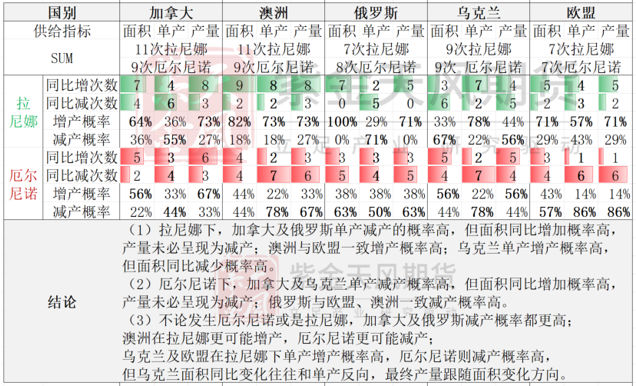
Core Viewpoint - The article discusses the impact of El Niño and La Niña on canola production in major exporting countries, highlighting the probabilities of yield changes and area variations under different climatic conditions [5][10]. Group 1: El Niño Impact - In Canada, initial high temperatures during the sowing period lead to a higher probability of reduced yield (44%), but an increased area (56%) may offset this, resulting in a 67% chance of overall production increase [5]. - Ukraine experiences dry conditions during the planting period, with a high probability of reduced yield (78%) but also a 56% chance of increased area, leading to a 56% probability of production increase [5]. - Australia faces high temperatures and drought during the growing season, with a 78% probability of reduced yield and a 67% chance of overall production decrease [6]. - In Russia, some areas are cooler during the growing season, with a 63% probability of reduced area and a 50% chance of reduced yield, leading to a 63% probability of decreased production [7]. - The EU experiences wet and hot conditions during sowing, with an 86% probability of reduced yield and a 57% chance of decreased area, resulting in an 86% probability of reduced production [7]. Group 2: La Niña Impact - In Canada, only a small part of the western coastal region is affected by cooler temperatures, leading to a 55% probability of reduced yield but a 64% chance of increased area, resulting in a 73% probability of overall production increase [8]. - Australia shows a high probability of increased production (82%) and yield (73%) during La Niña conditions, with favorable weather during the growing season [8]. - Ukraine and the EU have a high probability of increased yield (78% for Ukraine and 71% for the EU) during La Niña, although Ukraine faces a 67% chance of reduced area, leading to a 56% probability of decreased production [8]. - In Russia, the harvest period sees high temperatures, with a 71% probability of reduced yield but a 100% chance of increased area, resulting in a 71% probability of no overall production decrease [8]. Group 3: Summary of Climatic Effects - Regardless of whether El Niño or La Niña occurs, Canada and Russia have a higher probability of reduced yield, while Australia is more likely to increase production under La Niña and decrease under El Niño [9][10]. - Ukraine and the EU show a higher probability of increased yield under La Niña, but Ukraine's area changes often inversely affect yield, leading to production following area trends [9][10]. - The weak La Niña phenomenon is expected to last until February next year, with current weather conditions in Canada, Russia, Australia, Ukraine, and the EU being monitored for their impact on canola production [10][11].


国投期货农产品日报-20251119
Guo Tou Qi Huo· 2025-11-19 11:01
国内棕榈油从近期的横盘区间跳升,表现转强,豆棕价差从高位回调,显示出棕油开始强于豆油。美豆油表现偏强,一方面市 场对美国生物柴油政策预期偏乐观,一方面美国柴油市场表现偏强、美国柴油产量低于平均水平,柴油出口强劲。国内需求也 好于平均水平,预计美国柴油中期会表现为供需偏紧的格局,预计美国柴油市场的强劲对植物油有边际溢出效应。随着豆油的 走强,国际市场上豆棕价差也在走强,棕榈油也开始主动跟随。棕榈油马来西亚的短期高频数据显示供需面偏弱。大豆国内近 端压榨利润仍然偏差,国内表现出豆油强于豆粕。由于豆油表现偏强,我们预计棕榈油会被带动,基于这个国素,预计棕榈油 单边走势阶段性见底的概率偏大。 本报告版权属于国投期货有限公司 | | | | | 操作评级 | 2025年11月19日 | | --- | --- | --- | | | | 杨蕊霞 农产品组长 | | 显一 | ☆☆☆ | F0285733 Z0011333 | | 豆油 | ★☆☆ | 吴小明 首席分析师 | | 棕榈油 | ★☆☆ | | | 豆粕 | な女女 | F3078401 Z0015853 | | | | 董甜甜 高级分析师 | | 莱油 | ...
农产品日报-20251118
Guo Tou Qi Huo· 2025-11-18 14:18
Report Industry Investment Ratings - Soybean: ★☆☆ [1] - Palm Oil: ななな [1] - Soybean Meal: ★☆☆ [1] - Rapeseed Oil: ★☆☆ [1] - Rapeseed Meal: ★☆☆ [1] - Corn: ☆☆☆ [1] - Live Hogs: ななな [1] - Eggs: ★☆☆ [1] Core Views - The report analyzes the market conditions of various agricultural products including soybeans, palm oil, soybean meal, rapeseed oil, rapeseed meal, corn, live hogs, and eggs, and provides investment ratings and market trend predictions for each [1] - It also points out the influencing factors such as supply - demand relationships, policy changes, and weather conditions for different agricultural products [2][3][6] Summary by Related Catalogs Soybean - The main contract of soybean futures reduced positions significantly today, and the price dropped rapidly from a high. 35,000 tons of soybeans were auctioned by Sinograin today, all sold at an average price of 3,900 yuan/ton. The price difference between domestic and imported soybeans decreased. The market is speculating on China's policy - based procurement of US soybeans and the increase in US domestic soybean crushing volume. Short - term focus on the performance of domestic soybean spot and policy [2] Soybean & Soybean Meal - In October, the US soybean crushing volume reached 228 million bushels, a record high. The planting progress of new - season soybeans in Brazil is slow, with a sowing rate of 69.0% as of November 15, behind last year's 73.8%. Concerns about the impact of La Nina on soybean yields in Brazil and Argentina. The main contract of domestic soybean meal futures continued to correct, and the basis weakened. The domestic market has sufficient soybean supply and poor crushing profits, with high soybean inventory and a decline in soybean meal inventory but still in the million - ton level. Wait for the signing of the Sino - US economic and trade agreement and track its implementation. Consider buying on dips after stabilization [3] Soybean Oil & Palm Oil - US soybeans are strong. The market is speculating on China's policy - based procurement of US soybeans and the increase in US domestic soybean crushing volume. The cost of imported soybeans has risen, and domestic near - end crushing profits are still poor. Soybean oil is stronger than soybean meal and palm oil. Palm oil is in a sideways shock, and its price trend may change with the improvement of supply - demand [4] Rapeseed Meal & Rapeseed Oil - Domestic rapeseed futures oscillated weakly today, weaker than their competitors. Rapeseed products have a statistical premium, resulting in mediocre demand, especially for rapeseed meal. Australian rapeseed is expected to arrive in China soon, and the premium of rapeseed futures prices will gradually decline. The supply of domestic rapeseed products has variables, and the demand is expected to be average, with short - term pressure on futures prices [6] Corn - Dalian corn futures oscillated and corrected today. The increase in new - season corn in Northeast China has decreased, and farmers are more reluctant to sell, with prices slightly stronger. The arrival of corn in Shandong has increased slightly, and prices are stable. The inventory of downstream corn is generally low, and the purchase price has risen with the increase in the operating rate of deep - processing enterprises. Wait for the signing of the Sino - US trade agreement, and pay attention to the sales progress of new corn in Northeast China. The 01 contract of Dalian corn futures may continue to correct [7] Live Hogs - The near - month contract of live hog futures hit a new low, and the far - month contract followed. The spot price is relatively stable. The futures market is trading on potential future supply pressure. Historically, the bottom of the pig cycle often shows a double - bottom "W" shape. The low price in October is likely the first emotional bottom, and there is a high probability of a second bottom in the first half of next year due to supply pressure and the off - season of demand [8] Eggs - Egg futures continued to face selling pressure, with an overall increase in positions, and the February contract led the decline. The spot price of eggs across the country generally fell. Reasons include the decline of vegetable prices, the approaching delivery of the December contract, and the current high - supply and off - season - demand situation. Hold short positions in near - month contracts at high levels [9]
国投期货农产品日报-20251118
Guo Tou Qi Huo· 2025-11-18 14:12
Report Industry Investment Ratings - Soybean Futures: ★☆☆ (One star, indicating a bullish/bearish bias with a driving force for price movement, but limited operability on the market) [1] - Palm Oil: Not clearly rated [1] - Soybean Meal: ★☆☆ [1] - Rapeseed Oil: ★☆☆ [1] - Rapeseed Meal: ★☆☆ [1] - Corn: ☆☆☆ (White star, suggesting a relatively balanced short - term trend with poor operability, advisable to wait and see) [1] - Live Pigs: Not clearly rated [1] - Eggs: ★☆☆ [1] Core Views - The report analyzes multiple agricultural products including soybeans, soybean meal, etc., and provides insights into their price trends, supply - demand situations, and potential investment opportunities based on domestic and international market data and policy factors [2][3][4] Summaries by Related Catalogs Soybean - The main contract of soybean futures significantly reduced positions today, with prices dropping rapidly from high levels. 35,000 tons of soybeans were auctioned by Sinograin at an average price of 3,900 yuan/ton. The price difference between domestic and imported soybeans decreased. The market is speculating on China's policy - based procurement of US soybeans and the increase in US domestic soybean crushing volume. Short - term focus is on the performance of domestic soybean spot and policy [2] Soybean & Soybean Meal - In October, the US soybean crushing volume reached 228 million bushels, a record high. The planting progress of new - season soybeans in Brazil is slow, with a sowing rate of 69.0% as of November 15, behind last year's 73.8%. The impact of La Nina on soybean yields in Brazil and Argentina needs continuous attention. Domestically, the main contract of Dalian soybean meal futures continued to correct, and the basis weakened. The domestic market has sufficient soybean supply and poor crushing profits. Soybean inventory remains high, and soybean meal inventory has decreased but is still in the millions. Wait for the signing of the new Sino - US economic and trade agreement and track its implementation. Consider buying on dips after stabilization [3] Soybean Oil & Palm Oil - US soybeans are performing strongly. The market is speculating on China's policy - based procurement of US soybeans and the increase in US domestic soybean crushing volume. The cost of imported soybeans has risen, and domestic near - term crushing profits are still poor. Domestic soybean oil is stronger than soybean meal and palm oil. Palm oil's short - term high - frequency data shows a weak supply - demand situation and is currently in a sideways shock. A change in palm oil price trends requires an improvement in the supply - demand situation. Short - term focus on the guidance of the oil supply - demand situation [4] Rapeseed Meal & Rapeseed Oil - Domestic rapeseed - related futures had a weak shock today, weaker than their counterparts. Rapeseed products still have a statistical premium, resulting in lackluster demand, especially for rapeseed meal. The premium of rapeseed - related futures prices is expected to gradually decline as Australian rapeseed is about to arrive in China. The medium - to - long - term supply - demand of rapeseed products is more affected by Sino - Canadian relations, but there are no significant changes currently. Domestic rapeseed supply has variables, and attention should be paid to the arrival time of Australian rapeseed and direct imports of rapeseed meal and oil. Demand is expected to be mediocre, and rapeseed - related futures prices are under short - term pressure [6] Corn - Dalian corn futures oscillated and corrected today. The increase in new corn in Northeast China has decreased, and farmers' reluctance to sell has strengthened, with prices slightly stronger. The amount of corn arriving in Shandong has increased slightly, and prices are stable. The inventory of middle - and downstream corn is generally low, and the purchase price has risen with the increase in the operating rate of deep - processing enterprises. Wait for the signing of the Sino - US trade agreement, and pay attention to the sales progress of new corn in Northeast China. The Dalian corn futures 01 contract may continue to correct [7] Live Pigs - The near - month live pig futures hit a new low, and the far - month contracts followed. The overall position increased by nearly 10,000 lots. The average spot price of live pigs is stable. The futures market is trading on the potential future supply pressure. Historically, the bottom of the pig cycle often shows a double - bottom "W" shape. The low pig price in October was likely the first emotional bottom - building. It is expected that pig prices will have a high probability of a second bottom - building in the first half of next year due to continuous supply pressure and the off - season of demand [8] Eggs - Egg futures continued to face selling pressure, and the overall position increased. The February contract led the decline. The national spot price of eggs generally decreased. Vegetable prices showed a downward trend, the December contract was approaching delivery and converging its premium to the spot, and the fundamental situation is a high - supply and off - season - demand stage. It is recommended to hold short positions in the near - month high - level contracts [9]
厄尔尼诺、拉尼娜对油菜籽主要出口国影响复盘
Qi Huo Ri Bao· 2025-11-18 03:11
Core Insights - The impact of El Niño and La Niña on canola seed production varies by region, with different probabilities of yield changes based on climatic conditions during different growth stages [1][2][3][4][5][6][9][10][15]. Group 1: El Niño Effects - In Canada, initial high temperatures during sowing may lead to a higher probability of reduced yield (44%), but an increase in area planted (56%) could offset this, resulting in a 67% chance of overall yield increase [1]. - Ukraine experiences dry conditions during the planting period, with a high probability of reduced yield (78%), yet an increase in area planted (56%) suggests that total production may not decline (56% chance of increase) [1]. - Australia faces high temperatures and drought during the growing season, leading to a 78% probability of reduced yield and a 67% chance of overall production decline [2]. - In Russia, some areas may experience cold conditions during the growing season, with a 63% probability of reduced area planted and a 50% chance of reduced yield [3]. - The EU is expected to face wet and hot conditions, with an 86% probability of reduced yield and a 57% chance of decreased area planted [3]. Group 2: La Niña Effects - In Canada, only a small portion of the western coastal region is affected by cold temperatures, leading to a 55% probability of reduced yield, but a 64% chance of increased area planted suggests that total production may not decline (73% chance of increase) [4]. - Australia is expected to see consistent yield increases, with an 82% probability of increased area planted and a 73% chance of increased yield [5]. - In Ukraine and the EU, there is a high probability of increased yield during the growing and harvesting periods, with Ukraine showing a 78% chance of increased yield despite a 67% probability of reduced area planted [5]. - In Russia, the harvesting period may see high temperatures, leading to a 71% probability of reduced yield, but a 100% chance of increased area planted suggests that total production may not decline (71% chance of increase) [6]. Group 3: Summary of Probabilities - Regardless of whether El Niño or La Niña occurs, Canada and Russia show higher probabilities of reduced yield, while Australia is more likely to see increased production under La Niña and reduced production under El Niño [6]. - Ukraine and the EU have a higher probability of increased yield under La Niña, while El Niño presents a higher risk of reduced yield, with Ukraine's area planted often inversely related to yield changes [6].