期限溢价

Search documents
热点思考 | 降息重启,美债利率怎么走?(申万宏观·赵伟团队)
申万宏源宏观· 2025-09-20 16:05
Group 1 - The Federal Reserve has restarted interest rate cuts, with the 10-year U.S. Treasury yield briefly falling below 4.0% [1][3] - Since the early 1970s, the Federal Reserve has experienced 12 interest rate cut cycles, with 5 occurring in a soft landing environment and 7 in a hard landing context [5][6] - In soft landing scenarios, the average interest rate cut is about 234 basis points (bps) over an average duration of 9 months, while in hard landing scenarios, the average cut is 647 bps over 20 months [5][6] Group 2 - The macroeconomic conditions determine the slope and space of the decline in U.S. Treasury yields, with preventive cuts resulting in smaller declines and earlier rebounds [2][27] - The low point of the 10-year Treasury yield often occurs 1-2 months before or after the last rate cut in preventive cut scenarios [28][75] - The timing of the low point in Treasury yields is closely related to the pace of interest rate cuts, with faster cuts leading to earlier lows [2][75] Group 3 - Despite the restart of interest rate cuts, the potential for further declines in the 10-year Treasury yield may be limited due to the rise in the long-term nominal neutral interest rate to the 3-3.5% range [3][50] - The market has priced in 4-5 rate cuts by the end of 2026, but the Federal Reserve may only cut rates once if the PCE inflation is projected at 2.6% and unemployment at 4.4% [3][50] - The increase in term premium is expected to dominate the direction of long-term Treasury yields, with the term premium rising to around 0.9% in 2025 due to expanded debt supply and policy uncertainty [3][56]


申万宏源证券晨会报告-20250917
Shenwan Hongyuan Securities· 2025-09-17 00:43
Core Insights - The report highlights the significant rise in long-term interest rates in developed countries since August, particularly in France and the UK, reaching levels not seen since 2011 and 1998 respectively, raising concerns about potential liquidity pressures in risk assets [2][8] - The increase in long-term rates is primarily driven by inflationary pressures, which have weakened the likelihood of interest rate cuts, with the UK facing greater challenges than the Eurozone [2][3] - The report identifies four key events over the past three years that have caused volatility in equity and currency markets due to rising interest rates, including the UK pension crisis in 2022 and the US debt supply shock in 2023 [3][8] Market Performance - The Shanghai Composite Index closed at 3862 points, with a slight increase of 0.04% over one day, and a 4.47% increase over five days [1] - The Shenzhen Composite Index showed a stronger performance, closing at 2490 points with a 0.74% increase over one day and an 8.22% increase over five days [1] - Among industry sectors, home appliance components saw the highest growth, with a 6.28% increase yesterday and a 25.04% increase over the past six months [1] Interest Rate Trends - The report notes that the rise in long-term interest rates is expected to continue in the short term, with specific indicators to monitor for potential liquidity shocks in equity markets [3][4] - The report emphasizes that when the historical volatility of US Treasury rates exceeds 10%, it is crucial to be aware of potential liquidity risks [3][4] - Long-term interest rates reflect both economic investment returns and social financing costs, with rising rates potentially leading to systemic risks if they constrain government actions [4][9] Economic Indicators - The report suggests that the current credit spread indicators for corporate bonds in the US, Europe, and Japan are below the 5% threshold of the past five years, indicating manageable credit risk [4][9] - It highlights the importance of monitoring fiscal expansion events that could lead to debt pressure, particularly in the context of high valuation levels in global equity markets [3][9] Conclusion - The report concludes that while the short-term outlook for long-term interest rates remains upward, the potential for systemic risks increases if rates rise to levels that constrain government fiscal policies [4][9] - Investors are advised to keep an eye on key economic indicators and market conditions that could signal shifts in liquidity and risk profiles [3][4]
There is value in the bond market at the end of the curve, says Wellington's Brij Khurana
Youtube· 2025-09-16 21:40
Core Insights - The bond market is anticipating a 25 basis point rate cut from the Fed, with potential dissent among Fed voters regarding the extent of cuts [1][2] - The market is focused on the Fed's summary of economic projections, particularly the dot plot indicating future policy rates, with expectations of three cuts this year [2][3] - There is a concern that the market's expectation of the Fed rate dropping below 3% next year may not materialize, which could lead to disappointment [3] Economic Conditions - The economy is described as having two speeds, with high-income consumers continuing to spend, contributing to inflationary pressures, while small businesses struggle with high interest rates [8][9] - Core inflation, excluding shelter, increased by 2.7% last month, the highest in two years, indicating that high-income consumers are faring well [9] - The Fed faces challenges in balancing support for small businesses through rate cuts while managing the potential for increased wealth effects and stickier inflation [10] Market Expectations - The bond market is pricing in significant rate cuts, with expectations that the Fed will act aggressively to prolong economic expansion [11][12] - There is a notion of a "Goldilocks" environment where growth is slowing, but aggressive Fed actions could sustain the economic cycle [12] - Inflation-linked bonds are suggested as a viable investment option, especially if inflation begins to rise, as the market is already pricing in a return to the Fed's 2% target [13][14] Tariff Impact - Tariff policies are believed to significantly affect fixed income markets, with evidence of inflationary impacts from tariffs not being fully recognized [15] - Core goods have shown a month-over-month increase, indicating that inflationary pressures are emerging, which could lead to stagflationary conditions [15]
凯雷:美国财政部和美联储的角色将变得模糊
Sou Hu Cai Jing· 2025-09-10 12:48
Core Viewpoint - The Trump administration's call for significant interest rate cuts by the Federal Reserve, combined with the prospect of increased short-term bond issuance, may disrupt the Treasury bond market and ultimately raise long-term borrowing costs [1] Group 1: Federal Reserve and Interest Rates - The Federal Reserve is under pressure from the Trump administration to lower the benchmark interest rate to stimulate the U.S. economy [1] - This pressure could lead to a scenario where bondholders lose confidence in the Fed's commitment to maintaining the real value of their principal [1] Group 2: Treasury Bond Market Dynamics - Increased issuance of short-term Treasury bills, as suggested by Treasury Secretary Mnuchin, may be a strategy to save on interest expenses in the current high-yield environment [1] - If the Fed appears more focused on government financing rather than protecting bondholders, it could trigger bond sell-offs and an increase in term premiums [1]

一代人一遇的机会!基金经理高呼:现在是抄底的绝佳时机
Jin Shi Shu Ju· 2025-09-04 07:11
Group 1 - The bond market has become a focal point, with long-term bond yields reaching multi-decade highs, presenting a "once-in-a-generation opportunity" for UK government bonds [1] - The UK 30-year bond yield hit 5.723%, the highest since 1998, while the 10-year bond yield reached 4.835%, the highest since the beginning of the year [1] - The volatility in the UK bond market has been exacerbated by reduced demand from pension funds as they cut their holdings of 30-year bonds [1] Group 2 - The government has emphasized its fiscal rules in response to concerns about fiscal irresponsibility, which could provide buying opportunities for UK bonds if the market believes in this commitment [2] - If the Bank of England slows its quantitative tightening, it may further enhance the attractiveness of UK government bonds, especially at real yields of 2.5% to 3% [2] - The UK bond market is viewed as one of the most interesting interest rate markets for 2025, with long-end bonds considered cheap despite potential risks related to the budget [3]
“戒不掉”的“债瘾”
Hua Er Jie Jian Wen· 2025-09-04 05:03
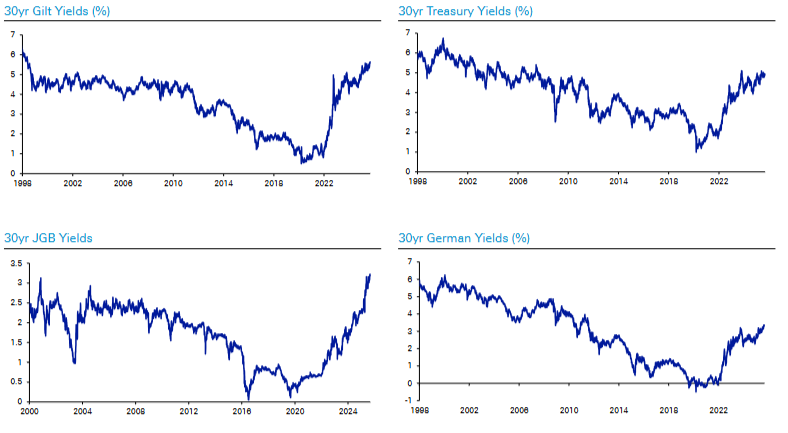
Core Viewpoint - Major economies are trapped in a "debt addiction," with expansive fiscal policies leading them into a prolonged "debt test" [1] Group 1: Market Reactions - A global sell-off of long-term bonds began in late August, originating from Europe, with France's government facing a confidence vote raising doubts about its fiscal tightening plans [1][3] - The UK and Japan also contributed to the turmoil, with the UK facing budget concerns and Japan experiencing political instability, leading to rising long-term interest rates [1][4][5] - The UK’s 30-year bond yield reached its highest level since 1998, while Japan, France, and Germany also saw long-term rates rise to multi-decade highs [1][6] Group 2: Fiscal Challenges - The current market volatility indicates that fiscal expansion combined with rising inflation is becoming a core driver of sovereign debt risk [2] - Persistent high deficits have become the norm for major economies, with France not achieving a budget surplus since 1974 and Italy last achieving one nearly a century ago [7][8] Group 3: Structural Issues - The increase in long-term bond yields is attributed to both cyclical and structural factors, with inflation being a key determinant of short-term interest rates [14][15] - Structural "debt addiction" has emerged post-pandemic, with rising debt levels leading to two significant challenges: the increasing correlation between sovereign bonds and equities, and the rising long-term yield risk due to high government debt levels [17] - Aging populations and high debt burdens contribute to unsustainable fiscal pressures, exemplified by France's debt-to-GDP ratio of 114% and a significant portion of its deficit being foundational and difficult to reduce [18]
债市“九月诅咒”被激活:30年期美债收益率蓄势破5% 全球长期限国债齐跌
Zhi Tong Cai Jing· 2025-09-03 04:44
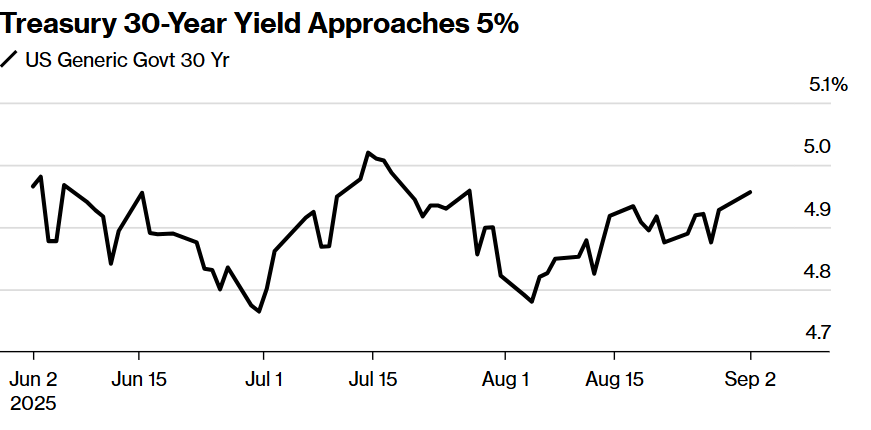
Group 1 - The core viewpoint of the articles highlights a significant rise in long-term U.S. Treasury yields, particularly the 30-year yield approaching the 5% mark, which is negatively impacting stock market valuations globally [1][4][5] - A large-scale sell-off of long-term government bonds is spreading from Europe and America to Asia and Oceania, with Japan's 20-year bond yield reaching its highest level since 1999 and Australia's 10-year yield hitting a peak since July [4][5] - Historical data indicates that September is typically a challenging month for long-term government bonds, with a median decline of 2% for bonds with maturities over 10 years in the past decade [5][6][10] Group 2 - The upcoming economic data, particularly the non-farm payroll report, is expected to influence the Federal Reserve's monetary policy decisions, including potential interest rate cuts [4][11][14] - The bond market is currently reflecting concerns over fiscal spending paths, with higher term premiums being factored into bond prices [6][11] - There is speculation that a weak non-farm payroll report could increase the likelihood of a 50 basis point rate cut by the Federal Reserve, which may provide relief to the long-term bond market [11][15]
日本长期限国债抛压迎来缓和 10年期国债拍卖呈现2023年以来最强劲需求
智通财经网· 2025-09-02 07:14
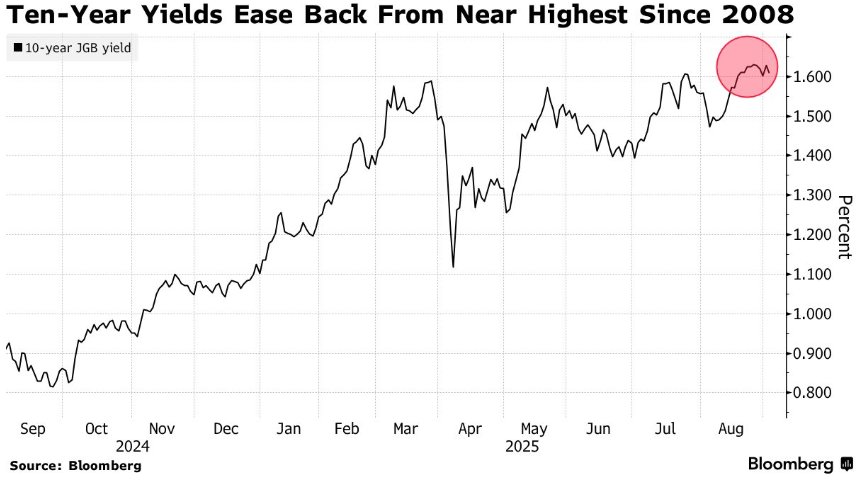
Group 1 - The core point of the article is that the 10-year Japanese government bond yield has turned downward from a 17-year high, with strong demand observed in the latest auction, indicating a potential easing of investor concerns regarding a sell-off in long-term Japanese bonds [1][4][8] - The 10-year Japanese government bond yield decreased by 2 basis points to 1.60%, after reaching 1.625% on Monday, which is close to the highest level since 2008 [1][4] - The auction results showed a significant increase in the bid-to-cover ratio for the 10-year bonds, rising from 3.06 to 3.92, indicating robust demand compared to the average over the past 12 months [1][4] Group 2 - The successful issuance of the bonds has alleviated global investor anxiety about a potential sell-off in long-term Japanese bonds, which had been under pressure due to concerns over the Bank of Japan's monetary policy and government spending [4][8] - The Bank of Japan's Deputy Governor reiterated the established monetary policy path to raise the benchmark interest rate when conditions allow, without indicating when this might occur [5] - Market participants are closely watching the upcoming auction of 30-year bonds, which could impact secondary market demand for bonds [6][7] Group 3 - Political uncertainty remains a concern, as the ruling party is set to release a report on its recent electoral losses, which could affect the stability of Prime Minister Kishida [6][7] - The market is speculating on potential changes in leadership within the ruling party, which could influence long-term bond yields [7][8] - The demand for long-term Japanese bonds appears to be driven by expectations of a potential reduction in the issuance of ultra-long government bonds following discussions with primary dealers [7][8]
中金 | 美债季报:财政主导下的美债与流动性
中金点睛· 2025-09-01 23:41
Core Viewpoint - The article discusses the evolving economic landscape in the U.S., highlighting a potential shift towards a "fiscal dominance, monetary coordination" policy model, driven by rising inflation and increasing fiscal deficits, despite the market's expectations for interest rate cuts by the Federal Reserve [3][20][24]. Group 1: Economic Recovery and Inflation - The U.S. economy is experiencing a bumpy recovery, with consumer and business confidence gradually improving as policy uncertainties decrease [5][9]. - Inflation is expected to trend upwards towards the end of the year, primarily due to a "wage-inflation" spiral and tariff impacts, which may challenge traditional monetary policy approaches [16][18]. - The labor market is showing signs of recovery, with job vacancies increasing and wage growth potentially on the rise, indicating a solid foundation for consumer spending [9][12][16]. Group 2: Fiscal Dominance and Monetary Coordination - The article outlines a new policy model characterized by fiscal dominance, where fiscal policy increasingly influences monetary policy decisions, particularly in light of persistent fiscal deficits [20][24]. - The federal deficit for the current fiscal year reached $1.63 trillion by July, with projections suggesting it could rise to $1.92 trillion for the full year, indicating a significant fiscal burden [20][21]. - The article suggests that the current administration's pressure on the Federal Reserve to lower interest rates is a strategic move to reduce financing costs for both the government and private sectors, especially ahead of upcoming elections [26][29]. Group 3: Bond Market Dynamics - The article anticipates a significant increase in U.S. Treasury bond issuance, with projections of $1 trillion in net issuance for Q3 and $590 billion for Q4, primarily in long-term bonds [33][34]. - The demand for bonds is expected to be driven mainly by households, money market funds, and foreign investors, although recent trends show a decrease in holdings by money market funds [37][41]. - The article warns that if the Federal Reserve cuts rates while inflation rises, it could lead to higher long-term interest rates, with projections suggesting the 10-year yield could reach approximately 4.8% by year-end [4][45].

特朗普“降息”图谋难得逞:短期美联储说了算,长期仍看债市脸色
Jin Shi Shu Ju· 2025-08-29 01:38
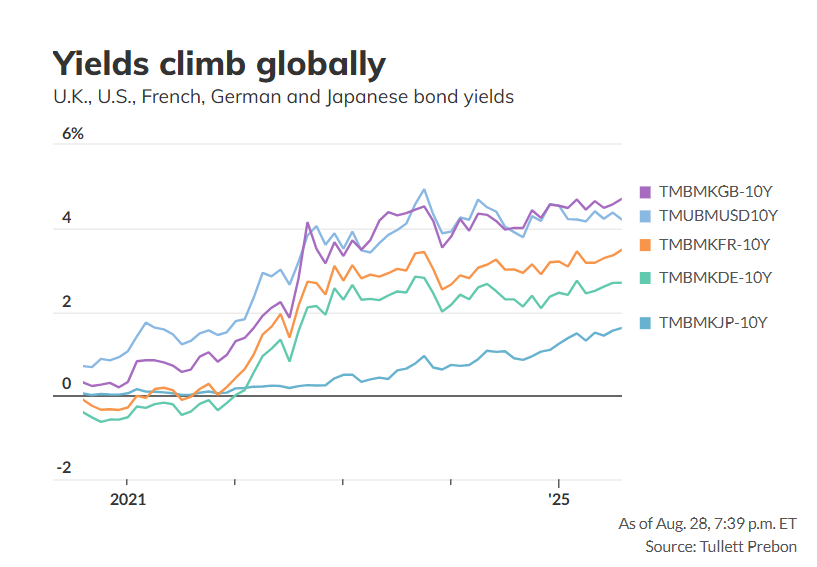
Core Viewpoint - President Trump's efforts to influence U.S. interest rates may ultimately depend on global bond market dynamics, as long-term borrowing costs are primarily driven by market forces rather than the Federal Reserve's short-term rate decisions [1][3]. Group 1: Global Bond Market Dynamics - Major economies, including the U.S., are experiencing rising long-term borrowing costs, leading to some of the highest yields in decades for investors [1]. - The G7 countries are facing similar fiscal challenges, with varying degrees of severity, as noted by Apollo Global Management's chief economist [1]. - Central banks, including the Federal Reserve, have lowered short-term rates from pandemic peaks, but global benchmark 10-year bond yields remain stubbornly high [1][3]. Group 2: Long-term Interest Rate Trends - Global central banks are seeking to normalize interest rates, contributing to rising long-term bond yields [3]. - Increased government spending and commitments to defense spending in Europe may lead to larger deficits and higher government bond issuance, pushing up the term premium [3]. - Japan's long-term bond yields are under upward pressure due to inflation concerns, with its 30-year bond yield reaching 3.21%, close to a 30-year high [3]. Group 3: Market Reactions and Investor Sentiment - Despite Trump's attempt to dismiss a Federal Reserve board member, the bond market showed little immediate reaction, indicating investor confidence in the Fed's independence [4]. - The U.S. 10-year bond yield is stable around 4.21%, higher than France's 3.48%, reflecting differing fiscal concerns [4]. - The U.K. is experiencing a typical case of rising yields due to budget deficits, with its 10-year bond yield nearing 4.70% [4][5]. Group 4: Implications for Fixed Income Investors - Investors are concerned about the potential loss of Federal Reserve independence, which could lead to a steeper yield curve and a weaker dollar [6]. - The yield curve has steepened as the market anticipates a potential rate cut by the Fed, with the spread between 2-year and 10-year yields widening to about 60 basis points [6]. - High bond yields present significant implications for fixed income investors, especially if economic turmoil prompts aggressive Fed actions [6].