
美元疲软

Search documents
美联储转向偏宽松立场 马来西亚林吉特料保持稳定
Jin Tou Wang· 2025-09-19 04:22
Core Viewpoint - The Malaysian Ringgit is expected to remain stable against the US Dollar due to the Federal Reserve's shift towards a more accommodative monetary policy, which is putting pressure on the Dollar [1] Exchange Rate Outlook - The current exchange rate of the Malaysian Ringgit against the US Dollar is reported at 4.2040, with a rise of 0.24% [1] - Economists predict that the exchange rate will trade within the range of 4.15 to 4.20 Ringgit per Dollar in the near term [1] - The Federal Reserve is anticipated to implement two more rate cuts of 25 basis points each this year, further weakening the Dollar [1] Market Focus - The market is closely watching weak labor data to support expectations for further easing by the Federal Reserve [1] - The core Personal Consumption Expenditures (PCE) price index is a key focus; a strong reading could diminish hopes for imminent rate cuts [1] - Housing data will also be monitored for signs that may influence the pace of the Federal Reserve's easing measures [1] Long-term Projections - By the end of 2025, the exchange rate is expected to settle at 4.08 Ringgit per Dollar [1] - Short-term resistance for the Dollar/Ringgit pair is seen at 4.21 Ringgit, while support is at 4.19 Ringgit [1] - The Dollar/Ringgit pair has recently increased by 0.3%, reaching 4.2080 Ringgit [1]
贺博生:9.17黄金高位回落迎接美联储利率决议,原油晚间行情最新操作建议
Sou Hu Cai Jing· 2025-09-17 10:01
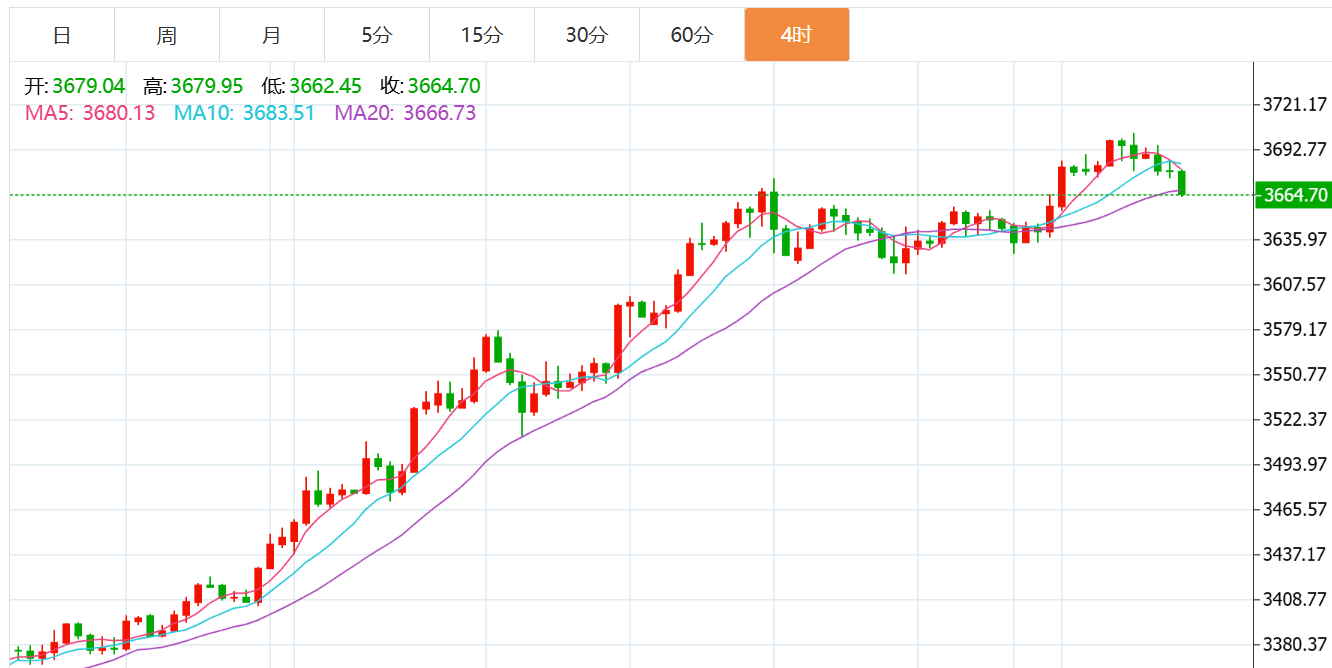
Group 1: Gold Market Analysis - The price of spot gold has recently experienced significant fluctuations, reaching a historical peak of $3702.93 per ounce before settling at $3689.60, driven by expectations of a Federal Reserve interest rate cut and geopolitical risks [1][2] - The weakening of the US dollar, which fell by 0.74% to a low of 96.54, has provided additional support for gold prices, making gold cheaper for holders of other currencies [2][4] - Technical analysis indicates that gold is approaching the $3700 mark, with support levels identified at $3660-3653 and potential upward targets around $3710 and $3750 [4] Group 2: Oil Market Analysis - Brent crude oil futures have seen a slight decline to $68.46 per barrel, while WTI crude oil futures also dropped to $64.51 per barrel, amid concerns over potential supply disruptions due to geopolitical tensions [5][6] - The market is anticipating a Federal Reserve interest rate cut of 25 basis points, which is expected to stimulate economic activity and fuel demand [5] - Technical analysis suggests that oil prices are currently in a weak consolidation phase, with short-term upward trends expected, particularly if prices break above resistance levels of $66.0-67.0 [6]

机构:美联储若释放鸽派信号或将提振亚洲股市
Ge Long Hui A P P· 2025-09-16 02:28
Core Viewpoint - The dovish guidance from Federal Reserve Chairman Jerome Powell may exacerbate the weakness of the US dollar, potentially boosting Asian stock markets [1] Group 1: Market Dynamics - The strong performance of Asian stock markets this year has primarily been driven by local capital [1] - A renewed decline in the US dollar could stimulate capital flows from the US to emerging markets in search of diversified allocations [1] Group 2: Earnings Outlook - Analysts note that improvements in fundamentals and earnings have significantly contributed to the recent strength of Asian stock markets [1] - Due to trade agreements, earnings expectations for most Asian markets have been notably revised upward for the coming year [1] Group 3: Risks - If the Federal Reserve's dot plot indicates that the median interest rate forecast for 2026 remains unchanged, or if Powell downplays the prospect of rate cuts, this could pose a major risk for Asian markets [1]
标普500指数、纳指再创新高 Alphabet(GOOGL.US)市值突破3万亿美元
Zhi Tong Cai Jing· 2025-09-15 23:15
Market Performance - The three major indices closed higher, with the Nasdaq reaching an intraday high of 22,352.05 points and the S&P 500 hitting 6,619.62 points, both marking new intraday records [1] - The Dow Jones increased by 50.03 points (0.11%) to close at 45,884.25 points, while the Nasdaq rose by 207.65 points (0.94%) to 22,348.75 points, and the S&P 500 gained 31.02 points (0.47%) to finish at 6,615.31 points [1] - Notable stock movements included Tesla rising by 3.5% and Google increasing by 4.4% [1] European Market Performance - The German DAX30 index rose by 65.13 points (0.27%) to 23,753.74 points, while the French CAC40 index increased by 71.69 points (0.92%) to 7,896.93 points [2] - The UK FTSE 100 index fell by 6.61 points (0.07%) to 9,276.68 points, and the Italian FTSE MIB index gained 485.59 points (1.14%) to 43,052.00 points [2] Commodity Prices - Light crude oil futures for October delivery increased by $0.61 to $63.30 per barrel (0.97% rise), while Brent crude oil for November delivery rose by $0.45 to $67.44 per barrel (0.67% rise) [2] Currency Exchange Rates - The US Dollar Index fell by 0.26% to 97.300, with the Euro trading at 1.1769 USD and the British Pound at 1.3605 USD, both higher than the previous trading day [3] - The Dollar weakened against the Japanese Yen, Swiss Franc, and Canadian Dollar compared to the previous day [3] Cryptocurrency and Gold - Bitcoin increased by 0.14% to $115,542.3, while Ethereum decreased by 1.81% to $4,524.98 [4] - Spot gold reached a new historical high at $3,679.06 [4] Macro News - The US Bureau of Labor Statistics is hiring part-time economic assistants to collect price data for the Consumer Price Index (CPI), indicating a reliance on statistical estimation due to personnel shortages [4] - The hiring aims to reduce the proportion of estimated prices in the CPI, which could significantly lower the current estimation error range [4] Corporate News - Nasdaq CEO Adena Friedman supports reforming corporate reporting cycles, advocating for companies to have the option of quarterly or semi-annual reports [7] - This proposal aims to reduce the reporting burden on companies and potentially invigorate the US capital markets [7] Individual Company News - Coinbase is exploring the launch of a new cryptocurrency called "network token" through its public blockchain Base, aimed at facilitating decentralized payments and encouraging developer participation [8]

美银:新兴市场明年初将迎来更多“资本流入”
美股IPO· 2025-09-15 09:24
Core Viewpoint - Emerging markets are expected to see a significant inflow of funds in early next year, driven by a weak dollar, local central bank rate cuts, and historically low allocations from global funds [1][3]. Group 1: Factors Supporting Emerging Markets - The anticipated resumption of interest rate cuts by the Federal Reserve, along with concerns over Trump's tariffs and fiscal policies, is negatively impacting the dollar's performance [5]. - Hedge funds and other speculative investors have placed bearish bets against the dollar, amounting to approximately $5 billion as of early September [5]. - The weak dollar, further rate cut space from local central banks, and historically low allocations to emerging markets are expected to support the asset class [5][6]. Group 2: Performance and Returns - Emerging market bonds have delivered nearly 9% returns this year, outperforming developed market bonds, which have seen a 7.5% increase during the same period [4]. - The dollar index has declined over 8% this year, potentially marking its largest annual drop since 2017 [4]. Group 3: Key Beneficiaries - Brazil, Mexico, Colombia, Turkey, and Poland are identified as major beneficiaries of foreign capital inflows [6]. - Asian local currency bonds are less likely to attract funds due to already low interest rates and the preference of export-oriented economies for weaker currencies [6]. Group 4: Investor Sentiment - Analysts expect previously cautious global funds to increase their investments in emerging markets, giving these markets a competitive edge over developed markets [7].
5日国际金价上涨 本周国际金价涨近4%
Sou Hu Cai Jing· 2025-09-06 10:10
Core Viewpoint - Weak U.S. employment data has increased market expectations for a Federal Reserve interest rate cut, leading to a rise in international gold prices [1] Group 1: Market Impact - On Friday, December gold futures closed at $3,653.30 per ounce, reflecting a 1.29% increase [1] - The international gold price has risen by a cumulative 3.90% this week, influenced by a weak dollar, increased gold reserves by central banks, and geopolitical uncertainties [1]
美元疲软对全球投资者意味着什么
Guo Ji Jin Rong Bao· 2025-09-05 12:24
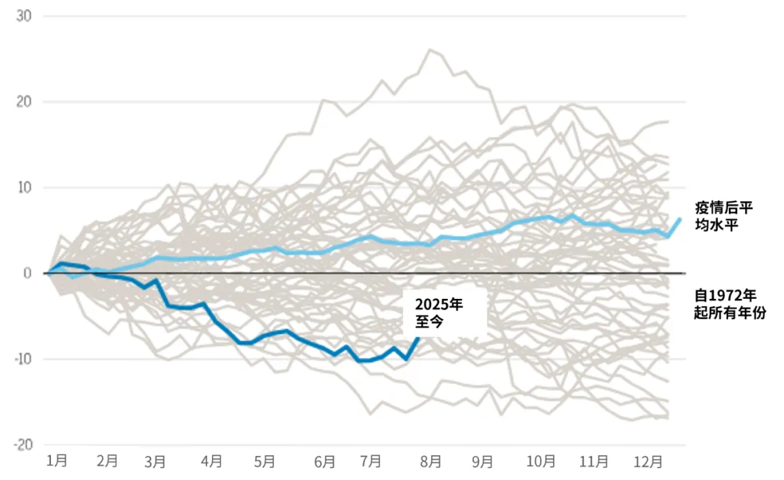
Core Insights - The US dollar has shown signs of weakness at the beginning of the year, a situation that has been rare over the past 50 years, primarily due to the impact of recent trade protectionist policies [1][2] - Despite a mild recovery in the dollar following preliminary trade agreements with major partners like the EU and Japan, uncertainties surrounding trade policies and President Trump's unexpected tariff measures continue to dominate the news [1][2] Group 1: Economic Implications - The ongoing weakness of the dollar may indicate deeper issues related to the decline of US credit, which could have far-reaching consequences as the dollar has long been viewed as a safe-haven currency [2] - The current US tariff policies aim to reduce trade deficits, yet ironically, the stability of the dollar often attracts foreign surplus capital inflows, which could be jeopardized if the dollar loses its status [2] Group 2: Key Areas of Focus - Attention is being paid to three main areas: US political dynamics, which could influence dollar sentiment; changes in foreign demand for US treasuries and stocks, indicating potential shifts in dollar dominance; and the Federal Reserve's policies, which remain crucial in the context of inflation or unexpected growth impacts [3] Group 3: Investment Implications - A weaker dollar typically supports global equities, commodities, and emerging markets, but the uncertainty surrounding US tariffs may complicate this dynamic, potentially affecting corporate earnings for US multinationals and non-US companies operating in the US [4] - If the dollar remains relatively weak, investor demand for currency hedging in portfolios may change, impacting returns and volatility based on underlying currencies and foreign exchange exposure [6] - The Federal Reserve's maintenance of stable interest rates, while addressing the issue of interest rate cuts, could further exert pressure on the dollar [6]
避险需求推动黄金价格创新高
Sou Hu Cai Jing· 2025-09-03 08:45
Core Viewpoint - The global economic uncertainty has led investors to seek safe-haven assets, resulting in a surge in gold prices, which reached a new high of over $3500 per ounce on September 2, 2023 [1][4]. Group 1: Gold Market Dynamics - Gold prices hit $3501.59 per ounce during Asian trading, surpassing the previous record of $3500.10 set in April [1]. - The rise in gold prices is attributed to a weak dollar and expectations of interest rate cuts by the Federal Reserve, as inflation in the U.S. accelerates [2][5]. - Concerns over the independence of the Federal Reserve have intensified, prompting investors to sell dollars and buy gold as a hedge [2][4]. Group 2: Market Reactions and Influences - The price of silver also reached a 14-year high at $40.76 per ounce, driven by similar market sentiments [4]. - The pressure from former President Trump on the Federal Reserve and the recent court rulings regarding tariffs have contributed to the volatility in the market [2][4]. - Analysts note that geopolitical uncertainties, inflation worries, and concerns about the health of the U.S. economy have collectively driven gold prices up by 33% this year [6][7]. Group 3: Broader Economic Context - The expectation of a rate cut by the Federal Reserve is reinforced by the recent personal consumption expenditures report, which aligns with analyst forecasts [5]. - Central banks around the world are increasing their gold reserves as a strategy to diversify away from the dollar, further supporting the rise in gold prices [6].
今日金价:大家要有心理准备,周末,金价或将迎来大风暴
Sou Hu Cai Jing· 2025-09-02 19:26
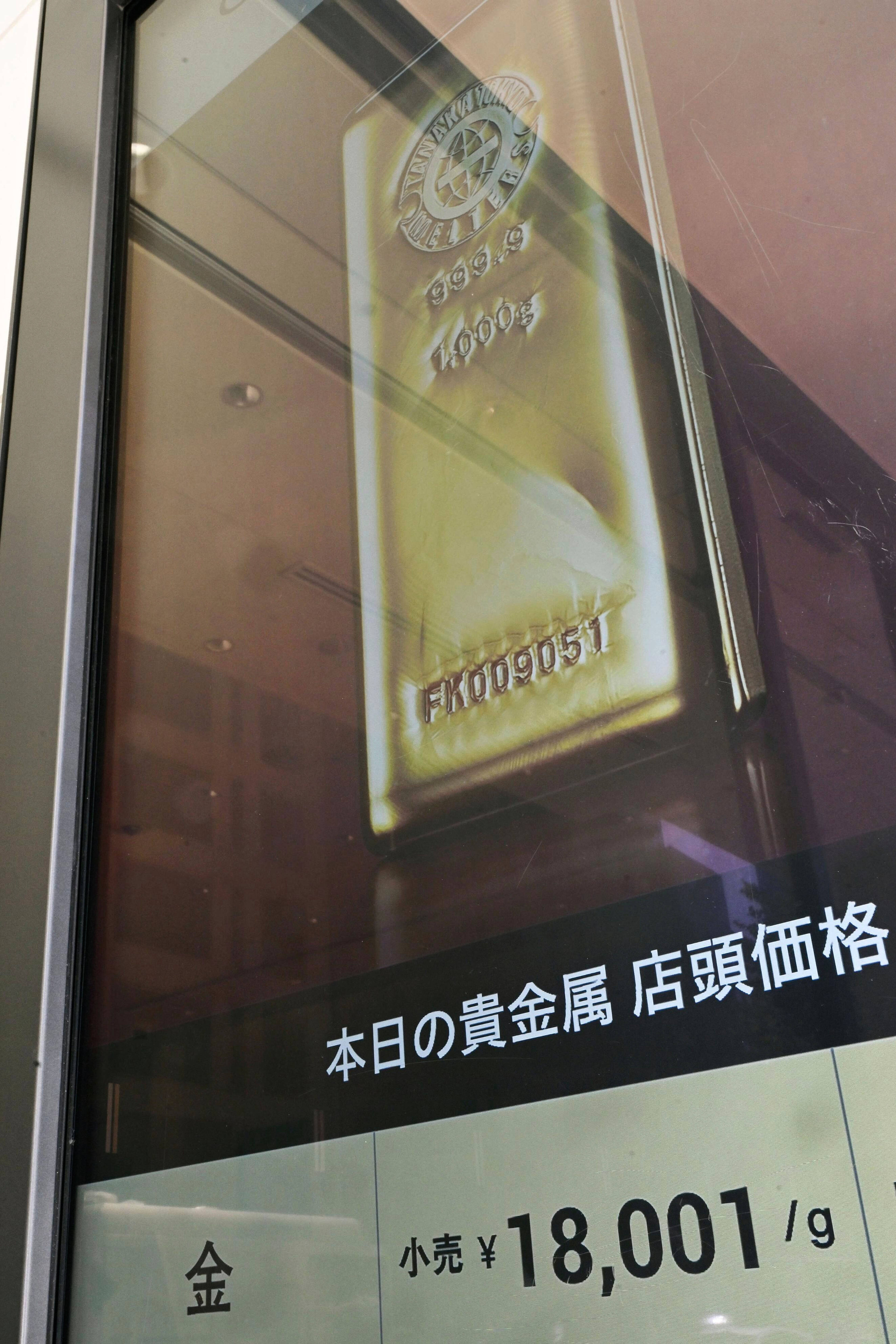
Core Viewpoint - The international gold price has surged past $3500 per ounce, reaching a historical high, while domestic gold jewelry prices are also rising significantly, creating a dilemma for potential investors on whether to enter the market now or wait [1][4]. Group 1: Factors Driving Gold Price Increase - The primary driver of the gold price surge is the strong market expectation for a Federal Reserve interest rate cut, with a nearly 90% probability of a 25 basis point cut in September [2]. - A weakening US dollar has also contributed to the rise in gold prices, making gold cheaper for buyers using other currencies, thus stimulating demand [2]. - Geopolitical risks, particularly the escalation of the Ukraine crisis, have led investors to seek safe-haven assets like gold, enhancing its value [2]. Group 2: Central Bank Purchases - Global central banks are continuously increasing their gold holdings, providing solid buying support for gold prices. Over 90% of surveyed central banks expect to continue increasing their gold reserves in the next 12 months, marking a new high since the survey began in 2019 [3]. Group 3: Domestic Market Performance - The domestic gold market is thriving, with prices for gold bars and jewelry rising significantly. Major brands are reporting prices above 1020 RMB per gram, reflecting the strong performance of gold [6]. - The A-share market's gold sector is also performing well, with several companies experiencing significant stock price increases due to the rising gold prices [6]. Group 4: Divergent Market Opinions - There is a notable divergence in opinions among Wall Street institutions regarding future gold prices. Optimistic forecasts suggest prices could reach $3700 per ounce by the end of 2025, while others caution against potential overvaluation and risks of a price correction [4][6]. Group 5: Investment Considerations - Gold jewelry is not considered an ideal investment due to high processing costs, which diminish its investment value. In contrast, physical gold such as bars and coins is more directly linked to market prices and has lower premiums [10]. - Data from the China Gold Association indicates a significant decline in gold jewelry consumption, while demand for gold bars and coins has increased, highlighting a shift in consumer preferences towards more investment-oriented gold products [10].

美股异动|国际金价创新高,黄金股逆势上涨
Ge Long Hui· 2025-09-02 13:57
Core Viewpoint - Gold stocks are rising against the trend, with gold resources increasing over 6%, Harmony Gold up over 5%, and Kinross Gold up over 1% due to expectations of U.S. interest rate cuts and a weakening dollar [1] Group 1 - Spot gold reached a new high, peaking at $3,508.7 per ounce [1] - Silver spot prices also surpassed the $40 mark, achieving a 14-year high [1]