
避险

Search documents
金银铂钯齐涨 贵金属缘何连创新高?
Xin Hua Wang· 2025-12-24 09:50
Core Viewpoint - The precious metals market, particularly gold, silver, platinum, and palladium, has experienced significant price increases driven by multiple factors including market sentiment, concerns over the U.S. dollar's credibility, and rising industrial demand for silver and platinum [1][2]. Group 1: Gold Market Performance - On December 24, gold prices reached a historic high, surpassing $4,500 per ounce for the first time [1]. - In China, the price of gold hit 1,017 yuan per gram, with gold jewelry prices rising to 1,410 yuan per gram [1]. - The gold market has seen over 40 record highs this year, with prices increasing by more than 70% year-to-date [2]. Group 2: Silver and Other Precious Metals - Silver prices have surged nearly 50% in Q4, breaking the $70 per ounce mark and continuing to rise above $72 [1]. - Year-to-date, silver and platinum prices have increased by over 140%, while palladium has risen by more than 100% [1]. - The industrial demand for silver, particularly in sectors like photovoltaics and electric vehicles, is a key driver of its price increase [2]. Group 3: Market Dynamics and Investor Sentiment - The rise in precious metal prices is attributed to a combination of factors, including concerns over U.S. dollar credit and sovereign debt, as well as geopolitical tensions [2]. - The demand for precious metals has led to increased inflows into ETFs, with significant increases in holdings reported on December 23 [3]. - Analysts suggest that the sustainability of the current bullish trend in precious metals will depend on ongoing market demand and investor sentiment [3].
黄金历史首次突破4500美元,大宗集体狂飙!
Wind万得· 2025-12-24 00:00
Core Viewpoint - The article highlights a significant surge in gold prices, which have surpassed $4500 per ounce, alongside a historical high in silver prices, driven by a collective rise in commodity markets [1]. Group 1: Market Trends - The US dollar index continues to decline, trading below 98 [2]. - The current exchange rates include USDX at 97.8933, EURUSD at 1.17965, and GBPUSD at 1.35137, with slight fluctuations noted [3]. Group 2: Influencing Factors on Gold Prices - Lower interest rates are making gold more attractive as they reduce expected returns on government bonds, leading to increased demand for gold as both a safe haven and speculative asset [4]. - Goldman Sachs projects that gold prices will reach $4900 per ounce by the end of 2026, while Yardeni Research has raised its forecast for gold to $6000 per ounce by the same date, citing macroeconomic concerns rather than a rebound in global economic activity [6]. - UBS analysts note that gold has rebounded quickly since a sharp decline in late October, driven by geopolitical tensions and a favorable US interest rate environment, with expectations of continued high demand from central banks and investors [6].


李槿:12/18避险居高不下!今明谨防冲高回落!
Sou Hu Cai Jing· 2025-12-18 02:29
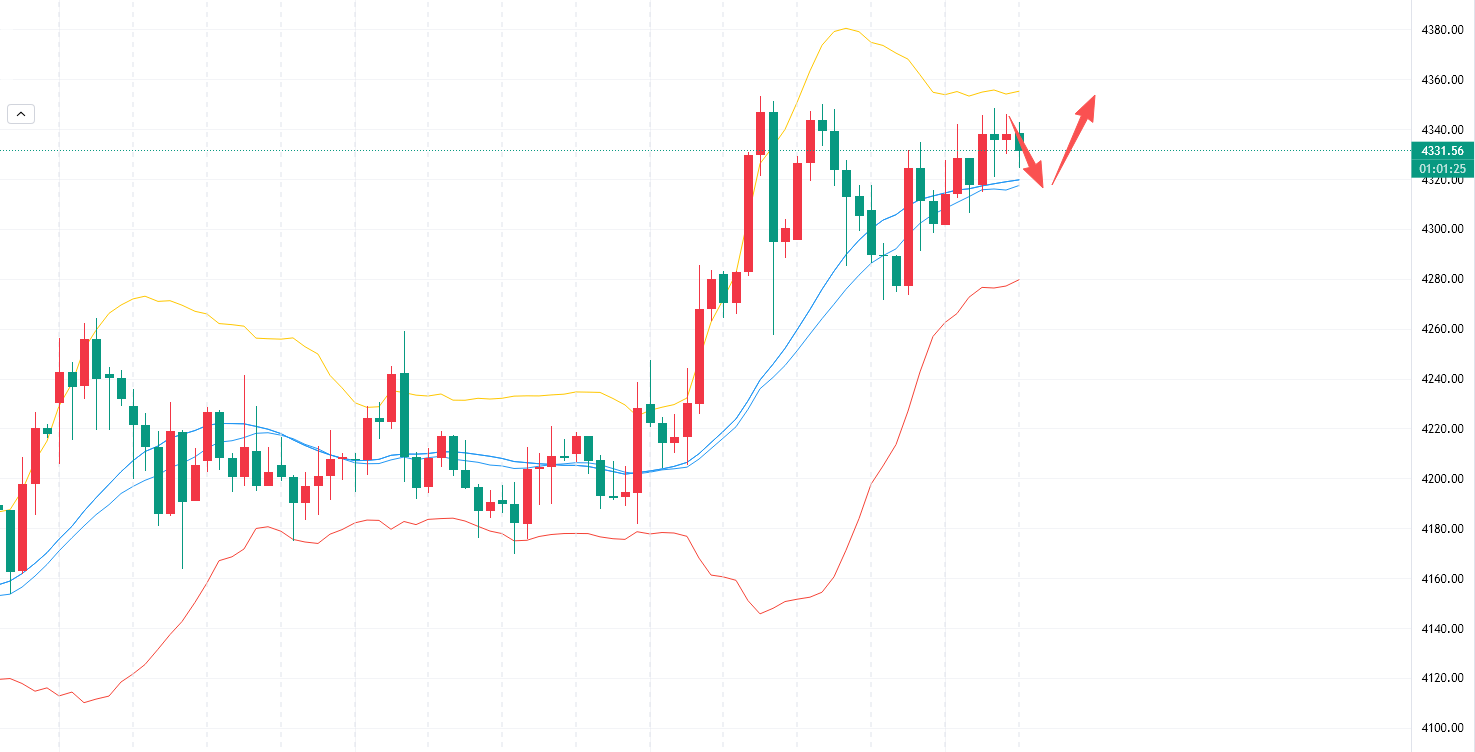
Core Viewpoint - The gold market is experiencing fluctuations, with prices testing resistance levels around 4350 and 4380, while silver has reached a historical high of 66.88 [1][3]. Group 1: Gold Market Analysis - Gold prices are currently under pressure but are expected to test the resistance levels of 4350 and 4380 in the short term [1][4]. - A potential stabilization at 4350 could lead to further upward movement towards 4380, indicating a bullish sentiment [1]. - The market is closely monitoring upcoming economic data, including the delayed U.S. November CPI, which could influence inflation expectations and interest rate forecasts [1]. Group 2: Silver Market Analysis - Silver has surpassed the 66 mark, achieving a new historical high of 66.88, indicating strong bullish momentum [1]. - The current support level for silver is around 4320, with potential buying opportunities if prices do not break below this level [1][4]. Group 3: Economic Indicators and Market Sentiment - The market is cautious about the potential impact of geopolitical tensions, particularly in Venezuela, which could lead to increased demand for safe-haven assets [1]. - A confirmation of cooling inflation from CPI and PCE data could further elevate expectations for interest rate cuts [1]. - The upcoming speeches from key figures, such as Trump, and the Bank of Japan's decisions are also critical events to watch in the near term [1].
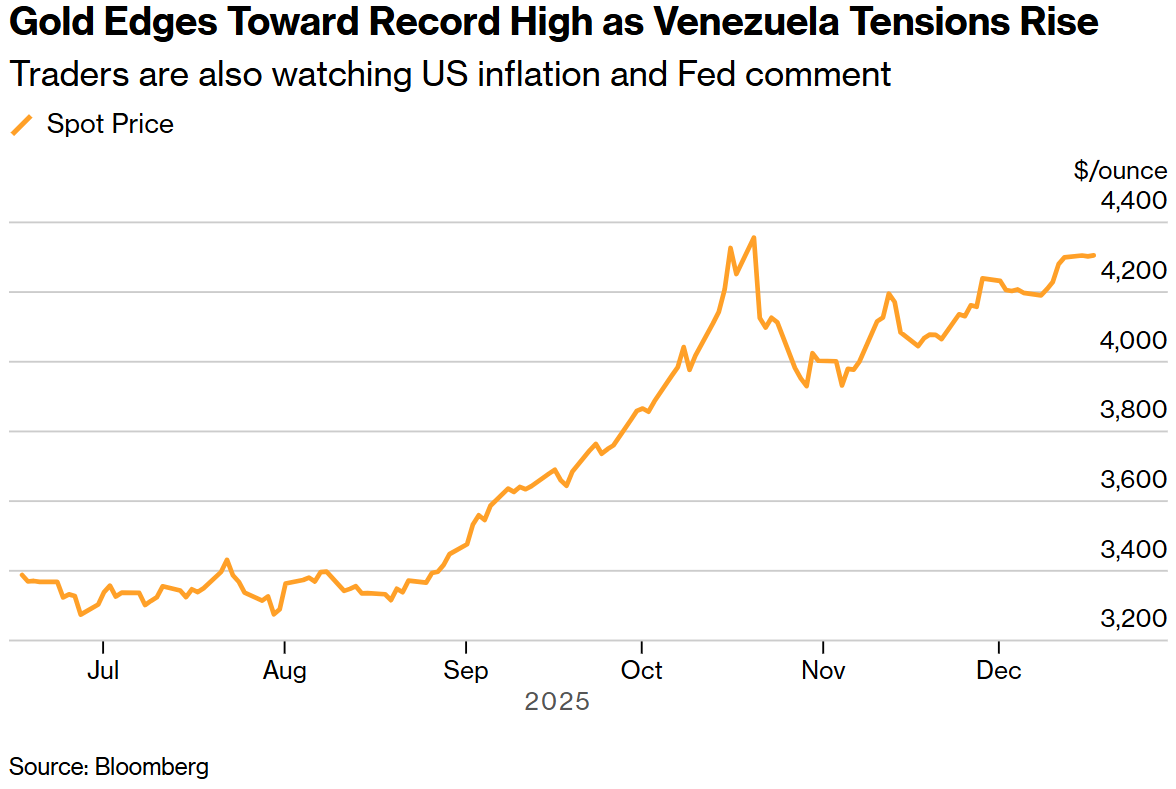
委内瑞拉紧张局势升级点燃避险 黄金借势冲击历史最高点
智通财经网· 2025-12-17 03:47
Group 1 - Gold prices are approaching historical highs, with current prices exceeding $4,325 per ounce, recovering from a slight dip after five consecutive days of gains [1][4] - Silver has reached new peaks, continuing its strong upward trend, with prices rising by 3% to $65.6463 per ounce, marking a record high [4][5] - The geopolitical tensions, particularly in Venezuela, are contributing to the rise in gold prices, as investors seek safe-haven assets amid uncertainty [1][4] Group 2 - Gold has increased by approximately two-thirds this year, potentially achieving its best annual performance since 1979, driven by significant central bank purchases and a general withdrawal from government bonds and major currencies [4] - The market is closely monitoring signs of further monetary easing from the Federal Reserve, which recently implemented its third consecutive interest rate cut, benefiting non-yielding precious metals like gold [4] - The appointment of a new Federal Reserve chairman is expected to provide further signals regarding monetary policy for the upcoming year, with ongoing interviews for the position [4]
穿越经济周期的压舱石,黄金ETF长期配置逻辑
Sou Hu Cai Jing· 2025-12-15 09:19
Core Viewpoint - In the context of a shifting global economic landscape and increasing market volatility, investors are increasingly focusing on the stability and risk resistance of their asset portfolios. Gold, as a time-tested hard currency, plays a crucial role as a "ballast" in asset allocation, and the emergence of gold ETFs allows ordinary investors to conveniently capture the long-term value of gold [1]. Group 1: Economic Context and Federal Reserve Actions - On December 11, 2025, the Federal Reserve lowered the federal funds rate by 25 basis points to a range of 3.50%–3.75%, marking the third rate cut of the year. Following the announcement, the 10-year U.S. Treasury yield declined, the dollar index weakened, and gold prices shifted from a decline to an increase, maintaining high volatility [1]. - The FOMC's voting results showed 9 votes in favor and 3 against, indicating a division in the committee regarding inflation pressures and economic slowdown assessments. The committee also announced a monthly purchase plan of $40 billion in short-term Treasury bonds starting December 12 to maintain ample reserves [4]. Group 2: Gold's Unique Attributes - Gold is recognized for its strong safe-haven properties, providing stability during geopolitical conflicts, global economic crises, and unexpected market events. Unlike traditional financial assets, gold's intrinsic value is less affected by a single economy or financial system, making it a reliable asset during times of uncertainty [9]. - Gold serves as an effective hedge against inflation, as its value is closely tied to physical commodities. In environments of monetary expansion and rising inflation, gold can maintain its value, helping investors preserve purchasing power [9]. - The low correlation of gold with traditional assets enhances its appeal for risk diversification. Gold's pricing logic is distinct from that of stocks and bonds, allowing it to act independently and even provide a counterbalance during traditional asset downturns [10]. Group 3: Gold ETFs as an Investment Tool - Gold ETFs address the challenges of traditional physical gold investment, such as storage issues, high transaction barriers, and limited liquidity, making them an optimal tool for ordinary investors to engage in gold investment [12]. - Gold ETFs facilitate convenient and low-cost investment in gold, allowing investors to trade gold as easily as stocks without the burdens of physical gold ownership, such as storage and transportation costs [12]. - The high liquidity of gold ETFs supports dynamic portfolio adjustments, enabling investors to buy or sell based on market conditions without facing liquidity constraints [13]. - Gold ETFs are designed to closely track gold prices, ensuring that investors can capture long-term appreciation without the risks associated with gold-related stocks or funds [13]. Group 4: Conclusion on Gold's Role in Asset Allocation - In the current complex market environment, the focus of asset allocation has shifted from "pursuing high returns" to "achieving stable appreciation." Gold, with its safe-haven, anti-inflation, and low-correlation attributes, serves as a "ballast" for navigating economic cycles, while gold ETFs provide accessible, low-cost, and highly liquid investment options for ordinary investors [15][16].
FT中文网精选:如何看待黄金投资逻辑?
日经中文网· 2025-12-15 02:44
Core Viewpoint - The article emphasizes that increasing the allocation of gold in investment portfolios is becoming an inevitable choice for institutional investors, especially given the significant rise in gold prices this year, which have increased by up to 60%, outperforming major indices like the Nasdaq and Hang Seng [5][6]. Group 1 - Gold has demonstrated a unique investment logic this year, moving beyond traditional pricing mechanisms based on "safe-haven" and "anti-inflation" narratives [6]. - Historical context shows that gold prices surged around 2010 due to inflation and asset bubbles driven by China's stimulus measures, leading to increased domestic demand for gold [6]. - The relationship between gold and the US dollar is highlighted, noting that low US interest rates at the time allowed for profitable arbitrage opportunities involving gold imports and domestic lending [6].
全球地缘政治动荡 沪银维持多头趋势
Jin Tou Wang· 2025-12-12 07:13
Group 1 - Silver futures are currently trading above 14,855, with a recent price of 14,914, reflecting a 3.90% increase, and have reached a high of 15,033 and a low of 14,486 during the session [1] - Geopolitical tensions globally are providing additional support for silver, with U.S. President Trump expressing disappointment in the Russia-Ukraine negotiations and indicating potential escalation in U.S. actions regarding border security and drug trafficking [2] - The Israeli Prime Minister convened a security cabinet meeting due to concerns over military actions against Lebanon, contributing to increased global uncertainty and driving funds into silver as a safe haven [2] Group 2 - Shanghai silver has continued to rise, successfully breaking the important 15,000 yuan/kg level, with a bullish trend observed throughout the week and support seen around 14,500 [3] - The premium for Shanghai silver is currently 400 yuan/kg, indicating strong market sentiment, with the main contract expected to operate within a range of 14,000 to 15,100 [3]
避险、抗通胀需求持续支撑金价,上海金ETF嘉实(159831)一键布局黄金投资机遇
Sou Hu Cai Jing· 2025-12-04 03:16
Group 1 - The core viewpoint is that gold prices are expected to continue to be influenced by multiple complex factors in 2026, with current prices showing a slight increase to over $4210 per ounce [1] - The International Monetary Fund predicts a slowdown in global economic growth from 3.2% in 2025 to 3.1% in 2026, with the US growth rate dropping to 2.0% and the Eurozone and Japan maintaining growth between 1.0% and 1.2% [1] - Emerging markets are projected to maintain a growth rate of around 4.5%, but internal disparities are increasing [1] Group 2 - Central banks have been a major source of demand for gold in recent years, although some central banks are now reducing their gold holdings due to high prices exceeding their target ratios [2] - Overall, there is still potential for an increase in the proportion of gold in global central bank asset allocations [2] - The Shanghai Gold ETF (159831) closely tracks the Shanghai gold benchmark price, providing a transparent and efficient investment tool for investors [2] Group 3 - Investors without stock accounts can also access gold investment opportunities through the off-market linked fund (016582) [3]
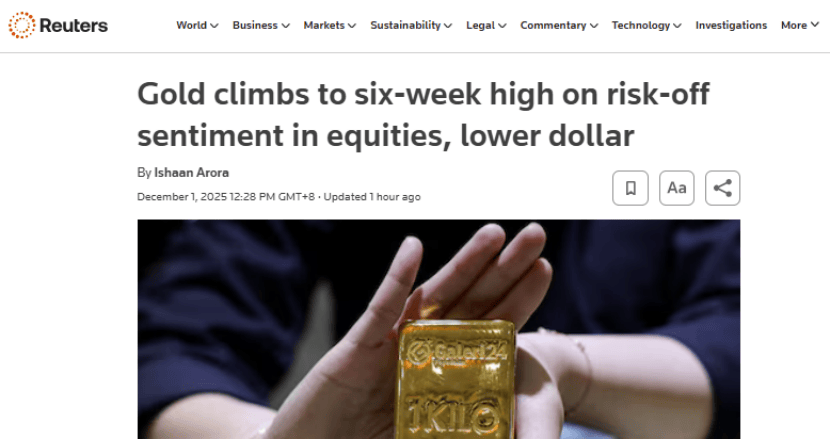
避险与降息预期共振,贵金属市场全线飘红
Sou Hu Cai Jing· 2025-12-01 07:25
Core Insights - The global precious metals market experienced a rally on December 1, with gold prices reaching a six-week high and silver prices hitting a historical record, driven by a weaker dollar and heightened risk aversion in the market [1][2] Group 1: Market Performance - Spot gold rose by 0.2% to $4240.54 per ounce, marking the highest level since October 21 [1] - December futures for gold increased by 0.5% to $4276.00 [1] - Silver prices surged by 2% to $57.48 per ounce, with an intraday peak of $57.86, a new all-time high [1] Group 2: Influencing Factors - The decline in the dollar's value was a key factor in boosting precious metal prices, as it made gold and silver cheaper for investors holding other currencies [1] - Market sentiment showed a significant drop in risk appetite, with S&P futures down 0.8% and major cryptocurrencies also experiencing sell-offs [2] - The futures market indicates an 87% probability of a Federal Reserve rate cut in December, which typically benefits non-yielding assets like gold [5] Group 3: Technical and Future Outlook - Analysts suggest that the short-term trajectory of precious metals will heavily depend on the upcoming U.S. core Personal Consumption Expenditures (PCE) data [6] - If the PCE data is moderate, it could reinforce rate cut expectations, providing upward momentum for gold prices [6] - Some analysts caution that current precious metal prices are relatively high, indicating potential profit-taking pressure [6] - A technical analyst noted that after breaking a key resistance level, gold's next target could be $4300 per ounce, though short-term volatility may increase [6]
印度免签潮突袭!外国投资者撤离印度,美印贸易战会产生影响吗?
Sou Hu Cai Jing· 2025-11-27 17:54
Group 1: India Opens Visa for Chinese Tourists - India has announced the full restoration of global tourist visa processing for Chinese citizens, ending a five-year restriction that began in 2020 [3][5] - The reopening of commercial direct flights alongside the visa policy aims to enhance bilateral relations and facilitate business interactions [5][9] - Despite the positive reception, there are concerns regarding public health, environmental pollution, and safety issues in India, which may deter some potential travelers [7][9] Group 2: Hang Seng Technology Index Volatility - The Hang Seng Technology Index experienced a significant decline after previously soaring over 50% earlier in the year, with a maximum drawdown exceeding 15% in two months [11][12] - Factors contributing to this decline include excessive prior gains, U.S. tariffs on Chinese goods, and a mini-crash in U.S. AI stocks, which negatively impacted global tech sentiment [12][13] - Despite the current volatility, the long-term investment logic remains intact, with major companies like Tencent and Alibaba increasing their AI investments [13][15] Group 3: Federal Reserve's Interest Rate Decisions - The market is closely watching the Federal Reserve's decision on interest rates in December, with a 71% probability of a 25 basis point cut [20][22] - The outcome of this decision is crucial as it will influence market liquidity and risk appetite, potentially affecting stock and cryptocurrency prices [22][24] - Investors are advised to remain flexible in their positions, regardless of the Fed's decision, as market conditions remain uncertain [22][24] Group 4: Gold as a Safe-Haven Asset - Gold continues to be viewed as a reliable asset amid global economic uncertainties, with its value influenced by real interest rates and the U.S. dollar index [24][26] - A potential interest rate cut by the Fed could lead to a rise in gold prices, while inflation concerns may also drive demand for gold as an anti-inflation asset [24][26] - Investors are encouraged to consider gold as a long-term holding in their portfolios to hedge against market volatility [24][26]
