AI叙事

Search documents
别被暴跌吓倒!下周或现黄金坑
Sou Hu Cai Jing· 2025-11-23 03:30
Core Viewpoint - The global capital markets experienced a significant sell-off of risk assets, with the A-share market also declining sharply, indicating a shift in investor sentiment towards defensive sectors [1] Market Performance - The Shanghai Composite Index fell by 3.90%, the Shenzhen Component dropped by 5.13%, and the ChiNext Index decreased by 6.15%, all reaching new lows [1] - Over 5,000 stocks declined, with nearly 100 hitting the daily limit down, reflecting extreme market pessimism [1] - Defensive sectors such as shipbuilding, cultural media, and agriculture showed resilience, while previously popular sectors like energy metals, batteries, and photovoltaic equipment faced significant losses [1] Global Market Context - The Hang Seng Index fell by 5.09%, the S&P 500 dropped by 1.95%, and the Nasdaq decreased by 2.74%, influenced by cooling expectations for interest rate cuts from the Federal Reserve and instability in the U.S. AI narrative [1] - Federal Reserve officials began to signal dovish stances, with New York Fed President Williams stating there is still room for rate cuts, potentially alleviating liquidity concerns [1] Technical Analysis - The Shanghai Composite Index has broken below the lower Bollinger Band, indicating significant short-term overselling [2] - Following the panic selling, some institutional funds are starting to position themselves against the trend, increasing the likelihood of a technical and emotional market recovery [2] Key Factors to Watch - Upcoming U.S. economic data, including September retail sales and PPI, could influence market sentiment, especially if they underperform, potentially reinforcing expectations for a December rate cut [3] - International events such as the progress of the Russia-Ukraine peace plan and the UK's autumn budget may also impact market emotions [4] Sector Opportunities - Performance certainty will remain a core theme, with technology sectors like AI applications, robotics, and storage chips showing potential for recovery due to their recent declines and technological advancements [4] - Low-valuation, high-dividend sectors like banks and utilities are suitable for risk-averse investors [4] Investment Strategy - Prioritize high-quality stocks with solid performance and significant pullbacks while avoiding speculative stocks [5] - Continuous monitoring of Federal Reserve policy and global economic data is crucial, as these will be key variables determining market direction [6] Market Signals - A successful market rebound, even if limited, would indicate the market's self-repair mechanism is functioning, suggesting underlying resilience [6] - Conversely, a failure to rebound would signal that market confidence is still fragile and that a trend reversal is not yet imminent [6][7] Observational Approach - Investors should remain vigilant, recognizing that the market may still be searching for a true bottom, requiring patience and careful observation [7] - Quality rebounds should be accompanied by increasing trading volume and orderly rotation of market hotspots, while weak performance may indicate deeper adjustment pressures [8]
机构展望 | 哑铃策略应对风格再平衡 机构建议布局“周期+科技”
Shang Hai Zheng Quan Bao· 2025-11-10 01:57
Core Viewpoint - The A-share market is experiencing a narrow fluctuation with a notable rotation of hot sectors, indicating a clear trend of style rebalancing, particularly between cyclical and technology growth sectors [1][2] Group 1: Market Trends - The cyclical sectors such as chemicals, lithium batteries, and photovoltaics have shown strength, while the previously leading artificial intelligence sector is undergoing high-level consolidation [1] - The current market environment suggests a need for investors to focus on the phase rebalancing between technology and cyclical styles due to significant performance improvements in cyclical products reported in Q3 [2] - The overall market is expected to maintain a volatile pattern as the main market narrative remains centered around the AI industry, which is crucial for breaking through index resistance [1][3] Group 2: Investment Strategies - Analysts recommend a "cyclical + technology" allocation strategy to balance risk and return in the current market [2] - Investment opportunities are identified in cyclical sectors such as steel, chemicals, construction materials, agriculture, and new consumption, alongside a focus on AI software applications and innovative pharmaceuticals in the technology sector [3] - The emphasis is placed on sectors benefiting from policy support and market recovery, particularly in the brokerage sector, which is seen as having a phase-specific allocation opportunity [3]
多位基金经理加仓港股,聚焦AI应用和创新药
Huan Qiu Wang· 2025-11-10 01:09
Group 1 - Notable fund managers have increased their positions in Hong Kong stocks during the third quarter, particularly in AI applications and innovative pharmaceuticals, leading to discussions about a potential market rebound in Hong Kong [1] - Daiwa Securities Group reported that mainland Chinese investors are realizing profits in Hong Kong stocks through the Stock Connect mechanism, with a focus on sectors such as electronics, computers, and military industries, while also increasing holdings in high-dividend stocks like energy and metal producers [1] Group 2 - Citic Securities' research indicates that not only the TMT sector but also non-ferrous metals and chemicals are experiencing price increases influenced by AI narratives, with these sectors collectively accounting for over 60% of institutional holdings [4] - The strategy for portfolio adjustment is not to avoid AI narratives but to select stocks with a rising trend in ROE from a low base, suggesting that AI narratives are affecting the slope of market trends rather than the overall trend itself [4]

中金2026年展望 | 大宗商品:秩序新章的三重奏
中金点睛· 2025-11-09 23:37
Core Viewpoint - The article discusses the restructuring of global trade patterns accelerated by the 2025 U.S. tariff policy, leading to a reconfiguration of global industrial division and macro order, which may significantly increase asset volatility and economic uncertainty [2][8]. Group 1: Geopolitical and Supply Challenges - Geopolitical tensions and resource protectionism are expected to further challenge the already fragile supply elasticity in energy and metal markets, with a decade-long down cycle in upstream investments leading to unstable existing supplies and insufficient incremental supplies [5][16]. - The ongoing geopolitical risks and resource protectionism are likely to increase macro uncertainties, further challenging the supply elasticity in energy and metal markets [5][23]. Group 2: Demand Dynamics and Energy Transition - The focus on strategic security is shifting demand-side attention towards energy transition and reserve construction, indicating that energy transition remains a significant trend and reserve building is essential for strategic commodities [5][36]. - The global energy system has seen a new round of investment expansion since 2021, with a significant shift towards renewable energy and related sectors, reflecting a steady advancement in energy transition [36][39]. Group 3: Emerging Demand and Industrialization - Emerging demand is gaining momentum, driven by AI narratives and the ongoing electrification trend, which is expected to provide sustained demand growth for commodities like copper [6][48]. - The restructuring of trade patterns and industrial division is likely to support the industrialization processes in emerging economies, with significant demand potential from countries along the Belt and Road Initiative [6][56]. Group 4: Commodity Market Outlook for 2026 - The article anticipates that geopolitical tensions, resource security demands, and emerging demand growth will form a "triple play" for the commodity market as it enters a new chapter [2][8]. - The supply-demand balance in the commodity market is expected to improve marginally in 2026, with a focus on micro-level differences and fundamental changes in various commodities [58][60]. Group 5: Specific Commodity Insights - The copper market is projected to face a supply gap due to insufficient upstream investment and increasing demand from electrification, with prices expected to remain elevated [68]. - The oil market may experience a shift from surplus to a more balanced state, with potential upward price adjustments driven by geopolitical risks and supply constraints [64][65]. - Agricultural commodities are expected to see a gradual recovery, influenced by trade policies, weather risks, and the growth of biofuels [70][71].

A股分析师前瞻:年末为什么会出现仓位与风格的再平衡?
Xuan Gu Bao· 2025-11-09 13:15
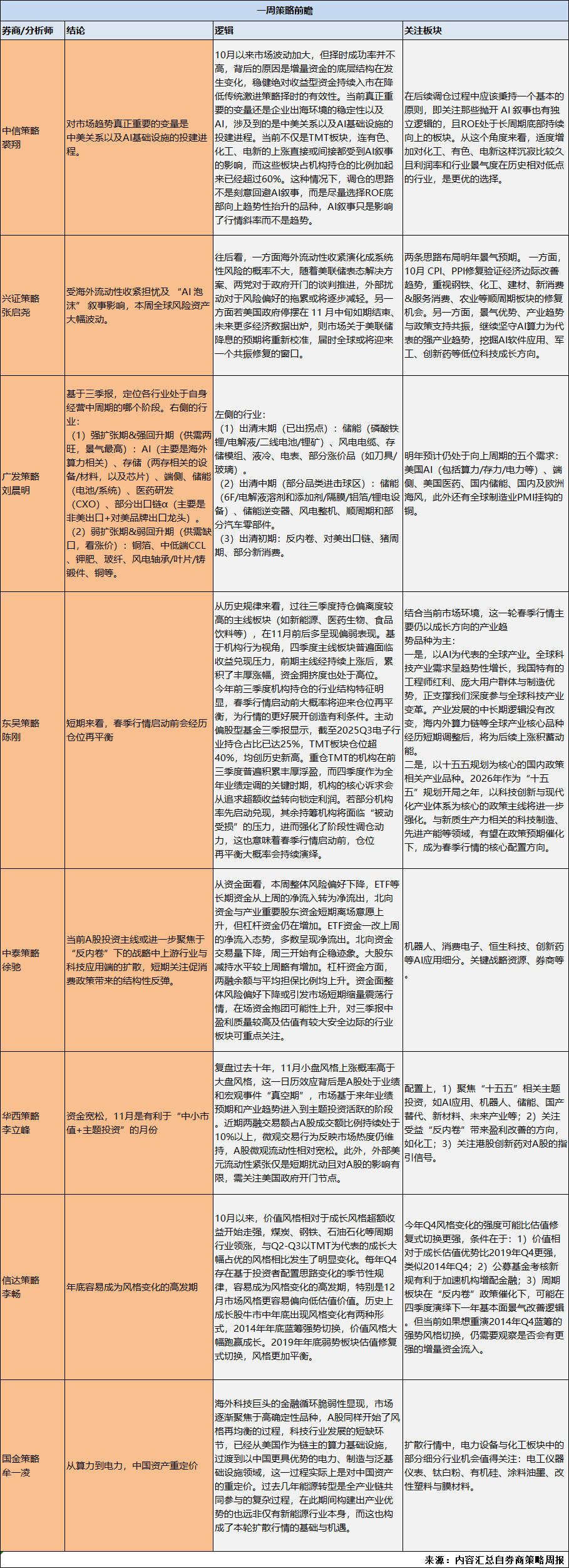
Group 1 - The focus of brokerage strategy analysts this week is on year-end style rebalancing, with historical patterns indicating that sectors with high deviation in holdings during the third quarter, such as new energy, pharmaceuticals, and food and beverage, tend to show weaker performance around November [1][3] - The fourth quarter is expected to face profit-taking pressure in main sectors, as previous main lines have accumulated significant gains, leading to high levels of capital crowding [1][3] - The structure of institutional holdings in the first three quarters of this year is evident, suggesting a high probability of position rebalancing before the spring market rally, which will create favorable conditions for better market performance [1][3] Group 2 - The strategy team from Guojin highlights the fragility of financial cycles among overseas tech giants, leading to a focus on high-certainty varieties, with A-shares also beginning a process of style rebalancing [2][4] - The transition of the tech industry's development from U.S.-led computing infrastructure to China's advantages in electricity, manufacturing, and general infrastructure represents a repricing of Chinese assets [2][4] - In the diffusion market, opportunities in specific sub-sectors within the electric equipment and chemical sectors are worth attention, including electrical instruments, titanium dioxide, organic silicon, and specialty plastics [2][4] Group 3 - The strategy team from Dongwu notes that the spring market rally is likely to experience a position rebalancing before its initiation, with a focus on sectors that have independent logic beyond AI narratives and are experiencing upward trends in ROE from long-term lows [1][3] - The analysis indicates that the small-cap style has a higher probability of rising compared to large-cap style in November, attributed to A-shares being in a performance and macro event "vacuum period," leading to active theme investments based on next year's performance expectations [1][3] Group 4 - The strategy team from Huaxi reviews the past decade, noting that November is favorable for "small-cap value + theme investment," with the market entering an active phase based on performance expectations and industry trends [1][3] - The current investment focus in A-shares may further concentrate on upstream industries and technology applications under the "anti-involution" strategy, with short-term attention on policies promoting consumption [1][3]
【广发宏观团队】中国经济增长的五个潜在空间
郭磊宏观茶座· 2025-11-09 09:27
Economic Growth Potential - The article discusses five potential areas for economic growth in China, emphasizing the importance of maintaining GDP growth within a reasonable range, with a target of around 4.8% for the 14th Five-Year Plan [1] - The IMF forecasts a GDP growth rate of 3.2% for the global economy and 4.1% for emerging markets from 2026 to 2030, indicating that China can maintain a growth advantage [1] Investment and Consumption - The establishment of long-term mechanisms for local government investment is crucial, as fixed asset investment (FAI) growth during the 14th Five-Year Plan was only 3.1% annually, with a decline of -0.5% in the first three quarters of this year [1] - Increasing rural residents' pensions can create a new consumer group, with 538 million people participating in the basic pension system, and a significant improvement in the income expectations of 180 million actual recipients [2] Real Estate Market - The real estate sector is expected to reach a "structural bottom," with sales and investment declining by 10.3% and 8.1% respectively during the 14th Five-Year Plan [3] - By October 2025, rental yields in major cities have rebounded to 2.4%, indicating a potential recovery in the real estate market [3] Emerging Industries - The article highlights the cultivation of new industry demands through the application of new technologies and products, as outlined in the 14th Five-Year Plan [4] - The government aims to implement large-scale application demonstrations for new technologies, which could lead to new industry growth [4] Globalization of Industries - The globalization of certain advantageous industries in China is expected to enhance domestic supply chains, with the 14th Five-Year Plan focusing on maintaining and improving the competitiveness of traditional industries [4] Market Performance Insights - The article notes that global stock markets are experiencing increased volatility, with a shift in narrative affecting technology stocks and a return to value investing [5] - The performance of various asset classes is highlighted, with energy, healthcare, and real estate sectors showing strong gains, while technology and communication sectors lagged [5] Commodity Prices - Gold and silver prices are experiencing fluctuations, with gold slightly down by 0.4% and silver down by 0.5% [6] - Oil prices are influenced by supply and demand dynamics, with Brent crude oil futures dropping by 2.21% [7] U.S. Economic Conditions - The article discusses the ongoing U.S. government shutdown, which is affecting various sectors, including transportation and food assistance programs, potentially leading to a decline in consumer spending [12][13] - Mixed economic data from the U.S. shows stabilization in employment indicators, while manufacturing continues to contract [15][17] Chinese Economic Indicators - The article mentions that high-frequency models indicate a stable volume and rising prices in the short term, with expectations for GDP growth around 4.73% [18] - Consumer price index (CPI) and producer price index (PPI) trends are discussed, with expectations for a slight recovery in CPI due to a low base effect [19] Policy Developments - The Chinese government is focusing on carbon neutrality and has made significant progress in renewable energy installations, with non-fossil energy consumption expected to rise [25][26] - The government is also promoting the development of new application scenarios in various sectors to drive economic growth [32][34]


如何解读美国回购市场流动性收紧︱重阳问答
重阳投资· 2025-11-07 07:32
Core Viewpoint - The article discusses the tightening liquidity in the US repurchase market, highlighting the significant widening of the spread between the Secured Overnight Financing Rate (SOFR) and the Overnight Reverse Repurchase Rate (ONRRP) to 47 basis points, the highest since the pandemic began in 2020, and the surge in the usage of the Standing Repo Facility (SRF) to $50 billion, marking a new high since its establishment in 2021 [2][3]. Group 1: Causes of Liquidity Tightening - The liquidity tightening is attributed to a combination of the US government shutdown and month-end factors, with the usage of overnight reverse repos declining sharply after the Federal Reserve halted interest rate hikes and accelerated balance sheet reduction [3]. - The Treasury General Account (TGA) balance has risen to $1 trillion, significantly above the acceptable level of $850 billion, further draining liquidity from the repo market [3]. - The combination of reduced liquidity in the repo market and banks being more cautious in external financing due to regulatory requirements at month-end has led to the rapid widening of the SOFR and ONRRP spread [3]. Group 2: Current Market Impact - Despite the tightening liquidity in the repo market, there has not been a substantial impact on other financial markets, as the daily limit for the SRF is $500 billion, and the Federal Reserve can quickly respond to liquidity needs [4]. - Recent data shows that the SOFR and ONRRP spread has narrowed to 25 basis points, indicating a decrease in the usage of the SRF [4]. - The performance of risk assets has been more reflective of their inherent vulnerabilities, with notable declines in global risk asset prices, but short-term fluctuations in the money market are not expected to have a direct and lasting impact on stock prices [4].

【广发宏观陈礼清】叙事松动,均衡化增强:大类资产配置月度展望
郭磊宏观茶座· 2025-11-06 10:52
Core Viewpoint - The performance of major asset classes in October 2025 shows a clear ranking, with Nikkei 225 leading, followed by strategies like long VIX and gold, indicating a shift in market dynamics and asset allocation strategies [1][14]. Group 1: Asset Performance - The major asset performance in October 2025 is ranked as follows: Nikkei 225 > Long VIX > Gold > Nasdaq > USD > Chinese bonds > European stocks > CSI 300 > South China Composite > ChiNext > Crude Oil > STAR 50 > Hang Seng Tech [1][14]. - The characteristics of asset balancing have strengthened, with broad narrative trading loosening and other assets experiencing some catch-up [2][14]. - Global stock markets showed more gainers than losers, with significant differentiation; Japanese stocks led gains, while U.S. stocks experienced increased volatility and Chinese assets adjusted [2][3][23]. Group 2: Macro Economic Indicators - The macroeconomic environment is characterized by a return to the "safe asset" pricing of G7 long-term bonds, with yields in Germany, the UK, France, and Italy declining [2][3][26]. - The U.S. dollar has rebounded by 2.5%, breaking the 100 mark, amidst a narrative shift regarding the restructuring of the dollar system [2][3][26]. - Domestic equity assets have shown a return to pricing power, with significant differentiation between large and small caps, and a return to dividend value [2][3][30]. Group 3: Investment Strategies - The next driving factors for equity assets may come from "investment shortfall补短板," with a high sensitivity to marginal changes in fixed asset investment [5][30]. - The calendar effect in Q4 is expected to promote style balancing, with historical data indicating higher success rates for dividend and financial sectors during this period [5][30]. - The high-growth sector's narrative may continue to loosen, impacting investment strategies and asset allocation [13][30]. Group 4: Market Sentiment and Trends - The sentiment in the bond market has improved, with the 10-year government bond yield declining to 1.79%, indicating a release of previous pricing risks [2][30]. - The correlation between stock and bond yields remains stable at -0.63, suggesting a continued "see-saw" effect in domestic markets [2][30]. - The recent volatility in major asset classes has led to a rotation in asset rankings, with the number of daily changes in asset rankings increasing from 121 to 128 [15][30].

港股收评:三大指数均涨超1%,半导体股走强,中资券商股表现弱势
Ge Long Hui· 2025-10-27 08:29
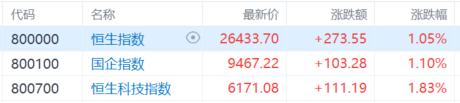
Market Overview - The Hong Kong and A-share markets experienced a synchronized rise, influenced by a preliminary consensus in US-China trade relations, with the Hang Seng Index rising by 1.05% and the Hang Seng Tech Index increasing by 1.83% [1][2] - The markets have rebounded for three consecutive days, indicating a positive trend [1] Sector Performance - Large technology stocks generally saw gains, with notable increases in Baidu (up over 6%), Huahong Semiconductor, and NIO (both up over 4%) [4][5] - Semiconductor stocks led the market, with significant gains from companies like Brainhole Technology (up over 13%) and InnoCare (up over 13%) [6] - The pharmaceutical outsourcing sector also performed well, with Zhaoyan New Drug rising over 8% and WuXi AppTec increasing over 4% [7] - Copper stocks showed strong performance, with China Daye Nonferrous Metals leading with an increase of over 11% [9] - Nuclear power stocks were generally up, with China National Nuclear Corporation rising over 10% [10] Investment Trends - Southbound funds recorded a net purchase of 2.873 billion HKD, indicating strong investor interest in the Hong Kong market [13] - Analysts suggest that the short-term volatility may not alter the long-term trend, with potential for improved market conditions in the fourth quarter [15]
谁带崩了黄金?
Ge Long Hui· 2025-10-23 03:47
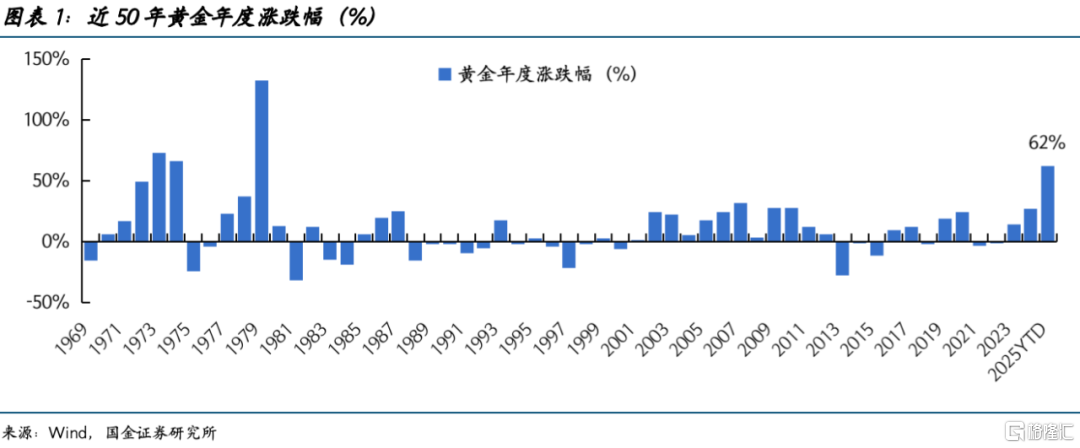
Core Viewpoint - The recent correction in gold prices is attributed to both technical factors and the fading of short-term drivers, with gold transitioning from a safe-haven asset to a high-volatility asset. Despite a significant increase of over 60% in gold prices this year, the long-term bullish outlook remains intact, although short-term volatility is expected to be high [1][30]. Technical Analysis - Current technical indicators show that gold is "extremely overbought" in both short-term and long-term perspectives, with 100% percentile readings indicating significant price deviations from moving averages, historically leading to price corrections [3]. - Gold has reached 45 historical highs this year, with a rapid increase of approximately 30% in less than two months, marking a unique occurrence in recent bull market conditions. Historical observations suggest that such rapid increases typically lead to an average pullback of 4% within a month [7]. Market Drivers - The World Gold Council's Gold Return Attribution Model (GRAM) identifies six factors influencing gold returns, including economic expansion, risk and uncertainty, FX opportunity cost, interest rate opportunity cost, momentum and trend, and residuals. The contributions from residuals in August and September indicate a decreasing explanatory power for short-term price increases [5][8]. - The recent surge in gold prices was driven by increased liquidity and a hedge against the AI bubble, with significant inflows into gold ETFs in Europe and the U.S. prior to recent market adjustments. The market's anticipation of potential interest rate cuts by the Federal Reserve has also contributed to gold's price movements [12][30]. Long-term Outlook - The long-term bullish case for gold is supported by the erosion of the U.S. dollar's status as a global reserve currency, driven by persistent fiscal deficits and declining geopolitical influence. The average annual federal deficit rate in the U.S. has been significantly higher than historical averages, leading to a continuous depreciation of the dollar against tangible assets like gold [28]. - As long as global stagflation and chaos persist, gold is expected to remain in a long-term upward trend, serving as a hedge against the long-term depreciation of dollar credit [30].