AI商业化

Search documents
投资要点:地缘扰动、抛售美债与金银
Huafu Securities· 2026-01-26 13:02
Report Industry Investment Rating No relevant content provided. Core View of the Report - From January 19 - 23, the market fluctuated upwards, with the All - A index rising 1.81%. Micro - cap stocks and the CSI 500 led the gains, while the CSI 300 and SSE 50 led the losses. In terms of style, the cyclical and advanced manufacturing sectors led the gains, while the medical and financial real - estate sectors led the losses. Among the 31 Shenwan industries, more rose than fell, with building materials, petroleum and petrochemicals, and steel leading the gains, and non - bank finance, communication, and banks leading the losses [2][11]. - Trump's frequent actions on geopolitical issues have become an important factor affecting global market pricing. The threat of selling US Treasuries has weakened the trust in US dollar assets, pushing funds into gold and silver. Crude oil prices have also risen due to geopolitical risks [13]. - Currently, attention can be paid to directions with fundamental performance support (power equipment, AI computing power, and the price - increase chain). In addition, considering the market's pursuit of elasticity, attention can be given to small - cap styles and the "Musk chain" [5][18][52]. Summary by Relevant Catalogs 1. Market Thinking: Geopolitical Disturbance, "Selling US Treasuries" and Gold and Silver - Market performance: From January 19 - 23, the All - A index rose 1.81%. Micro - cap stocks and the CSI 500 led the gains, while the CSI 300 and SSE 50 led the losses. Cyclical and advanced manufacturing styles led the gains, while medical and financial real - estate styles led the losses. Among the 31 Shenwan industries, building materials, petroleum and petrochemicals, and steel led the gains, and non - bank finance, communication, and banks led the losses [2][11]. - Geopolitical influence: Trump's actions on geopolitical issues have affected market pricing. The plan to sell US Treasuries by some pension funds has weakened the trust in US dollar assets, pushing funds into gold and silver. Crude oil prices have risen due to geopolitical risks. In the A - share market, micro - cap stocks and cyclical styles led the gains, and the space - photovoltaic concept was active [13][14]. 2. Market Observation: Decline in Stock - Bond Yield Difference and Industry Rotation Intensity 2.1 Market Valuation - The stock - bond yield difference dropped to 0.4%, less than +1 standard deviation. The valuation differentiation coefficient increased by 13.6% month - on - month, and this indicator usually peaks 0.5 - 1 months ahead of the market [22]. 2.2 Market Emotion - The market emotion index decreased by 24.8% month - on - month to 55.4, indicating an adjustment in the overall A - share emotion. The industry rotation intensity (MA5) dropped to 34, below the 40 warning level. The small - cap style was dominant, the micro - cap stock index outperformed the market, and the theme heat was mainly concentrated in gold and jewelry, selected photovoltaic, and glass fiber (13.1%, 11.8%, 11.6% respectively) [23]. 2.3 Market Structure - The market trading volume decreased month - on - month. The proportion of long - position stocks in petroleum and petrochemicals, building materials, and basic chemicals ranked among the top. There may be alpha opportunities within the comprehensive, electronics, and household appliances industries [29]. 2.4 Market Funds - The average daily trading amount of the Shanghai - Hong Kong and Shenzhen - Hong Kong Stock Connect during the week decreased by 626.61 billion yuan compared with last week, and the average daily trading volume decreased by 2.0243 million transactions. The top three stocks in terms of trading volume of the Stock Connect were Zhongji Innolight, New Fiber Optic Technology, and Contemporary Amperex Technology Co., Limited, with their 5 - day gains being - 5.2%, - 3.6%, and - 1.5% respectively. Margin trading funds had a net outflow of 99.8 billion yuan, mainly flowing into the non - ferrous metals, non - bank finance, and banking industries. ETF funds mainly played a role in hedging the outflow of funds. The change in major index ETFs was - 107.02 billion shares, with CSI 2000, STAR 100, and China Securities 2000 being more popular. The average daily share of newly established equity - biased funds this week was 78.6 billion shares, a year - on - year increase of 203.9% and a 190.0% increase compared with last week [35]. 3. Industry Hotspots - Tesla may sell its humanoid robot "Optimus" to the public by the end of 2027, accelerating the industrial trend [48]. - Musk plans to deploy space - photovoltaic, opening up the development prospects of the photovoltaic industry [49]. - ChatGPT's advertising business is about to be launched, marking a new step in the AI commercialization process [50]. 4. Industry Allocation - In late January, which is the intensive period for annual report performance pre - disclosures, attention can be paid to directions with fundamental performance support (power equipment, AI computing power, and the price - increase chain). In addition, considering the market's pursuit of elasticity, attention can be given to small - cap styles and the "Musk chain" [5][18][52].
投资要点::地缘扰动、“抛售美债”与金银
Huafu Securities· 2026-01-26 08:15
策 略 研 究 华福证券 2026 年 01 月 26 日 地缘扰动、"抛售美债"与金银 团队成员 投资要点: 本周(1/19-1/23)市场震荡上行,全 A 收涨 1.81%。从指数情况看, 微盘股、中证 500 领涨,沪深 300、上证 50 领跌。从风格情况看,周期、 先进制造领涨,医药医疗、金融地产领跌。本周 31 个申万行业涨多跌少, 建筑材料、石油石化、钢铁领涨,非银金融、通信、银行领跌。 策 略 定 期 报 告 市场观察:股债收益差下降,行业轮动强度下降。(1)市场估值:股 债收益差下降至 0.4%,小于+1 标准差。估值分化系数有所上升。(2)市 场情绪:市场情绪调整,行业轮动强度下降。市场小盘风格占优,微盘股 指数跑赢市场,主题热度主要聚集在黄金珠宝、光伏精选、玻璃纤维。(3) 市场结构:市场量能环比下降,石油石化、建筑材料、基础化工多头个股 占比居前,综合、电子、家用电器内部或存在α机会。(4)市场资金:本 周陆股通周内日平均成交金额较上周下降 627 亿元,本周陆股通周内日平 均成交笔数较上周下降 202 万笔。本周陆股通成交额排名前三的标的为中 际旭创、新易盛、宁德时代,近 5 日涨幅 ...
OpenAI CFO:让广告像功能,AI 才能长期赚钱
3 6 Ke· 2026-01-26 04:16
Core Insights - OpenAI is experiencing exponential growth in both computational power and revenue, with projections indicating a near tenfold increase over three years, necessitating new revenue sources beyond subscription fees [1][2][3] Group 1: Revenue Growth and Advertising Strategy - OpenAI plans to test advertising for free ChatGPT users in the U.S., emphasizing that ads will be integrated into the user experience without disrupting the model's output [2][3] - The company aims to ensure that advertisements provide value and are not intrusive, positioning them as part of the product rather than a separate revenue stream [3][6][10] - OpenAI's CFO, Sarah Friar, highlights that the goal is to create a seamless experience where ads assist users in decision-making rather than distract them [4][5][6] Group 2: AI Value Proposition - The value of AI lies in its ability to help users complete tasks efficiently, as demonstrated through various examples in healthcare and finance [12][18][21] - OpenAI's approach focuses on delivering the best answers regardless of advertising presence, maintaining user trust and product integrity [8][9][10] - The company believes that AI's true worth is realized in its actionable insights, not merely in providing answers [21][44] Group 3: Computational Power and Investment - There is a direct correlation between computational power and revenue, with increased usage leading to higher demand for computational resources [22][23] - OpenAI faces challenges in scaling its computational capacity to meet growing demand, indicating a need for significant investment in infrastructure [24][26] - The company is actively pursuing partnerships and investments in chips and data centers to support its growth trajectory [24][28] Group 4: Diverse Revenue Models - OpenAI is exploring various revenue models, including licensing agreements that tie earnings to the success of client projects, rather than traditional usage-based fees [30][31][33] - This model encourages long-term partnerships and reduces the risk for clients, making it more appealing for industries like healthcare and finance [32][33] - The company is rapidly expanding its client base, with a significant percentage of enterprises planning to adopt AI solutions in the near future [37][39] Group 5: Strategic Vision - OpenAI's overarching strategy is to align revenue generation with the value created by its AI technologies, ensuring that pricing reflects the benefits delivered to users [40][42][45] - The company is focused on integrating its business model with product capabilities, moving beyond traditional advertising to innovative pricing strategies [41][46]
ChatGPT也开始内测广告,AI们集体变身“首席卖货官”
Sou Hu Cai Jing· 2026-01-24 19:08
Core Insights - The idealistic vision of generative AI is fracturing as companies shift focus towards monetization through advertising [2][3][5] - OpenAI plans to launch an advertising service for ChatGPT, requiring advertisers to commit under $1 million during a trial phase [2][9] - The AI commercialization wave is driven by high operational costs and the need for profitability [5][12] Company Developments - OpenAI's advertising initiative will initially charge based on impressions, similar to Meta's advertising model, with potential future shifts to a cost-per-click model [2] - The advertising business at OpenAI is overseen by CEO Fidji Simo, who has a background in e-commerce and social media [2] - ChatGPT's operational costs are significant, with daily electricity costs nearing $700,000, leading to annual expenses exceeding $250 million [14] Industry Trends - AI technologies significantly impacted global retail, with an estimated $272 billion in retail sales influenced by AI during the last holiday season [4] - Companies like Alibaba and ByteDance are also investing heavily in AI and cloud computing, with Alibaba committing 380 billion yuan over five years [15] - The competitive landscape is evolving, with different companies adopting varied strategies for monetization, such as Google's partnership model and OpenAI's marketplace approach [17][18] User Experience and Trust Issues - Users are expressing discomfort with the integration of advertisements in AI interactions, feeling that the AI has shifted from a knowledgeable companion to a sales agent [10][21] - Concerns arise regarding the objectivity of AI responses when tasked with both answering questions and recommending products, as well as potential privacy issues related to user data [22]


百度、阿里巴巴美股收涨超5%!互联网企业是AI商业化的核心受益者
Mei Ri Jing Ji Xin Wen· 2026-01-23 01:16
Group 1 - The core viewpoint of the news highlights the positive performance of Chinese internet companies in the US stock market, with the Nasdaq China Golden Dragon Index rising by 1.59% and notable increases in stocks such as Baidu (up 5.90%), Alibaba (up 5.06%), Bilibili (up over 4%), and JD.com (up over 3%) [1] - Baidu has officially released the 5.0 version of its Wenxin large model, claiming its language and multimodal understanding capabilities are among the best in the world [1] - Alibaba has launched the open-source Qwen3-TTS suite and is reportedly planning to support the independent listing of its chip subsidiary, Pingtouge, although Alibaba has not yet responded to this news [1] - Since the rise of AI, Chinese internet platform companies have increased investments in self-developed chips, cloud computing, AI large models, and AI applications, with Alibaba Cloud's AI business starting to contribute to performance [1] - According to Huaxia Fund, internet companies are the primary beneficiaries of AI commercialization due to their access to vast, active, and structured user and business data, which serves as the "fuel" for training and iterating AI models [1] - The core businesses of internet companies, including advertising, search, e-commerce, social media, and media, are highly aligned with the efficiency optimization goals of AI, which is expected to enhance revenue in the future [1] Group 2 - For individual investors, the Hang Seng Internet ETF (513330.SH) listed on the A-share market offers a low-threshold, diversified investment opportunity, tracking the Hang Seng Internet Technology Index and focusing on internet platform companies and media firms [2] - The current valuation of the index is around 20 times, which presents a relatively high cost-performance ratio compared to Nasdaq and A-share TMT sectors [2]

AI赚钱难?Anthropic下调毛利率指引:营收虽涨12倍,难敌推理成本激增23%
Hua Er Jie Jian Wen· 2026-01-22 06:18
Claude聊天机器人开发商Anthropic在营收飙升的同时面临盈利挑战。 据The Information周三报道,该公司上月将2025年毛利率预期下调至40%,较此前乐观预期低10个百分 点,原因是在谷歌和亚马逊服务器上运行AI模型的推理成本比预期高出23%。这一数据凸显出AI公司 在追求规模增长的同时,仍难以摆脱对云服务商的依赖及由此带来的成本压力。 尽管毛利率不及预期,Anthropic的财务表现仍显示出强劲增长势头。据知情人士透露,该公司预计 2025年营收将达到45亿美元,较2024年的3.81亿美元增长近12倍。这一增速主要得益于其Claude Code编 码工具和Cowork办公助手在企业市场的成功,目前至少有九家客户年消费超过1亿美元,其中微软的支 出预计将达到5亿美元。 相比之下,竞争对手OpenAI预计2025年毛利率约为46%,包含付费和免费ChatGPT用户的推理成本。 OpenAI 2025年营收超过130亿美元,虽然绝对规模仍领先,但Anthropic正在缩小差距——两家公司当 前月度营收分别为17亿美元和7.5亿美元。这一对比表明,在AI商业化竞赛中,运营效率与成本控制已 成 ...
计算机ETF(512720)盘中涨超1.2%,关注AI商业化及应用场景拓展
Mei Ri Jing Ji Xin Wen· 2026-01-22 05:45
Core Viewpoint - The Computer ETF (512720) has seen a rise of over 1.2%, driven by the commercialization of AI and the expansion of application scenarios [1] Group 1: AI Commercialization and Market Dynamics - The demand for AI is expected to increase predictably, creating opportunities in the software sector [1] - Major model vendors are accelerating the commercialization and ecosystem development around chatbots, as evidenced by recent updates from Amazon, OpenAI, and Qianwen [1] - Google is likely to maintain its leading position due to its dominance in the search field and its top-tier large models [1] - OpenAI is beginning to explore marketing and advertising business under AI search, which may alter the overall landscape of search advertising [1] Group 2: Future Market Outlook - By 2026, the internet sector may enter a performance growth phase driven by AI monetization and optimized competition under anti-involution policies [1] - Business line integration and AI empowerment are expected to become key drivers of performance and valuation [1] - Continuous improvement in open-source model capabilities is anticipated to sustain demand for AI cloud services [1] Group 3: Computer ETF Overview - The Computer ETF (512720) tracks the CS Computer Index (930651), which selects listed companies in the computer hardware, software, and services sectors from the Shanghai and Shenzhen markets [1] - The index focuses on the information technology sector, with major allocations in software development, IT services, and computer hardware manufacturing [1]
博通打算做空英伟达
3 6 Ke· 2026-01-22 02:42
Core Insights - Goldman Sachs report highlights a significant 70% reduction in inference costs with the new TPU v7 chips from Google and Broadcom, indicating a major shift in the AI computing landscape [1][2][10]. Group 1: Cost Reduction and Implications - The 70% cost reduction signifies a fundamental change in the industry, moving beyond traditional hardware upgrades [2][5]. - The report emphasizes the importance of inference costs over training speeds, as the industry transitions from model training to deployment [4][10]. - The cost savings are attributed to three main factors: improved data transmission efficiency, tighter chip packaging, and specialized architecture of ASICs [7][8]. Group 2: Competitive Landscape - The TPU v7's cost is now comparable to NVIDIA's offerings, altering the competitive dynamics as companies reconsider their chip choices [9][10]. - The report suggests that the rise of ASICs represents a challenge to NVIDIA's dominance in the GPU market, indicating a shift towards customized solutions [11]. Group 3: Major Contracts and Market Movements - Anthropic's $21 billion order for custom ASICs marks a significant investment in dedicated AI infrastructure, reflecting a strategic shift in the industry [12][13]. - The funding for this order is backed by major players like Google and Amazon, highlighting the financial support for custom chip development [14][15]. Group 4: Role of Broadcom - Broadcom has transitioned to a key player in the AI chip market, acting as a contractor for major tech firms and providing essential interconnect technology [22][25]. - The company's business model, which includes upfront R&D fees and revenue sharing from chip sales, offers a more stable income compared to NVIDIA's model [24][27]. Group 5: Implications for China - The rise of ASICs and the reduction in inference costs may accelerate the development of China's own custom chip solutions, as companies seek alternatives to NVIDIA's GPUs [28][29]. - Chinese firms are increasingly investing in self-developed chips, aiming to create tailored solutions for their AI models [29][30]. - The report suggests that the focus should be on companies with core competencies in chip design and packaging technologies, rather than merely competing in low-cost chip production [31][34].


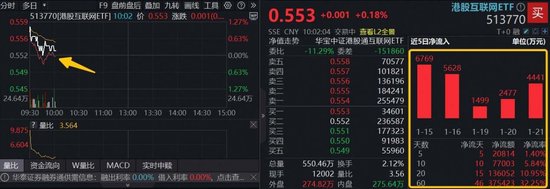
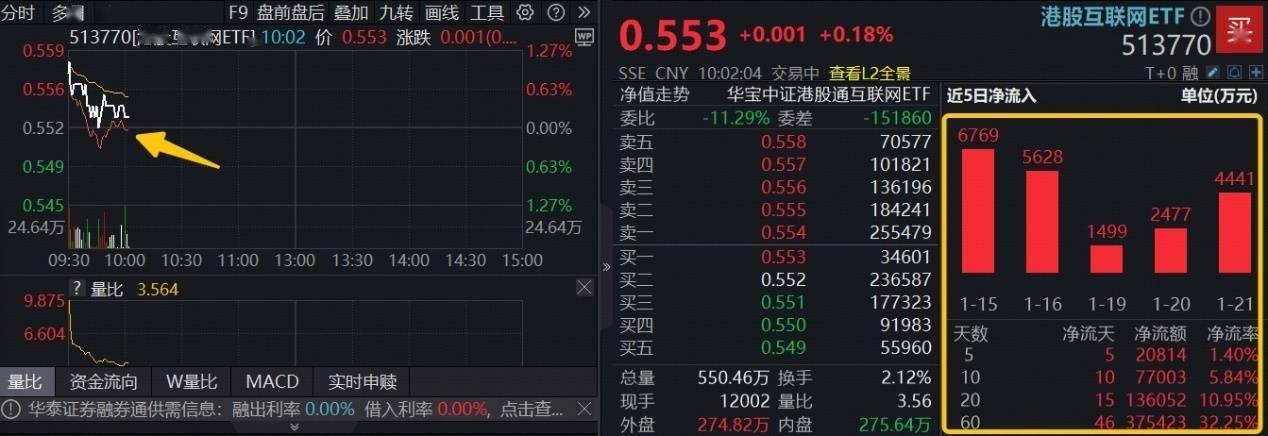
ETF盘中资讯|南向资金超百亿涌入,扫货阿里、腾讯!AI应用商业化提速,港股互联网ETF(513770)份额突破259亿份新高
Sou Hu Cai Jing· 2026-01-22 02:40
Core Viewpoint - The Hong Kong stock market shows a mixed performance among major internet companies, with significant inflows into the Hong Kong Internet ETF, indicating strong investor interest in AI-related assets and applications [1][2]. Group 1: Market Performance - On January 22, the Hong Kong stock market opened higher, with Alibaba-W and Bilibili-W rising over 1%, while Meituan-W, Tencent Holdings, and Kuaishou-W experienced slight declines [1]. - The Hong Kong Internet ETF (513770) saw a net inflow of 1.361 billion yuan over the past 20 days, reaching a record high of 25.904 billion shares [1]. - Southbound funds recorded a net inflow of over 13.9 billion HKD on January 21, marking the second instance this year of exceeding 10 billion HKD in net inflows, with Alibaba-W receiving a significant net purchase of 1.078 billion HKD [2]. Group 2: AI Applications and Industry Outlook - Major internet companies are entering a "harvest period" for AI applications, with Alibaba's "Qianwen" integrating into the Taobao ecosystem, and Baidu's "Wenxin Assistant" surpassing 200 million monthly active users [1]. - Ping An Securities maintains a positive outlook on the Hong Kong stock market, anticipating a rebound if positive factors materialize, particularly in the AI application sector [2]. - The Hong Kong Internet ETF (513770) tracks the CSI Hong Kong Internet Index, with Alibaba-W being the largest component, accounting for 14.71% of the index [2]. Group 3: Fund Performance and Strategy - The latest fund size of the Hong Kong Internet ETF reached 14.39 billion yuan, setting a new historical high, with an average daily trading volume exceeding 600 million yuan since 2025 [3]. - Investors looking to reduce volatility while maintaining exposure to technology can consider the Hong Kong Large Cap 30 ETF (520560), which combines high-growth tech stocks with stable dividend-paying companies [3].
南向资金超百亿涌入,扫货阿里、腾讯!AI应用商业化提速,港股互联网ETF(513770)份额突破259亿份新高
Xin Lang Cai Jing· 2026-01-22 02:20
Group 1 - The Hong Kong stock market opened higher on January 22, with mixed performance among internet giants; Alibaba-W and Bilibili-W rose over 1%, while Meituan-W, Tencent Holdings, and Kuaishou-W saw slight declines [1][10] - The Hong Kong Internet ETF (513770) experienced a net inflow of 1.361 billion yuan over the past 20 days, indicating strong buying interest [1][10] - The latest fund size of the Hong Kong Internet ETF reached 25.904 billion shares, setting a new historical high [1][10] Group 2 - The commercialization of AI is accelerating, with major internet companies entering a "harvest period" for AI applications; Alibaba's "Qianwen" integrates into the Taobao ecosystem, while Baidu's "Wenxin Assistant" surpassed 200 million monthly active users [3][10] - Southbound capital saw a significant inflow of over 13.9 billion HKD on January 21, marking the second instance this year of net inflows exceeding 10 billion, with Alibaba-W receiving a substantial net purchase of 1.078 billion HKD [3][10] - Ping An Securities believes that the mid-term upward trend of the Hong Kong stock market remains solid, with potential for a rebound if positive factors materialize, particularly in the AI application sector [3][10] Group 3 - The Hong Kong Internet ETF (513770) passively tracks the CSI Hong Kong Internet Index, with Alibaba-W being the largest weighted stock at 14.71%, and the top ten weighted stocks accounting for nearly 77% of the index [4][11] - The latest fund size of the Hong Kong Internet ETF reached 14.39 billion yuan, also a historical high, with an average daily trading volume exceeding 600 million since 2025 [12] - For investors looking to reduce volatility while still focusing on technology, the Hong Kong Large Cap 30 ETF (520560) is recommended, featuring a mix of high-growth tech stocks and stable dividend-paying companies [12]