地缘政治风险

Search documents
印度股市今年开局“十年来最差”
Huan Qiu Shi Bao· 2026-01-28 23:02
Group 1 - The Indian stock market is experiencing its worst annual start in a decade, with the Bombay Stock Exchange index down nearly 4% year-to-date and the NIFTY index facing its worst opening since 2016 [1] - Approximately $360 billion in market capitalization has been wiped out from the Indian stock market in January alone, putting significant pressure on the Modi government ahead of the upcoming budget announcement [1] - Foreign investors continue to sell off Indian stocks due to high valuations, weak earnings, and geopolitical risks, following a record outflow of funds in 2025 [1] Group 2 - The Modi government plans to announce a series of domestic policy reforms in the upcoming budget to sustain rapid economic growth and enhance resilience against external shocks [2] - The economic growth rate for the fiscal year ending March 31, 2026, is projected to be 7.4%, but infrastructure spending and tax cuts have limited the government's fiscal space for supporting the economy in the new budget [2] - Uncertainties in trade negotiations between New Delhi and Washington have led to market volatility and a decline in the rupee to historical lows [2]
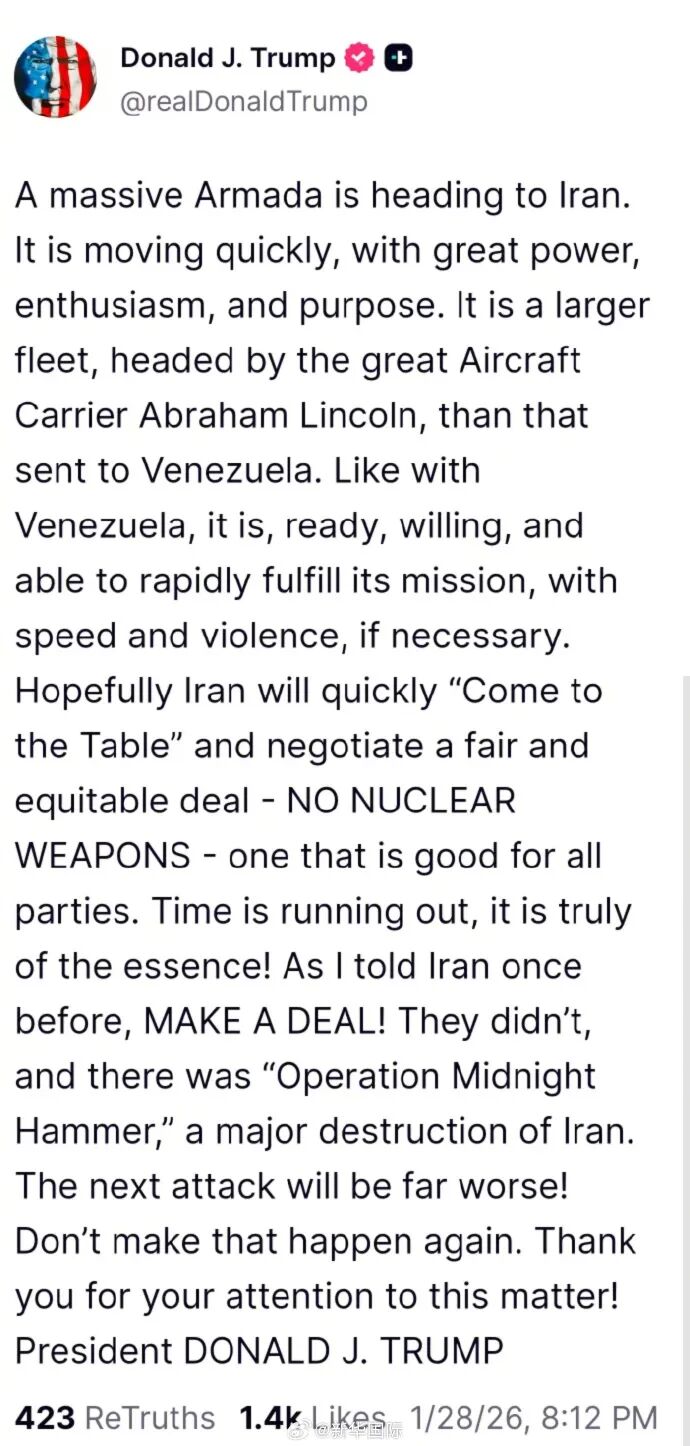
特朗普发文:一支庞大的舰队正前往伊朗 “下次打击将更猛烈”!伊朗启动紧急措施“备战” 油价、金价、银价都在涨
Mei Ri Jing Ji Xin Wen· 2026-01-28 16:55
据新华社报道,美国总统特朗普28日在社交媒体上说,一支庞大的舰队正前往伊朗,已准备好迅速履行其使命。他还称,希望伊朗能够迅速坐到谈判桌 前。 特朗普称,这支由"亚伯拉罕·林肯"号航空母舰率领的舰队"比派往委内瑞拉的舰队还要庞大"。该舰队"已准备好、愿意且能迅速履行其使命"。 特朗普要求伊朗"达成协议",并称正是因为伊朗方面此前未达成协议,美国去年发动了对伊朗的打击行动。他威胁,"下一次打击将更猛烈"。 上述消息发布后,原油走高,截至发稿,WTI原油涨0.77%,现报62.87美元/桶;布伦特原油涨0.63%,现报67.01美元/桶。 黄金、白银价格也短线拉升。 目前,伊朗及周边地区局势紧张。伊朗伊斯兰革命卫队海军政治副司令穆罕默德·阿克巴尔扎德于27日表示,伊朗不寻求战争,但已做好充分准备。 他还称,希望伊朗能够迅速坐到谈判桌前,并就一项"对各方都有利的协议"进行谈判。他强调,伊朗不能拥有核武器。 伊朗外长:没有对美国提出谈判请求 据新华社报道,伊朗外长阿拉格齐28日在政府例行会议间隙就伊美接触问题表示,近几天他本人未同美国总统特使威特科夫有任何接触,伊朗方面也未提 出任何谈判请求。 伊朗启动紧急措施"备战" ...

金银猛涨,多只大牛股紧急提示风险!
Shang Hai Zheng Quan Bao· 2026-01-28 15:41
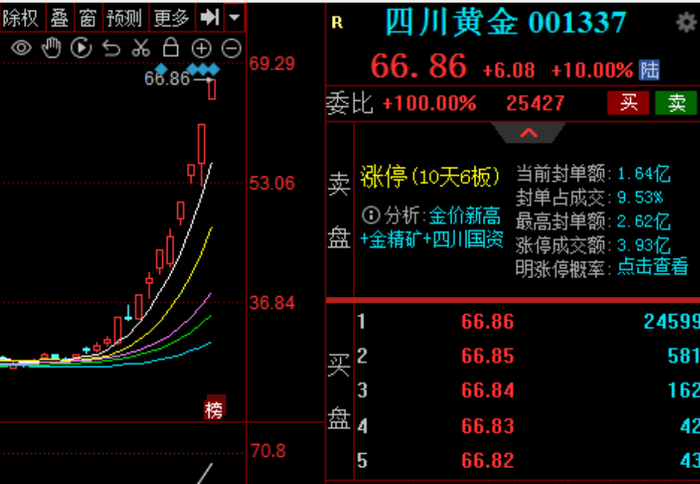
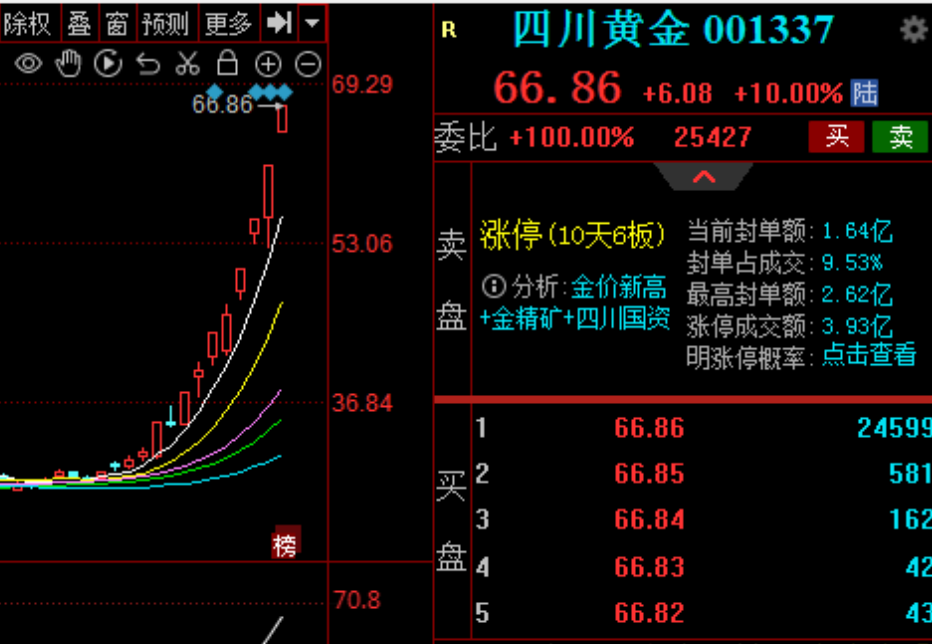
Core Viewpoint - International gold prices surged over $100 in a single trading day, with London spot gold breaking historical records, indicating a significant market movement driven by geopolitical tensions and macroeconomic factors [1][10]. Group 1: Gold Price Movement - On January 28, London spot gold reached a peak of $5311.06 per ounce, with a daily increase of 1.86%, while COMEX gold futures hit $5345 per ounce, rising by 3.33% [1]. - Domestic gold prices also set new records, with Shanghai Gold Exchange spot gold (Au99.99) peaking at 1185 CNY per gram [1]. - Year-to-date, gold prices have increased by approximately 20% as of January 28, driven by geopolitical issues and market dynamics [10]. Group 2: Stock Market Reaction - A surge in A-share gold concept stocks occurred, with over 30 stocks, including China Gold and Sichuan Gold, hitting the daily limit [1]. - Companies in the gold and silver sectors have issued risk warnings due to rapid stock price increases, indicating potential volatility [3][4]. Group 3: Regulatory Responses - Exchanges and banks have implemented measures to cool down the overheated gold and silver markets, including adjusting margin requirements and risk levels [5][9]. - The Chicago Mercantile Exchange announced changes to margin parameters for certain silver and platinum futures contracts, effective January 28 [5]. - The Shanghai Gold Exchange has issued multiple risk alerts and adjusted margin levels for silver contracts, effective January 30 [6][7]. Group 4: Company-Specific Announcements - Companies like Jin Hui Co. and Yu Guang Jin Lead have highlighted their low revenue dependence on silver, warning of potential impacts from price fluctuations [3]. - China Gold stated that its main business remains unchanged and urged consumers to make rational investment decisions, projecting a significant decrease in net profit for 2025 [3][4].


金银猛涨 多只大牛股紧急提示风险!
Shang Hai Zheng Quan Bao· 2026-01-28 15:11
Core Viewpoint - The international gold price surged over $100 in a single trading day, with London spot gold breaking historical records, indicating a significant market reaction to geopolitical tensions and economic factors [1][10]. Group 1: Market Performance - On January 28, London spot gold reached a peak of $5311.06 per ounce, with a daily increase of 1.86%, while COMEX gold futures hit $5345 per ounce, rising by 3.33% [1]. - Domestic gold prices also set new records, with Shanghai Gold Exchange spot gold (Au99.99) peaking at 1185 CNY per gram [1]. - A surge in A-share gold concept stocks was observed, with over 30 stocks, including China Gold and Sichuan Gold, hitting the daily limit [1]. Group 2: Risk Warnings from Companies - Multiple listed companies in the gold and silver sectors issued risk warnings, highlighting the potential volatility in their revenues due to fluctuating metal prices [3][4]. - Jin Hui Co. reported that silver sales accounted for only 12.46% of its total revenue, indicating limited exposure to silver price fluctuations [4]. - China Gold projected a significant decrease in net profit for 2025, estimating a drop of 55% to 65% year-on-year [4]. Group 3: Regulatory Measures - Exchanges and banks implemented measures to cool down the overheated gold and silver markets, including adjusting margin requirements and risk levels [5][9]. - The Chicago Mercantile Exchange raised margin requirements for certain silver contracts to approximately 11% of nominal value, effective January 28 [5]. - The Shanghai Gold Exchange and the Shanghai Futures Exchange announced adjustments to margin levels and trading limits for silver and gold futures contracts [7]. Group 4: Geopolitical Influences - The surge in gold prices is attributed to geopolitical tensions, particularly related to Greenland and Middle Eastern issues, which have heightened market uncertainty [10][11]. - Analysts suggest that the ongoing geopolitical risks could sustain the upward trend in gold prices, with potential for prices to exceed $6000 per ounce if current conditions persist [11][12].
白银暴涨!黄金冲破5100美元,投行喊涨6000,实则在给散户下套?
Sou Hu Cai Jing· 2026-01-28 14:43
大家好,今天犀哥这篇财经评论,主要来聊聊今年的贵金属市场行情。黄金直接站上5100美元每盎司, 白银更离谱,七天就暴涨了37.5%。 现在朋友圈里,一半人在晒金银投资的盈利截图,另一半人全在纠结,现在入场还能赚到钱不?我手里 持有的仓位,到底该卖还是该接着留? 可现在行情这么火爆,这个预测就不一样了,更多是为了引导市场情绪,吸引更多散户资金入场,等价 格被抬高了,投行背后的资金反而可能趁机离场,留下散户高位被套,普通人把投行的预测当成入场的 唯一依据,说白了就是赌徒式投资,风险大到离谱。 暴涨行情下,普通人最容易踩的3个误区 这轮金银暴涨,看着像是捡钱的好机会,实际上背后藏着巨大的风险,第一个误区,就是盲目迷信投行 的预测,把人家的"预测"当成了"必然会发生的事"。 随着金价一举突破5100美元,各大国际投行都开始上调预期,其中美国银行的预测最激进,直接说2026 年国际金价能涨到6000美元每盎司。 很多普通人看到这个预测,立马就动心了,觉得"金价肯定还会涨,现在入场稳赚不赔",甚至不惜拿出 自己的全部积蓄,跟风追高入场。 我跟大家说句实在话,投行的预测,从来都不是什么定心丸,背后其实带着明显的炒作成分。 ...
5300美元!金价再创新高,公募主动“降温”
Xin Lang Cai Jing· 2026-01-28 14:28
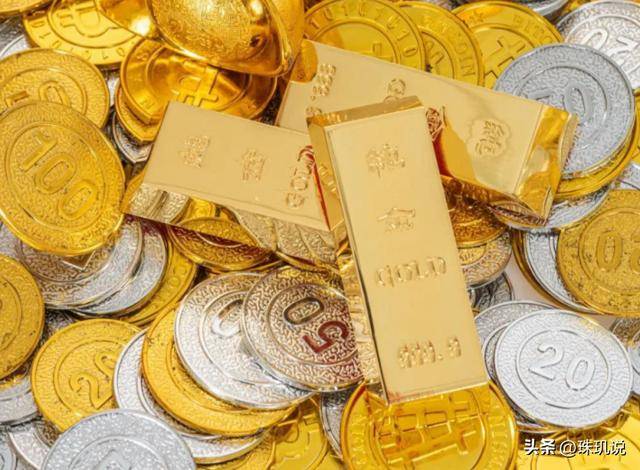
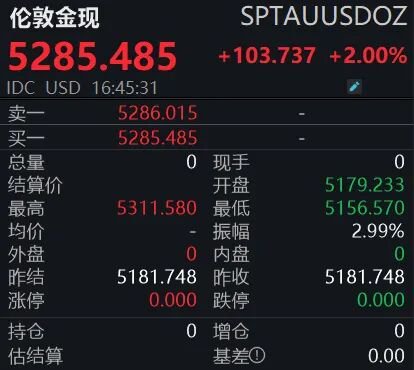
Core Viewpoint - The international gold market is experiencing a significant surge, with prices breaking through the $5,300 per ounce mark, driven by structural factors such as expanding U.S. fiscal debt, a weakening dollar, geopolitical uncertainties, and continued central bank purchases of gold [1][15]. Price Movement - On January 28, international gold prices reached new historical highs, with London gold first breaking the $5,200 per ounce mark and then surpassing $5,300 per ounce, closing at $5,285.485 per ounce, a daily increase of 2% [2][15]. - COMEX gold futures also saw a substantial rise, increasing by 4.38% to $5,305.3 per ounce, with intraday highs reaching $5,306 [4][17]. Domestic Market Impact - The rise in gold prices has led to significant increases in domestic gold jewelry prices, with some brands exceeding 1,620 yuan per gram [5][18]. - The surge in gold prices has prompted public funds to implement risk control measures, with E Fund's gold-themed LOF suspending subscriptions to cool the market [5][18]. Factors Supporting Gold Prices - The rapid increase in gold prices since the beginning of 2026 has been attributed to multiple factors, including heightened geopolitical risks, rising safe-haven demand, a weakening dollar index, and ongoing central bank gold purchases [9][22]. - As of January 28, gold prices have risen over 20% since the start of the year, from approximately $4,330 per ounce to above $5,300 per ounce, reflecting a nearly $1,000 increase in less than a month [9][22]. Future Outlook - Analysts believe that the upward trend in gold prices is likely to continue, with potential challenges around short-term volatility. The price may test the $5,500 per ounce level in the near term [11][24]. - Structural factors supporting gold prices, such as U.S. fiscal debt expansion and geopolitical uncertainties, remain unchanged, leading several institutions to raise their gold price targets [11][24]. - Investors are advised to approach gold investments cautiously, considering their risk tolerance and market conditions, while avoiding chasing high prices [11][24].
黄金、白银一路暴涨!两大交易所出手 调整涨跌停板、保证金比例
Zhong Guo Ji Jin Bao· 2026-01-28 13:31
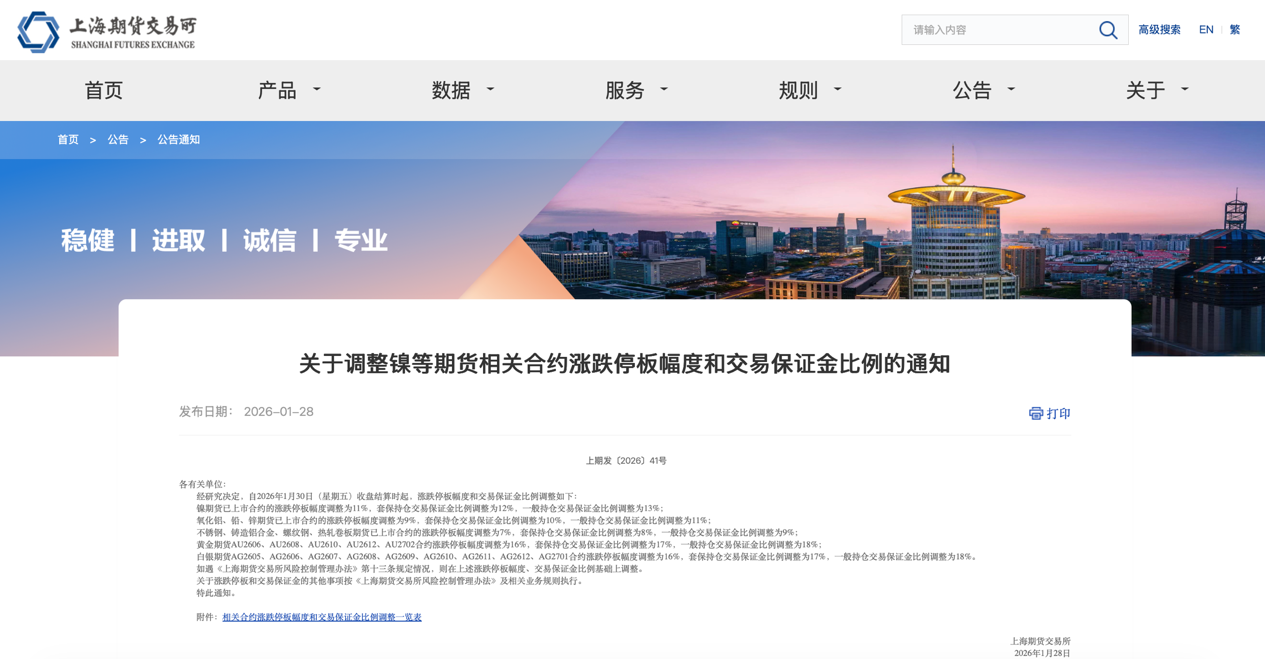
1月28日,上海期货交易所(以下简称上期所)发布公告,再次对黄金、白银等期货涨跌停板幅度、交易保证金比例进行调整;上海黄金交易所(以下简称 上金所)于同日发布公告,对白银延期合约交易保证金水平和涨跌停板比例进行调整。 上期所调整黄金、白银等期货涨跌停板幅度、交易保证金比例 白银期货AG2605、AG2606、AG2607、AG2608、AG2609、AG2610、AG2611、AG2612、AG2701合约涨跌停板幅度调整为16%,套保持仓交易保证金比例 调整为17%,一般持仓交易保证金比例调整为18%。 上期所称,如遇《上海期货交易所风险控制管理办法》第十三条规定情况,则在上述涨跌停板幅度、交易保证金比例基础上调整。关于涨跌停板和交易保证 金的其他事项按《上海期货交易所风险控制管理办法》及相关业务规则执行。 请输入内容 公告 ▼ 产品 ▼ 数据 - 服务 ▼ 首页 规则 ▼ 首页 > 公告 > 公告通知 稳健 | 进取 | 诚信 | 专业 关于调整镍等期货相关合约涨跌停板幅度和交易保证金比例的通知 发布日期: 2026-01-28 冒打印 開发〔2026〕414 26年1月30日(星期五)收盘结算时起,涨跌 ...
两大交易所出手,调整涨跌停板、保证金比例
Xin Lang Cai Jing· 2026-01-28 11:48
炒股就看金麒麟分析师研报,权威,专业,及时,全面,助您挖掘潜力主题机会! 来源:中国基金报 氧化铝、铅、锌期货已上市合约的涨跌停板幅度调整为9%,套保持仓交易保证金比例调整为10%,一 般持仓交易保证金比例调整为11%; 【导读】上期所、上金所对白银等期货交易进行调整 不锈钢、铸造铝合金、螺纹钢、热轧卷板期货已上市合约的涨跌停板幅度调整为7%,套保持仓交易保 证金比例调整为8%,一般持仓交易保证金比例调整为9%; 中国基金报记者 忆山 黄金期货AU2606、AU2608、AU2610、AU2612、AU2702合约涨跌停板幅度调整为16%,套保持仓交 易保证金比例调整为17%,一般持仓交易保证金比例调整为18%; 1月28日,上海期货交易所(以下简称上期所)发布公告,再次对黄金、白银等期货涨跌停板幅度、交 易保证金比例进行调整;上海黄金交易所(以下简称上金所)于同日发布公告,对白银延期合约交易保 证金水平和涨跌停板比例进行调整。 上期所调整黄金、白银等期货涨跌停板幅度、交易保证金比例 上期所发布公告称,经研究决定,自2026年1月30日(星期五)收盘结算时起,涨跌停板幅度和交易保 证金比例调整如下: 镍期货已 ...
原油日报:原油震荡上行-20260128
Guan Tong Qi Huo· 2026-01-28 11:33
Report Summary 1) Reported Industry Investment Rating - Not provided in the given content 2) Core View of the Report - The report predicts that crude oil prices will fluctuate and consolidate due to a combination of factors such as OPEC+ production plans, US inventory changes, geopolitical risks, and global supply - demand adjustments [1] 3) Summary by Relevant Catalogs [Market Analysis] - On January 4, OPEC+ decided to maintain the production plan set in early November 2025 and suspend production increases in February and March 2026 - The EIA data shows that US crude oil and gasoline inventories increased more than expected, and overall oil product inventories continued to rise - US oil producers lost up to 2 million barrels per day of production due to winter storms, about 15% of the national output - The IMF raised the 2026 world economic growth rate by 0.2 percentage points, and cold weather boosted diesel heating demand, alleviating demand concerns - Global floating crude oil storage is high, and the EIA's January report raised the expected surplus of crude oil supply in 2026 - Chevron is increasing the transportation of Venezuelan crude oil, but its impact on the global supply - demand is currently limited - The US imposed new sanctions on Iran on January 23, and there is a possibility of military action, raising geopolitical risks in the region - The power supply system of Kazakhstan's Tengiz oil field is expected to restart, and the CPC No. 3 offshore mooring terminal has completed maintenance, but the oil field can only resume half of its production capacity by February 7 [1] [Futures and Spot Market Quotes] - The main crude oil futures contract 2603 rose 2.49% to 460.3 yuan/ton, with a minimum price of 446.5 yuan/ton and a maximum price of 463.4 yuan/ton. The open interest increased by 74 to 48,237 lots [2] [Fundamental Tracking] - The EIA monthly report raised the 2026 WTI crude oil price by $0.79/barrel to $52.21/barrel, lowered the 2026 global oil demand from 105.2 million barrels per day to 104.8 million barrels per day, and raised the 2026 global oil production from 107.4 million barrels per day to 107.7 million barrels per day - The IEA raised the 2026 global oil demand growth rate by 70,000 barrels per day to 930,000 barrels per day and raised the 2026 global oil production growth rate by 100,000 barrels per day to 2.5 million barrels per day - As of the week ending January 16, US crude oil inventories increased by 3.602 million barrels (expected: 1.131 million barrels), 3.24% higher than the five - year average; gasoline inventories increased by 5.977 million barrels (expected: 1.705 million barrels); refined oil inventories increased by 3.348 million barrels (expected: - 0.162 million barrels); heating oil inventories increased by 0.279 million barrels (expected: - 0.745 million barrels); Cushing crude oil inventories increased by 1.478 million barrels [3] [Supply - Side Information] - OPEC's November 2025 oil production was revised down by 21,000 barrels per day to 28.459 million barrels per day, and its December 2025 production increased by 105,000 barrels per day month - on - month to 28.564 million barrels per day - US crude oil production in the week of January 16 decreased by 21,000 barrels per day to 13.732 million barrels per day, near the highest historical level - The four - week average supply of US crude oil products decreased to 19.946 million barrels per day, a 1.68% decrease from the same period last year - Gasoline weekly production decreased by 5.66% to 7.834 million barrels per day, with a four - week average of 8.218 million barrels per day, a 0.57% decrease from the same period last year - Diesel weekly production decreased by 13.96% to 3.524 million barrels per day, with a four - week average of 3.549 million barrels per day, a 1.14% decrease from the same period last year - The supply of US crude oil products decreased by 3.98% week - on - week [4]
彻底爆发,资金狂买两大顶流
Ge Long Hui· 2026-01-28 11:31
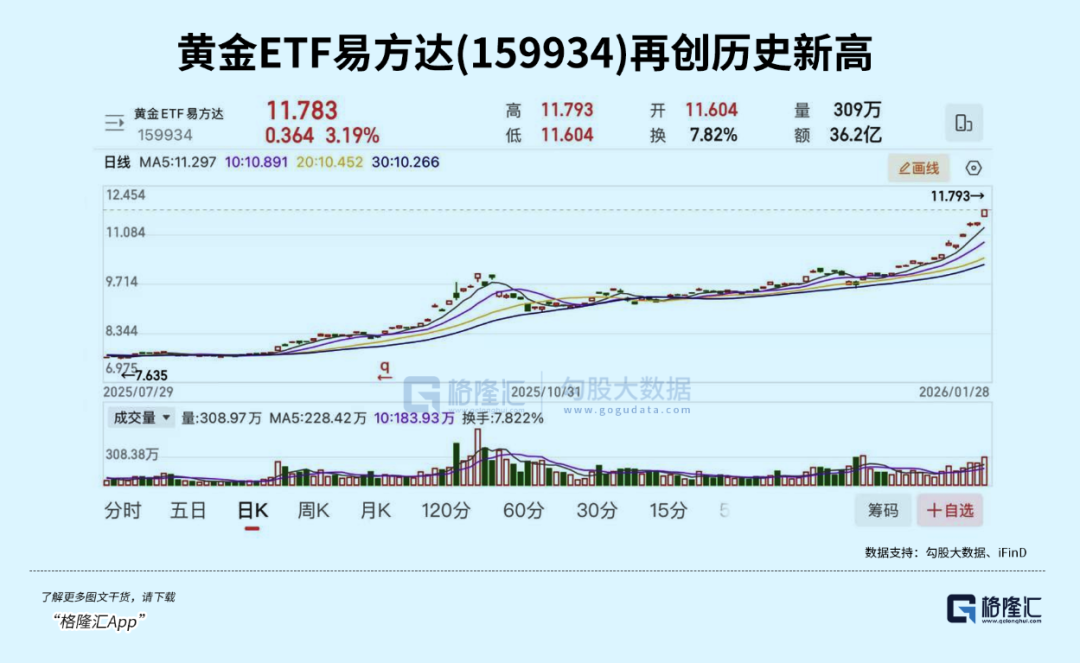
今天,最耀眼的两个板块,无疑是黄金和石油化工。 纽约期金突破5300美元/盎司,现货黄金向上触及5270美元/盎司,续创历史新高;WTI原油期货、布伦特原油期货,双双上涨。 黄金ETF易方达(159934)今日大涨3.19%,再创历史新高,年内涨21.37%,近3年涨超175%;低费率的化工行业ETF易方达(516570)涨2.87%。 为何这么强势? 01 继续狂飙 盘面上,不管是黄金还是原油,都有新的刺激因素。 其中一个,来自美元弱势。 2026年1月27日,美元指数为95.77,跌至近四年最低水平,2026年年初以来,美元指数下跌2.6%。 至此,美元指数和彭博美元现货指数均四连跌,均创去年4月特朗普公布对等关税以来最大四日跌幅。 不过,美国总统特朗普对此却显得云淡风轻,周二被记者问及是否担心美元贬值时,他表示:"不,我认为美元表现很棒。我认为美元的价值——看看我 们正在进行的贸易,美元表现出色。" 虽然特朗普不担心美元贬值,但评论认为,美元的跌势还没完。 长期来看,美联储独立性、不断扩大的预算赤字、财政挥霍相关的担忧以及政治两极分化等结构性因素,正对美元构成下行压力。 有忧,自然就有喜。 首先,美元降 ...