
未来产业

Search documents
四川国资基金10月投资多个项目,“押宝”未来产业赛道
Sou Hu Cai Jing· 2025-10-31 01:07
Group 1 - Chengdu Kechuang Investment Group has completed a Series B investment in Suzhou Fuchang Space Technology Co., a leader in the domestic commercial aerospace satellite power sector, and facilitated the establishment of a Southwest R&D and manufacturing base in Chengdu [1][2] - The investment will primarily fund the construction of a new generation of high-efficiency, high-power satellite power supply and distribution system R&D center in Chengdu, enhancing Fuchang Space's industrial layout in the Southwest region [2][3] - The Southwest R&D and manufacturing base will cover approximately 2,000 square meters and will integrate principle development, product design, testing, and production, becoming a strategic hub for Fuchang Space in the Southwest [2] Group 2 - Chengdu's future industry fund has added 18 quality projects, with a total proposed investment of approximately 6.2 billion yuan in various sectors including artificial intelligence, new materials, biomedicine, integrated circuits, and aerospace [3] - The Chengdu Science and Technology Bureau and the Chengdu Development and Reform Commission recently held two consultation meetings, marking the formalization of the Chengdu Future Industry Fund's operations [2][3] - Sichuan's industrial fund has made significant investments, including a C+ round financing for Chengdu Ridiwei Technology Co., aimed at R&D and market expansion in microwave and millimeter-wave products [4]
许维鸿:未来产业的发展密码是什么
Huan Qiu Wang· 2025-10-30 22:54
Group 1 - The core viewpoint emphasizes the importance of building a modern industrial system as a key strategy for economic development in China, highlighting the focus on future industries such as quantum technology, biomanufacturing, hydrogen energy, and more [1] - The projected value of future industries in China is estimated to reach approximately 11.7 trillion yuan in 2024, with expectations of 13.4 trillion yuan in 2025 and 15.5 trillion yuan in 2026, indicating significant growth potential [1] - There is a notable issue of "heavy invention, light transformation" in China's technology innovation landscape, necessitating improvements in the efficiency of converting scientific achievements into marketable products [2] Group 2 - The financial services for technology innovation rely on a unique capital market in China, where high-tech companies often lack fixed assets for collateral, thus depending on various funds and IPOs for capital support [3] - The competition among urban clusters in China is intensifying, driven by the integration of technology, industry, and capital, which presents opportunities for investment in new industrial chains [4] - The development of future industries requires a deep understanding and continuous research tracking, posing both challenges and opportunities for investment platforms established by cities [5]
为何要再造一个高技术产业
Jing Ji Ri Bao· 2025-10-30 22:14
Core Insights - The Chinese government aims to cultivate and expand emerging and future industries, with the goal of creating a new high-tech industry equivalent to the size of China's existing high-tech sector over the next decade, injecting continuous new momentum into the economy and high-quality development [1][3] Economic Context - China's economic growth faces challenges due to the weakening of traditional growth drivers and the slow replacement by new drivers, necessitating the reconstruction of a high-tech industry to stabilize growth [1][2] - The current contribution of high-tech manufacturing to industrial value added is less than 20%, indicating a significant gap compared to developed countries, which positions the reconstruction of a high-tech industry as a strategic move to enhance competitiveness [2] Strategic Importance - The reconstruction of a high-tech industry is seen as a critical step in reshaping industrial advantages, allowing China to consolidate its leading position in advantageous sectors and seize opportunities in future markets [2][4] - The ongoing technological revolution, particularly in areas like artificial intelligence, presents both opportunities and uncertainties, making the establishment of a high-tech industry essential for capturing new technological advancements and mitigating risks [2][3] Industrial Foundation - China's "three new" economy is projected to contribute 24.29 trillion yuan to GDP in 2024, exceeding 18%, supported by a robust industrial system and leadership in sectors like new energy vehicles and 5G [3] - The country ranks second globally in R&D expenditure, with significant breakthroughs in quantum computing and artificial intelligence, indicating a strong foundation for the development of a new high-tech industry [3] Future Industry Development - The focus will be on nurturing emerging pillar industries such as new energy, new materials, and aerospace, which are expected to create substantial market opportunities and drive the expansion of the high-tech sector [3][4] - Future industries will be strategically developed in areas like quantum technology and brain-computer interfaces, transitioning from technological reserves to market applications, thus becoming new growth points for the economy [3] Transformation of Manufacturing - The initiative to rebuild a high-tech industry represents a qualitative transformation of Chinese manufacturing, moving away from being "big but not strong" to a more resilient and innovative position in global competition [4]
学习笔记|推动科技自立自强 提升产业链安全性和竞争力
2 1 Shi Ji Jing Ji Bao Dao· 2025-10-30 15:45
Core Viewpoint - The 15th Five-Year Plan emphasizes the importance of technological self-reliance and innovation as key drivers for China's economic and social development, aiming to enhance the overall effectiveness of the national innovation system and promote high-quality development [2][4]. Group 1: Technological Innovation - The 15th Five-Year Plan aims to significantly improve the level of technological self-reliance and innovation, focusing on breakthroughs in key core technologies such as integrated circuits, advanced materials, and biomanufacturing [3][5]. - There is a strong emphasis on the integration of technological innovation and industrial innovation, with a call for a new type of national system to support decisive breakthroughs in critical areas [3][6]. - The plan highlights the need for a coordinated approach to education, technology, and talent development, fostering a robust ecosystem for innovation [4][6]. Group 2: Future Industries - The plan outlines the necessity to cultivate and expand emerging and future industries, including renewable energy, aerospace, and quantum technology, to drive economic growth [5][6]. - It advocates for the implementation of large-scale application demonstration actions for new technologies and products, aiming to accelerate the development of emerging industries [5]. - The exploration of diverse technological routes and viable business models is essential for positioning future industries as new economic growth points [5][6]. Group 3: Talent Development - The 15th Five-Year Plan emphasizes the importance of nurturing top-tier innovative talent and establishing a global influence in education and scientific research [4]. - It calls for a comprehensive mechanism to promote the development of education, technology, and talent, ensuring a synergistic relationship between technological innovation and talent cultivation [4]. - The plan aims to optimize the talent structure and promote regional coordination in talent development, addressing the need for strategic scientists and skilled professionals [4].
“十五五”规划建议的18个新提法 释放哪些重要信号?
Mei Ri Jing Ji Xin Wen· 2025-10-30 15:27
Group 1: Economic and Social Development - The "15th Five-Year Plan" emphasizes the importance of technology and innovation, mentioning "technology" 46 times and "innovation" 61 times, highlighting the need for original and disruptive innovations [1] - The plan includes measures to improve people's livelihoods, such as expanding free education and exploring the extension of compulsory education [1][16] - It proposes to enhance public service spending to boost consumer capacity, indicating a shift towards improving the consumption environment [7][10] Group 2: Future Industries and Technological Innovation - The plan aims to promote emerging industries like quantum technology, biotechnology, hydrogen energy, and artificial intelligence as new economic growth points [2][3] - It suggests establishing a risk-sharing mechanism for future industry investments to address uncertainties in technology and market [4][5] - The plan calls for a comprehensive implementation of "Artificial Intelligence+" to drive research and development across various sectors [6][7] Group 3: Consumption and Housing - The plan proposes to eliminate unreasonable restrictions on consumption in sectors like automobiles and housing, signaling a new phase in consumer development [8][19] - It aims to optimize the supply of affordable housing to meet the basic needs of urban wage earners and disadvantaged families, marking a shift from a "safety net" to a "universal" approach [19] Group 4: Energy and Environmental Goals - The plan sets a target for peak coal and oil consumption, aligning with the broader goal of achieving carbon neutrality by 2030 [9] - It emphasizes the need for a new energy system and the development of clean energy sources to support this transition [9] Group 5: Fiscal and Monetary Policy - The plan advocates for a more proactive fiscal policy to enhance sustainability and stimulate effective investment [10] - It suggests a stable and continuous approach to fiscal and monetary policies during the "15th Five-Year Plan" period [10] Group 6: Trade and International Cooperation - The plan focuses on expanding market access and opening up service sectors, indicating a shift towards enhancing service trade competitiveness [11][12] - It highlights the importance of developing green trade and intermediate goods trade to stabilize foreign trade [12][13]
北京释放明确信号:鼓励跨行业并购,引导要素向前沿科创集聚
2 1 Shi Ji Jing Ji Bao Dao· 2025-10-30 13:16
Core Viewpoint - The release of the "Opinions" marks a significant step in promoting mergers and acquisitions (M&A) at both national and local levels, aiming to enhance the quality of listed companies and facilitate high-quality development through M&A reforms [1][2]. Group 1: Policy Implementation - The "Opinions" provide a concrete implementation plan for improving the quality of listed companies and promoting new productive forces through M&A [2]. - The policy encourages resources to concentrate on strategic emerging industries and future industries, including artificial intelligence, healthcare, integrated circuits, and smart connected vehicles [2][3]. - The recent active performance of the Beijing Stock Exchange reflects investor optimism regarding the capital market reforms and the development prospects of innovative small and medium-sized enterprises [1][2]. Group 2: Market Practices - M&A has become a crucial path for listed companies to grow stronger, as evidenced by China Shenhua's acquisition of 13 energy assets, creating a nearly trillion-yuan energy conglomerate [2][3]. - The "Opinions" support cross-industry M&A, providing traditional enterprises with new pathways for transformation and upgrades [3]. - A project matching mechanism will be established to improve the efficiency of M&A transactions by addressing information asymmetry [3][4]. Group 3: Financial Support and Risk Management - The "Opinions" encourage the establishment of market-oriented M&A funds and promote collaboration with government investment funds to meet the demand for "patient capital" [3][6]. - A risk monitoring and early warning mechanism will be developed to closely monitor irrational market factors, ensuring that risk prevention is prioritized during M&A processes [6]. - The regulatory framework will be strengthened to protect minority investors and combat financial fraud and insider trading [6]. Group 4: Market Environment Optimization - The "Opinions" propose the establishment of a "M&A Pain Point Radar Mechanism" to identify and resolve institutional obstacles, simplifying administrative approval processes [4][5]. - Professional adjudication and arbitration mechanisms will be utilized to provide efficient solutions for M&A disputes, enhancing market stability [5].
中煤能源拟出资10亿元认购央企战新基金
Zhi Tong Cai Jing· 2025-10-30 09:53
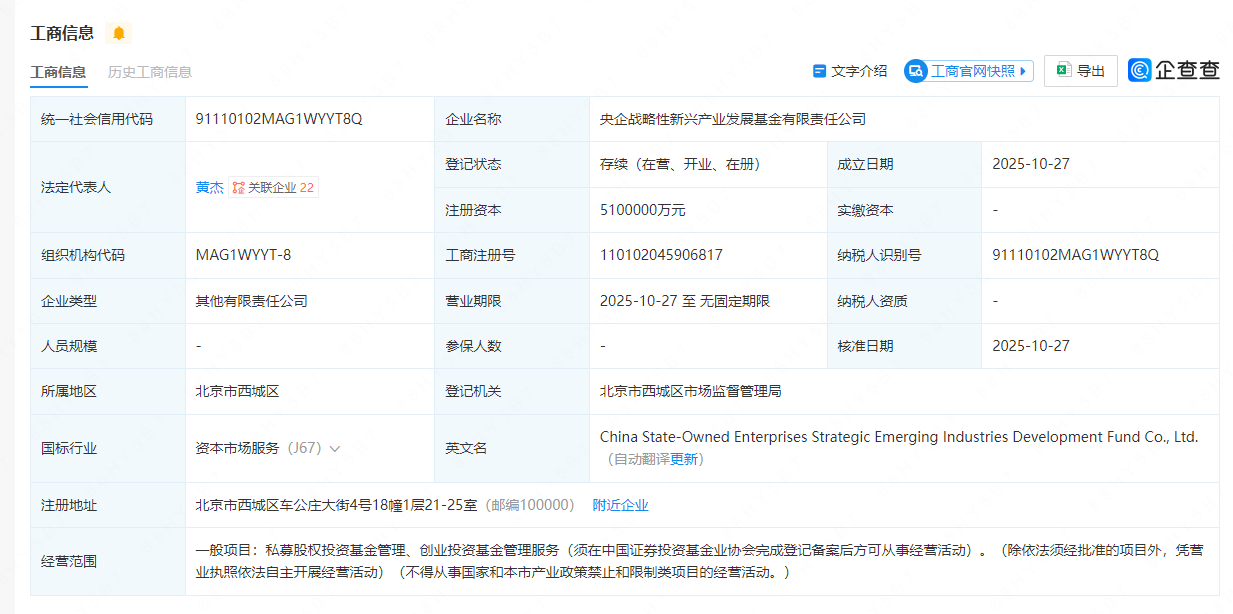
Core Viewpoint - China Coal Energy (601898) has invested 1 billion RMB in a state-owned enterprise's strategic new industry fund, acquiring a 1.96% stake, which aligns with national strategic initiatives to promote the development of nine key new industries [1] Group 1 - The total transaction amount is 1 billion RMB, sourced from the company's own funds [1] - The investment aims to support the development of strategic new industries and future industries, emphasizing the importance of long-term, patient, and strategic capital [1] - The fund will focus on nine key new industry sectors related to central enterprises, facilitating the integration of innovation and industrial chains [1] Group 2 - The investment aligns well with the company's main business, allowing for broader access to industrial and financial platforms [1] - The transaction will not affect the company's normal cash flow or the development of its main business, ensuring no harm to the interests of the company and its shareholders [1]

510亿央企战新基金来了!重点支持这些领域
Guan Cha Zhe Wang· 2025-10-30 08:19
Core Viewpoint - The establishment of the Central Enterprises Strategic Emerging Industries Development Fund aims to accelerate the development of strategic emerging industries in China, with an initial scale of 51 billion yuan [1][3]. Fund Details - The fund has a total initial scale of 51 billion yuan, with China Guoxin contributing approximately 15 billion yuan [1]. - The investment period for the fund is set at 5 years, with a management and exit period of 8 years, potentially extendable to a total of 15 years [1]. - Other contributors to the fund include major state-owned enterprises such as Beijing Financial Street Capital Operation Group, China Mobile Capital, Sinopec Capital, and China National Petroleum Corporation [1]. Strategic Focus - The fund will primarily support industries such as artificial intelligence, aerospace, high-end equipment, quantum technology, future energy, future information, and future manufacturing [3][4]. - It aims to enhance the core functions and competitiveness of state-owned enterprises by addressing industrial weaknesses and promoting innovation [3]. Alignment with National Strategy - The fund's focus aligns with the "14th Five-Year Plan" which emphasizes building a modern industrial system and strengthening the real economy [3][4]. - The plan outlines key tasks including optimizing traditional industries, nurturing emerging industries, and developing modern infrastructure [4]. Economic Impact - The development of these strategic industries is expected to create significant economic growth opportunities, potentially equivalent to recreating China's high-tech industry over the next decade [5]. - The establishment of the fund is seen as a favorable development for hard technology sectors, providing numerous opportunities in the upcoming growth cycle [5]. Competitive Advantage - China possesses several advantages, including institutional, market, system, and talent advantages, which can facilitate the transformation of rapidly advancing technologies into industrial and economic growth [5]. - The country is well-positioned to leverage these advantages to capture strategic opportunities in emerging and future industries, potentially leading to the creation of trillion-yuan markets [5].

ETF市场日报 | 稀有金属相关ETF领涨!巴西ETF要来了
Sou Hu Cai Jing· 2025-10-30 07:37
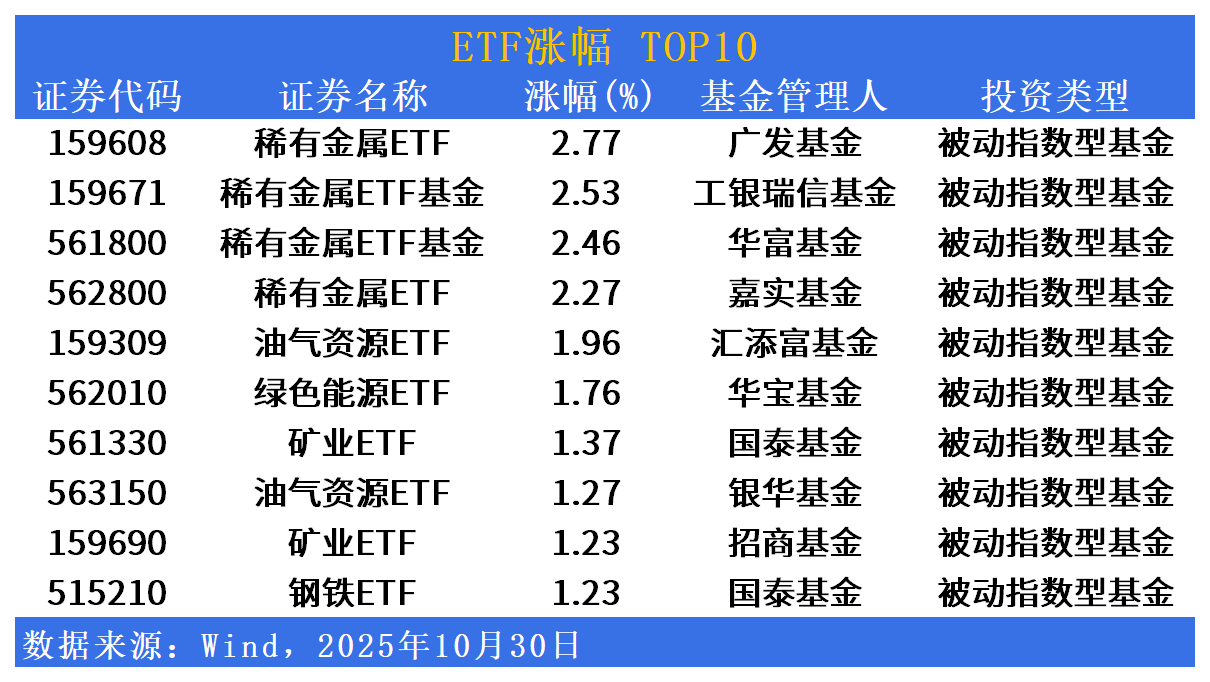
Market Overview - The A-share market experienced a collective pullback, with the Shanghai Composite Index falling below the 4000-point mark, closing down by 0.73% [1] - The total trading volume in the Shanghai and Shenzhen markets reached 24,217 billion [1] Sector Performance - The rare metals sector led the gains, with several ETFs in this category showing positive performance, including a 2.77% increase in the Rare Metals ETF (159608) [2] - Conversely, the innovative drug sector saw significant declines, with the ChiNext 50 ETF (159371) dropping by 9.67% [4][5] Investment Trends - The 20th Central Committee's Fourth Plenary Session emphasized the development of future industries, including quantum technology, biomanufacturing, hydrogen energy, and nuclear fusion, positioning new materials as a key component in supporting sectors like new energy and low-altitude economy [3] - Battery manufacturers are benefiting from dual demand for power and energy storage, with production expected to increase by 10% month-on-month and over 35% year-on-year in October [3] ETF Activity - The Short-term Bond ETF (511360) had the highest trading volume at 372.75 billion [6] - The turnover rate was led by the China-Korea Semiconductor ETF (213310) at 148.58% [8] New ETF Launches - Two Brazilian ETFs, the Huaxia Brazil ETF (159100) and the E Fund Brazil ETF (520870), will begin fundraising, closely tracking the Ibovespa Index, which reflects Brazil's economic performance [9] - The Jiashi Hang Seng Index Hong Kong Stock Connect ETF (520960) is designed for investors looking to access core Hong Kong stocks efficiently [10]
永贵电器:液冷超充迎政策红利,连接器持续探索新场景
Zheng Quan Shi Bao Wang· 2025-10-30 06:45
Core Viewpoint - The company reported a revenue increase of 15.68% year-on-year for the first three quarters of 2025, but net profit decreased by 29.25% primarily due to financial expenses related to convertible bonds, indicating stable operational performance despite the profit drop [1] Financial Performance - Revenue for the first three quarters reached 1.586 billion yuan, a 15.68% increase year-on-year [1] - Net profit attributable to shareholders was 71.21 million yuan, a decrease of 29.25% compared to the previous year [1] - Financial expenses amounted to 6.06 million yuan, an increase of 22.99 million yuan year-on-year, mainly due to interest accrual on convertible bonds [1] - The gross profit margin stood at 25.28%, reflecting stable profitability [1] Market Dynamics - The new energy vehicle market continues to grow, with total vehicle sales reaching 21.246 million units from January to September 2025, a 13.7% increase year-on-year, and new energy vehicle sales at 11.228 million units, up 34.9% [2] - The demand for charging infrastructure is increasing, with a current vehicle-to-charging pile ratio of 2.57:1, indicating significant market potential [2] Policy Environment - Recent policies aim to accelerate the construction of charging facilities and support the growth of the new energy vehicle market, including a plan to add 1.6 million DC charging guns by the end of 2027 [3] - The policies are designed to expand the market, increase demand, and alleviate competitive pressure, potentially restoring the company's gross margin to the 30% range [3] Technological Advancements - The company is positioned at the forefront of the industry with its liquid-cooled ultra-fast charging technology, capable of meeting high power requirements of 1000V and 1200A [4] - Collaborations with major automotive manufacturers like Huawei and BYD enhance the company's competitive edge and market presence [4] Future Growth Prospects - The rapid development of the charging gun and pile business, along with the company's advancements in high-end connectors, is expected to drive significant order growth [5] - The company is actively expanding its product offerings in emerging industries, including liquid cooling solutions for computing servers and products for humanoid robots and flying cars [5] - The focus on high-end connector applications in future industries positions the company for sustained growth and market leadership [5]
