
汽车智能化

Search documents
浙江世宝上半年净利润同比增长39.09% 稳步推进电动化和智能化技术路线
Zheng Quan Shi Bao Wang· 2025-08-26 12:42
Core Insights - Zhejiang Shibao reported a revenue of 1.524 billion yuan for the first half of 2025, representing a year-on-year growth of 35.32% [1] - The net profit attributable to shareholders reached 93 million yuan, up 39.09% year-on-year, while the net profit excluding non-recurring items was 80 million yuan, reflecting a 25.27% increase [1] - The operating cash flow net amount was 91 million yuan, showing a significant year-on-year growth of 484.21% [1] Performance Drivers - The company's performance growth is primarily driven by the acceleration of trends in automotive electrification, intelligence, and globalization, along with the increasing market share of Chinese passenger vehicles [1] - There was a notable increase in sales of the company's electrified and intelligent steering system products [1] Company Overview - Zhejiang Shibao specializes in the research, manufacturing, and sales of automotive steering gears and other key components of steering systems [1] - The company has production bases in Hangzhou, Yiwu, Siping, Wuhu, and Changzhou, and it operates a group research institute in Hangzhou and an automotive intelligent technology R&D center in Beijing [1] - With over 30 years of experience in the automotive industry, Zhejiang Shibao has a diversified and international customer base, serving as a first-tier supplier to many reputable vehicle manufacturers [1] Technological Advancements - The company is one of the first in China to independently develop electric power steering systems and intelligent steering systems for vehicles, providing advanced active steering solutions for autonomous driving cars [1] - As of July 2025, Zhejiang Shibao is supplying intelligent steering systems and key components to several mainstream vehicle manufacturers, including Chery, Geely, NIO, and Li Auto [2] - The company's steer-by-wire technology is applicable for L3 and above intelligent driving models, with customer projects currently under development [2]

佑驾创新(02431):舱驾客户生态持续扩容,L4业务商业化实现突破
EBSCN· 2025-08-26 06:46
Investment Rating - The report maintains a "Buy" rating for the company [4] Core Insights - The company achieved a revenue of 346 million RMB in the first half of 2025, representing a year-on-year growth of 46.1% [1] - The gross profit reached 52 million RMB, with a gross margin of 15%, reflecting a 0.9 percentage point increase year-on-year [1] - The company reported a loss of 162 million RMB, which is an increase from the loss of 112 million RMB in the same period last year, primarily due to increased investments in advanced driver assistance and L4 autonomous driving technologies, with R&D expenditures rising by 50.2% year-on-year [1] Summary by Sections Intelligent Driving Solutions - Revenue from intelligent driving solutions was 241 million RMB, a year-on-year increase of 32.4%, accounting for 69.8% of total revenue [2] - The company is expected to benefit from the implementation of industry standards, with a significant increase in the number of projects for L2+ business [2] - The L4 business has made key commercial breakthroughs, including the launch of unmanned buses and logistics vehicles, with over 10 unmanned bus projects secured [2] Smart Cockpit Business - Revenue from smart cockpit solutions reached 61 million RMB, showing a remarkable year-on-year growth of 99.0%, and accounting for 17.6% of total revenue [3] - The company’s DMS (Driver Monitoring System) has achieved the highest level of ASPICE certification, which is expected to drive demand due to new regulations [3] Financial Forecast - Revenue projections for 2025-2027 are 1.01 billion RMB, 1.48 billion RMB, and 2.01 billion RMB, with growth rates of 54%, 47%, and 36% respectively [4] - The company is expected to continue benefiting from the ongoing trend of automotive intelligence and the increasing demand for high-performance SoCs in domain controllers [4]
伯特利: 伯特利关于对外投资的进展公告
Zheng Quan Zhi Xing· 2025-08-25 16:20
Group 1 - The core viewpoint of the announcement is that Wuhu Berteli Automotive Safety Systems Co., Ltd. is making a strategic investment in a new venture capital partnership to capitalize on growth opportunities in emerging industries [1][2] - The company is investing a total of RMB 20 million, with a 99% ownership stake in the partnership, while the private fund management company holds a 1% stake [1] - The newly established partnership, named Gongqingcheng Bokin Venture Capital Partnership, will focus on investing in high-growth unlisted companies in sectors such as humanoid robots, automotive intelligence, and new travel technologies [2] Group 2 - The partnership has completed registration with the Asset Management Association of China and has obtained the Private Investment Fund Registration Certificate [2] - The fund manager is Xiamen Zongheng Jinding Private Fund Management Co., Ltd., and the custodian is Bank of Communications Co., Ltd. [2] - The registration date for the fund is August 22, 2025 [2]

【2025年半年报点评/福耀玻璃】2025Q2业绩超预期,汽玻龙头强者恒强
东吴汽车黄细里团队· 2025-08-25 15:04
Core Viewpoint - The company reported strong financial performance in the first half of 2025, with significant year-on-year growth in both revenue and net profit, indicating robust operational efficiency and market position in the global automotive glass industry [3][4]. Financial Performance - In the first half of 2025, the company achieved revenue of 21.447 billion yuan, a year-on-year increase of 16.95%, and a net profit attributable to shareholders of 4.805 billion yuan, up 37.33% year-on-year [3]. - For Q2 2025, the company reported revenue of 11.537 billion yuan, reflecting a year-on-year growth of 21.39% and a quarter-on-quarter increase of 16.42%. The net profit for the same quarter was 2.775 billion yuan, with a year-on-year growth of 31.47% and a quarter-on-quarter increase of 36.72% [4]. Margin and Cost Efficiency - The gross margin for Q2 2025 was 38.49%, showing a significant increase of 3.08 percentage points from the previous quarter, attributed to improved capacity utilization and ongoing cost reduction initiatives [4]. - The operating expense ratio for Q2 2025 decreased to 9.63%, down 1.01 percentage points from the previous quarter, primarily due to a reduction in financial expenses [4]. Market Position and Growth Drivers - The company is a leading player in the global automotive glass industry, benefiting from a concentrated market structure where major competitors have lower profitability and limited expansion plans. The company is in its third capital expenditure cycle, with upcoming capacity expansions in the U.S. and other locations expected to enhance its global market share [5][6]. - The increasing penetration of high-value automotive glass products, driven by advancements in vehicle intelligence, is expected to boost the average selling price (ASP) per vehicle, further supporting the company's growth [6]. Earnings Forecast and Investment Rating - Due to the better-than-expected profitability in Q2 2025, the company's net profit forecasts for 2025-2027 have been revised upward to 9.852 billion yuan, 11.163 billion yuan, and 13.089 billion yuan, respectively. Corresponding earnings per share (EPS) estimates are 3.77 yuan, 4.28 yuan, and 5.02 yuan, with price-to-earnings (P/E) ratios of 17.14x, 15.13x, and 12.90x [7].


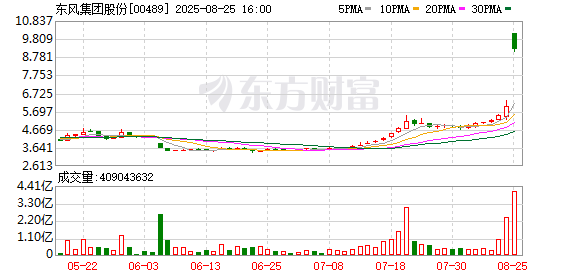
东风集团股份,大涨!公司回应私有化退市
Zhong Guo Zheng Quan Bao· 2025-08-25 14:25
Core Viewpoint - Dongfeng Group plans to privatize and delist while its subsidiary, Lantu Motors, will go public in Hong Kong to optimize resource allocation [4][5] Group 1: Financial Performance - In the first half of the year, Dongfeng Group reported revenue of 54.533 billion RMB, a year-on-year increase of 6.6% [5][6] - The gross profit was 7.599 billion RMB, with a gross margin of 13.9%, up 2.3 percentage points year-on-year [5][6] - Net profit attributable to shareholders was only 0.55 billion RMB, a significant decline of 92% year-on-year [5][6] - Total vehicle sales were approximately 824,000 units, down 14.7% year-on-year [5] Group 2: Strategic Moves - The company aims to enhance its strategic positioning and operational boundaries across various business segments post-privatization [7] - There are currently no further plans for capital operations related to the A-share company after privatization [7] Group 3: Collaboration with Huawei - Dongfeng Group has signed a comprehensive strategic cooperation agreement with Huawei to deepen collaboration in areas such as automotive intelligence and digital transformation [8][9] - The partnership aims to leverage Huawei's expertise in integrated product development and smart vehicle technology [9] - Joint innovation labs will be established to focus on software development, intelligent driving, and AI applications [9]

富瀚微(300613) - 2025年8月21日投资者关系活动记录表
2025-08-25 12:42
Group 1: Market Overview - The professional video market is currently experiencing structural changes, with overseas market growth significantly outpacing domestic growth. New product technology iterations are driving growth faster than traditional products. Overall shipment volume for the company in the first half of the year remained nearly flat compared to last year, with a year-on-year decline of approximately 3% [3][4]. - Major clients have been aggressively reducing inventory since Q4 of last year, with the impact on the company being more pronounced in Q1 and gradually weakening in Q2. It is expected that order demand will return to normal levels in Q3 [3][5]. Group 2: Product Development and Strategy - The company is focusing on high-demand products rather than blindly pursuing performance metrics. High-end products have begun mass production, with AI-ISP products being released in the first half of the year and expected to ramp up in the second half [3][5]. - The company is cautious about large-scale investments in the AI glasses sector, preferring to adopt an external ISP solution to maintain product differentiation and reduce supply chain risks [6]. Group 3: Financial Performance and Margins - The automotive business has the highest and most stable gross margin, while the professional video business has seen a year-on-year decline of about 1 percentage point but remains stable overall. The smart IoT business has experienced a decline in gross margin due to intense market competition, although shipment volumes are growing rapidly [5]. - The company anticipates that the recent rise in storage chip prices will not significantly impact gross margins in the next six months, as they have made adequate preparations for inventory [5]. Group 4: Future Outlook - The company expects gradual improvement in the professional video sector, with confidence in the industry's recovery based on client and market feedback. The strategy is to meet the diverse needs of major clients and grow alongside them [14][15]. - The company aims to achieve revenue of over 5 billion in the next 3 to 5 years, positioning itself among the top tier of domestic fabless integrated circuit companies [15].
华阳集团系列二十-中报点评:单二季度净利润同比增长29%,汽车电子和精密压铸业务持续增长【国信汽车】
车中旭霞· 2025-08-25 12:04
Core Viewpoint - The company is focused on automotive electronics and precision die-casting, aiming to become a leading system supplier for automotive electronic products and components both domestically and internationally [1][59]. Financial Performance - In Q2 2025, the company achieved a net profit of 186 million yuan, representing a year-on-year increase of 28.5% [2][11]. - For H1 2025, the company reported total revenue of 5.311 billion yuan, a year-on-year increase of 26.65%, with a net profit of 341 million yuan, up 18.98% [11][62]. - The automotive electronics business generated revenue of 3.788 billion yuan in H1 2025, up 23.37%, while the precision die-casting business saw revenue of 1.292 billion yuan, an increase of 41.32% [3][11]. Business Segments Automotive Electronics - The automotive electronics segment includes products such as electronic rearview mirrors, cockpit domain controllers, vehicle-mounted cameras, digital keys, and precision motion mechanisms, all of which saw significant sales growth in H1 2025 [9][12]. - The company maintains a leading market share in HUD products domestically and has improved its global market share in vehicle wireless charging [12][35]. - The customer base is diversifying, with significant revenue growth from clients like Changan, BAIC, Xiaomi, Stellantis, and NIO [9][12]. Precision Die-Casting - The precision die-casting segment focuses on lightweight automotive components, with applications in electric vehicle systems, communication modules, and automotive braking and transmission systems [53][55]. - Revenue from this segment increased significantly in H1 2025, with new projects secured from major clients such as ZF, Bosch, and BYD [55][56]. Product Development and Innovation - The company emphasizes R&D as a key competitive advantage, investing 440 million yuan in H1 2025, which is 8.29% of its revenue [27][28]. - The company has launched new products like VPD and continues to enhance its HUD technology, ensuring it remains at the forefront of market trends [36][44]. - Collaborations with tech companies like Huawei and Xiaomi have expanded the product offerings, including advanced HUD systems and wireless charging solutions [6][44]. Market Strategy - The company is expanding its production capacity and global footprint, with new facilities in Huizhou and Shanghai, and subsidiaries in Thailand and Mexico [56][57]. - The focus on smart cockpit technology and lightweight solutions aligns with industry trends towards electric and intelligent vehicles [1][8].

思特威H1实现营收37.86亿元,净利润同比增长164.93%
Ju Chao Zi Xun· 2025-08-25 10:33
Financial Performance - The company reported a total operating revenue of 3.79 billion yuan for the first half of the year, representing a 54.11% increase compared to the same period last year [1][3] - The total profit reached 441.14 million yuan, marking a significant increase of 182.81% year-on-year [1][3] - The net profit attributable to shareholders was 396.86 million yuan, up 164.93% from the previous year [1][3] - The net profit after deducting non-recurring items was 395.70 million yuan, reflecting a 159.40% increase compared to the same period last year [1][3] Revenue Breakdown - Revenue from smartphone applications amounted to 1.75 billion yuan, a growth of 40.49%, accounting for 46.35% of total revenue [1] - Revenue from smart security solutions reached 1.55 billion yuan, increasing by 58.77%, which represents 40.93% of total revenue [1] - Revenue from automotive electronics was 481.64 million yuan, showing a remarkable growth of 107.97%, making up 12.72% of total revenue [1] Product Development - The company launched several domestically produced 50-megapixel CMOS image sensors for high-end flagship smartphones, enhancing its product lineup [2] - The SC595XS sensor features a high dynamic range of 110dB and offers low noise, high frame rate, and low power consumption, significantly improving video capture quality for flagship smartphones [2] - In the automotive electronics sector, the company deepened collaborations with major car manufacturers, leading to increased production volumes in smart driving applications [2]

中信建投:重视汽车业中报预期上修及估值修复行情 绩优价值及科创成长共振
Zhi Tong Cai Jing· 2025-08-25 06:21
Group 1: Automotive Sector - The automotive industry is entering a concentrated period of mid-year performance disclosures, with expectations for strong performance from previously undervalued auto parts companies leading to valuation upgrades [1] - Xpeng's Q2 gross margin exceeded market expectations, while Great Wall Motors reported better-than-expected orders for its new Tank 500 model, indicating a positive sales outlook [2] - The high-end domestic brand market remains a blue ocean, with significant growth expected in the 300,000 yuan and above segment by 2026, driven by new product capabilities and brand strength [2] Group 2: Auto Parts Sector - Companies like Fuyao Glass and Songyuan Safety have seen significant stock price increases following strong mid-year reports, with traditional auto parts firms now trading at a PE ratio below 20 times [3] - The overseas expansion is becoming a core growth driver for quality auto parts companies, with those possessing global competitive advantages expected to achieve growth alpha [3] - The intelligent driving sector, particularly L4 autonomous driving, is anticipated to experience a turning point in costs and technology this year, with ongoing evolution in technology iterations and new business models [3] Group 3: Robotics Sector - The market is optimistic about Tesla's Optimus robot industrialization progress, with potential for additional small batch orders from Tier 1 suppliers [4] - Nvidia is expected to showcase its first humanoid robot in November, indicating advancements in the robotics sector [4] - The robotics sector is characterized by strong industry trends and high liquidity, with a focus on leading companies in the supply chain, particularly those achieving breakthroughs in the 0-1 stage of development [4]


燃油车与电动汽车的“智能和解”
Zhong Guo Qi Che Bao Wang· 2025-08-25 01:30
Core Insights - The launch of Audi A5L and A5L Sportback equipped with Huawei's intelligent driving system demonstrates that fuel vehicles can also offer smart experiences, challenging the notion that "electrification equals smart technology" [2][3] - The integration of advanced electronic and electrical architectures in fuel vehicles is bridging the technological gap with electric vehicles, allowing for high-level intelligent features [3][4] - The automotive industry is moving towards a more inclusive ecosystem where smart technology transcends energy forms, promoting diversity and consumer choice [6][7] Technological Advancements - The introduction of the E³1.2 electronic architecture enables fuel vehicles to achieve advanced intelligent features comparable to electric vehicles, with a 42% penetration rate for Level 2 assisted driving in fuel vehicles, only 8% lower than electric vehicles [3][4] - The A5L family features a unique "man-machine unity" experience through its S-Sport suspension system, which is difficult to replicate in electric vehicles [3] Market Trends - Consumer expectations for automotive smart features are diversifying, with urban commuters favoring assisted driving and driving enthusiasts valuing control experience [6] - The flexibility of smart systems in the A5L Sportback, offering five modes including manual control, has resonated well with consumers, with 30% opting for configurations that allow more manual intervention [6][8] Industry Dynamics - The trend of technological neutrality is reshaping the automotive supply chain, as companies like CATL and Bosch adapt their products to support both fuel and electric vehicles [7] - New standards, such as GB/T 44721~2024, emphasize that smart functions should be evaluated independently of the power system, facilitating the smart transformation of fuel vehicles [7] Business Model Innovations - SAIC Audi's subscription service for smart features allows consumers to select desired modules, enhancing consumer choice and engagement [8] - Collaborations between traditional automakers and tech companies, such as Audi and Huawei, are setting industry benchmarks for integrating digital and intelligent capabilities [8]
