汽车智能化

Search documents
7月车市运行日益平稳,理想首发VLA大模型
CAITONG SECURITIES· 2025-08-12 08:32
Core Insights - The automotive market is stabilizing due to the anti-involution trend, with July retail sales reaching 1.826 million units, a year-on-year increase of 6.3% but a month-on-month decrease of 12.4%. Cumulative retail sales for the year stand at 12.728 million units, reflecting a 10.1% year-on-year growth [1][7][15] - The intelligent driving index continues to rise, with the latest release of the VLA driver model by Li Auto, enhancing the human-like driving behavior of vehicles and allowing users to control driving through voice commands [4][22][32] - Investment recommendations include companies with strong positions in automotive intelligence and advanced software capabilities, such as Ruiming Technology, Daotong Technology, and others [4][38] Automotive Market Analysis - In July, the automotive market showed a "front low, middle high, and back flat" trend, with retail sales slightly above the historical high of 1.768 million units in July 2023, indicating a stable market environment [7][15] - The number of models with price reductions in July was 17, compared to 23 in the same month last year, suggesting a relatively stable pricing environment [4][7] - The penetration rate of new energy vehicles reached 54.0% in July, supported by policies such as tax exemptions and trade-in programs [15] Intelligent Driving Developments - The intelligent driving index reached 35.6 in June, with a month-on-month increase of 1.8 units, driven by the sales growth of high-intelligence models like Model Y and Wanjie M8 [22][24] - Li Auto's new i8 model, featuring the VLA driver model, is set to enhance user experience by allowing voice command control [4][32] Investment Recommendations - The report suggests focusing on companies that excel in automotive intelligence and software capabilities, including Ruiming Technology, Daotong Technology, and others [4][38]


德赛西威(002920):半年度业绩超预期,智驾业务持续高增
CAITONG SECURITIES· 2025-08-12 08:23
Investment Rating - The investment rating for the company is "Accumulate" (maintained) [2] Core Views - The company reported a significant increase in revenue and net profit for the first half of 2025, with revenue approximately 14.644 billion yuan, a year-on-year increase of 25.25%, and net profit approximately 1.223 billion yuan, a year-on-year increase of 45.82% [7] - The company is expected to benefit from the trend of automotive intelligence, expanding its product matrix and accelerating its international strategy [7] - The forecasted revenue for 2025-2027 is 34.604 billion, 42.856 billion, and 52.517 billion yuan respectively, with corresponding net profits of 2.676 billion, 3.377 billion, and 4.190 billion yuan [7] Financial Performance - The company's revenue for 2023A was 21.908 billion yuan, with a growth rate of 46.7%, and is projected to grow at rates of 26.1%, 25.3%, 23.8%, and 22.5% for the following years [6][8] - The net profit for 2023A was 1.547 billion yuan, with a growth rate of 30.6%, projected to grow at rates of 29.6%, 33.5%, 26.2%, and 24.1% for the subsequent years [6][8] - The company's earnings per share (EPS) for 2025E is projected to be 4.82 yuan, with a price-to-earnings (PE) ratio of 22.0 [6][8] Business Segments - The smart cockpit business generated revenue of 9.459 billion yuan, a year-on-year increase of 18.76%, while the smart driving business saw revenue of 4.147 billion yuan, a year-on-year increase of 55.49% [7] - The connected business revenue was 1.038 billion yuan, showing a slight decrease of 2.11% year-on-year [7] Market Performance - The company's stock performance over the last 12 months showed a decline of 5%, while the benchmark index (CSI 300) increased by 9% [4]
长安汽车(000625):重大事项点评:重组后首次集体增持,看好公司长期发展
Huachuang Securities· 2025-08-12 05:25
Investment Rating - The report maintains a "Strong Buy" rating for Changan Automobile, with a target price of 16.11 CNY, indicating a potential upside of 24% [2][10]. Core Views - The report highlights the collective share purchase by 19 executives of Changan Automobile, demonstrating confidence in the company's long-term development following its restructuring [2][4]. - The company is expected to achieve a significant increase in both sales and profits by 2025, driven by three major initiatives: new energy, smart technology, and international expansion [4][10]. - The restructuring of Changan into an independent central enterprise is anticipated to enhance resource integration and innovation capabilities [4][10]. Sales and Profit Forecast - The report projects that Changan's self-owned passenger vehicle sales will reach 1.9 million units in 2025, a year-on-year increase of 14% [4]. - The expected sales for the new energy segment are forecasted to be 1.05 million units in 2025, representing a 45% year-on-year growth [4]. - The overall operating profit for Changan's self-owned vehicles (excluding Deep Blue) is estimated at 2.1 billion CNY in 2025, a decrease of 1.7 billion CNY year-on-year, while Deep Blue is expected to achieve a net profit of 640 million CNY, marking a 24% increase [4][11]. Financial Metrics - The total revenue for Changan is projected to be 177.23 billion CNY in 2025, with a year-on-year growth rate of 11% [11]. - The net profit attributable to the parent company is expected to be 6.39 billion CNY in 2025, reflecting a decline of 12.7% compared to the previous year [11]. - The report anticipates a diluted earnings per share (EPS) of 0.64 CNY for 2025 [11]. Strategic Initiatives - Changan's "Five New" strategy aims to leverage the unique resource integration capabilities of a central enterprise to enhance innovation and operational efficiency [4][10]. - The company is actively pursuing global expansion, with a new factory in Thailand expected to add 100,000 units of overseas production capacity [4][10].

诚迈科技入选“信息技术应用产学协同人才培养行动计划”首批参与单位
Zheng Quan Shi Bao Wang· 2025-08-12 04:53
Group 1 - The "Action Plan" for collaborative talent cultivation in information technology applications has been officially launched, with Chengmai Technology invited as one of the first participating units [1] - The "Action Plan" aims to establish a three-in-one autonomous talent cultivation system through systematic deployment of five core tasks, guided by relevant educational committees and implemented by the Zhongguancun Emerging Technology Service Industry Alliance [1] - Chengmai Technology has been deeply involved in the Xinchuang field for many years, continuously injecting innovative vitality into the domestic software and hardware ecosystem through long-term cooperation with universities [1] Group 2 - The Hongzhi Intelligent Automotive Operating System, launched by Chengmai Technology's subsidiary Zhida Chengyuan, is based on the open-source HarmonyOS and provides a fully domestically controllable solution from bottom-layer chips to operating systems, featuring high performance and security [1] - The core of the Hongzhi Intelligent Automotive Operating System lies in the deep customization and innovative integration of OpenHarmony 5.0, enabling rapid adaptation to mainstream domestic chip platforms [2] - The system utilizes distributed soft bus technology to effectively break down barriers between devices, achieving seamless collaboration with mobile phones, smartwatches, IoT devices, and PCs within the Harmony ecosystem [2]

德赛西威 | 2025H1:盈利高增 国际化战略持续深化【民生汽车 崔琰团队】
汽车琰究· 2025-08-12 03:07
Core Viewpoint - The company reported strong growth in its core business segments, with significant revenue and profit increases in the first half of 2025, indicating a positive outlook for future performance [2][3][5]. Revenue and Profit Performance - In H1 2025, the company achieved revenue of 14.644 billion yuan, a year-on-year increase of 25.25%, and a net profit attributable to shareholders of 1.223 billion yuan, up 45.82% year-on-year [2]. - Q2 2025 revenue reached 7.852 billion yuan, reflecting a year-on-year growth of 29.90% and a quarter-on-quarter increase of 15.61% [2]. Business Segment Growth - **Smart Cockpit**: Revenue for the smart cockpit segment in H1 2025 was 9.459 billion yuan, a year-on-year increase of 18.76%. The fourth-generation smart cockpit has begun mass production with clients such as Li Auto, Xiaomi, and Geely [3]. - **Smart Driving**: The smart driving segment saw revenue of 4.147 billion yuan in H1 2025, marking a year-on-year growth of 55.49%. The company continues to strengthen its leading position in the industry [3]. - **Connected Services**: Revenue from connected services was 1.038 billion yuan in H1 2025, a slight decline of 2.11% year-on-year. The company focuses on providing software development and digital operation services for automakers [3]. International Expansion - The company's overseas sales revenue reached 1.038 billion yuan in H1 2025, a year-on-year increase of 36.82%. New production capacity began in Indonesia in May 2025, and a production project in Monterrey, Mexico, was launched in June 2025 [4]. Investment Outlook - The company is expected to benefit from trends in large-screen and multi-screen smart cockpit products, as well as the expansion of smart driving products covering levels L2, L3, and above. Revenue projections for 2025-2027 are 33.431 billion yuan, 40.081 billion yuan, and 47.846 billion yuan, respectively [5][7].


【周观点】7月第5周乘用车环比+5.0%,继续看好汽车板块
东吴汽车黄细里团队· 2025-08-11 13:43
Core Viewpoint - The automotive industry is entering a new crossroads phase, with the end of the electric vehicle (EV) dividend and the dawn of intelligent driving technology. The recommendation is to increase the allocation weight of "dividend style" investments in the second half of 2025 [6][12]. Group 1: Weekly Review Summary - In the fifth week of July, the compulsory insurance for vehicles reached 462,000 units, with a week-on-week increase of 5.0% and a month-on-month increase of 16.2% [11]. - The performance ranking of segmented automotive sectors this week is as follows: SW motorcycles and others (+9.6%) > SW automotive parts (+4.5%) > SW automobiles (+2.7%) > SW commercial passenger vehicles (+2.6%) > SW passenger vehicles (-0.7%) > SW commercial freight vehicles (-4.2%) [11][19]. - The top five stocks covered this week include Chunfeng Power, Xinquan Co., Xiaopeng Motors-W, Mingyang Technology, and Hengshuai Co. [11][25]. Group 2: Industry Core Changes - Xiaopeng's new P7 will debut on August 6, featuring design, intelligent cockpit, control range, and intelligent driving assistance, with an expected launch in August [5][11]. - The Li Auto i8 has undergone SKU adjustments and price reductions, standardizing to the max version and reducing prices by 10,000 yuan for max and 20,000 yuan for ultra [5][11]. - The new Wanjie M7 has been announced, adopting the latest family design language with a wheelbase of 3030mm, offering five/six-seat versions and EV/EREV energy types [5][11]. Group 3: Market Focus and Configuration - The A-share automotive market performed well this week, while the Hong Kong automotive sector lagged behind the broader market. The motorcycle segment performed the best [7][12]. - The recommendation is to increase the allocation weight of "dividend style" investments, focusing on buses (Yutong Bus), heavy trucks (China National Heavy Duty Truck Group A-H/Waichai Power), two-wheelers (Chunfeng Power/Lonxin General), and parts (Fuyao Glass, Xingyu Co., Xinquan Co., Jifeng Co.) [12]. - For AI intelligent vehicles, the preference is for Hong Kong stocks (Xiaopeng Motors-W, Li Auto-W, Xiaomi Group-W) over A-shares (Seres, SAIC Group, BYD) [12]. Group 4: Sales and Forecasts - The total number of passenger vehicles insured this week was 462,000, with a week-on-week increase of 5.0% and a month-on-month increase of 16.2%. New energy vehicles accounted for 245,000 units, with a penetration rate of 53.1% [47]. - The forecast for 2025 indicates a total retail sales volume of 2,369,000 units, representing a year-on-year increase of 4.1% [48][49]. - The expected sales volume for heavy trucks in 2025 is 750,000 units, with a year-on-year increase of 24.9% [53].

车市最新成绩单来了
Shang Hai Zheng Quan Bao· 2025-08-11 12:40
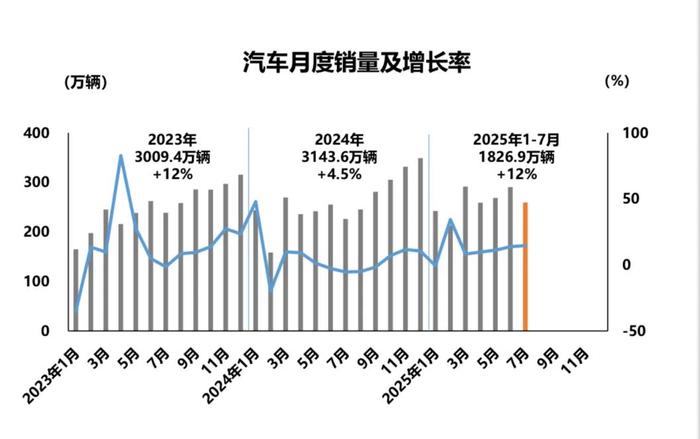
8月11日,中国汽车工业协会(简称"中汽协")信息发布会在北京召开,2025年1—7月汽车产销数据及 经济运行情况在会上公布。中汽协最新统计显示,7月,中国汽车销量同比增长14.7%,在7—8月的行 业传统淡季呈现淡季不淡的新态势。 中汽协有关负责人表示,从行业市场环境看,以旧换新政策效果继续显现,行业综合整治"内卷"工作取 得积极进展,企业新车型持续投放,助力车市平稳运行,同比实现增长。 另外,华为鸿蒙智行最新数据显示,2025年7月鸿蒙智行全系交付新车突破4.7万辆,位居"新势力第一 阵营",同比增长8.3%。其中,赛力斯和华为合作的问界系列7月交付突破4万辆,占据主力。 中国汽车月度销量及增长率数据 1—7月,新能源汽车产销累计完成823.2万辆和822万辆,同比分别增长39.2%和38.5%,新能源汽车新车 销量达到汽车新车总销量的45%。在新能源汽车主要品种中,与上年同期相比,氢燃料电池汽车产销明 显下降,其他大类新能源汽车品种产销呈不同程度增长。 在汽车出口方面,7月,中国汽车出口57.5万辆,环比下降2.8%,同比增长22.6%。2025年1—7月,汽车 出口368万辆,同比增长12.8%。 " ...





德赛西威: 2025年半年度报告
Zheng Quan Zhi Xing· 2025-08-11 11:14
Core Viewpoint - The report highlights the financial performance and strategic direction of Huizhou Desay SV Automotive Co., Ltd. for the first half of 2025, showcasing significant growth in revenue and net profit, alongside a commitment to innovation and international expansion in the automotive electronics sector. Financial Performance - The company's operating revenue for the first half of 2025 reached approximately 14.64 billion yuan, representing a year-on-year increase of 25.25% compared to 11.69 billion yuan in the same period last year [11][21]. - The net profit attributable to shareholders was approximately 1.15 billion yuan, up 45.94% from 789.72 million yuan in the previous year [11][21]. - Basic earnings per share increased to 2.21 yuan, a rise of 46.36% from 1.51 yuan [11][21]. - The total assets at the end of the reporting period were approximately 21.66 billion yuan, showing a slight increase of 0.81% from the previous year [11][21]. Business Overview - The company focuses on three main areas: intelligent cockpits, intelligent driving, and connected services, maintaining a leading position in the industry [9][10]. - The intelligent cockpit segment generated approximately 9.46 billion yuan, accounting for 64.59% of total revenue, while the intelligent driving segment achieved 4.15 billion yuan, reflecting a growth of 55.49% [11][21]. - The connected services and other segments contributed approximately 1.04 billion yuan, a slight decrease of 2.11% [11][21]. Market Trends - The automotive industry in China experienced a significant increase in production and sales, with new energy vehicle sales reaching 696.8 million units, a year-on-year growth of 41.4% [7][8]. - The report indicates a strong demand for intelligent and connected vehicle technologies, driven by the rapid advancement of smart driving systems and the need for enhanced safety and reliability [8][9]. Strategic Initiatives - The company has updated its development strategy, emphasizing a mission to lead in safe, enjoyable, and green travel, and a vision of "smart travel, globally shared" [8][9]. - It aims to enhance its technological capabilities and expand its international presence, with a focus on building a global supply chain network and localizing services [16][18]. - The company is committed to sustainable development, aligning its operations with carbon neutrality goals and enhancing its product offerings to meet low-carbon standards [18][19].
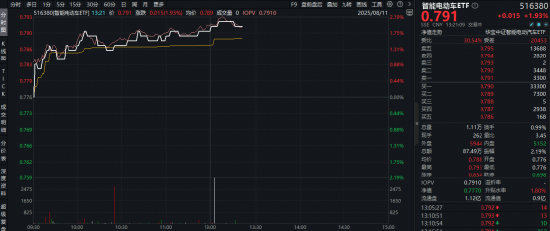
ETF盘中资讯|宁德时代旗下锂矿停产!锂矿、锂电池“大爆发”,天齐锂业涨停,智能电动车ETF(516380)盘中拉升2%
Sou Hu Cai Jing· 2025-08-11 05:53
Group 1 - The core viewpoint of the news highlights a strong market reaction in lithium mining and battery sectors following the suspension of operations at CATL's Jiangxiawo lithium mine, leading to significant stock price increases for companies like Tianqi Lithium and Ganfeng Lithium [1][3] - CATL announced that its mining license for the Jiangxiawo mine expired on August 9, resulting in a temporary halt in mining activities, although the company stated that the overall impact on its operations is limited [3] - Analysts from Huayuan Securities noted that the supply disruption has led to a surge in lithium futures prices, while the upcoming peak demand season in September and October may support lithium prices [3] Group 2 - The automotive sector is expected to experience a valuation uplift due to the expansion of smart components, with advancements in intelligent driving systems anticipated to penetrate mid-to-low-end markets by 2025 [4] - The integration of AI and the focus on smart and connected vehicles are projected to expand the industry scale, leading to rapid growth in earnings per share (EPS) for related sectors and stocks [4] - The Smart Electric Vehicle ETF (516380) is positioned to capture long-term investment opportunities in the electric and smart vehicle sectors, covering key players in smart cockpit, intelligent driving, and automotive electronics [5]


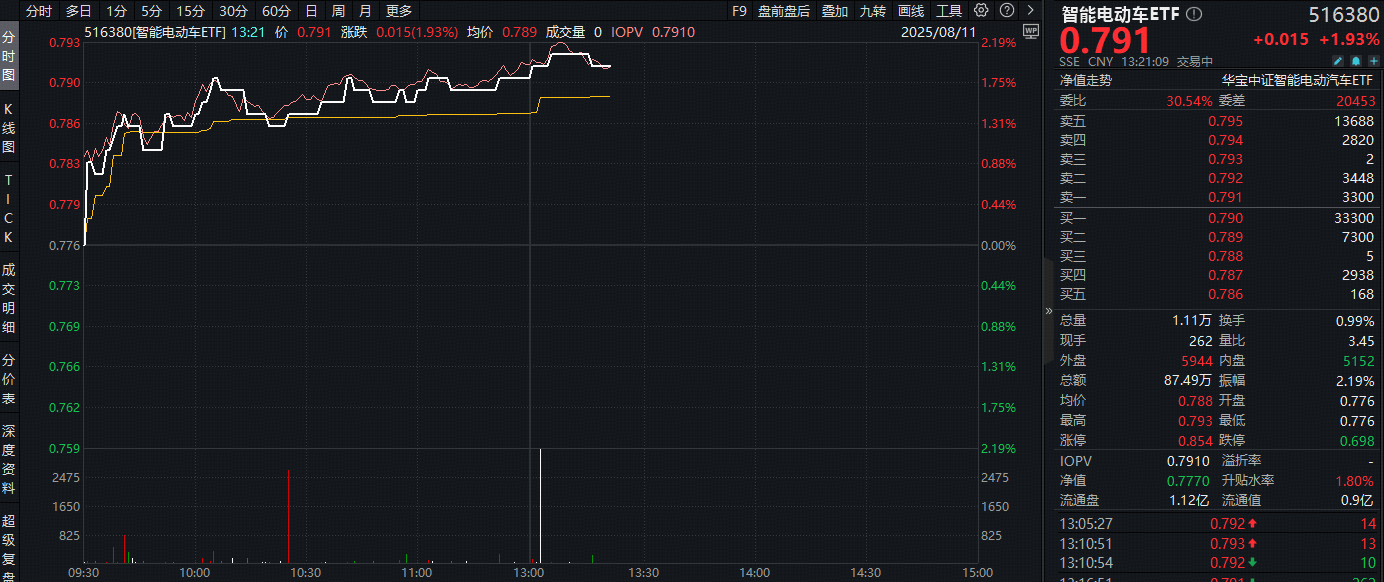
宁德时代旗下锂矿停产!锂矿、锂电池“大爆发”,天齐锂业涨停,智能电动车ETF(516380)盘中拉升2%
Xin Lang Ji Jin· 2025-08-11 05:50
Group 1 - The core viewpoint of the news highlights a strong surge in lithium mining and battery stocks, influenced by the suspension of operations at CATL's Jiangxiawo lithium mine, with notable stock performances including Tianqi Lithium reaching the daily limit and other companies like Ganfeng Lithium and Hunan Youneng seeing significant gains [1][3] - CATL announced that its mining license for the Jiangxiawo mine expired on August 9, leading to a temporary halt in operations, but the company stated that the overall impact on its business is limited as it is expediting the renewal process for the mining license [3] - Analysts from Huayuan Securities noted that the expiration of CATL's mining rights has caused a surge in futures prices due to supply-side disruptions, while the upcoming peak demand season in September and October is expected to support lithium prices [3] Group 2 - The automotive parts sector is anticipated to experience a valuation uplift due to the expansion of smart technology in vehicles, with expectations for advanced driving features to penetrate mid-to-low-end markets by 2025 [4] - The smart electric vehicle ETF (516380) is positioned to capture investment opportunities in the electric and smart vehicle sectors, focusing on leading companies in electric vehicle electrification and smart technology [4] - The solid-state battery technology is expected to see breakthroughs, with several automakers planning to adopt this technology around 2027, indicating a potential acceleration in the industry's commercialization process [3][4]